MR8740T_user_manual_eng_20191016H.pdf - 第90页
85 Saving Data 4 In the [W aveform] area, click [On] or [Off] to congure the waveform save setting. Off Does not save any waveforms. On Saves waveforms. Click the [ T ype] box, and then choose a save format of data fr…
84
Saving Data
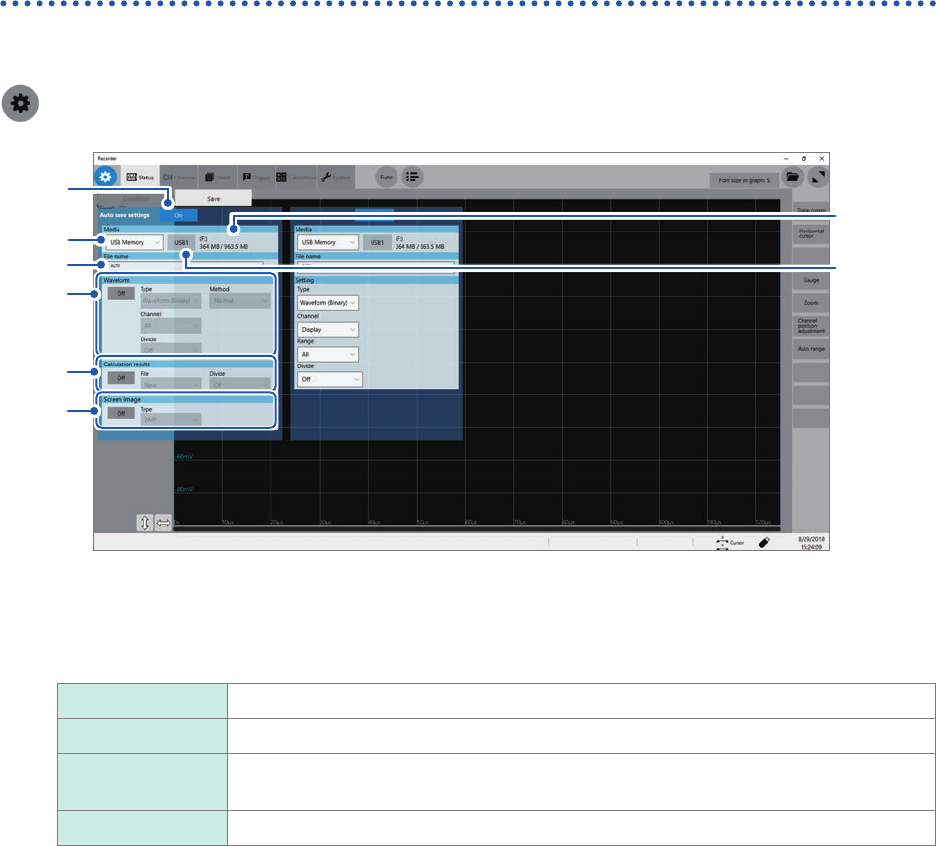
Automatically saving waveform data
The instrument automatically saves data every time it has acquired the measured data with the
recording length. Specify a save destination and items to be saved before starting a measurement.
> [Status] > [Save]
1
2
3
4
5
6
2
-(1)
2
-(2)
1
Click the [Auto save settings] button to set it to [On].
2
Click the [Media] box, and then choose a destination to save from the list.
SSD/HDD
Built-in SSD
USB ash drive USB ash drive
Mail Sends measured data to a computer in the network or to a remote computer as an
email attachment.
FTP transfer: Sends waveform data to a computer connected to your network.
(1) When you choose a save destination, the state of the storage device such as its drive letter and capacity
appears on the right of the [Media] box. If no storage device is inserted, the string [None] appears.
(2) When you choose [USB Memory] as the save destination, choose a USB ash drive you would like to use
as a save destination from among all attached USB ash drives.
• The [HIOKI_MR8740T] folder is automatically created in the specied save destination, and sub-folders are
automatically created in the folder according to the [Type] setting.
Waveform (Binary), Waveform (Text), Waveform (Float): WAVE
Setting: CONFIG
Numerical calculation result: MEASURE
Screenshot: PICT
When you choose [FTP], congure the LAN and FTP client function settings.
Refer to “Conguring the LAN settings with the instrument” (p. 182) and “11.3 Sending Data to a Computer
With the FTP Client Function” (p. 192).
• Use Model Z4006 USB Drive (Hioki’s option) for protecting data.
3
Enter the le name in the [File name] box.
• Number of characters for a le name: Up to 100 characters
• The maximum length of a le name that includes its path: Up to 255 characters

85
Saving Data
4
In the [Waveform] area, click [On] or [Off] to congure the waveform save setting.
Off
Does not save any waveforms.
On Saves waveforms.
Click the [Type] box, and then choose a save format of data from the list.
Waveform
(Binary)
Saves waveform data in binary format.
(Only data saved in binary format can be loaded onto the instrument)
Waveform (Text) Saves waveform data in text format.
(The instrument decimates the data and saves the remaining data as a le. The les
can be opened with editors and spreadsheet software installed in computers; however,
they cannot be loaded onto the instrument.)
Click the [Method] box, and then from the list, choose an action to be taken if the size of waveform
data to be saved exceeds the capacity of the storage device.
Normal
Stops the auto-save if the storage device is full.
Delete Deletes older les and continues the auto-save even when the storage device is full
(waveform les only).
The instrument deletes les only created after the measurement has started. It does
not delete previously existing les.
Click the [Channel] box, and then choose an option for channels to be saved.
All
Saves measured data of all channels.
The instrument also saves data acquired across channels with the waveform display
set to [Off].
Display Saves data acquired across channels with the waveform display set to [On] on all
sheets.
(When you choose [Waveform (Binary)] in the [Divide] box)
Click the [Divide] box, and then from the list, choose a size of each le.
Off
Saves a le without dividing it.
16 MB,
32 MB,
64 MB
Choose this option to divide a large le into several les and save them. A le is
divided into several les each of which has the specied size. The instrument creates
a folder with the specied name, divides a le into several les, and then saves them
in the folder.
The instrument automatically creates a folder, and then creates waveform les and an index le (extension:
.IDX) in the folder. Loading the IDX le allows the waveform les to be loaded in a batch.
(When you choose [Waveform (Text)] in the [Type] box)
Click the [Divide] box, and then from the list, choose an option for the number of lines of each le.
Off
Saves a le without dividing it.
60,000 data,
1,000,000 Data
Divides a le according to data points (row) you specify.
When using the memory division function, you cannot use the division save function.
4
Saving/Loading Data and Managing Files
86
Saving Data
(When you choose [Waveform (Text)] in the [Type] box)
Click the [Thin out] button to set it to [On] or [Off].
When you choose [On], click the number box on the right, and then enter the number of data points out of
which a data point is retained.
Storing les in text format requires a lot of storage space. Data decimation can reduce le sizes.
Off
No data is decimated.
On (2 to 1,000) Allows you to enter the decimation number. The instrument retains one data point out
of the specied number of data points.
Example
When you enter [3], the instrument retains one data point out of three consecutive data points: it decimates
the two other points.
The number of data points is reduced by one third of the original number.
5
In the [Calculation result] area, click [On] or [Off] to congure the saving setting of the
numerical calculation result .
Off
Does not save any numerical calculation results.
On Saves numerical calculation results.
Click the [File] box, and then from the list, choose an option for saving data to les.
New
Creates a new le for each measurement and saves it.
Append Appends data to an existing le and saves it.
Click the [Divide] box, and then choose a le division setting from the list.
Off
Does not divide any les.
Split by Calc. No. Creates a le for each calculation number.
6
In the [Screen image] area, click [On] or [Off] to congure the saving setting of display
images.
Off
Does not save any screenshot.
On Saves a screenshot.
Click the [Type] box, and then choose a save format of images from the list.
BMP
, PNG, JPEG
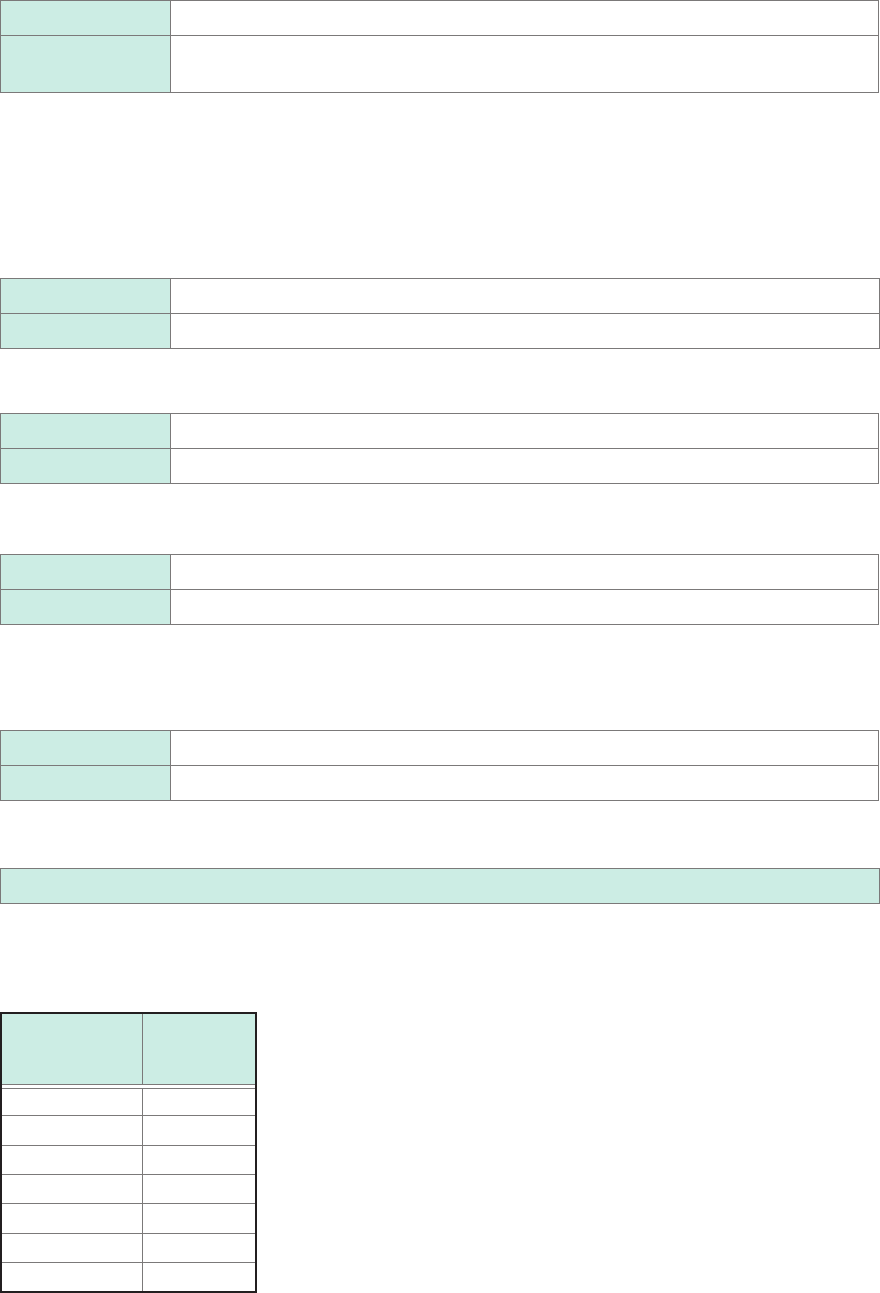
When you choose data in text format or numerical calculation results to be saved
Characters or display items used on the instrument are converted as follows:
Character
used on the
instrument
Saved
character
2
^2
3
^3
μ
~
u
Ω
~
o
e
~
e
°
~
c
±
~
+