00191413-01.pdf - 第206页
6 Product / Package Form User Manu al Line Computer UNIX 6.1 Package Form Editor Software Version 501.xx 01/99 Issue 6 - 28 Fig. 6.1.11 Dialog Box for the I ndividual Setting of Acceleration Values for Each Axis (applies…

User Manual Line Computer UNIX 6 Product / Package Form
Software Version 501.xx 01/99 Issue 6.1 Package Form Editor
6 - 27
Y during placement
(not for 6xx) reduced acceleration of the Y-axis during transporting the
component from the pick-up to the placement position by means
of the RV head
reduced acceleration of the Y-axis during transporting the
component from the IC camera to the placement position by
means of the IC head.
●
Activate the button next to the desired axis.
(In the case of nozzle type 6xx only the buttons for the z and d-axes can be activated).
●
Confirm the setting by clicking on
OK
.
The dialog box closes.
The acceleration of the selected axes is reduced to 35% for all nozzles of the selected type.
This value is entered in the appropriate editing fields in the view area.
NOTE
If the associated button was not activated for all axes (processes), the corresponding editing fields
only contain a broken line (----). This indicates that the acceleration of at least one axis has not been
reduced (in the case of nozzle type 6xx this is either the z or d-axis).
Special Handling for Nozzles of the Types 4xx, 7xx and 8xx on the Machine Types SIPLACE
80S-20/23/HS-50 and 80F
4
/F
5
The "Acceleration" special handling option can be selected for each nozzle of the types mentioned above
as well as individually for each axis. This means that the respective axis will move at the acceleration
corresponding to the value entered.
Procedure (Example for Nozzle 820):
●
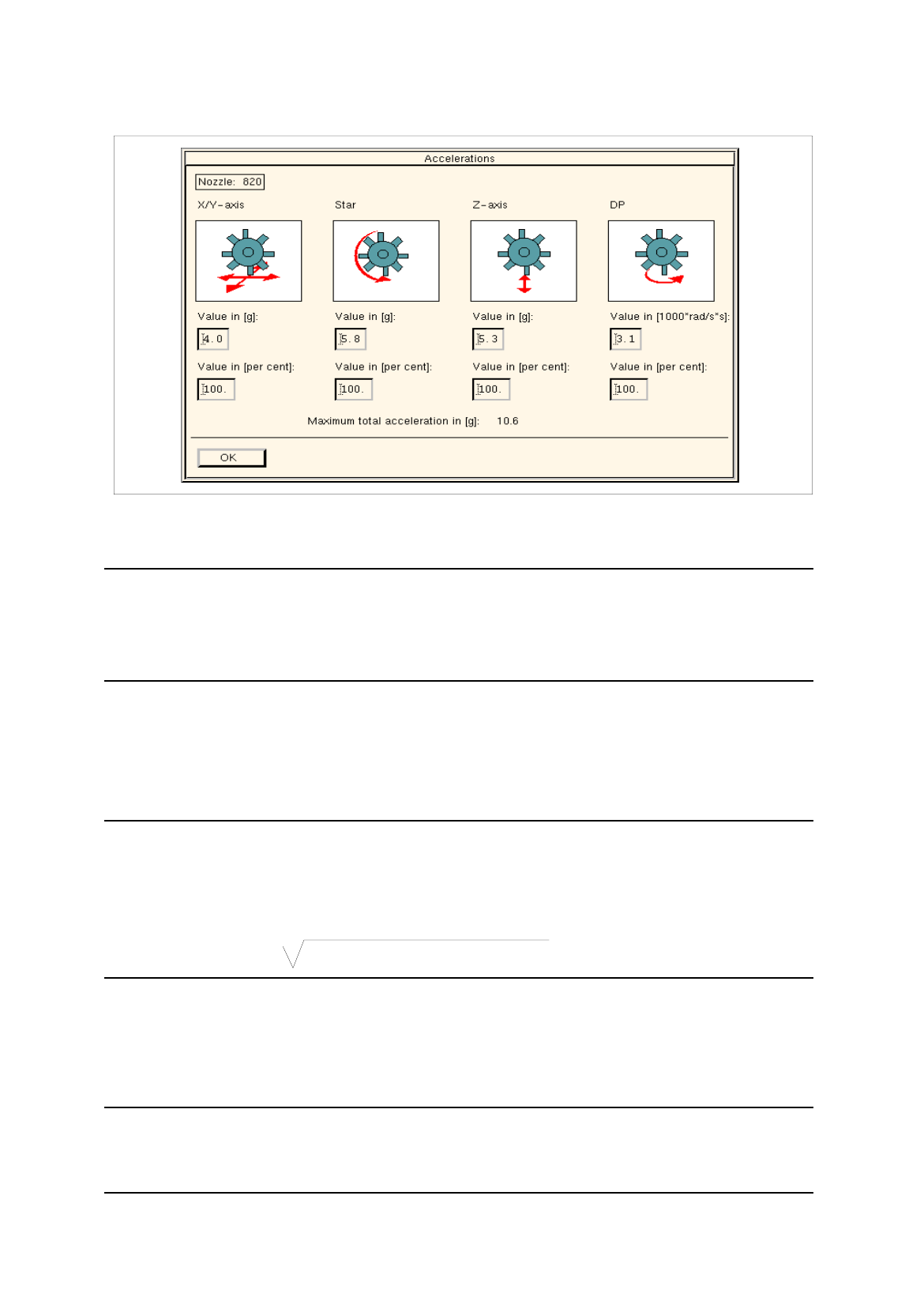
In the view area (see Fig. 6.1.9) click on the "Special handling" button next to the desired nozzle.
●
Click on the ">>" button. The following dialog box opens.
6 Product / Package Form User Manual Line Computer UNIX
6.1 Package Form Editor Software Version 501.xx 01/99 Issue
6 - 28
Fig. 6.1.11 Dialog Box for the Individual Setting of Acceleration Values for Each Axis
(applies only to nozzle types 4xx, 7xx and 8xx)
NOTE
The acceleration value can either be entered in [g] for the x/y, star and z-axes, or in
[1000 x rad/s
2
] for the dp-axis. Or else, a value corresponding to a percentage of the maximum acce-
leration of the axis at issue can be entered.
●
Click on the editing field of the desired axis.
●
Enter the value and press the RETURN key or click into a different field.
From the value entered for the acceleration, the percentage value or, conversely, the value in [g] or
[1000 x rad/s
2
] is calculated immediately and automatically entered in the appropriate editing field.
NOTE
The acceleration values for the x/y, star and z-axes can be changed in increments of 0.1, and for the
dp-axis in increments of 100.
The maximum overall acceleration calculated from the acceleration values for the x/y and star axes is
displayed in [g] below the editing fields.
Max. overall acceleration =
(
accel.
x +
accel.
star
)
2
+ accel. y
2
●
Confirm the entries by clicking on
OK
.
The dialog box closes.
The percentage value of the acceleration is displayed in the appropriate editing field in the view
area, provided the same value has been set for all axes.
NOTE
If the percentage value entered for the acceleration differs for one or more axes from the default
values (35%, 70% or 100%), the respective editing field only contains a broken line (----).

User Manual Line Computer UNIX 6 Product / Package Form
Software Version 501.xx 01/99 Issue 6.1 Package Form Editor
6 - 29
6.1.2.10 Package Form Editor Selection Fields - "Handling data" Screen
In the selection fields a button is located next to each "handling type" (see Fig. 6.1.4).
The required "handling type" can be activated or deactivated by clicking on the corresponding button.
Selection field "Handling instructions"
This field serves to define the type of handling a component type will be subjected to during the placement
cycle.
-
Vacuum test during pick-up
When the component is picked up sensors are used to
check whether the component has been picked up.
-
Vacuum test during placement
Prior to being placed, the component is interrogated by means
of sensors to verify that the component is still attached to the
nozzle.
-
Coplanarity check
The coplanarity laser module determines by means of co-
planarity measurement whether pins of the component
are bent and whether it may have to be discarded.
-
Good nozzle contact
In the case of cubic components, this setting provides
good nozzle contact by means of adequate vacuum supply.
Selection field "Centering"
This selection field serves to define the type of centering suited for the component type. For this purpose, the
setting "Centering in head" or "External centering" can be chosen from. Moreover, the centering procedure for
the particular centering type can be defined.
- Centering in head
The component is centered by means of the revolver head or the
placement head on the HS-180 if any one of the following three
options is selected in addition.
with H jaws
mech. centering by means of h-jaws (measuring jaws) of the
placement head of the HS-180.
with Z jaws
mech. centering by means of z-jaws of the placement head of
the HS-180.
with camera
optical centering by means of the component camera of the
revolver head.