00195941-03-UM SiplaceCA-EN.pdf - 第480页
7 Station Enlargements User Manual SIPLACE CA 7.13 Coplanarity Laser Module Edition 08/2011 EN 480 The position values thus calcu lated are comp ared against the limit value specified by the user . If they exceed this va…
User Manual SIPLACE CA 7 Station Enlargements
Edition 08/2011 EN 7.13 Coplanarity Laser Module
479
7.13 Coplanarity Laser Module
[00119719-xx] Coplanarity module SIPLACE X-/CA-/D-series
7.13.1 Functional Description
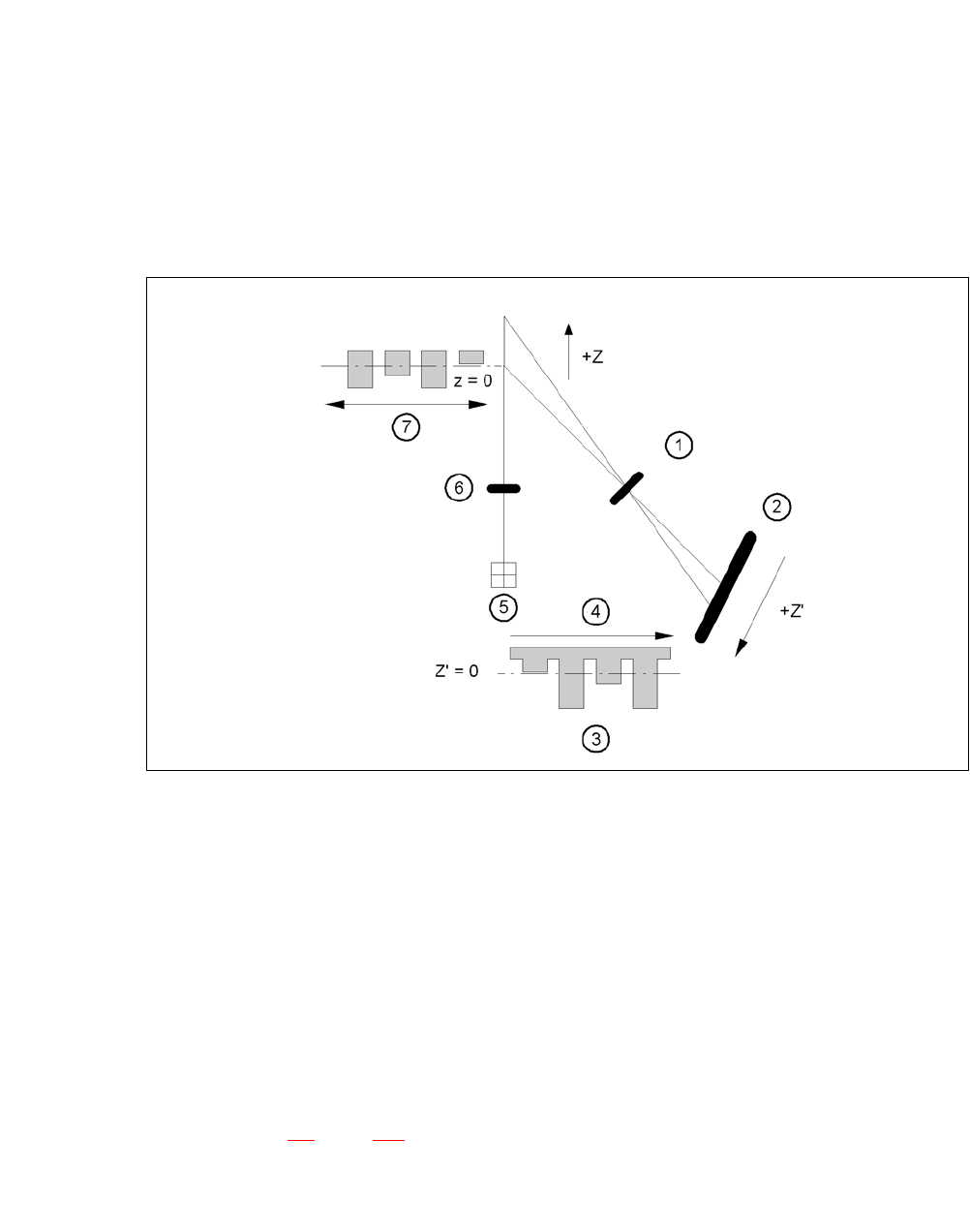
The coplanarity laser module is used to measure vertical bending of the leads. The lead length is
measured without contact using the laser triangulation principle.
7
Fig. 7.13 - 1 Laser triangulation measurement principle
(1) Receiver lens
(2) Detector
(3) Measuring signal
(4) Time t
(5) Laser
(6) Transmitter lens
(7) Travel direction
7
The TwinHead picks up the component to be checked, enters it optically with the component cam-
era (see section 7.4
, page 463) and moves in succession all four sides over the fixed laser beam
of the coplanarity laser module. In this way, every lead is scanned from below by the laser beam.
The laser light scattered by the underside of the lead is recorded by a sensor, and is then used to
calculate the exact position of the lead with respect to the PCB.

7 Station Enlargements User Manual SIPLACE CA
7.13 Coplanarity Laser Module Edition 08/2011 EN
480
The position values thus calculated are compared against the limit value specified by the user. If
they exceed this value, the component is disposed of or returned.
The coplanarity laser module is used in combination with the optical component centering mode.
Components with bent or missing leads are detected and disposed of, if necessary.
7.13.2 Technical Data
Component spectrum: Usable for ’Gullwing’-component packages, pitch > 0,3 mm
and maximum component size 55 mm x 55 mm. Further
restrictions depend on the machine configuration.
Measuring principle: Measurement without contact via laser triangulation
Algorithm functions: JEDEC standard - calculation of contact level: all deviations
are calculated in relation to this level. If the component is
angled with respect to the vacuum nozzle, as can happen if
an adapter is used, then it will have no influence over the
choice between ‘good’ and ‘bad’.
Measuring range: 3 mm
Measuring range start (SMR) 24 mm
Reference distance
Measuring range center (MMR) 25.5 mm
Measuring range end (EMR) 27 mm
Linearity ± 1.5 µm
Resolution: 0.15 µm
Measuring rate 10 kHz
Wave length 670 nm, red
Max. output 1 mW
Laser Class 2
Permissible ambient light: 30,000 lx
Light spot diameter SMR 80 µm
MMR 35 µm
EMR 80 µm
Operating temperature: 0°C ... + 50°C
Storage temperature - 20°C ... + 70°C
Sensor protection class IP 65
Controller protection class IP 50
Supply voltage 24 VDC (± 15%, max. 500 mA)
Output, digital RS 422, 687.5 kBaud
User Manual SIPLACE CA 7 Station Enlargements
Edition 08/2011 EN 7.13 Coplanarity Laser Module
481
Electromagnetic EN 50081-1 and
compatibility (EMC)EN 61000-6-2
Vibration 2 g / 20 ... 500 Hz
Mechanical shock 15 g / 6 ms
Weight of sensor approx. 0.5 kg
Weight of controller 1 kg
7.13.3 Safety Instructions
7.13.3.1 Safety Instructions for the Sensor of the Coplanarity Module
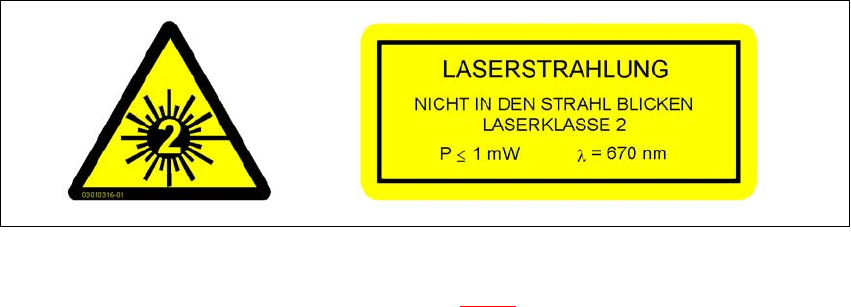
The sensor works with a semiconductor laser of wave length 670 nm (visible/red).
The maximum optical output power is 1 mW.
The sensor is classified as laser class 2.
– When operating the sensor, always follow the relevant regulations of VDE 0837 concerning
"Radiation safety for laser equipment" and German accident prevention regulation entitled
"Laser radiation" (BGV B2).
– Also follow the accident prevention regulations applicable in your country.
The following information plates are attached to the front and back of the sensor housing:
7
Fig. 7.13 - 2 Identification of laser class 2 for the sensor
The laser function is shown by an LED (see section 7.13.4).
NEVER look directly into the laser beam, despite the low laser output. The beam is visible, so the
eyes will be protected by the natural eyelid-closing reflex.