00195941-03-UM SiplaceCA-EN.pdf - 第70页
2 Operational Safety User Manual SIPLACE CA 2.6 Safety Instructions for Operating the Placement Machine Edition 08/2011 EN 70 NOTE 2 The manual removal of t antalum capacitors whic h have not been picked up is described …
User Manual SIPLACE CA 2 Operational Safety
Edition 08/2011 EN 2.6 Safety Instructions for Operating the Placement Machine
69
2.6.2 Safety Instructions for Processing Capacitors Based on Powdered Metal
There is a risk associated with processing capacitors based on powdered metal (e.g. tantalum).
The risk is that
– Should these components be destroyed, a sudden exothermic reaction i.e. heat formation,
will occur. If the ambient conditions are unfavorable, and depending on the capacitance, this
buildup of heat can cause damage.
– This effect can occur when these components are cut.
Please contact your suppliers to clarify whether the components that you handle are affected.
In extremely rare cases, this risk can occur in the tape cutter of SIPLACE machines, with the re-
mote possibility of causing a smoldering fire in the waste tape.
The ambient conditions are unfavorable if:
(1) The components remain on the tape while the set tape cycle is checked (since the operator
can cycle the feeder module onward without removing components during this check).
(2) The components remain on the tape, e.g. due to a tear in the cover foil.
(3) The components remain on the tape, and the components or tape do not conform to the spec-
ification, thus increasing the pickup error rate.
Please follow the instructions given below to minimize the risk when placing capacitors based on
powdered metal.
(1) If the component tape is cycled onward manually, the operator must remove any components
remaining in the tape pocket.
(2) If the cover foil tears, the operator must remove any components remaining on the tape.
To ensure that tantalum capacitors do not cause the tape material to burn when it is cut as a result
of pickup errors, the user interface has been extended to include the "Remove component from
tape in the event of a pickup error" option. You need to enable this option in SIPLACE Pro. On the
placement machine, the component that was not picked up is paced forward again until it is ready
for removal from the component tape. The track is deactivated and the operator is sent an error
message to remind him to pick up the tantalum component from the tape.
2 Operational Safety User Manual SIPLACE CA
2.6 Safety Instructions for Operating the Placement Machine Edition 08/2011 EN
70
NOTE 2
The manual removal of tantalum capacitors which have not been picked up is described in sec-
tion 6.1.1.3, page 378.
2.6.3 Safety Instructions for Removing Nozzles from Collect&Place CA Heads
CAUTION
RISK OF INJURY TO FINGERS BY SHARP NOZZLES 2
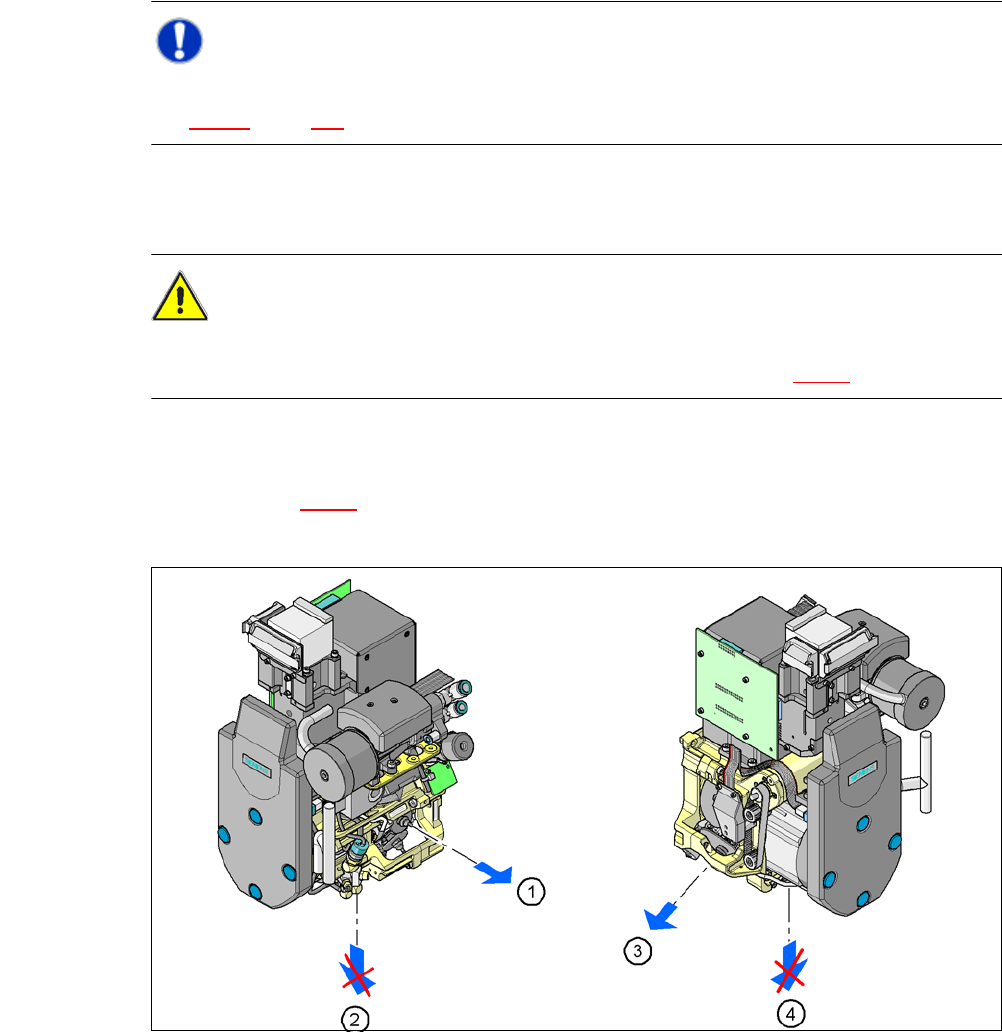
Do not remove the nozzles in the pick/place position (item 2 and 4 in fig. 2.6 - 2).
The procedure for removing nozzles manually from the sleeve is as follows:
Step the sleeve, from which you want to remove the nozzle, to the removal position (item 1
and 3 in fig. 2.6 - 2
).
Remove the nozzle from the sleeve here.
2
Fig. 2.6 - 2 Position of the sleeve during a manual nozzle change
(1) Removal position for sleeves and nozzles, C&P12 CA
(2) Pickup and place position, C&P12 CA
(3) Removal position for sleeves and nozzles, C&P6 CA
(4) Pickup and place position, C&P6 CA
User Manual SIPLACE CA 2 Operational Safety
Edition 08/2011 EN 2.6 Safety Instructions for Operating the Placement Machine
71
2.6.4 Safety Instructions for Manually Moving the Z Axis at the TwinHead
CAUTION
RISK OF CRUSHING AT THE TWINHEAD 2
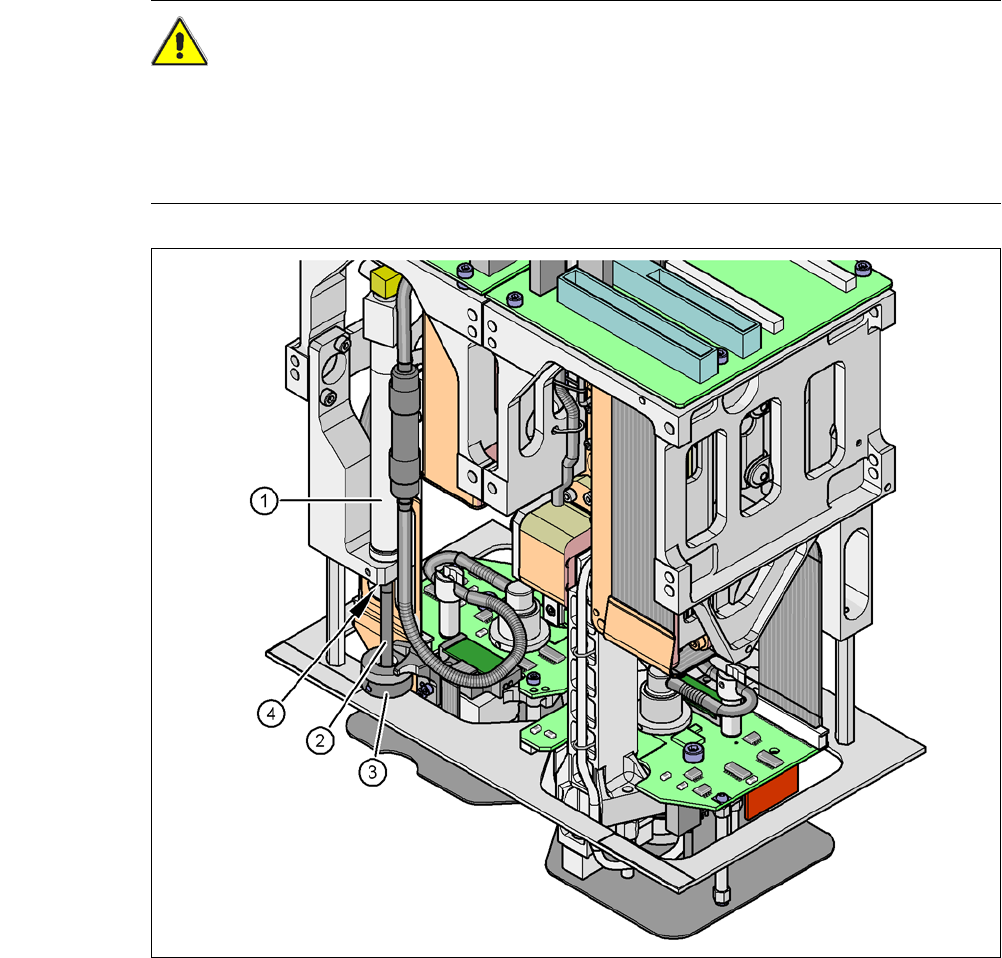
NEVER move the Z axis down with your hand at the buffer of the retract unit. The strong spring
force of the cylinder poses a risk of injury to your fingers, when the bumper springs back. This
also applies to the inside of the TwinHead, when the piston rod return to its starting position.
Fig. 2.6 - 3 Risk of crushing from the retract unit on the TwinHead
(1) Retract unit, compressed air cylinder
(2) Piston rod
(3) Bumper of the retract unit
(4) Crushing point for fingers