KE-2030使用说明书 - 第155页
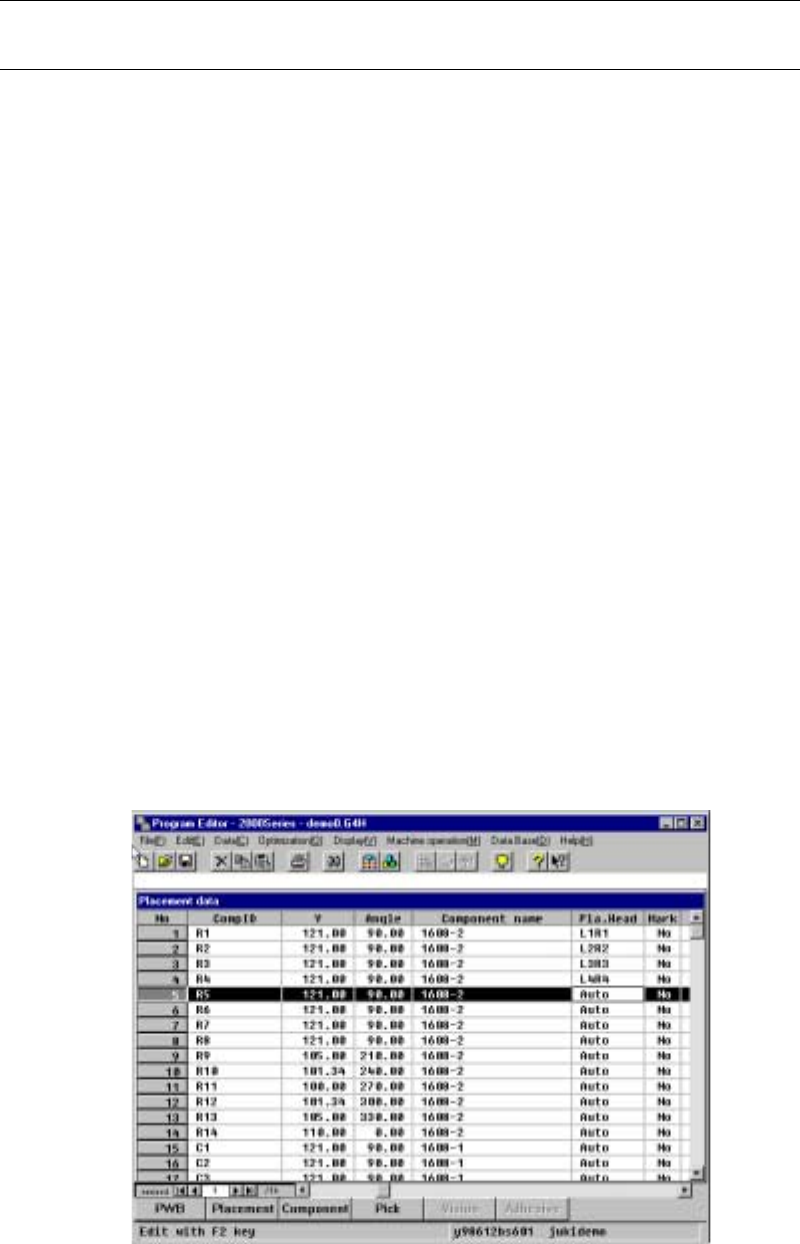
4 – 56 ⑥ Mar k Select f rom the pop- up list box whether or not corr ection is made f or placement position using t he local fiducial m ark when the machine places a com ponent on a board. W hen y ou enter t he component…
4 – 55
If += is appended before the number entered, that number is added to the
value of the field one line above the field at the cursor.
If -= is appended before the number entered, that number is subtracted from
the value of the field one line above the field at the cursor.
Note: Do not enter any space between “+” and “+”, “-“ and “-“, “+” and “=“, or
“-“ and “=“.
③ Angle
Enter the placement angle using the formula bar.
The setting range is from 0° to 359.95° in increments of 0.05°.
④ Component name
Enter the component name using the formula bar. Each time a component name
is entered, the component data space is allocated accordingly. If you enter a
wrong component name, the corresponding component data space is released
when you change the wrong name unless you enter any Component data.
When you enter a component name, the machine searches it through the
Component library. When the machine finds the same component name in the
Component library, it loads the corresponding component data into a production
program. Upper case characters and lower case characters are handled as the
same as each another, but are displayed separately. If a component name is
registered in the Component database in advance, the registered characters are
displayed instead of the characters you entered here.
The length of a component name is up to 20 characters. The 21st and the
following characters are ignored.
⑤ Pla. Head
Select the head to mount on the machine from the pop-up list box. If you do not
want to select a head, select “Auto” from the pop-up list box displayed as shown
below.
4 – 56
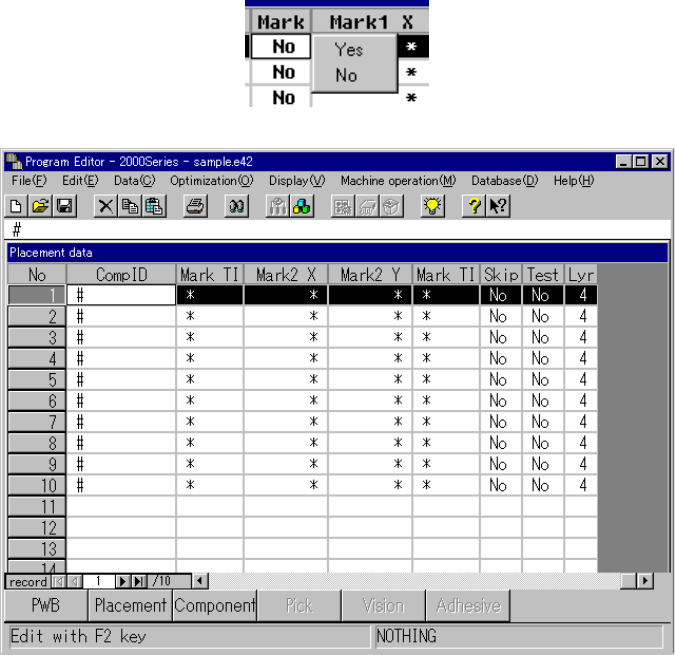
⑥ Mark
Select from the pop-up list box whether or not correction is made for placement
position using the local fiducial mark when the machine places a component on a
board.
When you enter the component ID, “No” (this means “not used”) appears as
default for the mark. To change the default setting, using the Edit key of clicking
the input field with the right button of a mouse, open the list box to select the
desired item.
When you select “Yes” (this means “planned to be used”), you have to enter
positions of two sets of local fiducial marks. If you enter the position of only one
set of fiducial marks, Placement data cannot be completed.
⑦ Mark position (Mark 1 X, Mark 1 Y, Mark 2 X and Mark 2 Y)
Using the formula bar, set the mark position.
The input value can be entered only when the Mark item set as “Yes”.
⑧ Mark recognition parameters (Mark-1TI, Mark-2TI)
These indicate obtained whether or not the recognition parameters of the mark is
already obtained.
Perform the teaching operation to obtain these parameters.
When teaching is complete, “OK” appears. If it is incomplete, there will be no
indication.
4 – 57
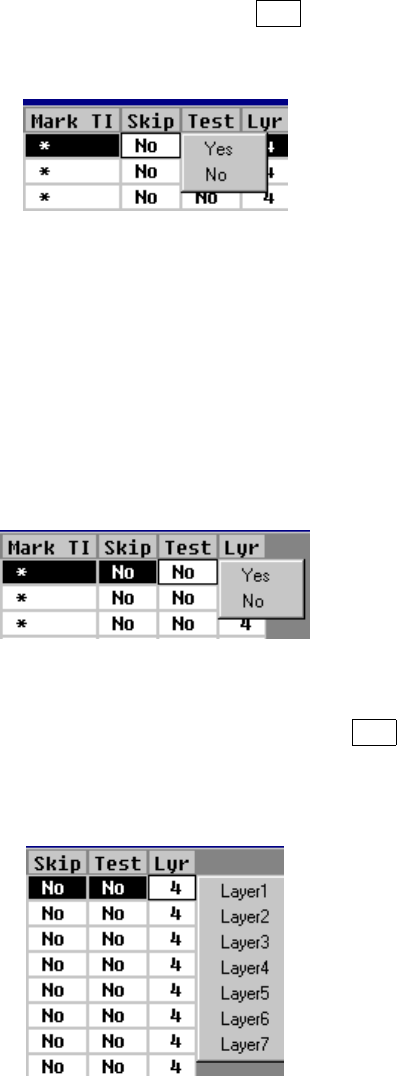
⑨ Skip
This item specifies whether or not to skip the displayed point of placement: Yes or
No
“No” (for “Not skipped”) is displayed as a default in the “Skip” field. To change
the setting of the “Skip” field, press the Edit key ( F2 key) or press the right
button of a mouse to open the list box and select “Yes” or “No”.
⑩ Test
This item specifies whether or not to carry out a test run. If you specify a
placement point within the range for trial run to set the conditions for a trial run,
only the Placement data whose “Test” field is set to “Yes” is used to perform a
trial run.
“No” (for “Not to carry out a test run”) is displayed as a default in the “Test list
box” field. To change the setting of the “Test” field, press the Edit key or click the
input focus with the right button of a mouse to call a list box and select “Yes” or
“No”.
⑪ Lyr (Layer)
To change the setting of the “Lyr” field, press the Edit key ( F2 key) or press the
right button of a mouse to open the list box, then select the desired layer. The
selectable layers are from the layer 1 to layer 7.