KE-2030使用说明书 - 第79页
3 − 14 3.4 Starting up or Terminating the Sy stem W indow s NT star ts up af ter power-on, t hen the application m anager included as t he soft ware for t he main unit is executed: t he initialize window appears on the s…
3 − 13
② Home, End
When the information covers two or more screen pages, the Home key
moves the cursor to the beginning of the line and End key does to the end of
the line.
③ Scroll
− If the ↑ key is pressed when you are on the top line of a screen page
and if there is more information vertically before it, the key scrolls the
information down one line.
− If the ↓ key is pressed when you are on the bottom line of a screen
page and if there is more information vertically after it, the key scrolls the
information up one line.
− If the ← key is pressed when you are at the beginning of the line and if
there is more information to the left, the key scrolls the information one
field to the left.
− If the → key is pressed when you are at the end of the line and if there
is more information to the right, the key scrolls the information one field to
the right.
④ Insert
The Insert key toggles data entry mode between the Insert mode and
Overtype mode.
Data entry mode Cursor shape
Insert
❙
Blinking
Overtype
− Blinking
3 − 14
3.4 Starting up or Terminating the System
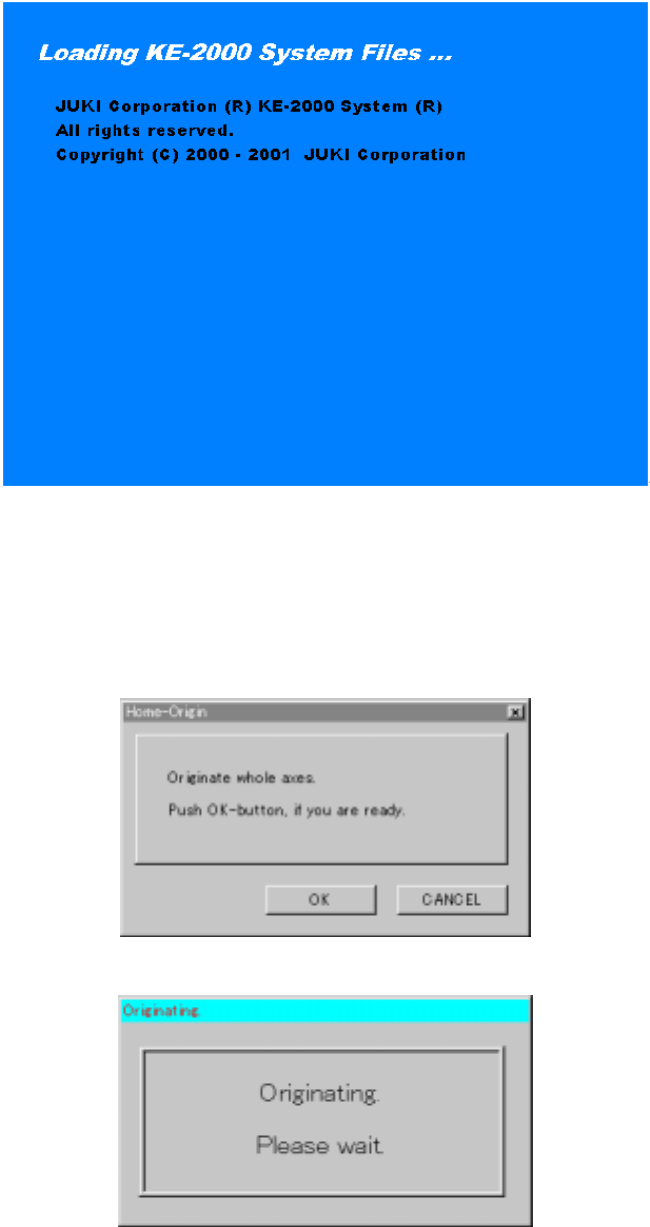
Windows NT starts up after power-on, then the application manager included as the
software for the main unit is executed: the initialize window appears on the screen.
Figure 3.4.1 Start-up screen
When the system is initialized for a while, the <Returning to ORIGIN> screen appears.
If you do not perform the return-to-origin function, press the <CANCEL> key. When
the system completes the return-to-origin function successfully, the application
manager window appears on the screen.
Figure 3.4.2 <Home-Origin> dialog box
Figure 3.4.3 Zeroing waiting dialog box
3 − 15
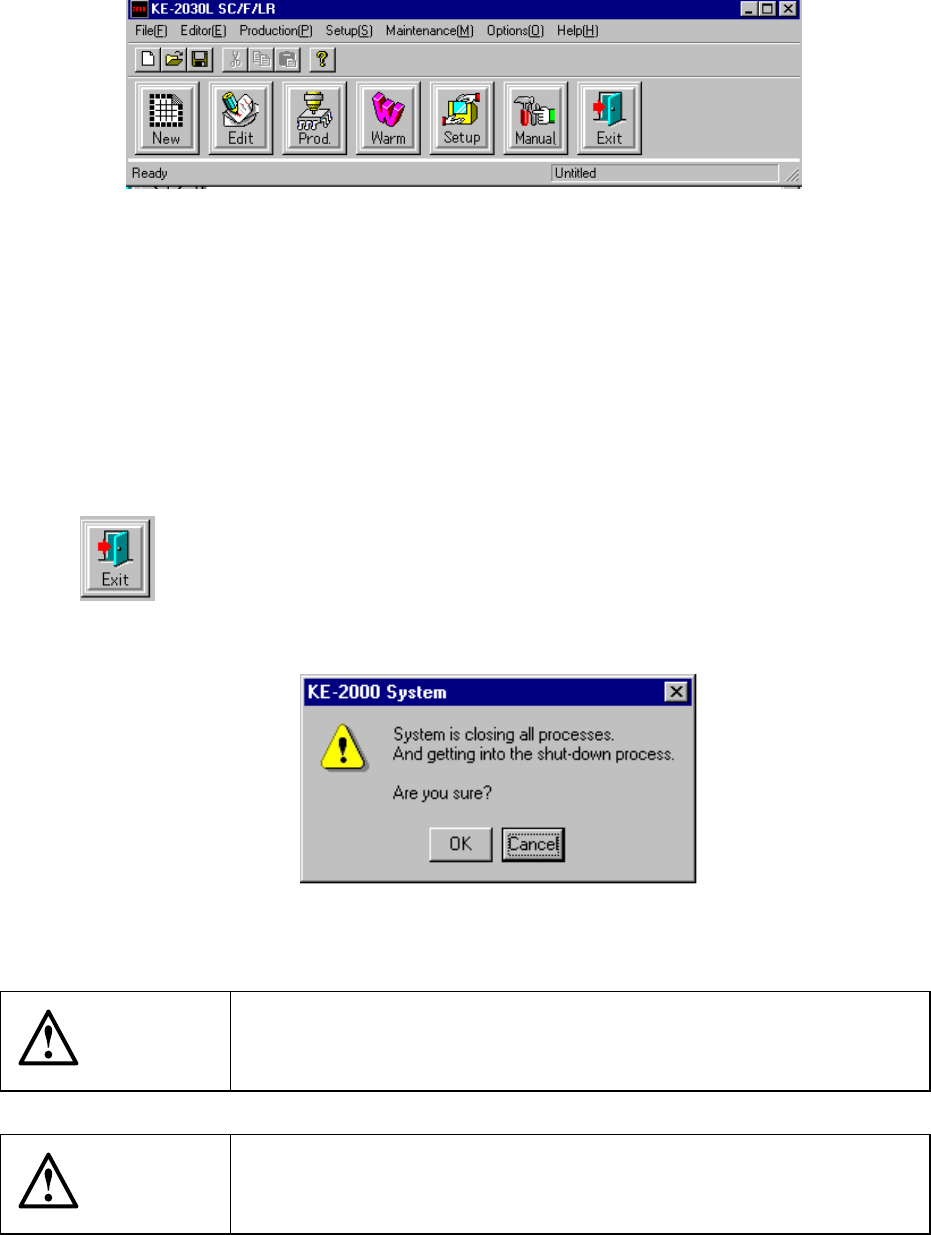
Figure 3.4.4 Main window
To terminate the system, click the <Exit> command button. When you click the <Exit>
button, the confirmation dialog box appears on the screen. When you click the <OK>
button displayed on this dialog box, the shut down process starts, then the system
terminates. If you click the <Cancel> button on this dialog box, the main menu
reappears.
When you click the <Exit> button, the shut-down process confirmation
dialog box opens.
Figure 3.4.5 shut-down process confirmation dialog box
CAUTION
If you turn off the machine without performing the shut-down process,
you may not be able to restart the machine. Be sure to perform the
shut-down process to terminate the system.
CAUTION
When you start up the main unit, two consol screens (under DOS) are
started up at the same time. These consol screens are necessary to
control the system. Never close them.