00193922-01.pdf - 第305页
User Manual SIPLAC E HF Series 7 Station extensions Software Vers ion SR.505.xx 05/2004 US Edition 7.4 Du al conveyor 305 7.4. 2 General As the nam e sugge sts, the dual c onveyor has two trans port tracks, wh ich are e …
7 Station extensions User Manual SIPLACE HF Series
7.4 Dual conveyor Software Version SR.505.xx 05/2004 US Edition
304
7.4 Dual conveyor
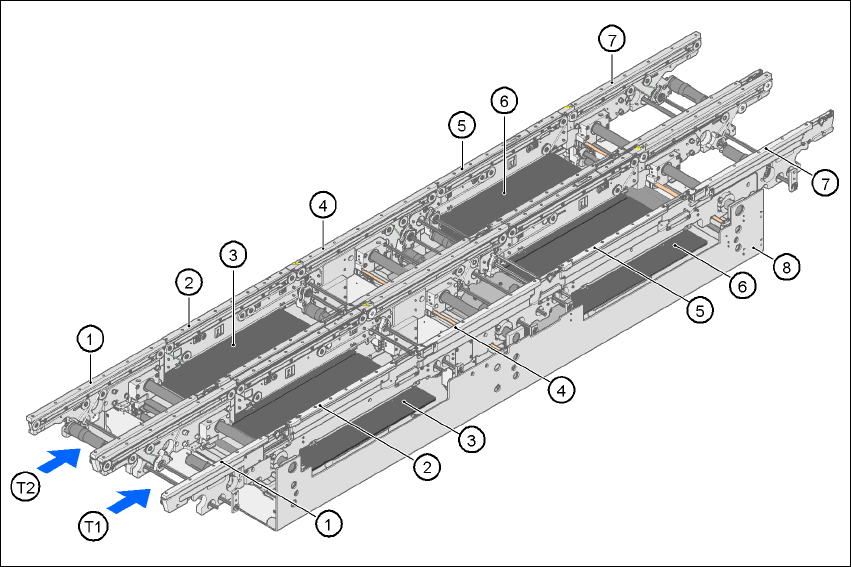
7.4.1 Structure of the dual conveyor
The conveyor belts are driven by DC motors. There is a lifting table for clamping the PCBs in each
processing area. The PCB conveyor width can either be set from the user interface or preset in
the placement program.
7
Fig. 7.4 - 1 Structure of the PCB dual conveyor
(1) Input conveyor
(2) Processing conveyor 1
(3) Lifting table 1
(4) Intermediate conveyor
(5) Processing conveyor 2
(6) Lifting table 2
(7) Output conveyor
(8) Assembly trough
T1 Conveyor track 1
T2 Conveyor track 2

User Manual SIPLACE HF Series 7 Station extensions
Software Version SR.505.xx 05/2004 US Edition 7.4 Dual conveyor
305
7.4.2 General
As the name suggests, the dual conveyor has two transport tracks, which are electrically and me-
chanically independent of one another. In the standard version, the right-hand side is the fixed
side. There is another version, however, in which the left-hand side is the fixed side.
7.4.3 Defining the conveyor tracks
The right transport track (viewed in the transport direction) is designated "Transport 1" and the left
as "Transport 2" (see Fig. 7.4 - 1
).
7.4.4 Changing transport mode
7
7.4.5 Asynchronous transport mode
7.4.5.1 Description
In asynchronous mode, only one PCB in a transport track is processed. At the same time, another
PCB in the second transport track is moved into the placement position. This saves the full con-
veying time of one PCB, thus considerably increasing performance, particularly for PCBs with a
short cycle time.
7.4.5.2 Function
Once the machine has received the job data (panel, set-up), the PCBs on the feeding belts are
continuously transported to the available processing belt (provided that the processing belt is free)
throughout the placement operation. The placement sequence starts as soon as a PCB has
moved onto the processing belt. The PCBs are processed one after another.
If the placement sequence is interrupted, the conveyor interface will be disabled and the PCBs
currently on the processing belts will be completed.
The conveyor interface is disabled or enabled simultaneously for both transport tracks.
Conveyor mode Entry in the SITEST program
Single conveyor
0
Dual conveyor, synchronous
1
Dual conveyor, asynchronous
2

7 Station extensions User Manual SIPLACE HF Series
7.4 Dual conveyor Software Version SR.505.xx 05/2004 US Edition
306
7.4.6 Synchronous transport mode
7.4.6.1 Description
In synchronous mode, two PCBs of the same size are moved into the placement position at the
same time. They must be processed as a common panel.
In this way, the top and bottom of a PCB can be processed on a single line, and the time required
to transport the PCB is shorter since two PCBs are always transported at the same time. It also
ensures better utilization of the nozzle configuration.
7.4.6.2 Function
PCBs on conveyor tracks 1 and 2 are moved synchronously onto the conveyor sections (i.e. the
conveyors are controlled synchronously, but independently of one another). The components to
be placed on conveyor tracks 1 and 2 must be organized into a panel via two subpanels. (See the
SIPLACE Pro user manual).
If only one conveyor track (or center conveyor) is full when the placement sequence starts, the
subpanel on this section will be identified as “not for placement”.
7.4.6.3 Restrictions
If the dual conveyor is operated in synchronous mode, the ‘PCB whispering down the line’ option
is deactivated. PCB barcode operation is not supported in this mode. The ‘Global ink spot’ option
cannot be used.
7.4.7 Controlling the dual conveyor using the Single Functions menu
The online help contains information on controlling the dual conveyor and on the Single Functions
menu.
7.4.8 Automatic width adjustment on the dual conveyor
When the command is received, the conveyors are set to the desired width one after another. Dif-
ferent widths are possible.
PLEASE NOTE 7
Automatic width adjustment is deactivated if “synchronous transport” is selected.