00193922-01.pdf - 第328页
7 Station extensions User Manual SIPLACE HF Series 7.11 Coplanarity laser module Software Version S R.505.xx 05/2004 US E dition 328 and is then use d to cal culate t he exact p osition of the l ead with respec t to the …
User Manual SIPLACE HF Series 7 Station extensions
Software Version SR.505.xx 05/2004 US Edition 7.11 Coplanarity laser module
327
7.11 Coplanarity laser module
7.11.1 Description of the functions
The coplanarity laser module is used to measure vertical bending of the leads. The lead length is
measured without contact using the laser triangulation principle.
7
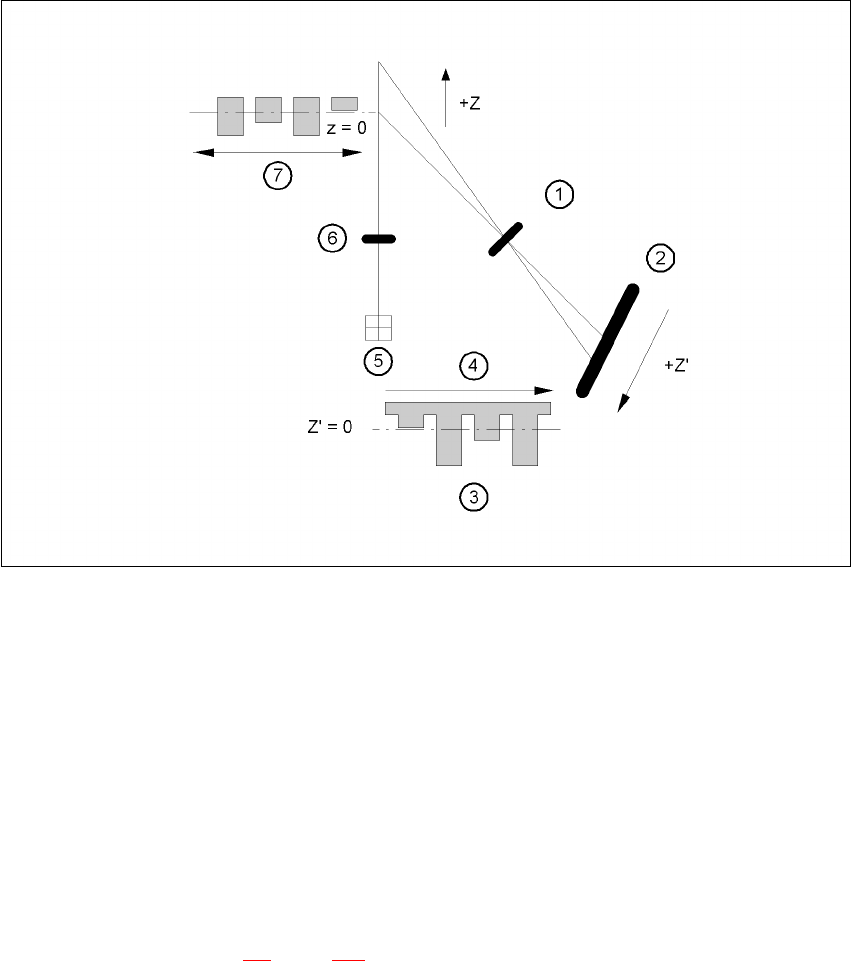
Fig. 7.11 - 1 Laser triangulation measurement principle
(1) Receiver lens
(2) Detector
(3) Measuring signal
(4) Time t
(5) Laser
(6) Transmitter lens
(7) Travel direction
The TwinHead picks up the component to be checked, centers it optically using the component
vision camera (see section 7.2
, page 299) and moves all four sides one after another over the
fixed laser beam of the coplanarity laser module. In this way, every lead is scanned from below
by the laser beam. The laser light scattered by the underside of the lead is recorded by a sensor,
7 Station extensions User Manual SIPLACE HF Series
7.11 Coplanarity laser module Software Version SR.505.xx 05/2004 US Edition
328
and is then used to calculate the exact position of the lead with respect to the PCB. The position
values thus calculated are compared against the limit value specified by the user. If they exceed
this value, the component is disposed of or returned.
The coplanarity laser module is combined with optical component centering, and is used in a
vision module. Components with bent or missing leads are detected and disposed of, if neces-
sary.
7.11.2 Technical data
Component range: Can be used for gull wing components, pitch > 0.3
The component size and lead pitch are limited by the component
position recognition system,
i.e. max. size 43.0 x 43.0 x 11.0 mm³.
Measuring principle: Contact-free measurement by laser triangulation
Algorithm functions: JEDEC standard calculation of the placement plane; all deviations
are determined in relation to this plane. If the component is angled
with respect to the vacuum nozzle, as can happen if an adapter is
used, then it will have no influence over the choice between ‘good’
and ‘bad’.
Output: < 5 mW
Measuring range: ± 2.5 mm
Laser focus: elliptical, 50x 95µm²
Thermal stability: ± 1µm/K
Wave length: 670 nm
Resolution 0.25µm
Scanning frequency: 10 kHz
Weight: 500 g
Operating temperature: 0°C ... 40
Humidity: 5 - 95% non-condensing
Ambient pressure: Atmospheric pressure
Vibration: as per IEC 68-2-6
Mechanical shock: as per IEC 68-2-27
EMC: as per EN 50081-2 emitted interference
as per EN 50082-2 immunity to interference
Degree of protection: IP 64
Mech. dimensions: 118 x 30 x 125.5 mm³
Permissible ambient light: 30,000 lx
User Manual SIPLACE HF Series 7 Station extensions
Software Version SR.505.xx 05/2004 US Edition 7.11 Coplanarity laser module
329
Safety: The coplanarity laser module conforms to laser class 1, when
installed in the machine. The module will not work when off the
machine unless further devices are installed or the protective func-
tions are modified. If the protective functions on the device are
bypassed, the machine automatically conforms to laser class 3B -
(Risk of injury to eyes and skin) and thus requires protective mea-
sures to VBG 93.
7.11.3 Safety instructions
DANGER
NEVER modify or bypass safety devices on the coplanarity laser module! 7
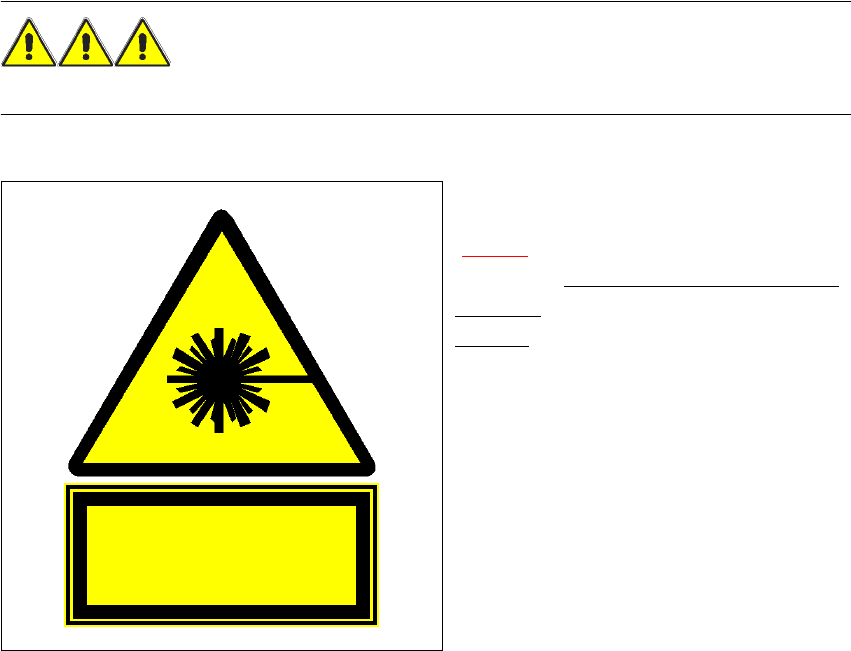
With no protective measures, the coplanarity
laser module conforms to laser class 3B.
(7.11 - 2
).
This means there is a risk of injury to eyes
and skin! For this reason, you should
NEVER
bypass the safety devices!
Fig. 7.11 - 2 Identification for laser class 3B
The following safety devices must be installed on the machine if the laser module is to be oper-
ated in laser class 1 without risk to the eyes and skin:
Invisible laser radiation
Do not expose the beam
Class 3 B Laser Product
1mW max., 670 nm;
as per IEC 825-1(1993)