00193922-01.pdf - 第65页
User Manual SIPLAC E HF Series 2 Operational safety Software Vers ion SR.505.xx 05/2004 US Edition 2.6 Safety equipment 65 2.6.5 EMERGENCY ST OP l oop s and signaling circuit 2.6.5.1 S tructure of the emergency stop loop…
2 Operational safety User Manual SIPLACE HF Series
2.6 Safety equipment Software Version SR.505.xx 05/2004 US Edition
64
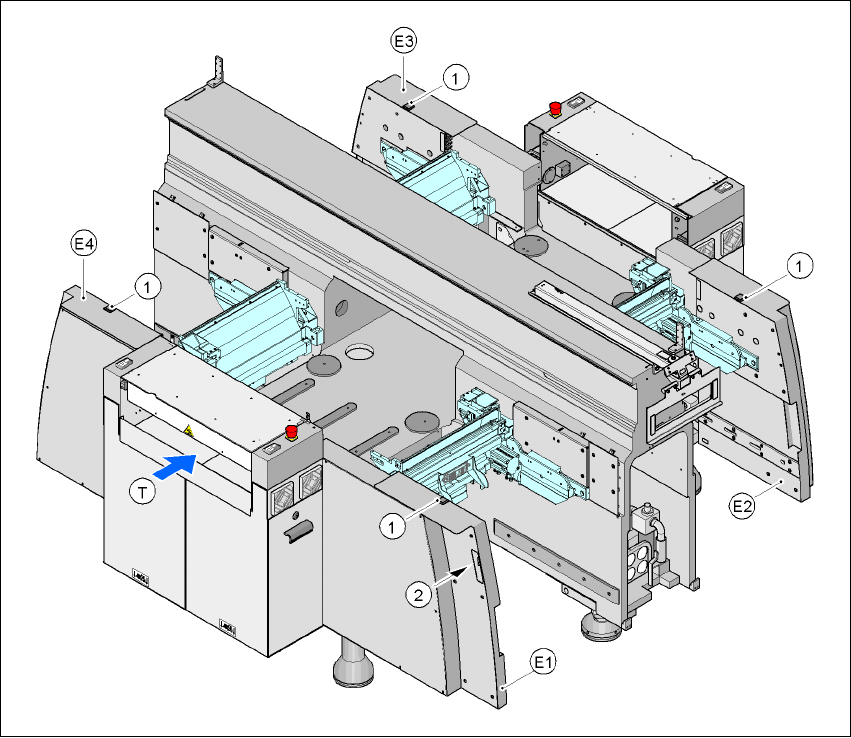
2.6.4 Position of the push-buttons for docking the component trolleys in and out
2
Fig. 2.6 - 7 Position of the push-buttons for docking the component trolleys in and out
2
(1) Push-button on the top
(2) Push-button in the hand guard
E1 Hand guard, location 1
E2 Hand guard, location 2
E3 Hand guard, location 3
E4 Hand guard, location 4
Two push-buttons are integrated into the hand guard module (items E1, E2, E3 and E4). These
are used to dock the component trolley in or out at the location. To
dock out,
press the push-button
(item 1) on the top of the hand guard. To
dock in,
press both push-buttons at the same time (item
1 and item 2). They are far enough apart from one another that you will need both hands to press
the button. This is intended to prevent the risk of injury to operators while docking the component
trolley in or out.
User Manual SIPLACE HF Series 2 Operational safety
Software Version SR.505.xx 05/2004 US Edition 2.6 Safety equipment
65
2.6.5 EMERGENCY STOP loops and signaling circuit
2.6.5.1 Structure of the emergency stop loops
The following contacts are connected in series and form the emergency stop loop:
– make contacts for the four protective cover switches
– make contacts for the two PCB conveyor covers
– make contacts for the two emergency stop buttons
– make contacts for the four component trolleys
– make contacts in the cover flaps (option) over the push-buttons for docking the component trol-
leys in or out.
– Channels of the SSK K6 protective contactor combination
With emergency stop loop 2, the CAN bus signal from the signaling circuit (see Section 2.6.5.2
)
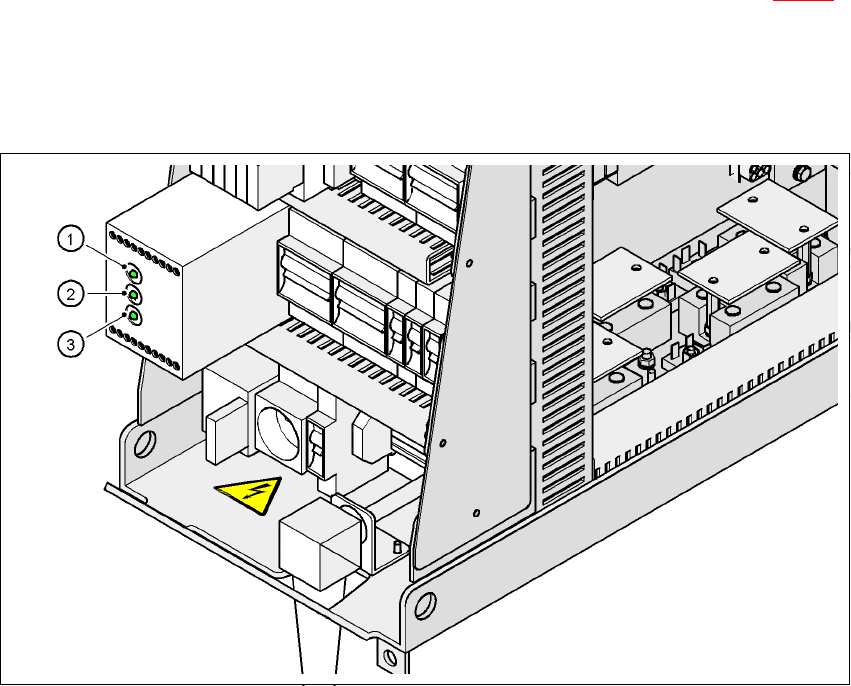
is supplied to channel 2 of the protective contactor combination SSK K6. If the emergency stop
loop is closed, and the signaling circuit is not signaling a malfunction, then the two green LEDs for
channels 1 and 2 light up, in addition to the green mains power check LED of the protective con-
tactor combination.
2
Fig. 2.6 - 8 Signal LED on the protective contactor combination
(1)Netz / Power
(2)Kanal 1 / Channel 1
(3)Kanal 2 / Channel 2
2 Operational safety User Manual SIPLACE HF Series
2.6 Safety equipment Software Version SR.505.xx 05/2004 US Edition
66
2.6.5.2 Structure of the signaling circuit
The six signaling contacts for the covers are connected in parallel and form the "cover signal" cir-
cuit. If one or more covers are opened, the contacts close, and the 24 V signal reaches the CAN
bus and signals that one of the covers is open.
The two signaling contacts for the EMERGENCY STOP buttons are connected in parallel and form
the "emergency stop push-button signal circuit". When an emergency stop button is pressed, a
24 V signal is sent to the CAN bus and signals that one of the emergency stop buttons has been
pressed. The four signaling contacts for the cover flaps over the push-buttons are connected in
parallel. They form the "Flap signal" circuit. If one or more cover flaps is raised, a 24 V signal is
applied to the CAN bus and signals that one of the cover flaps is not closed.
The four signaling contacts of the component trolley are polled individually. If a component trolley
is missing, it is located and displayed on the monitor. All 4 component trolleys must be docked in
to form the
"M-COTable" signal. The signal at the CAN bus input is then approx. 16V. If a component trolley
is missing, the signal voltage is 0 V.
2.6.5.3 Description of the functions of the emergency stop loops
The following conditions must be fulfilled in order to start and operate the placement machine:
– all four component trolleys must be docked in and connected.
– all covers - four over the gantries, one over the PCB input belt and one over the output belt -
must be closed.
– both emergency stop buttons must be released.
– the cover flaps (option) over the feeders must be closed.
– the minimum operating pressure must have been reached.
– the "software enable" signal must be active. This ensures that the safety circuit is closed.
– the power supply must be sending 24 V to the Start buttons and the protective contactor com-
bination.
– If one of the Start buttons is now pressed, the protective contactor combination PCC K6 will
switch and activate the following components:
– 250 VDC link voltage for the servo amplifiers for the gantry axes
– 145 VDC link voltage for the star axes
– the axis unit receives a "Servo enable" signal for the servo amplifiers
– 34 VDC operating voltage is switched to the component trolleys.
– 24 VDC operating voltage is switched to the used tape cutters.
– the PCB conveyor control receives the enable signal for the PCB clamping, the PCB stop-
per and the lifting table control.
The machine is then ready for use.