SIPLACE 80 F4_EN.pdf - 第37页
36 Description The productivity can b e further en- hanced through exact kn owledge of the current system condition and utiliza tion rate. This informa - tion is furnished by Production and Machi ne Data Ac quisitio n sy…
35
Description
A single placement program on
the line computer is sufficient for
all of the SIPLACE machines in a
production line. It contains the in-
formation necessary for placement
of a specific type of PCB, from the
dimensions of the PCB to the
placement positions of the com-
ponents to the complete compo-
nent and GF library. The program
can be created manually using edi-
tors in the SIPLACE line computer
or - easily and time-saving - it can
be generated automatically from
the CAD data of the PCB. The
converted data read in by means
of a CAD postprocessor can be
transferred into the SIPLACE line
computer’s data pool via a stan-
dard LAN. The placement pro-
grams then pass from the HOST
computer directly into the master
data management of the line com-
puter.
The CAD postprocessor can be
variably adjusted insofar as the or-
der of the data and the format are
concerned. The data to be con-
verted must meet the following
preconditions:
ASCII data
Table-oriented: one line per
placement position
Separators can be variably ad-
justed but must be the same for
all fields
Minimum information content:
component name, X-, Y-. angle
position.
The central filing of the line com-
puter (master) data enables an
automated link to higher-level
computer systems. Changes
therefore automatically affect all
connected, appropriately config-
ured lines. It is possible to switch
between local and central data
management at any time.
Using a conversion program inte-
grated into the SIPLACE line com-
puter it is possible to adopt place-
ment programs from earlier
Siemens SMD placement ma-
chines which could be run on an
SP-120/HS-180 line or on MS-1xx
machines (BP and BM files). The
data are converted into the
SIPLACE format and stored in the
line computer, where they have to
be supplemented by additional re-
quired information such as PCB
dimensions, layouts of subpanels
in the cluster and set-ups.
An additional computer with the
same hardware and software con-
figuration as the line computer can
be employed as an external
programming station. Even if it is
at a different location than the
production equipment, it can man-
age data for a number of lines and
be connected with the line com-
puters in production via LAN.
The file format >setupname<.rt, in
which set-up data in simple form
can be generated, makes it possi-
ble to import set-ups which were
programmed on your own or third-
party systems. It facilitates pro-
gramming on external systems
and the use of higher-level produc-
tion controls. This file is also
stored in table-oriented ASCII for-
mat and is therefore very easy to
create.
The goal of SIPLACE set-up opti-
mization is to reduce placement
times and non-productive machine
time. Attention is directed to opti-
mally balancing the entire line in
addition to minimizing the place-
ment time of each individual ma-
chine. The nozzle allocation of the
placement heads is adjusted for
the PCB at hand. To minimize
travel, the optimal erection location
of the feeder and the most favor-
able order of placement is com-
puted. As long as the component
table capacity of a SIPLACE line
permits, set-up optimization can
be employed to combine a number
of products into a single set-up.
An optional add-on is changeover
optimization which optimally com-
bines a relatively large number of
products in several set-ups. The
objectives are to achieve the
shortest possible throughput times
and optimal balancing of the entire
lines but also to factor in changeo-
ver/set-up times.
SIPLACE Software Architecture:
Creation of Placement Programs
Generation of Placement Program from the CAD Data of the PCB
Data conversion
Configurable postprocessor of the line
computer or external postprocessor of the
CAD system manufacturer or 3
rd
party
software vendor
Data transfer
Standard LAN (Ethernet TCP/IP and FTP or
NFS) or disk (MS-DOS; UNIX)
36
Description
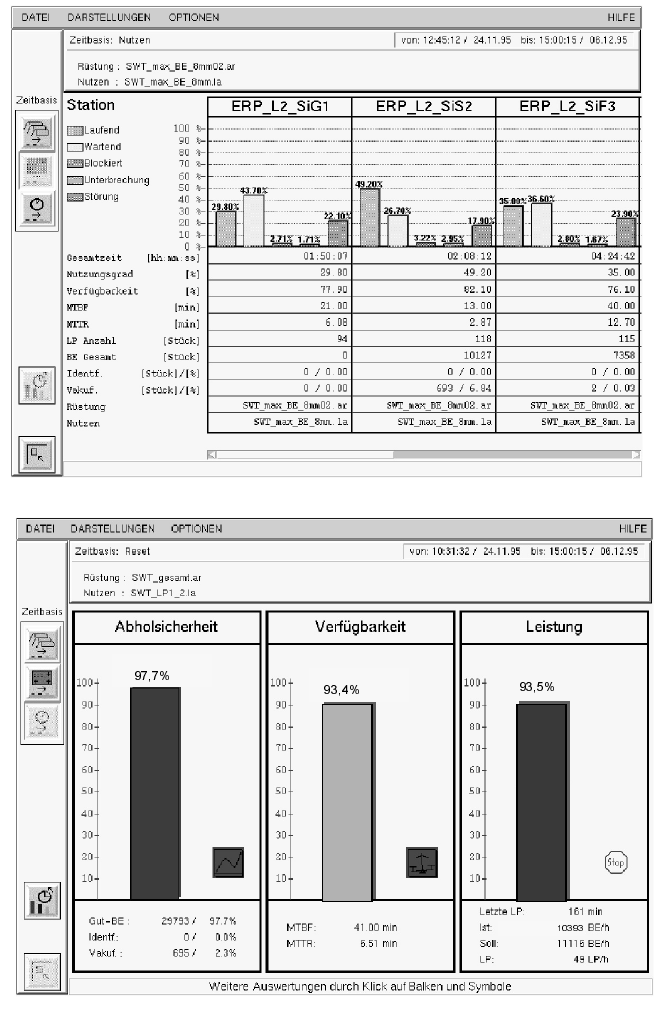
The productivity can be further en-
hanced through exact knowledge
of the current system condition
and utilization rate. This informa-
tion is furnished by Production and
Machine Data Acquisition systems
(PDA/MDA). The SIPLACE Ma-
chine Data Management System
collects all relevant data about the
line and individual stations and
presents the data in graphic form.
This includes evaluations as to
availability, pick-up error rates,
placement speed, MTBF and
MTTR as well as displaying the
track errors complete with com-
ponent item number of GF num-
ber. This speedy, comprehensive
view of the operating behavior fur-
nishes starting points for possible
improvements.
SIPLACE Software Architecture:
Machine Data Management System
Screen Shots
37
Description
The function of the Semiconductor
Equipment Communication Stan-
dard (SECS) II is the uniform defini-
tion of communication interfaces
to the production equipment ob-
tained from different manufactur-
ers. It has been further developed
into GEM Standard (General
Equipment Model) which is also
suitable for SMT production facili-
ties. To this end, an external user-
specific production computer
(host) is connected via LAN to a
GEM computer integrated into the
machine control. The interface is
used by host systems created by
the user or by application software
from a third-party manufacturer.
The SECS II / GEM communication
protocol supports central control,
process control and their data
management of entire production
lines at the line computer. It is
possible through Statistical Proc-
ess Control (SPC), for example, to
effect preventive maintenance
which eliminates or greatly re-
duces non-productive time.
SIPLACE Software Architecture:
Data Interface SECS II / GEM (Option)
Functions
Identification of the equipment
Access to
Product data, error messages,
machine states, measurement results
Protection of
Data, connections
(connection set-up, resynchronization)
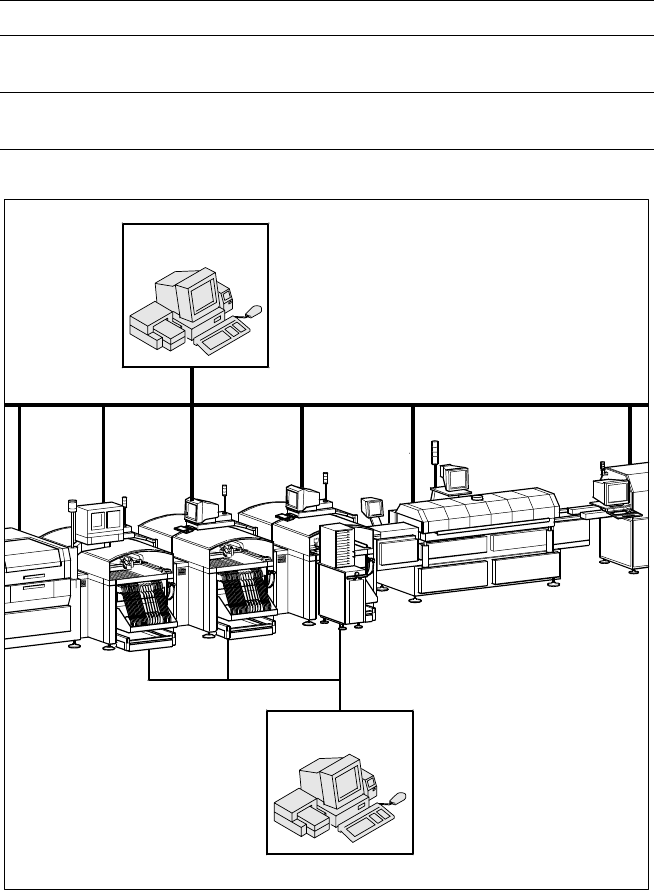
Configuration of a Production Line with GEM Computer
HOST
Line Computer
Factory LAN GEM
GEM
GEM
GEM
GEM