IPC-TM-650 EN 2022 试验方法--.pdf - 第147页
Caution: Oxalic acid is toxi c. IPC-TM-650 Number Subject Date Revision Page 2 of 2 2.3.14 Print, Etch, and Plate Test 4/73 5.2. 1.3 Immerse the specimens in a 10% solution of oxalic acid in water at 1 6 ℃ to 32℃ for 1 5…
IPC-TM-650 Test Methods Manual
MIL-P-13949
The Institute for Interconnecting and Packaging Electronic Circuits
2215 Sanders Road • Northbrook, IL 60062-6135
Material in this Test Methods Manual was voluntarily established by Technical Committees of the IPC. This material is advisory only
and its use or adaptation is entirely voluntary. IPC disclaims all liability of any kind as to the use, application, or adaptation of this
material. Users are also wholly responsible for protecting themselves against all claims or liabilities for patent infringement.
Equipment referenced is for the convenience of the user and does not imply endorsement by the IPC.
Page 1 of 2
IPC-TM-650
TEST
METHODS
MANUAL
Number
2.3.14
Subject
Print,
Etch,
and
Plate
Test
Date
Revision
4/73
Originating
Task
Group
N/A
1
Scope
This
test
method
provides
a
standard
method
for
evaluating
the
effect
of
established
processing
operations
used
in
the
manufacture
of
PWBs
on
materials
that
are
con¬
sidered
for
use
in
the
manufacture
of
PWBs.
Specific
criteria
for
the
acceptability
are
based
on
copper
foil
adhesion
and
visual
surface
condition
of
the
base
laminate.
2
Applicable
Documents
2
.4.8
Peel
Strength
of
Metallic
Clad
Laminates
3
Test
Specimens
3.1
Copper-clad
epoxy
glass
laminate
materials
ranging
from
0.8
mm
to
6.5
mm
thick,
clad
on
one
or
both
sides.
3.2
Three
specimens
shall
be
tested
from
each
material,
except
in
the
case
where
the
material
is
clad
on
both
sides,
and
then
six
specimens
shall
be
processed
for
each
material.
Each
specimen
will
have
four
readings
for
peel
strength
(see
IPC-TM-650,
Method
2.4.8).
4
Equipment/Apparatus
4.1
Etching
Typical
production
printing,
etching,
and
plat¬
ing
equipment
and
materials
4.2
Tester
For
peel
strength
equipment
(see
IPC-TM-650,
Method
2.4.8)
5
Procedure
5.1
Print
and
Etch
5.1.1
Sand
the
edges
of
the
test
specimens
to
remove
burrs,
allowing
close
contact
between
the
specimen,
nega¬
tive,
and
frame
glass,
resulting
in
a
better
defined
etched
pat¬
tern.
5.1.2
Scrub
the
copper
surface(s)
with
FFF
pumice
and
a
brush
to
remove
any
contamination
on
the
surface
of
the
specimen
until
it
passes
a
water
break
test.
5.1.3
Dry
the
specimens
using
compressed
filtered
air.
5.1
.4
Dip
the
specimens
in
the
following
photoresist
solution
at
room
temperature:
One
part
by
volume
KPR
III
One
part
by
volume
toluene
One
part
by
volume
acetone
The
specific
gravity
of
the
solution
is
0.920.
5.1
.5
Hold
the
specimen
by
one
corner
when
dipping.
Allow
excess
solution
to
drain
until
dripping
stops.
5.1.6
Put
the
specimens
on
rack
(after
draining)
into
80℃
oven
from
three
to
five
minutes
to
dry
and
harden
KPR.
5.1.7
Remove
the
rack
from
the
oven
and
allow
the
speci¬
mens
to
cool
to
room
temperature.
5.1.8
Place
the
specimens
upon
the
negative
in
the
printing
frame
with
the
copper
side
against
the
negative.
5.1.9
Expose
the
mounted
specimen
76
mm
from
the
fluo¬
rescent
black
light
for
seven
minutes.
5.1.10
Develop
in
trichlorethylene
vapor
for
15
seconds.
It
may
require
two
to
six
cycles
until
the
pattern
is
clear.
Air-dry
the
specimen
after
developing.
Note:
Use
the
test
pattern
in
Method
2.4.8.
5.2
Etching
Process
and
Etchant
Removal
5.2.1
Method
A
5.2.1.
1
Etch
the
specimens
with
vigorous
aeration
for
the
minimum
time
(the
time
to
produce
a
clean
pattern
with
a
minimum
of
undercutting
is
approximately
seven
minutes
for
34
mm
and
1
5
minutes
for
69
mm
copper,
using
fresh
ferric
chloride
solution)
in
42°
Baume
(be)
ferric
chloride
solution
maintained
at
24℃
to
38℃.
The
etching
solution
shall
be
renewed
when
the
etching
time
exceeds
15
minutes
for
34
mm
copper
or
30
minutes
for
69
mm
copper.
5.2.1.
2
After
removal
of
the
copper,
immediately
wash
the
specimens
with
running
tap
water
at
16℃
to
32℃
for
two
to
five
minutes.
Thereafter,
keep
the
specimens
from
drying
until
reaching
step
5.2.1
.7.
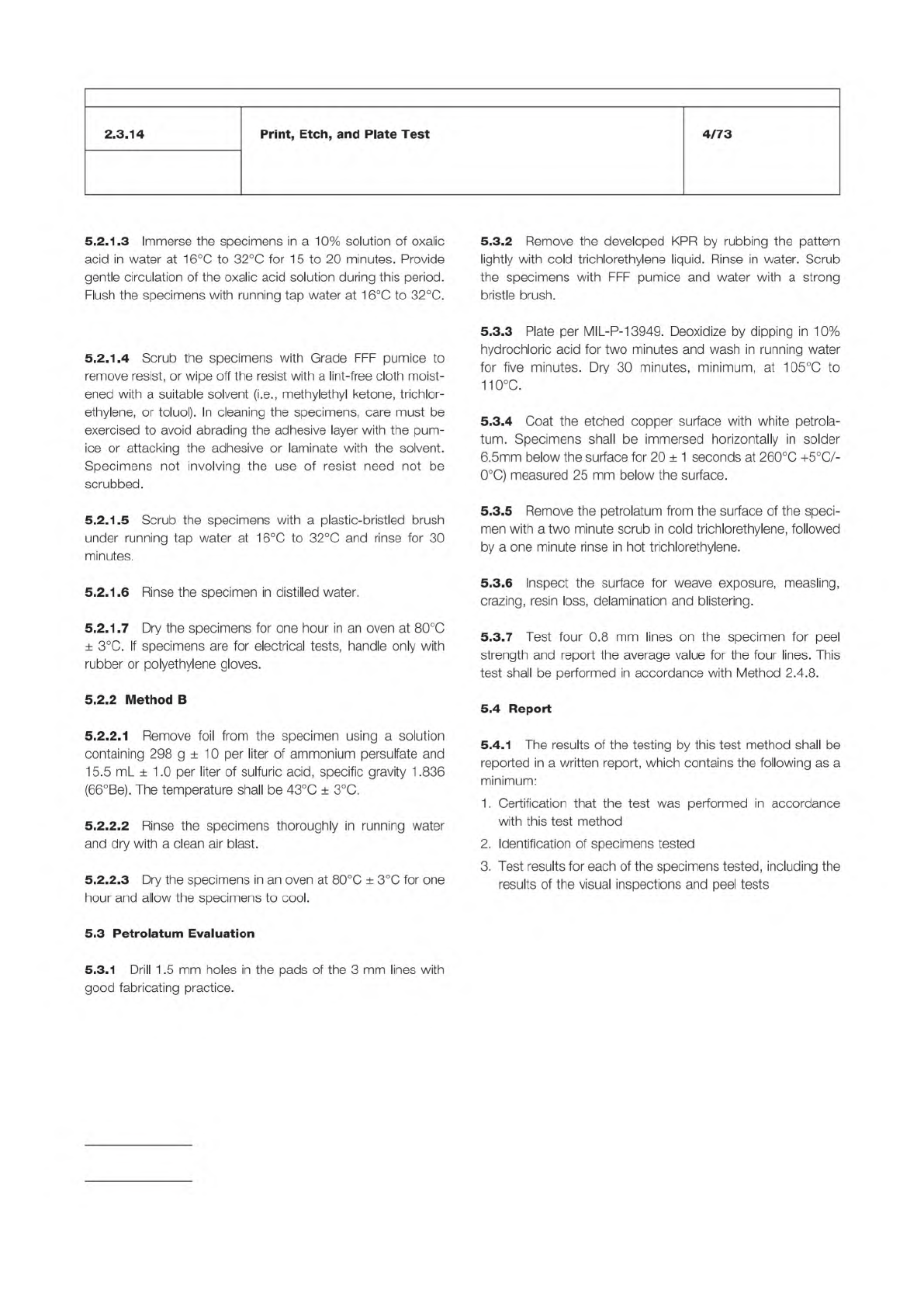
Caution: Oxalic acid is toxic.
IPC-TM-650
Number
Subject Date
Revision
Page 2 of 2
2.3.14
Print,
Etch,
and
Plate
Test
4/73
5.2.
1.3
Immerse
the
specimens
in
a
10%
solution
of
oxalic
acid
in
water
at
1
6
℃
to
32℃
for
1
5
to
20
minutes.
Provide
gentle
circulation
of
the
oxalic
acid
solution
during
this
period.
Flush
the
specimens
with
running
tap
water
at
1
6
℃
to
32℃.
5.2.
1.4
Scrub
the
specimens
with
Grade
FFF
pumice
to
remove
resist,
or
wipe
off
the
resist
with
a
lint-free
cloth
moist¬
ened
with
a
suitable
solvent
(i.e.,
methylethyl
ketone,
trichlor¬
ethylene,
or
toluol).
In
cleaning
the
specimens,
care
must
be
exercised
to
avoid
abrading
the
adhesive
layer
with
the
pum¬
ice
or
attacking
the
adhesive
or
laminate
with
the
solvent.
Specimens
not
involving
the
use
of
resist
need
not
be
scrubbed.
5.2.1.
5
Scrub
the
specimens
with
a
plastic-bristled
brush
under
running
tap
water
at
16℃
to
32℃
and
rinse
for
30
minutes.
5.2.1.
6
Rinse
the
specimen
in
distilled
water.
5.2.1.
7
Dry
the
specimens
for
one
hour
in
an
oven
at
80℃
土
3
℃.
If
specimens
are
for
electrical
tests,
handle
only
with
rubber
or
polyethylene
gloves.
5.2.2
Method
B
5.2.2.1
Remove
foil
from
the
specimen
using
a
solution
containing
298
g
±
10
per
liter
of
ammonium
persulfate
and
15.5
mL
±1.0
per
liter
of
sulfuric
acid,
specific
gravity
1
.836
(66°
Be).
The
temperature
shall
be
43℃
±
3
℃.
S.2.2.2
Rinse
the
specimens
thoroughly
in
running
water
and
dry
with
a
clean
air
blast.
S.2.2.3
Dry
the
specimens
in
an
oven
at
80℃
土
3
℃
for
one
hour
and
allow
the
specimens
to
cool.
5.3
Petrolatum
Evaluation
5.3.1
Drill
1.5
mm
holes
in
the
pads
of
the
3
mm
lines
with
good
fabricating
practice.
5.3.2
Remove
the
developed
KPR
by
rubbing
the
pattern
lightly
with
cold
trichlorethylene
liquid.
Rinse
in
water.
Scrub
the
specimens
with
FFF
pumice
and
water
with
a
strong
bristle
brush.
5.3.3
Plate
per
MIL-P-13949.
Deoxidize
by
dipping
in
10%
hydrochloric
acid
for
two
minutes
and
wash
in
running
water
for
five
minutes.
Dry
30
minutes,
minimum,
at
105℃
to
110℃.
5.3.4
Coat
the
etched
copper
surface
with
white
petrola¬
tum.
Specimens
shall
be
immersed
horizontally
in
solder
6.5mm
below
the
surface
for
20
土
1
seconds
at
260℃
+5℃/-
0
℃)
measured
25
mm
below
the
surface.
5.3.5
Remove
the
petrolatum
from
the
surface
of
the
speci¬
men
with
a
two
minute
scrub
in
cold
trichlorethylene,
followed
by
a
one
minute
rinse
in
hot
trichlorethylene.
5.3.6
Inspect
the
surface
for
weave
exposure,
measling,
crazing,
resin
loss,
delamination
and
blistering.
5.3.7
Test
four
0.8
mm
lines
on
the
specimen
for
peel
strength
and
report
the
average
value
for
the
four
lines.
This
test
shall
be
performed
in
accordance
with
Method
2.4.8.
5.4
Report
5.4.1
The
results
of
the
testing
by
this
test
method
shall
be
reported
in
a
written
report,
which
contains
the
following
as
a
minimum:
1
.
Certification
that
the
test
was
performed
in
accordance
with
this
test
method
2.
Identification
of
specimens
tested
3.
Test
results
for
each
of
the
specimens
tested,
including
the
results
of
the
visual
inspections
and
peel
tests
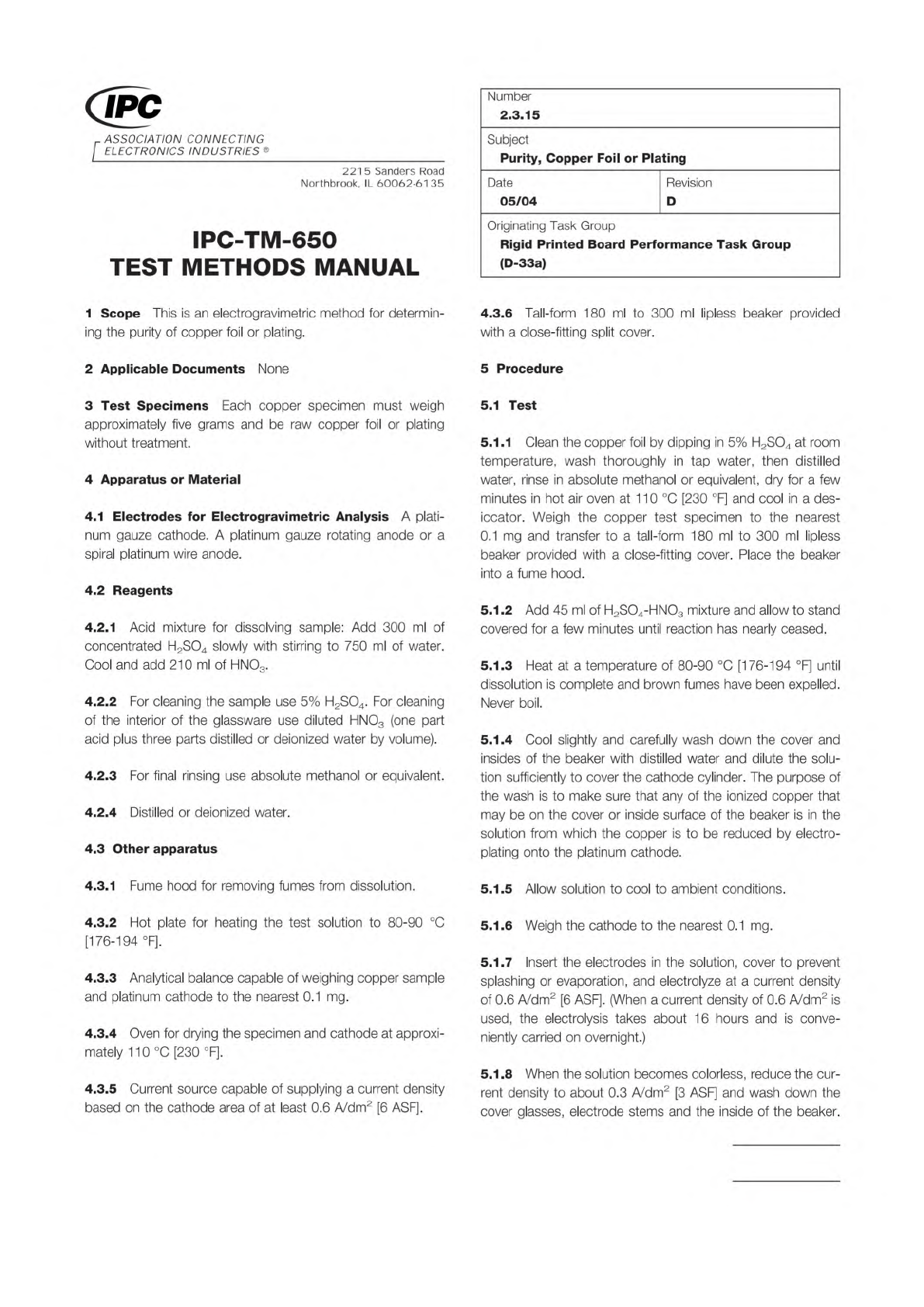
Material in this Test Methods Manual was voluntarily established by Technical Committees of IPC. This material is advisory only
and its use or adaptation is entirely voluntary. IPC disclaims all liability of any kind as to the use, application, or adaptation of this
material. Users are also wholly responsible for protecting themselves against all claims or liabilities for patent infringement.
Equipment referenced is for the convenience of the user and does not imply endorsement by IPC.
Page 1 of 2
r
ASSOCIATION
CONNECTING
/
ELECTRONICS
INDUSTRIES
®
221
5
Sanders
Road
Northbrook,
IL
60062-6135
IPC-TM-650
TEST
METHODS
MANUAL
1
Scope
This
is
an
electrogravimetric
method
for
determin¬
ing
the
purity
of
copper
foil
or
plating.
2
Applicable
Documents
None
3
Test
Specimens
Each
copper
specimen
must
weigh
approximately
five
grams
and
be
raw
copper
foil
or
plating
without
treatment.
4
Apparatus
or
Material
4.1
Electrodes
for
Electrogravimetric
Analysis
A
plati¬
num
gauze
cathode.
A
platinum
gauze
rotating
anode
or
a
spiral
platinum
wire
anode.
4.2
Reagents
4.2.1
Acid
mixture
for
dissolving
sample:
Add
300
ml
of
concentrated
H
2s
O4
slowly
with
stirring
to
750
ml
of
water.
Cool
and
add
210
ml
of
HN03.
4.2.2
For
cleaning
the
sample
use
5%
H2S04.
For
cleaning
of
the
interior
of
the
glassware
use
diluted
HN03
(one
part
acid
plus
three
parts
distilled
or
deionized
water
by
volume).
4.2.3
For
final
rinsing
use
absolute
methanol
or
equivalent.
4.2.4
Distilled
or
deionized
water.
4.3
Other
apparatus
4.3.1
Fume
hood
for
removing
fumes
from
dissolution.
4.3.2
Hot
plate
for
heating
the
test
solution
to
80-90
[176-194
°F].
4.3.3
Analytical
balance
capable
of
weighing
copper
sample
and
platinum
cathode
to
the
nearest
0.1
mg.
4.3.4
Oven
for
drying
the
specimen
and
cathode
at
approxi¬
mately
110
[230
°F].
4.3.5
Current
source
capable
of
supplying
a
current
density
based
on
the
cathode
area
of
at
least
0.6
A/dm2
[6
ASF]-
Number
2.3.15
Subject
Purity,
Copper
Foil
or
Plating
Date
Revision
05/04
D
Originating
Task
Group
Rigid
Printed
Board
Performance
Task
Group
(D-33a)
4.3.6
Tail-form
180
ml
to
300
ml
lipless
beaker
provided
with
a
close-fitting
split
cover.
5
Procedure
5.1
Test
5.1
.1
Clean
the
copper
foil
by
dipping
in
5%
H2S04
at
room
temperature,
wash
thoroughly
in
tap
water,
then
distilled
water,
rinse
in
absolute
methanol
or
equivalent,
dry
for
a
few
minutes
in
hot
air
oven
at
11
0
[230
°F]
and
cool
in
a
des¬
iccator.
Weigh
the
copper
test
specimen
to
the
nearest
0.1
mg
and
transfer
to
a
tail-form
180
ml
to
300
ml
lipless
beaker
provided
with
a
close-fitting
cover.
Place
the
beaker
into
a
fume
hood.
5.1
.2
Add
45
ml
of
H2S04-HN03
mixture
and
allow
to
stand
covered
for
a
few
minutes
until
reaction
has
nearly
ceased.
5.1.3
Heat
at
a
temperature
of
80-90
[1
76-194
°F]
until
dissolution
is
complete
and
brown
fumes
have
been
expelled.
Never
boil.
5.1.4
Cool
slightly
and
carefully
wash
down
the
cover
and
insides
of
the
beaker
with
distilled
water
and
dilute
the
solu¬
tion
sufficiently
to
cover
the
cathode
cylinder.
The
purpose
of
the
wash
is
to
make
sure
that
any
of
the
ionized
copper
that
may
be
on
the
cover
or
inside
surface
of
the
beaker
is
in
the
solution
from
which
the
copper
is
to
be
reduced
by
electro¬
plating
onto
the
platinum
cathode.
5.1.5
Allow
solution
to
cool
to
ambient
conditions.
5.1.6
Weigh
the
cathode
to
the
nearest
0.1
mg.
5.1.7
Insert
the
electrodes
in
the
solution,
cover
to
prevent
splashing
or
evaporation,
and
electrolyze
at
a
current
density
of
0.6
A/dm2
[6
ASF].
(When
a
current
density
of
0.6
A/dm2
is
used,
the
electrolysis
takes
about
16
hours
and
is
conve¬
niently
carried
on
overnight.)
5.1.8
When
the
solution
becomes
colorless,
reduce
the
cur¬
rent
density
to
about
0.3
A/dm2
[3
ASF]
and
wash
down
the
cover
glasses,
electrode
stems
and
the
inside
of
the
beaker.