IPC-TM-650 EN 2022 试验方法--.pdf - 第166页
Figure 1 Hull Cell Hook U p IPC-TM-650 Number Subject Date Revision Page 2 of 3 2.3.21 Plating Quality Hull Cell Method 8/97 A 5.1.3 Cold water rinse. 5.1.4 Wipe surface with Hull Cell sponge that has been soaked in D.l.…
The Institute for Interconnecting and Packaging Electronic Circuits
2215 Sanders Road • Northbrook, IL 60062-6135
Material in this Test Methods Manual was voluntarily established by Technical Committees of the IPC. This material is advisory only
and its use or adaptation is entirely voluntary. IPC disclaims all liability of any kind as to the use, application, or adaptation of this
material. Users are also wholly responsible for protecting themselves against all claims or liabilities for patent infringement.
Equipment referenced is for the convenience of the user and does not imply endorsement by the IPC.
Page 1 of 3
IPC-TM-650
TEST
METHODS
MANUAL
1
.0
Scope
1.1
The
Hull
Cell
is
a
miniature
plating
unit
designed
to
pro¬
duce
cathode
deposits
on
a
panel
that
correlates
the
charac¬
teristics
of
the
plating
unit
being
evaluated.
Interpretation
of
the
“as
plated"
cathode
panel
give
rapid
information
about
brightness
levels,
irregular
plate
deposits,
uniformity
of
depos¬
its,
coverage,
throwing
power,
impurities,
and
plating
bath
chemistry.
1
.2
Theory:
Within
the
parameters
of
recommended
operat¬
ing
characteristics
of
a
particular
plating
solution,
the
HULL
CELL
will
duplicate
what
is
actually
occurring
in
the
plating
unit
proper.
Correlation
of
the
"as
plated”
panel
and
the
HULL
CELL
SCALE
allows
rapid,
nondestructive
testing
of
plating
solu¬
tions
for
research,
preventative
maintenance,
troubleshooting,
and
quality
control.
2
.0
Applicable
Documents
R.
O.
Technical
Bulletin
No.
404
The
Hull
Cell,
by
Sedusky
and
Mohler
3
.0
Test
Specimen
3.1
Description
of
Specimen
A
representative
sample
from
the
plating
unit
to
be
evaluated
is
withdrawn
and
should
be
a
composite
sampling
from
various
areas
in
the
plating
tank
and
from
various
depths
within
these
areas.
3.2
Specimen
Preparation
The
representative
sample
should
be
analyzed
chemically
for
those
critical
components
recommended
by
the
supplier
of
the
plating
bath.
Correlation
of
Hull
Cell
panels
without
the
information
on
the
bath
chem¬
istry
can
be
very
misleading.
3.3
Operating
Conditions
Particular
attention
shall
be
given
to
the
physical
conditions
of
the
plating
unit
at
the
time
of
sampling
and
these
operating
conditions
should
be
dupli¬
cated
during
Hull
Cell
testing.
If
this
is
not
done,
interpretation
will
be
meaningless.
Example:
temperature,
cathode
agitation,
air
agitation.
Number
2.3.21
Subject
Plating
Quality
Hull
Cell
1
Method
Date
Revision
8/97
A
Originating
Task
Group
N/A
4.0
Apparatus
4.1
Description
of
Equipment
A
bench
or
portable
minia¬
ture
plating
cell
is
employed
using
the
following
components,
a.
A
rectifier
(D.C.
power
source)
with
variable
controls
for
amperage
from
0-10
amps,
0-12
volts.
This
power
source
should
have
less
than
5%
ripple.
b.
Hull
Cell
Anode
chemistry
of
the
anode
the
same
as
is
in
the
plating
unit
or
as
recommended
by
the
chemical
supplier.
Example:
zinc
anode
for
zinc
plating
bath.
c.
Color
coded
coated
cables
capable
of
carrying
the
current
required
with
an
alligator
clip
soldered
to
cell
end.
Color
code
recognized
universally
is
as
follows:
anode
black;
cathode
red.
d.
Hull
Cell
Cathode
Panels
—
two
most
widely
used
are
zinc
plated
steel
and
thin
plastic
protected
brass
panels.
e.
Hull
Cell
—
with
scribed
solution
level
line,
267
ml,
524
ml,
or
1
000
ml
size.
The
most
commonly
used
size
is
the
267
ml.
Hull
Cells
are
available
in
Lucite,
Polypropylene,
and
Porcelain.
f.
Hull
Cell
Scale
—
a
calibrated
ruler
for
interpretation
of
1
,
2,
3,
and
5
amp
panels
to
determine
current
densities.
g.
Hull
Cell
Agitator
—
optional
motor
driven
arm
and
panel
assembly
for
duplicating
solution
and/or
cathode
agita¬
tion.
h.
Air
Agitation
Hull
Cell
—
specially
designed
for
introducing
air
into
the
miniature
plating
unit
to
duplicate
air
agitation
operations.
i.
Timer
—
separate
or
built
into
the
DC
power
unit
depend¬
ing
upon
the
sophistication
desired.
5.0
Procedure
5.1
Preparation
(It
is
recommended
that
panels
be
handled
with
tweezers
and
gloves
to
prevent
misleading
results.)
5.1.1
Pre-clean
cathode
test
panel.
5.1.2
For
zinc
plated
steel
panels:
immerse
in
50%
by
vol¬
ume
C.P.
Hydrochloric
acid
to
strip
off
protective
zinc
film.
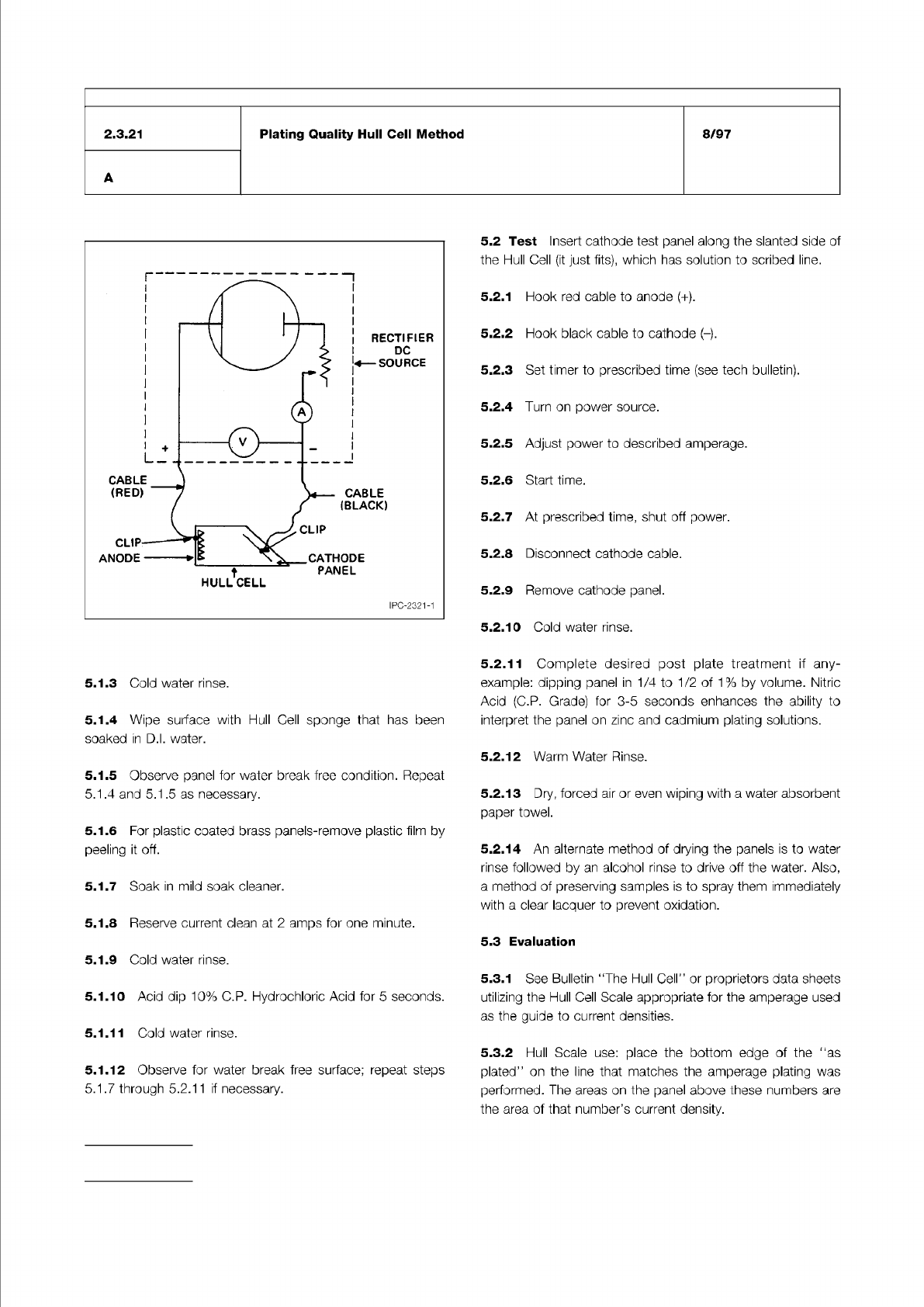
Figure 1 Hull Cell Hook Up
IPC-TM-650
Number
Subject Date
Revision
Page 2 of 3
2.3.21
Plating
Quality
Hull
Cell
Method
8/97
A
5.1.3
Cold
water
rinse.
5.1.4
Wipe
surface
with
Hull
Cell
sponge
that
has
been
soaked
in
D.l.
water.
5.1.5
Observe
panel
for
water
break
free
condition.
Repeat
5.1
.4
and
5.1
.5
as
necessary.
5.1.6
For
plastic
coated
brass
panels-remove
plastic
film
by
peeling
it
off.
5.1.7
Soak
in
mild
soak
cleaner.
5.1.8
Reserve
current
clean
at
2
amps
for
one
minute.
5.1.9
Cold
water
rinse.
5.1.10
Acid
dip
10%
C.P.
Hydrochloric
Acid
for
5
seconds.
5.1.1
1
Cold
water
rinse.
5.1.12
Observe
for
water
break
free
surface;
repeat
steps
5.1
.7
through
5.2.1
1
if
necessary.
5.2
Test
Insert
cathode
test
panel
along
the
slanted
side
of
the
Hull
Cell
(it
just
fits),
which
has
solution
to
scribed
line.
5.2.1
Hook
red
cable
to
anode
(+).
5.2.2
Hook
black
cable
to
cathode
(-).
5.2.3
Set
timer
to
prescribed
time
(see
tech
bulletin).
5.2.4
Turn
on
power
source.
5.2.5
Adjust
power
to
described
amperage.
5.2.6
Start
time.
5.2.7
At
prescribed
time,
shut
off
power.
5.2.8
Disconnect
cathode
cable.
5.2.9
Remove
cathode
panel.
5.2.10
Cold
water
rinse.
5.2.1
1
Complete
desired
post
plate
treatment
if
any-
example:
clipping
panel
in
1
/4
to
1
/2
of
1
%
by
volume.
Nitric
Acid
(C.P.
Grade)
for
3-5
seconds
enhances
the
ability
to
interpret
the
panel
on
zinc
and
cadmium
plating
solutions.
5.2.12
Warm
Water
Rinse.
5.2.13
Dry,
forced
air
or
even
wiping
with
a
water
absorbent
paper
towel.
5.2.14
An
alternate
method
of
drying
the
panels
is
to
water
rinse
followed
by
an
alcohol
rinse
to
drive
off
the
water.
Also,
a
method
of
preserving
samples
is
to
spray
them
immediately
with
a
clear
lacquer
to
prevent
oxidation.
5.3
Evaluation
5.3.1
See
Bulletin
1(The
Hull
Cell"
or
proprietors
data
sheets
utilizing
the
Hull
Cell
Scale
appropriate
for
the
amperage
used
as
the
guide
to
current
densities.
5.3.2
Hull
Scale
use:
place
the
bottom
edge
of
the
(1as
plated"
on
the
line
that
matches
the
amperage
plating
was
performed.
The
areas
on
the
panel
above
these
numbers
are
the
area
of
that
number's
current
density.
NOTE:
NOTE:
IPC-TM-650
Page 3 of 4
Number
2.3.25.1
Revision
Subject
Ionic
Cleanliness
Testing
of
Bare
PWBs
Date
October
2000
Between
measurements,
rinse
the
cell
with
deionized
water
and
leave
the
cell
soaking
in
virgin
extract
solution.
Never
use
a
dry
cell
as
this
is
bad
technique.
5.2.2.4
Using
the
linear
relationship
formed
in
5.2.1
.6,
determine
the
concentration
of
sodium
chloride
correspond¬
ing
to
the
conductivity
reading.
Use
the
equation
given
below
to
determine
the
total
micrograms
of
sodium
chloride
equiva¬
lence
per
square
centimeter
(pg
NaCI
Eq.
/cm2)
Using
the
nomogram:
Conductivity
of
Unknown
一
Concentration
of
Unknown
Concentration
Volume
of
Extract
Solution
(pg/liter)
x
(liter)
Extracted
Surface
Area
(cm2)
二
pg
NaCI
Eq.
/cm2
5.2.2.5
If
the
conductivity
of
the
unknown
solution
is
outside
of
the
bounds
represented
on
the
existing
nomogram,
then
continue
the
technique
used
to
generate
the
nomogram
(see
5.2.1)
until
the
bounds
contain
the
conductivity
of
the
unknown
solution.
5.3
Measurement
-
Static
ROSE
Tester
Method
This
section
was
developed
using
an
Omegameter
600SMD
with
a
1
0,000
mL
cell.
Make
appropriate
changes
to
the
procedure
to
accommodate
other
static
ROSE
testers.
5.3.1
Perform
a
system
verification
check.
5.3.2
Set
the
instrument
to
an
appropriate
amount
of
sol¬
vent
volume.
A
target
solution
level
should
be
1.5
mL
for
one
cm2
of
board
surface.
It
is
not
necessary
to
cover
the
spray
jets
(if
applicable).
If
the
lid
is
on
the
test
cell,
the
C02
mixing
is
minimized.
5.3.3
Enter
the
appropriate
surface
area
into
the
instrument.
5.3.4
To
allow
for
the
volume
of
solvent
that
is
to
be
added,
the
instrument
setup
volume
will
be
set
at
the
minimum
vol¬
ume
(e.g.,
2300
mL)
plus
the
volume
of
solution
in
the
extrac¬
tion
bag
(e.g.,
100
mL).
Dwell
time
or
run
time:
2
minutes
Pass
/
Fail
Value:
None
Begin
the
test
and
follow
the
test
prompts.
Remove
the
cell
cover.
5.3.5
Carefully
open
the
test
bag
and
quickly
pour
the
extract
solution
into
the
test
cell.
To
minimize
CO2
absorption,
the
addition
should
be
made
as
quickly
as
possible
and
the
cell
cover
quickly
replaced.
5.3.6
The
instrument
should
very
quickly
reach
equilibrium
(10-15
seconds)
and
then
should
remain
essentially
unchanged
for
the
remainder
of
the
two
minute
run.
5.3.7
Log
the
reading
in
total
pg
of
sodium
chloride
equiva¬
lence
per
cm2.
5.3.8
Static
ROSE
Calculation
Example:
Testing
a
bare
board,
10
cm
x
20
cm
[3.9
in
x
7.9
in]
Surface
area
is
1
0
cm
x
20
cm
x
2
=
400
cm2
[62
in2]
Bag
size
should
be
about
1
5
cm
x
30
cm
[5.9
in
x
12
in]
or
larger
Extract
solution
would
be
about
620
mL
ROSE
volume
input
to
4620
mL
(4000
mL
to
cover
sprays
and
620
mL
from
extraction)
ROSE
tester
cell
volume
set
to
4000
mL
Run
time
-
2
minutes
5.4
Measurement
-
Dynamic
ROSE
Tester
Method
5.4.1
Perform
a
system
verification
check.
5.4.2
Program
the
instrument
with
the
appropriate
surface
area
of
the
board.
5.4.3
Cycle
the
instrument
to
the
beginning
cleanliness
point.
5.4.4
Carefully
open
the
test
bag
and
quickly
pour
the
extract
solution
into
the
test
cell.
To
minimize
CO2
absorption,
the
addition
should
be
made
as
quickly
as
possible
and
the
cell
cover
quickly
replaced.
5.4.5
When
the
instrument
completes
the
test,
log
the
read¬
ing
in
total
pg
of
sodium
chloride
equivalence
per
cm2.
6
Notes
6.1
The
background
for
this
test
method
may
be
found
in
technical
papers:
11
Rationale
and
Methodology
for
a
Modified
Resistivity
of
Sol¬
vent
Extract
Test
Method/'
Philip
W.
Wittmer,
I
PC
1995
Fall
Meeting
Proceedings,
S13-4.