IPC-TM-650 EN 2022 试验方法--.pdf - 第174页
Caution: No sealant (e.g., stopcock grease, etc.) shall be applied to the mating surfaces of the de siccator cover or bottom. Sealants may cause these to sti ck together , and any method employed to release a stuck cover…
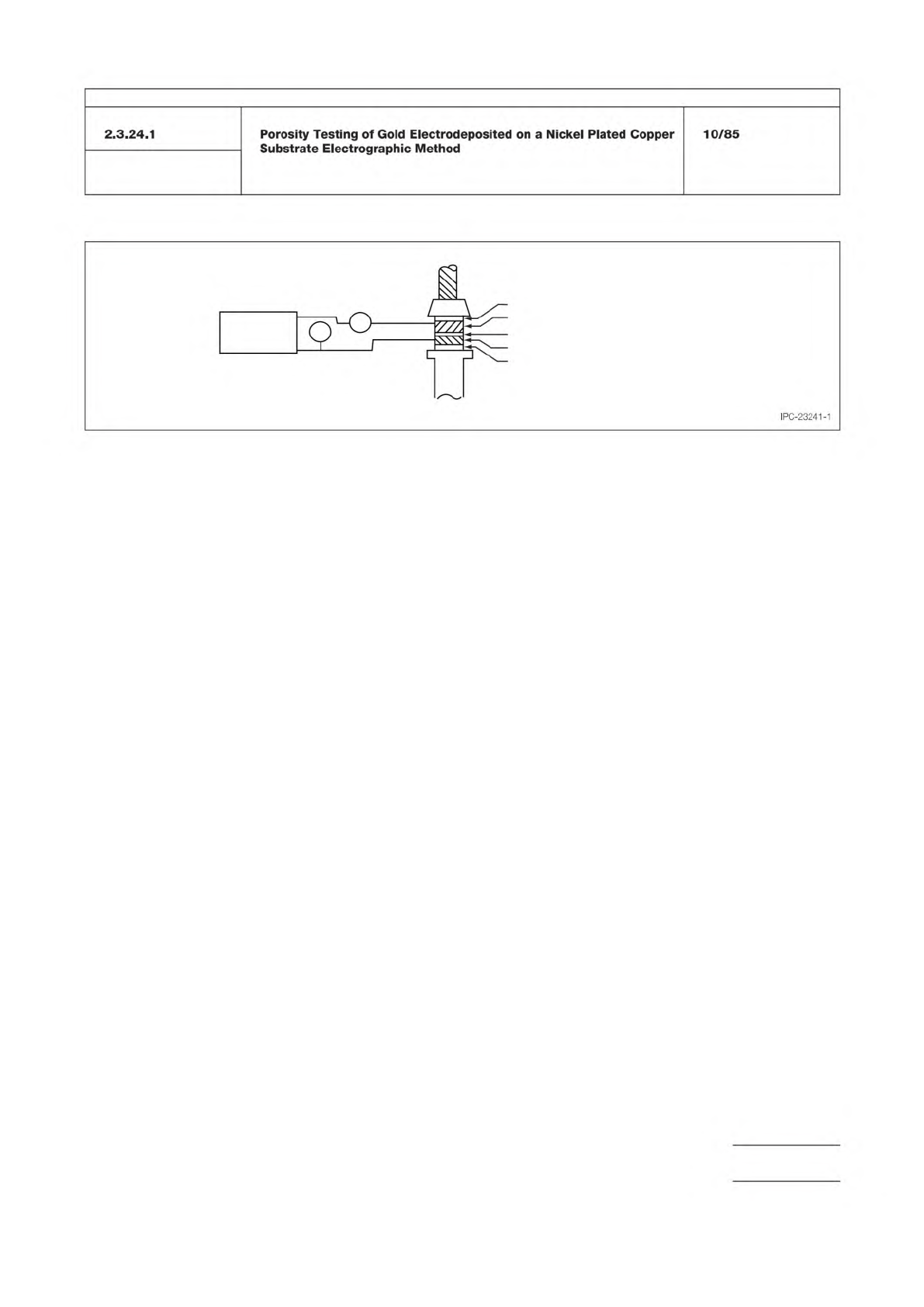
Figure 1 Porosity Test Schematic
mA
VM
Power Supply
o-1 a DC
o-10 V
-
+
-
+
Teflon®
Gold Clad Plate
Photographic Paper, Silver Halide Free
Sample Under Test
Teflon®
IPC-TM-650
Number
Subject Date
Revision
Page 3 of 3
Porosity
Testing
of
Gold
Electrodeposited
on
a
Nickel
Plated
Copper
Substrate
Electrographic
Method
10/85
2.3.24.1
IPC-23241-1
Caution: No sealant (e.g., stopcock grease, etc.) shall be
applied to the mating surfaces of the desiccator cover or
bottom. Sealants may cause these to stick together, and any
method employed to release a stuck cover is likely to be
extremely hazardous.
Caution: Perform all work in hood, since the vapors given off
are toxic. Chemical goggles, completely closing the eyes,
should be worn and eyewash facilities should be readily
available.
Material in this Test Methods Manual was voluntarily established by Technical Committees of the IPC. This material is advisory only
and its use or adaptation is entirely voluntary. IPC disclaims all liability of any kind as to the use, application, or adaptation of this
material. Users are also wholly responsible for protecting themselves against all claims or liabilities for patent infringement.
Equipment referenced is for the convenience of the user and does not imply endorsement by the IPC.
Page 1 of 2
r
ASSOCIATION
CONNECTING
/
ELECTRONICS
INDUSTRIES
221
5
Sanders
Road
Northbrook,
IL
60062-6135
IPC-TM-650
TEST
METHODS
MANUAL
1.0
Outline
for
Methods
The
part
is
exposed
to
an
atmo¬
sphere
that
is
corrosive
to
the
basis
metal.
Where
there
is
porosity,
the
reagent
attacks
the
basis
metal
and
generates
corrosion
products.
The
part
is
examined
for
corrosion
prod¬
ucts.
1.1
Method
1
(Nitric
Acid
Vapor-Gold
on
Copper)
This
method
applies
only
to
gold
coatings
on
copper
and
copper-
base
alloys.
1
.2
Method
2
(Extended
Nitric
Acid
Vapor)
This
method
applies
only
to
gold
coatings
on
copper
and
copper-base
alloys.
1.3
Method
3
(Nitric
Acid
Vapor
-
Gold
on
Nickel)
This
method
applies
to
gold
coatings
on
copper,
copper-base
alloys,
and
nickel.
2
.0
Nitric
Acid
Vapor
-
Gold
on
Copper
2.1
Apparatus
Methods
1
,
2,
and
3.
2.1.1
Collimated
Incandescent
Lamp
No.
31-33-53,
Bausch
and
Lomb
Co.,
or
No.
359,
American
Optical
Co.,
or
equivalent.
2.1.2
Desiccator
(Glass)
Fisher
Scientific
Co.
Series
8-595
or
8-624
or
equivalent.
The
size
of
the
desiccator
shall
be
chosen
so
that
no
more
than
1
64
cm3
of
air
space
exists
for
6.45
cm2
of
nitric
acid
surface
area
when
approximately
301
ml
of
acid
are
placed
in
the
bottom.
2.1.3
Part
Support
A
supporting
structure
made
of
glass
or
other
material
not
attached
by
nitric
acid
vapors
to
hold
the
parts
under
test
in
the
upper
part
of
the
desiccator.
2.1.4
Oven
An
oven
capable
of
drying
parts
at
125℃.
Number
2.3.24.2
Subject
Porosity
of
Metallic
Coatings
on
Copper-Base
Alloys
and
Nickel
(Nitric
Acid
Vapor
Test)
Date
Revision
8/97
A
Originating
Task
Group
N/A
2.1.5
Pressure
Sensitive
Polytetrafluoroethylene
Tape
with
Silicone
Adhesive
Backing
Connecticut
Hard
Rubber
Company
TFE
Type
HM225
or
equivalent.
2.2
Reagents
Methods
1
and
2.
Nitric
Acid,
69,
0
to
71.0
Percent
HN03.
3
.0
Procedure
3.1
Method
1
(Nitric
Acid
Vapor-Gold
on
Copper)
To
minimize
and
tendency
for
the
cover
to
stick,
press
a
mini¬
mum
of
three
strips
of
the
pressure
polytetrafluoroethylene
tape
(adhesive
side
down)
at
equal
intervals
around
the
mat¬
ting
surface
of
the
bottom
of
the
desiccator.
Place
approxi¬
mately
300
ml
of
nitric
acid
in
the
bottom
of
the
desiccator.
Cover
the
desiccator
and
allow
about
30
minutes
for
equilib¬
rium
to
be
established
before
starting
the
test.
This
equilibrium
is
necessary
only
when
the
nitric
acid
is
first
placed
in
the
desiccator.
Clean
the
part
with
1,1,1
-trichloroethane
or
toluene
or
other
suitable
solvent
and
dry
with
filtered
dry
air
(gage
pressure
less
than
207
kPa
(30
psi)).
Inspect
the
cleaned
part
at
10
power
magnification
for
evi¬
dence
or
particulate
matter
of
the
surface.
If
any
remains,
reclean
the
solvent
or
use
a
clean
soft
brush
to
remove
it
prior
to
the
start
of
the
porosity
test.
Place
the
clean
part
on
the
support
so
that
adequate
space
exists
to
allow
circulation
of
acid
vapor
and
air
around
it.
Carefully
remove
the
desiccator
cover,
place
the
support
in
the
desiccator
and
immediately
replace
the
cover
to
prevent
an
excessive
loss
of
vapors
that
would
disrupt
the
equilibrium
previously
established.
The
test
shall
be
performed
at
a
tem¬
perature
of
24
±
3
℃
and
a
maximum
relative
humidity
of
60
percent.
Unless
otherwise
specified,
the
time
of
exposure
to
the
reagent
vapor
shall
be
one
hour.
Caution: Perform all work in a hood,
since vapors given off are toxic. Chemical goggles, com-
pletely enclosing the eyes, should be worn and eye wash
facilities should be readily available.
IPC-TM-650
Page 2 of 2
Number
2.3.24.2
Subject
Porosity
of
Metallic
Coatings
on
Copper-Base
Alloys
and
Nickel
(Nitric
Acid
Vapor
Test)
Date
8/97
Revision
A
Remove
the
part
from
the
desiccator
and
immediately
transfer
it
to
an
oven
at
125℃
for
30
minutes.
Remove
and
inspect
the
part
with
10
power
magnification
using
the
collimated
incandescent
light
source
arranged
so
that
the
light
beam
strikes
the
surface
being
examined
at
an
angle
of
less
than
1
5
degrees.
The
presence
of
blue,
green,
or
bluish-white
protru¬
sions
indicates
that
the
coating
is
discontinuous
(i.e.,
porous,
scratched,
etc.)
at
these
spots.
The
acceptable
number,
sizes,
and
location
of
these
protrusions
shall
be
as
specified
on
the
appropriate
drawing
or
specification.
3.2
Method
2
(Extended
Nitric
Acid
Vapor-Gold
on
Copper)
Procedure
This
method
is
an
extension
of
method
1
and
may
be
used
only
after
the
test
specimen
has
passed
the
requirements
of
the
visual
examination
with
the
collimated
light
source.
The
method
permits
the
determination
of
the
actual
sizes
of
the
larger
pores.
The
inspection
should
be
per¬
formed
as
indicated
below.
After
examining
the
oven-dried
test
specimen
in
accordance
with
Method
1
,
brush
the
corrosion
products
from
the
speci¬
men.
Inspect
the
area
where
the
corrosion
products
appeared
at
a
magnification
that
permits
measurements
of
the
largest
dimensions
of
the
discontinuities
with
reasonable
accuracy.
The
acceptable
distribution
of
pore
sizes
shall
be
as
specified
on
the
appropriate
drawing
or
specification.
3.3
Method
3
(Nitric
Acid
Vapor-Gold
on
Nickel)
3.3.1
Apparatus
The
apparatus
described
in
methods
1
and
2.
3.3.3
Procedure
Use
the
procedure
for
Method
1
up
to
removal
from
nitric
acid
vapors.
At
the
end
of
the
one
hour
exposure
to
the
nitric
acid
vapors,
remove
the
part
from
the
desiccator
and
immediately
dip
it
in
the
1
0
percent
by
weight
sodium
hydroxide
solution
for
25
to
30
seconds
at
room
temperature.
Rinse
the
part
with
water
and
then
dip
it
for
25
to
30
seconds
in
the
polysulfide
reagent
at
room
temperature.
Then
rinse
it
in
water
and
dry
using
fil¬
tered
compressed
air
(gage
pressure
less
than
207
kPa).
Inspect
the
part
at
10
power
magnification.
The
presence
of
black
corrosion
products
is
evidence
of
porosity.
The
accept¬
able
number,
sizes,
and
locations
of
pores
shall
be
as
speci¬
fied
on
the
appropriate
drawing
or
specification.
3.4
Polysulfide
Reagent
Makeup
Dissolve
sodium
sulfide
crystals
in
water
until
solution
is
saturated.
Add
excess
flow¬
ers
of
sulfur
(more
than
250
grams
per
1000
ml).
Stir
and
allow
solution
to
stand
24
hours.
Filter
and
dilute
with
water
to
a
specific
gravity
of
1
.142
at
room
temperature
as
defined
in
ASTM
Designation
E
41
.
The
solution
should
be
a
red-orange
color.
To
check
reagent
effectiveness,
dip
a
clean
copper
or
high
(more
than
95
percent)
copper
alloy
specimen
into
the
reagent
at
room
temperature
as
defined
in
ASTM
Designation
E
41
.
It
shall
blacken
within
1
0
seconds.
3.3.2
Reagents
Nitric
acid,
69.0
to
71
.0
percent
HN03.
Sodium
Hydroxide
10
percent
by
weight
solution.
Polysulfide
reagent.