IPC-TM-650 EN 2022 试验方法--.pdf - 第185页
1 Scope This test p rocedure is designed t o m easure the lev el of ext ract abl e ion ic co nta minat ion on the su rface of printed boards and printed board assemblies by i on chroma- tography. 2 Applicable Documents M…
IPC-TM-650
Page 4 of 4
Number
2.3.25.1
Subject
Ionic
Cleanliness
Testing
of
Bare
PWBs
Date
October
2000
Revision
“Ionic
Cleanliness
of
LPISM
Circuit
Boards,"
Hank
Sanftle-
ben,
IPO
1995
Fall
Meeting
Proceedings,
S13-3.
6.2
IPC-HDBK-001
"Handbook
and
Guide
to
the
Require¬
ments
for
Soldered
Electrical
and
Electronic
Assemblies
to
Supplement
ANSI/J-STD-001
"
is
another
source
for
under¬
standing
ROSE
testing
in
general.
6.3
This
method
may
also
be
known
as
the
modified-ROSE
test.
This
test,
due
to
its
longer
extraction
time
and
higher
extraction
temperature,
has
demonstrated
better
correlation
with
the
total
ion
determination
by
ion
chromatography
than
IPC-TM-650,
Test
Method
2.3.25,
Detection
and
Measure¬
ment
of
Ionizable
Surface
Contaminants
by
Resistivity
of
Sol¬
vent
Extract
(ROSE)
Method.
However,
as
a
bulk
contamina¬
tion
measurement
method,
it
cannot
distinguish
individual
ion
species.
6.4
From
an
analytical
standpoint,
the
dip
probe
method
is
preferred
as
more
repeatable
than
the
automated
ROSE
testers
and
avoids
many
of
the
test
inaccuracies
(e.g.,
C02
absorption
from
spray
agitation)
inherent
in
those
instruments.
It
should
be
stressed
that
the
dip
probe
method
is
an
electro¬
lytic
conductivity
measurement
and
must
be
temperature-
compensated.
6.5
The
dip
probe
calibrations
can
be
run
at
multiple
tem¬
peratures
and
a
family
of
curves
generated,
widening
the
test
window
for
use
with
this
method.
Higher
temperatures,
how¬
ever,
will
lead
to
a
faster
2-propanol
evaporation
rate.
The
test
can
also
be
run
with
more
dilute
concentrations,
prepared
by
series
dilution.
6.6
Conductivity
cells
have
a
“constant”
value.
Measured
readings
must
be
multiplied
by
this
constant.
Exposure
to
harsh
chemicals
may
alter
the
constant,
making
a
re-calibration
necessary.
Do
not
allow
the
probe
used
for
this
procedure
to
contact
sticky,
oily,
or
resinous
liquids
(e.g.,
flux).
6.7
This
procedure
is
intended
to
be
a
process
control
aid
and
as
such,
no
pass-fail
criteria
is
stated.
It
is
expected
that
the
fabricator/assembler
will
determine,
with
their
customer,
the
necessary
pass-fail
criteria
for
their
product
by
this
method.
6.8
This
method
is
best
suited
for
monitoring
and
control
of
a
previously
optimized
process
and
should
not
be
used
to
generate
acceptance
data
unless
part
of
a
larger
correlation
study.
Values
generated
with
this
method
should
be
corre¬
lated
to
acceptable
electrical
performance
if
used
for
accep¬
tance.
6.9
Kapak™
500
Series
Bags
can
be
obtained
from:
Kapak
Corporation
5305
Parkdale
Drive
Minneapolis,
MN
55416
800-527-2557
www.kapak.com
A
secondary
source
of
Kapak™
or
Scotchpak™
polyester
bags
or
pouches
can
be
obtained
from:
VWR
International
1310
Goshen
Parkway
West
Chester,
PA
1
9380
Orders:
1-800-932-5000
Web
Orders:
www.vwrsp.com
If
an
alternative
to
the
Kapak™
bag
or
Scotchpak™
is
desired,
the
bag
must
have
the
following
characteristics:
•
No
extractable
ionic
material
in
75%
2-propanol
/
25%
DI
water
at
80℃
[1
76°F]
for
60
minutes
•
0.01
cm
[0.0039
in]
wall
thickness
minimum
•
Heat
sealable
or
mechanical
seal
6.10
There
is
some
concern
regarding
ROSE
tester
cell
size.
Testing
a
2
cm
x
2
cm
[0.79
in
x
0.79
in]
board
in
a
20,000
mL
cell
causes
such
a
severe
dilution
as
to
cause
the
signal
to
be
lost
in
the
noise.
A
recommended
cell
size
is
5000
mL
or
less.
Smaller
cell
volumes
will
allow
for
a
more
measurable
result.
If
a
smaller
cell,
or
running
with
a
smaller
test
volume,
are
not
an
option,
then
the
number
of
bare
boards
can
be
increased,
all
extracted
separately,
and
the
extract
solutions
all
tested
at
once.
6.1
1
When
testing
hybrids
or
microelectronics,
be
aware
that
2-propanol
stored
in
glass
containers
can
leach
out
materials
such
as
sodium,
borates,
and
silica.
2-propanol
stored
in
plastic
containers
does
not
have
such
a
leaching
problem.
1 Scope
This test procedure is designed to measure the
level of extractable ionic contamination on the surface of
printed boards and printed board assemblies by ion chroma-
tography.
2 Applicable Documents
Measurement of Extractable/Leachable
Anion Contamination Levels on Drive Components by Ion
Chromatography (IC)
Cleaning and Cleanliness Test Program, Phase
III, Water Soluble Fluxes, Part 1: B-24, lnteractions of Water
Soluble Fluxes with Metal/Substrates
Cleaning and Cleanliness Test Program, Phase
III, Water Soluble Fluxes, Part 2: B-36, Comparison to Phase
1 Rosin Benchmark
An In-Depth Look at Ionic Cleanliness Testing
Users Guide for Cleanliness of Unpopulated
Printed Boards
‘‘Setting Up Ion Chromatography Capability’’
3 Test Specimens
3.1
Printed board and/or printed board assembly for extrac-
tion
4 Apparatus and Material
4.1
Ion Chromatograph capable of accurately measuring ion
concentrations down to 0.5 parts per million (ppm). The
equipment and chemistry should be set up and standardized
per the manufacturer’s instructions. The separation column
and eluent composition should be chosen to provide baseline
resolution between the ions of interest.
4.2
Hot water bath capable of maintaining 80 ± 2 °C [176 ±
3.6 °F].
4.3
Clean extraction vessels.
4.4
Clean labware (Ionic free).
4.5
Cleanroom vinyl gloves. (<3 ppm of Cl).
4.6
Deionized water with a resistivity of at least 18.0
megohm-centimeter.
4.7
IC or ACS grade chemicals for eluent and regenerant
preparation.
4.8
National standard - traceable calibration standards (e.g.,
NIST traceable).
4.9
Volumetric Flasks (Typically 25, 50, 100, and 1000ml).
4.10
Precision Pipetting Equipment (such as Eppendorf).
5 Test Procedures
5.1 Extraction Procedure
Select a low-ion extraction bag
sized to fit the board with approximately 2.5 cm [1.0 in]
excess on each side to minimize required extract solution,
with several inches at the top to allow for air expansion when
the bag is heated.
See for an IPC-
TM-650 Equipment Vendor Listing for possible vendors.
5.1.1
Use clean gloves and or tongs when handling the
samples to be tested. Place each sample in an extraction bag.
5.1.2
Prepare a 75/25 (± 5%) v/v 2-propanol/H
2
0 solution
for the extraction.
A tolerance was added to the IC method because it is
a more specific and accurate method by comparison to the
ROSE method.
5.1.3
Add a known volume of the extraction solution to
the extraction bag covering the sample (approximately
0.5 mL/cm
2
of surface area).
5.1.4
Add the same volume of extraction solution to an
empty bag of the same lot for use as a blank.
5.1.5
Suspend the bags in the 80 ± 2°C [176 ± 3.6°F] water
bath allowing the water to force most of the air from the bags.
Do not allow any of the water from the water bath into the
extract solution in the bags. Fold the top of the bags over the
suspending bar and clip in place with binder clips. This will
3000 Lakeside Drive, Suite 309S
Bannockburn, IL 60015-1249
IPC-TM-650
TEST METHODS MANUAL
Number
2.3.28
Subject
Ionic Analysis of Circuit Boards, Ion
Chromatography Method
Date
11/12
Revision
B
Originating Task Group
Ionic Conductivity / Ion Chromatography Task
Group (5-32a)
Association
Connecting
Electronics
Industries
IDEMA
M13-99
IPC-TP-1043
IPC-TP-1044
IPC-TR-583
IPC-5701
IPC-WP-008
Note:
www.ipc.org/html/testmethods.htrn
Note:
Material
/n
this
Test
Methods
Manual
was
voluntarily
established
by
Technical
Committees
of
I
PC.
This
material
/s
advisory
only
and
"s
use
or
adaptation
,
s
entirely
voluntary.
IPC
disclaims
all
liability
of
any
kind
as
to
the
use,
application,
or
adaptation
of
this
material.
Users
are
also
wholly
responsible
for
protecting
themselves
against
all
claims
or
liabilities
for
patent
infringement.
Equipment
referenced
/s
for
the
convenience
of
the
user
and
does
not
imply
endorsement
by
IPC.
Page
1
of
3
IPC-TM-650
Number
Subject Date
Revision
Page 2 of 3
2.3.36
Acid
Acceptance
of
Chlorinated
Solvents
10/85
5.2.2.3
Dilute
solution
to
exactly
1
liter
and
stopper.
See
6.3
for
safety
and
handling
information
and
6.4
for
first
aid
infor¬
mation.
5.3
Test
Procedure
5.3.1
Measure
specific
gravity
of
sample
using
ASTM
Method
D
2111-95.
5.3.2
Bulb
pipet
exactly
25
ml
sample
into
a
250
ml
Erlen-
meyer
flask.
5.3.3
Bulb
pipet
exactly
25
ml
hydrochlorination
reagent
into
sample,
stopper,
then
mix
thoroughly.
5.3.4
Let
sit
15
to
20
minutes
for
complete
reaction.
During
reaction
time,
a
blank
may
be
run
(see
5.3).
5.3.5
When
reaction
time
is
complete,
add
five
drops
of
bro¬
mothymol
blue
0.1
%
solution
with
an
eye
dropper.
5.3.6
Titrate
the
sample
to
endpoint
with
0.1
N
NaOH
solu¬
tion.
The
endpoint
is
reached
when
solution
color
changes
from
yellow
to
blue.
5.4
Blank
5.4.1
Bulb
pipet
exactly
25
ml
hydrochlorination
reagent
into
a
250
ml
Erlenmeyer
flask.
5.4.2
Add
five
drops
bromothymol
blue
0.1
%
solution
with
an
eye
dropper.
5.4.3
Titrate
blank
to
endpoint
with
0.1
N
NaOH
solution.
The
endpoint
is
reached
when
solution
color
changes
from
yellow
to
blue.
5.5
Disposal
of
Solutions
5.5.1
0.1
N
NaOH
in
Methanol,
Unused
This
solution
is
dilute
and
readily
soluble
in
water,
hence
it
can
be
safely
poured
down
the
sink.
Flush
with
excess
water.
5.5.2
All
Other
Solutions
DO
NOT
POUR
DOWN
THE
SINK.
Place
the
solutions
in
appropriate,
labeled,
metal
con¬
tainers
to
be
buried
or
burned
in
accordance
with
local,
state,
and
federal
regulations.
5.6
Cleaning
Glassware
Use
soap
and
water
to
clean
any
glassware.
Rinse
well
with
excess
water.
5«7
Safety
and
Handling,
First
Aid
See
6.3
and
6.4.
6
Notes
6.1
Calculations:
(B-A)
x
0.4
ml
sample
x
specific
gravity
(1)
=
Total
Acid
Acceptance
as
%
of
NaOH
where:
A
=
ml
of
0.1
N
NaOH
used
to
titrate
sample
B
=
ml
of
0.1
N
NaOH
used
to
titrate
blank
(1)
See
sale
specification
for
specific
gravity
of
solvent
choice.
6.2
Interpreting
Test
Results*
*
Note:
These
guidelines
have
been
established
using
inhibited
chlorinated
solvents
from
the
Dow
Chemical
Company.
The
solvent
manufacturer
should
be
consulted
for
particular
inter¬
pretation.
Solvent
is
Borderline
A)
Discard
Chlorinated
Solvent
Within
Normal
Check
Daily
B)
Remove,
distill
blend
Range
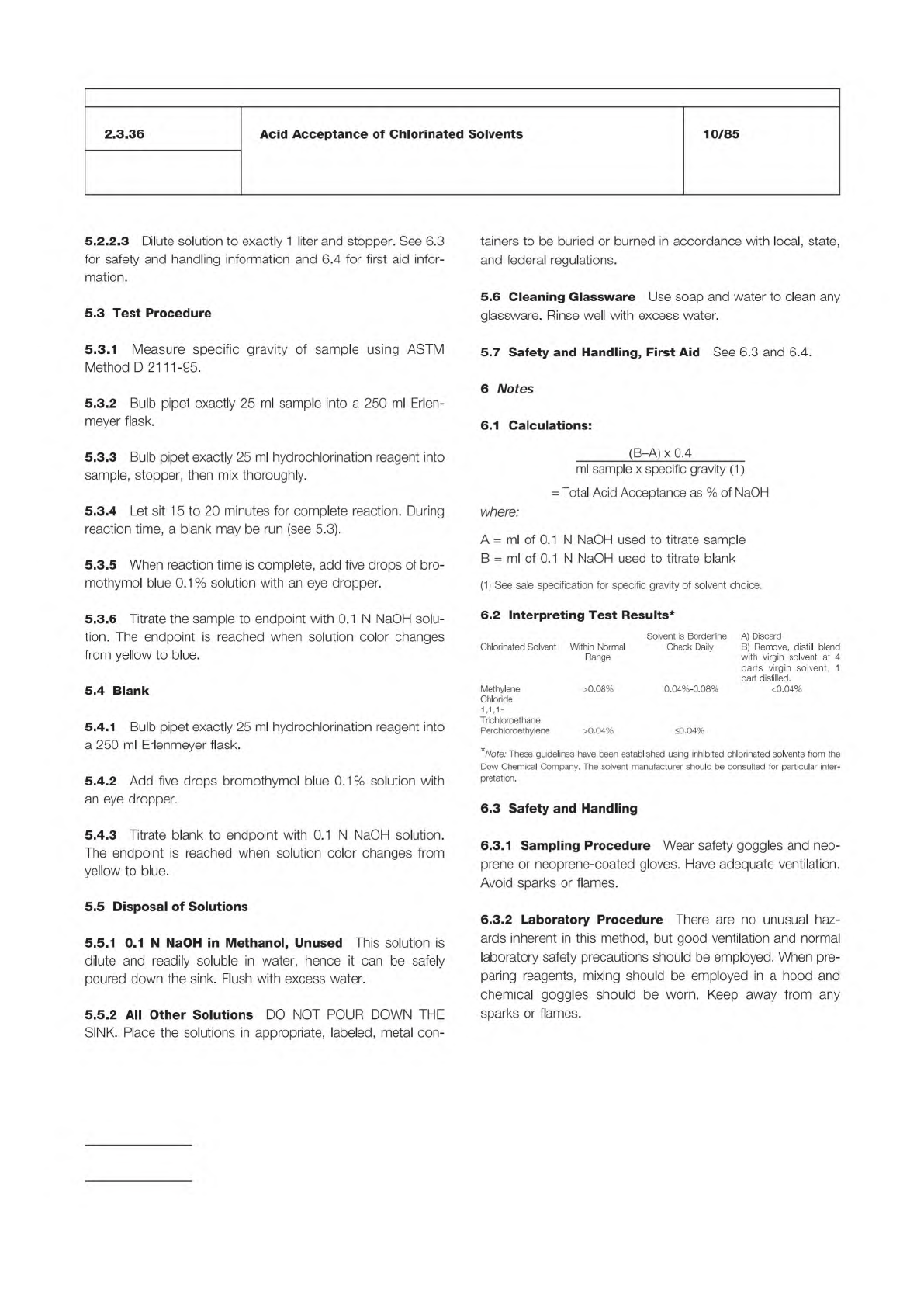
Methylene
>0.08%
Chloride
1,1,1-
Trichloroethane
Perchloroethylene
>0.04%
0.04%-0.08%
©04%
with
virgin
solvent
at
4
parts
virgin
solvent,
1
part
distilled.
<0.04%
6.3
Safety
and
Handling
6.3.1
Sampling
Procedure
Wear
safety
goggles
and
neo¬
prene
or
neoprene-coated
gloves.
Have
adequate
ventilation.
Avoid
sparks
or
flames.
6.3.2
Laboratory
Procedure
There
are
no
unusual
haz¬
ards
inherent
in
this
method,
but
good
ventilation
and
normal
laboratory
safety
precautions
should
be
employed.
When
pre¬
paring
reagents,
mixing
should
be
employed
in
a
hood
and
chemical
goggles
should
be
worn.
Keep
away
from
any
sparks
or
flames.