IPC-TM-650 EN 2022 试验方法--.pdf - 第186页
IPC-TM-650 Number Subject Date Revision Page 2 of 3 2.3.36 Acid Acceptance of Chlorinated Solvents 10/85 5.2.2.3 Dilute solution to exactly 1 liter and stopper. See 6.3 for safety and handling information and 6.4 for fir…
1 Scope
This test procedure is designed to measure the
level of extractable ionic contamination on the surface of
printed boards and printed board assemblies by ion chroma-
tography.
2 Applicable Documents
Measurement of Extractable/Leachable
Anion Contamination Levels on Drive Components by Ion
Chromatography (IC)
Cleaning and Cleanliness Test Program, Phase
III, Water Soluble Fluxes, Part 1: B-24, lnteractions of Water
Soluble Fluxes with Metal/Substrates
Cleaning and Cleanliness Test Program, Phase
III, Water Soluble Fluxes, Part 2: B-36, Comparison to Phase
1 Rosin Benchmark
An In-Depth Look at Ionic Cleanliness Testing
Users Guide for Cleanliness of Unpopulated
Printed Boards
‘‘Setting Up Ion Chromatography Capability’’
3 Test Specimens
3.1
Printed board and/or printed board assembly for extrac-
tion
4 Apparatus and Material
4.1
Ion Chromatograph capable of accurately measuring ion
concentrations down to 0.5 parts per million (ppm). The
equipment and chemistry should be set up and standardized
per the manufacturer’s instructions. The separation column
and eluent composition should be chosen to provide baseline
resolution between the ions of interest.
4.2
Hot water bath capable of maintaining 80 ± 2 °C [176 ±
3.6 °F].
4.3
Clean extraction vessels.
4.4
Clean labware (Ionic free).
4.5
Cleanroom vinyl gloves. (<3 ppm of Cl).
4.6
Deionized water with a resistivity of at least 18.0
megohm-centimeter.
4.7
IC or ACS grade chemicals for eluent and regenerant
preparation.
4.8
National standard - traceable calibration standards (e.g.,
NIST traceable).
4.9
Volumetric Flasks (Typically 25, 50, 100, and 1000ml).
4.10
Precision Pipetting Equipment (such as Eppendorf).
5 Test Procedures
5.1 Extraction Procedure
Select a low-ion extraction bag
sized to fit the board with approximately 2.5 cm [1.0 in]
excess on each side to minimize required extract solution,
with several inches at the top to allow for air expansion when
the bag is heated.
See for an IPC-
TM-650 Equipment Vendor Listing for possible vendors.
5.1.1
Use clean gloves and or tongs when handling the
samples to be tested. Place each sample in an extraction bag.
5.1.2
Prepare a 75/25 (± 5%) v/v 2-propanol/H
2
0 solution
for the extraction.
A tolerance was added to the IC method because it is
a more specific and accurate method by comparison to the
ROSE method.
5.1.3
Add a known volume of the extraction solution to
the extraction bag covering the sample (approximately
0.5 mL/cm
2
of surface area).
5.1.4
Add the same volume of extraction solution to an
empty bag of the same lot for use as a blank.
5.1.5
Suspend the bags in the 80 ± 2°C [176 ± 3.6°F] water
bath allowing the water to force most of the air from the bags.
Do not allow any of the water from the water bath into the
extract solution in the bags. Fold the top of the bags over the
suspending bar and clip in place with binder clips. This will
3000 Lakeside Drive, Suite 309S
Bannockburn, IL 60015-1249
IPC-TM-650
TEST METHODS MANUAL
Number
2.3.28
Subject
Ionic Analysis of Circuit Boards, Ion
Chromatography Method
Date
11/12
Revision
B
Originating Task Group
Ionic Conductivity / Ion Chromatography Task
Group (5-32a)
Association
Connecting
Electronics
Industries
IDEMA
M13-99
IPC-TP-1043
IPC-TP-1044
IPC-TR-583
IPC-5701
IPC-WP-008
Note:
www.ipc.org/html/testmethods.htrn
Note:
Material
/n
this
Test
Methods
Manual
was
voluntarily
established
by
Technical
Committees
of
I
PC.
This
material
/s
advisory
only
and
"s
use
or
adaptation
,
s
entirely
voluntary.
IPC
disclaims
all
liability
of
any
kind
as
to
the
use,
application,
or
adaptation
of
this
material.
Users
are
also
wholly
responsible
for
protecting
themselves
against
all
claims
or
liabilities
for
patent
infringement.
Equipment
referenced
/s
for
the
convenience
of
the
user
and
does
not
imply
endorsement
by
IPC.
Page
1
of
3
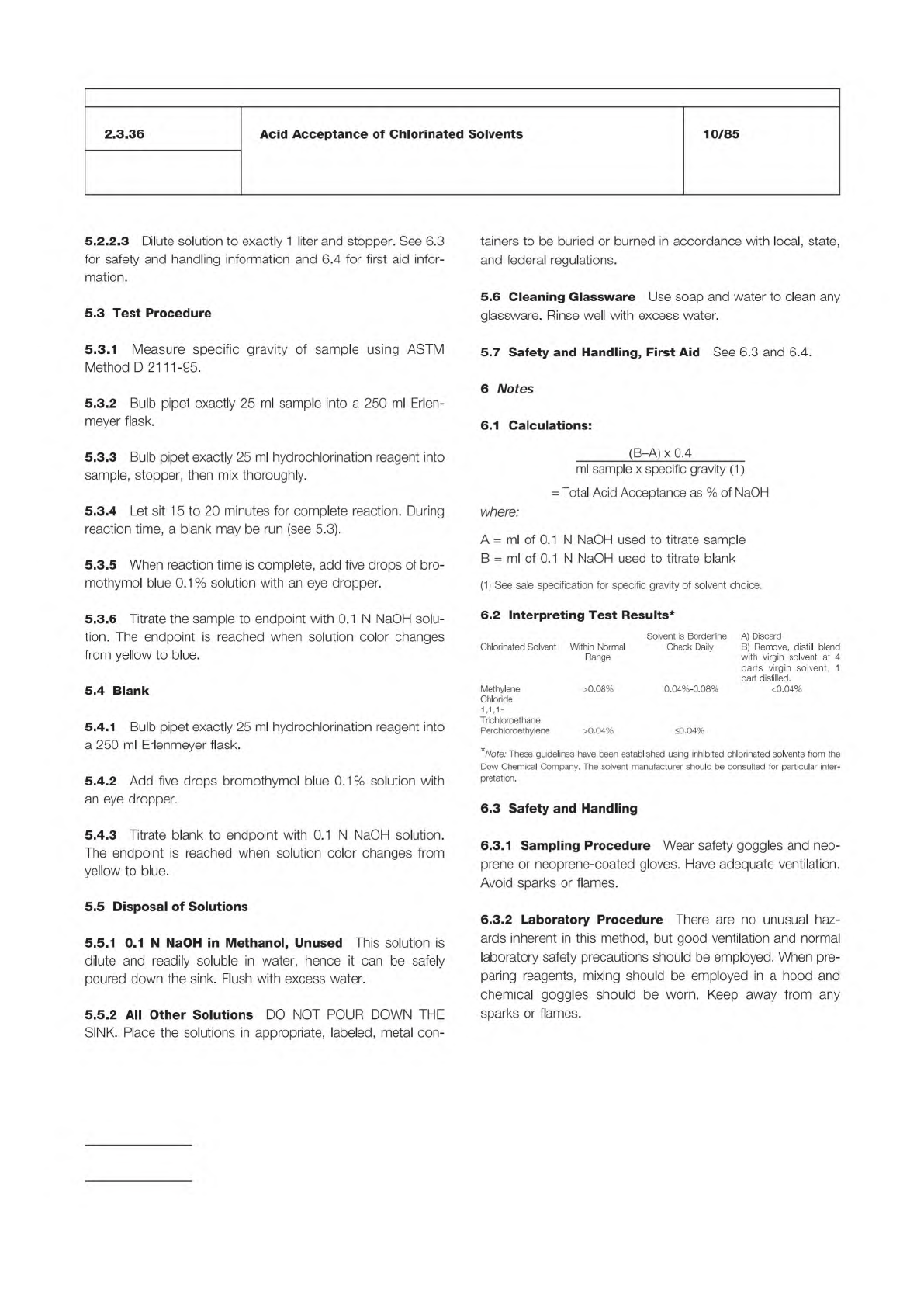
IPC-TM-650
Number
Subject Date
Revision
Page 2 of 3
2.3.36
Acid
Acceptance
of
Chlorinated
Solvents
10/85
5.2.2.3
Dilute
solution
to
exactly
1
liter
and
stopper.
See
6.3
for
safety
and
handling
information
and
6.4
for
first
aid
infor¬
mation.
5.3
Test
Procedure
5.3.1
Measure
specific
gravity
of
sample
using
ASTM
Method
D
2111-95.
5.3.2
Bulb
pipet
exactly
25
ml
sample
into
a
250
ml
Erlen-
meyer
flask.
5.3.3
Bulb
pipet
exactly
25
ml
hydrochlorination
reagent
into
sample,
stopper,
then
mix
thoroughly.
5.3.4
Let
sit
15
to
20
minutes
for
complete
reaction.
During
reaction
time,
a
blank
may
be
run
(see
5.3).
5.3.5
When
reaction
time
is
complete,
add
five
drops
of
bro¬
mothymol
blue
0.1
%
solution
with
an
eye
dropper.
5.3.6
Titrate
the
sample
to
endpoint
with
0.1
N
NaOH
solu¬
tion.
The
endpoint
is
reached
when
solution
color
changes
from
yellow
to
blue.
5.4
Blank
5.4.1
Bulb
pipet
exactly
25
ml
hydrochlorination
reagent
into
a
250
ml
Erlenmeyer
flask.
5.4.2
Add
five
drops
bromothymol
blue
0.1
%
solution
with
an
eye
dropper.
5.4.3
Titrate
blank
to
endpoint
with
0.1
N
NaOH
solution.
The
endpoint
is
reached
when
solution
color
changes
from
yellow
to
blue.
5.5
Disposal
of
Solutions
5.5.1
0.1
N
NaOH
in
Methanol,
Unused
This
solution
is
dilute
and
readily
soluble
in
water,
hence
it
can
be
safely
poured
down
the
sink.
Flush
with
excess
water.
5.5.2
All
Other
Solutions
DO
NOT
POUR
DOWN
THE
SINK.
Place
the
solutions
in
appropriate,
labeled,
metal
con¬
tainers
to
be
buried
or
burned
in
accordance
with
local,
state,
and
federal
regulations.
5.6
Cleaning
Glassware
Use
soap
and
water
to
clean
any
glassware.
Rinse
well
with
excess
water.
5«7
Safety
and
Handling,
First
Aid
See
6.3
and
6.4.
6
Notes
6.1
Calculations:
(B-A)
x
0.4
ml
sample
x
specific
gravity
(1)
=
Total
Acid
Acceptance
as
%
of
NaOH
where:
A
=
ml
of
0.1
N
NaOH
used
to
titrate
sample
B
=
ml
of
0.1
N
NaOH
used
to
titrate
blank
(1)
See
sale
specification
for
specific
gravity
of
solvent
choice.
6.2
Interpreting
Test
Results*
*
Note:
These
guidelines
have
been
established
using
inhibited
chlorinated
solvents
from
the
Dow
Chemical
Company.
The
solvent
manufacturer
should
be
consulted
for
particular
inter¬
pretation.
Solvent
is
Borderline
A)
Discard
Chlorinated
Solvent
Within
Normal
Check
Daily
B)
Remove,
distill
blend
Range
Methylene
>0.08%
Chloride
1,1,1-
Trichloroethane
Perchloroethylene
>0.04%
0.04%-0.08%
©04%
with
virgin
solvent
at
4
parts
virgin
solvent,
1
part
distilled.
<0.04%
6.3
Safety
and
Handling
6.3.1
Sampling
Procedure
Wear
safety
goggles
and
neo¬
prene
or
neoprene-coated
gloves.
Have
adequate
ventilation.
Avoid
sparks
or
flames.
6.3.2
Laboratory
Procedure
There
are
no
unusual
haz¬
ards
inherent
in
this
method,
but
good
ventilation
and
normal
laboratory
safety
precautions
should
be
employed.
When
pre¬
paring
reagents,
mixing
should
be
employed
in
a
hood
and
chemical
goggles
should
be
worn.
Keep
away
from
any
sparks
or
flames.
IPC-TM-650
Number
Subject Date
Revision
Page 3 of 3
2.3.36
Acid
Acceptance
of
Chlorinated
Solvents
10/85
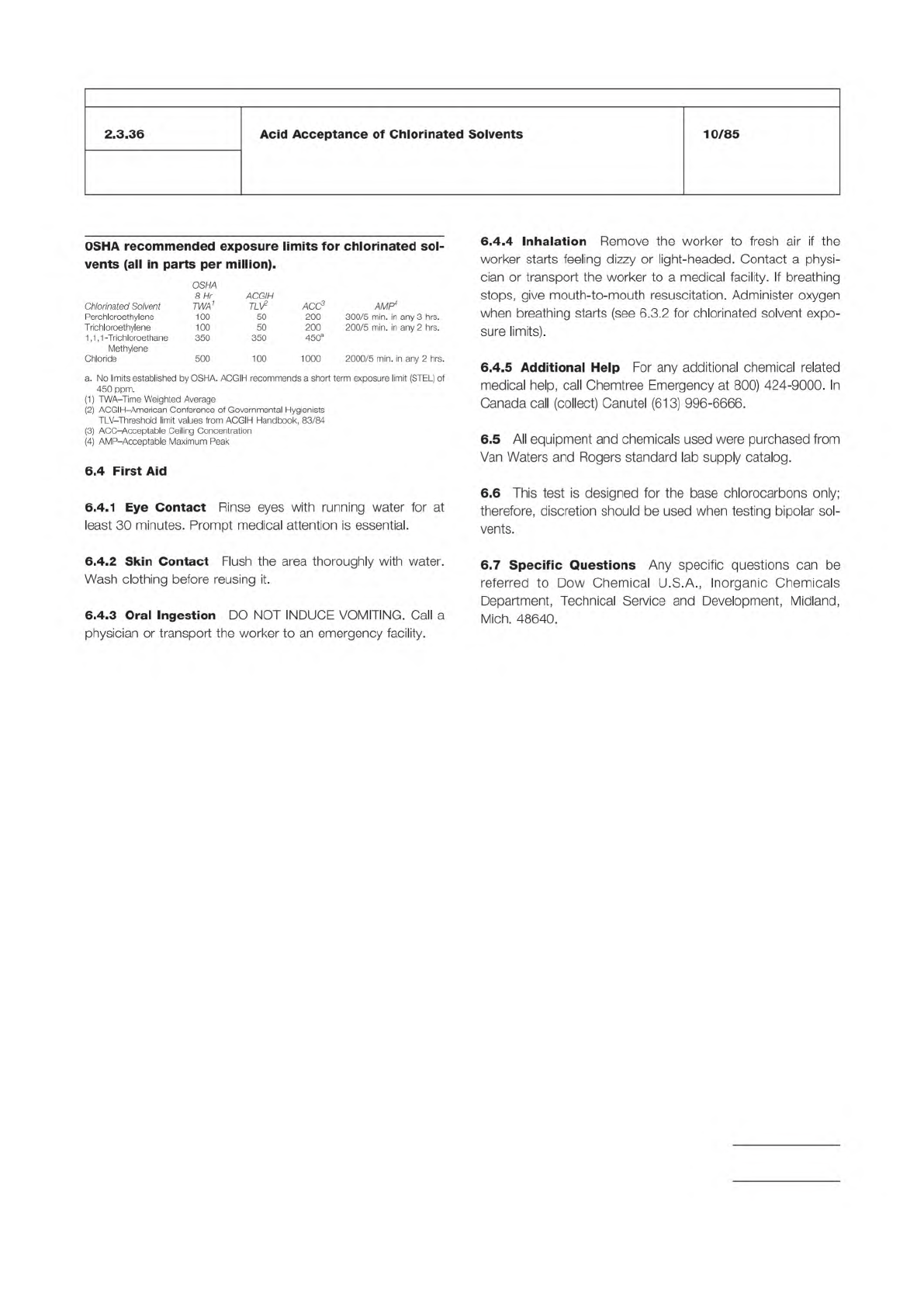
OSHA
recommended
exposure
limits
for
chlorinated
sol
vents
(all
in
parts
per
million).
OSHA
8
Hr
ACGIH
Chlorinated
Solvent
TWA1
TLV2
ACC3
AMP4
Perchloroethylene
100
50
200
300/5
min.
in
any
3
hrs.
Trichloroethylene
100
50
200
200/5
min.
in
any
2
hrs.
1,1,1
-Trichloroethane
350 350
450a
Methylene
Chloride
500
100
1000
2000/5
min.
in
any
2
hrs.
a.
No
limits
established
by
OSHA.
ACGIH
recommends
a
short
term
exposure
limit
(STEL)
of
450
ppm.
TWA-Time
Weighted
Average
ACGIH-American
Conference
of
Governmental
Hygienists
TLV-Threshold
limit
values
from
ACGIH
Handbook,
83/84
(3)
ACC-Acceptable
Ceiling
Concentration
AMP-Acceptable
Maximum
Peak
6.4
First
Aid
6.4.1
Eye
Contact
Rinse
eyes
with
running
water
for
at
least
30
minutes.
Prompt
medical
attention
is
essential.
6.4.2
Skin
Contact
Flush
the
area
thoroughly
with
water.
Wash
clothing
before
reusing
it.
6.4.3
Oral
Ingestion
DO
NOT
INDUCE
VOMITING.
Call
a
physician
or
transport
the
worker
to
an
emergency
facility.
6.4.4
Inhalation
Remove
the
worker
to
fresh
air
if
the
worker
starts
feeling
dizzy
or
light-headed.
Contact
a
physi¬
cian
or
transport
the
worker
to
a
medical
facility.
If
breathing
stops,
give
mouth-to-mouth
resuscitation.
Administer
oxygen
when
breathing
starts
(see
6.3.2
for
chlorinated
solvent
expo¬
sure
limits).
6.4.5
Additional
Help
For
any
additional
chemical
related
medical
help,
call
Chemtree
Emergency
at
800)
424-9000.
In
Canada
call
(collect)
Canutel
(613)
996-6666.
6.5
All
equipment
and
chemicals
used
were
purchased
from
Van
Waters
and
Rogers
standard
lab
supply
catalog.
6.6
This
test
is
designed
for
the
base
chlorocarbons
only;
therefore,
discretion
should
be
used
when
testing
bipolar
sol¬
vents.
6.7
Specific
Questions
Any
specific
questions
can
be
referred
to
Dow
Chemical
U.S.A.,
Inorganic
Chemicals
Department,
Technical
Service
and
Development,
Midland,
Mich.
48640.