IPC-TM-650 EN 2022 试验方法--.pdf - 第194页
Material in this T est M ethods Manual was voluntarily establis hed by T echni cal Committees of IPC. Thi s mat erial is a dvisory only and its use or adaptation is entirely voluntary . IPC disclaims all lia bility of an…
5.2.6.3
Standard 3: (0.2 ppm lithium, 2.0 ppm sodium,
ammonium, potassium, magnesium, and calcium) Pipet 1 ml
of the combination stock standard solution to a 25 ml volu-
metric flask and dilute to volume with 10% 2-propanol / 90%
deionized water and mix well. Prepare fresh daily.
5.2.7
Run a minimum 3 point calibration per the chromato-
graph manufacturer’s recommended methods for both anions
and cations, verifying correct standard concentrations have
been entered into the method.
5.2.8
Adjust the baselines and update the calibration as
required to obtain a good calibration curve. The correlation
factor (R
2
) for the curves should be a minimum of 0.98, with
higher values desirable. Any point on the calibration curve
should not deviate from the expected value by more than ±
10%.
The organic acids standards will typically not form a lin-
ear calibration and a quadratic curve may be required.
5.3 Analytical Procedure
5.3.1
The analysis of the extract solution should be done as
soon as possible after extraction, but
be no longer than
four days from the extraction date.
5.3.2
Start the chromatograph per the manufacturers rec-
ommended method and allow it to come to a stable baseline.
5.3.3
Analyze sample solutions for anion and cation content,
utilizing best analytical technique and laboratory practices.
5.4 Calculation of Results
5.4.1
Values from the chromatograms are typically reported
in parts per million (ppm).
5.4.2 Surface Area Calculation
Record the surface area
of printed board (length x width x 2), e.g., a rectangular
printed board with no cutouts. Alternatively, the surface area
of the printed board can be determined from CAD software or
other machine vision recognition system. Surface area should
be known to three significant figures.
5.4.3
Results are to be expressed as micrograms (µg) of ion
per square centimeter based on the extraction volume and the
calculated sample surface area.
µg/cm
2
=
(SC − BL) x Vol
Area
where:
SC = ppm from IC (µg/mL)
BL = PPM from the bag blank
Vol = final volume (ml)
Area = surface area (cm
2
)
‘‘ppm’’ value is actually specimen value minus blank
value.
5.4.4
Report all ions quantified.
6 Notes
A repeatable and reproducible ionic cleanliness evaluation
method requires some level of skill in accurately running an ion
chromatography unit. The reader may find IPC-WP-008 to be
of use.
Number
2.3.28.2
Subject
Bare Printed Board Cleanliness by Ion Chromatography
Date
12/2009
Revision
IPC-TM-650
Note:
shall
Note:
Page
3
of
3
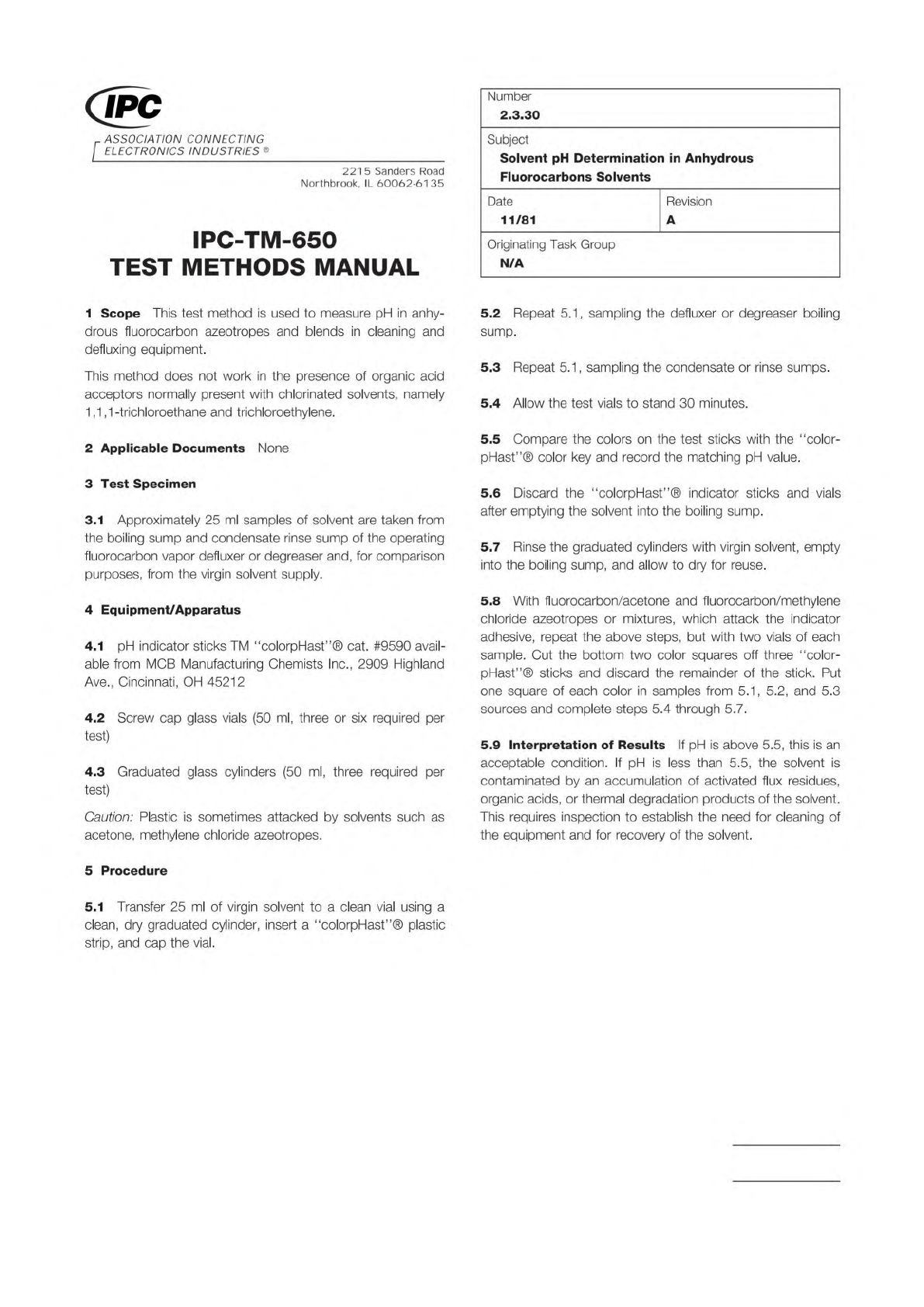
Material in this Test Methods Manual was voluntarily established by Technical Committees of IPC. This material is advisory only
and its use or adaptation is entirely voluntary. IPC disclaims all liability of any kind as to the use, application, or adaptation of this
material. Users are also wholly responsible for protecting themselves against all claims or liabilities for patent infringement.
Equipment referenced is for the convenience of the user and does not imply endorsement by IPC.
Page 1 of 1
r
ASSOCIATION
CONNECTING
/
ELECTRONICS
INDUSTRIES
®
221
5
Sanders
Road
Northbrook,
IL
60062-6135
IPC-TM-650
TEST
METHODS
MANUAL
1
Scope
This
test
method
is
used
to
measure
pH
in
anhy¬
drous
fluorocarbon
azeotropes
and
blends
in
cleaning
and
defluxing
equipment.
This
method
does
not
work
in
the
presence
of
organic
acid
acceptors
normally
present
with
chlorinated
solvents,
namely
1,1,1
-trichloroethane
and
trichloroethylene.
2
Applicable
Documents
None
3
Test
Specimen
3.1
Approximately
25
ml
samples
of
solvent
are
taken
from
the
boiling
sump
and
condensate
rinse
sump
of
the
operating
fluorocarbon
vapor
defluxer
or
degreaser
and,
for
comparison
purposes,
from
the
virgin
solvent
supply.
4
Equipment/Apparatus
4.1
pH
indicator
sticks
TM
"colorpHast”®
cat.
#9590
avail¬
able
from
MOB
Manufacturing
Chemists
Inc.,
2909
Highland
Ave.,
Cincinnati,
OH
45212
4.2
Screw
cap
glass
vials
(50
ml,
three
or
six
required
per
test)
4.3
Graduated
glass
cylinders
(50
ml,
three
required
per
test)
Caution:
Plastic
is
sometimes
attacked
by
solvents
such
as
acetone,
methylene
chloride
azeotropes.
5
Procedure
5.1
Transfer
25
ml
of
virgin
solvent
to
a
clean
vial
using
a
clean,
dry
graduated
cylinder,
insert
a
"colorpHast”®
plastic
strip,
and
cap
the
vial.
Number
2.3.30
Subject
Solvent
pH
Determination
in
Anhydrous
Fluorocarbons
Solvents
Date
Revision
11/81
A
Originating
Task
Group
N/A
5.2
Repeat
5.1,
sampling
the
defluxer
or
degreaser
boiling
sump.
5.3
Repeat
5.1
,
sampling
the
condensate
or
rinse
sumps.
5.4
Allow
the
test
vials
to
stand
30
minutes.
5.5
Compare
the
colors
on
the
test
sticks
with
the
“color-
pHast”®
color
key
and
record
the
matching
pH
value.
5.6
Discard
the
"colorpHast”®
indicator
sticks
and
vials
after
emptying
the
solvent
into
the
boiling
sump.
5.7
Rinse
the
graduated
cylinders
with
virgin
solvent,
empty
into
the
boiling
sump,
and
allow
to
dry
for
reuse.
5.8
With
fl
uorocarbon/acetone
and
fluorocarbon/methylene
chloride
azeotropes
or
mixtures,
which
attack
the
indicator
adhesive,
repeat
the
above
steps,
but
with
two
vials
of
each
sample.
Cut
the
bottom
two
color
squares
off
three
"color-
pHast"®
sticks
and
discard
the
remainder
of
the
stick.
Put
one
square
of
each
color
in
samples
from
5.1
,
5.2,
and
5.3
sources
and
complete
steps
5.4
through
5.7.
5.9
Interpretation
of
Results
If
pH
is
above
5.5,
this
is
an
acceptable
condition.
If
pH
is
less
than
5.5,
the
solvent
is
contaminated
by
an
accumulation
of
activated
flux
residues,
organic
acids,
or
thermal
degradation
products
of
the
solvent.
This
requires
inspection
to
establish
the
need
for
cleaning
of
the
equipment
and
for
recovery
of
the
solvent.
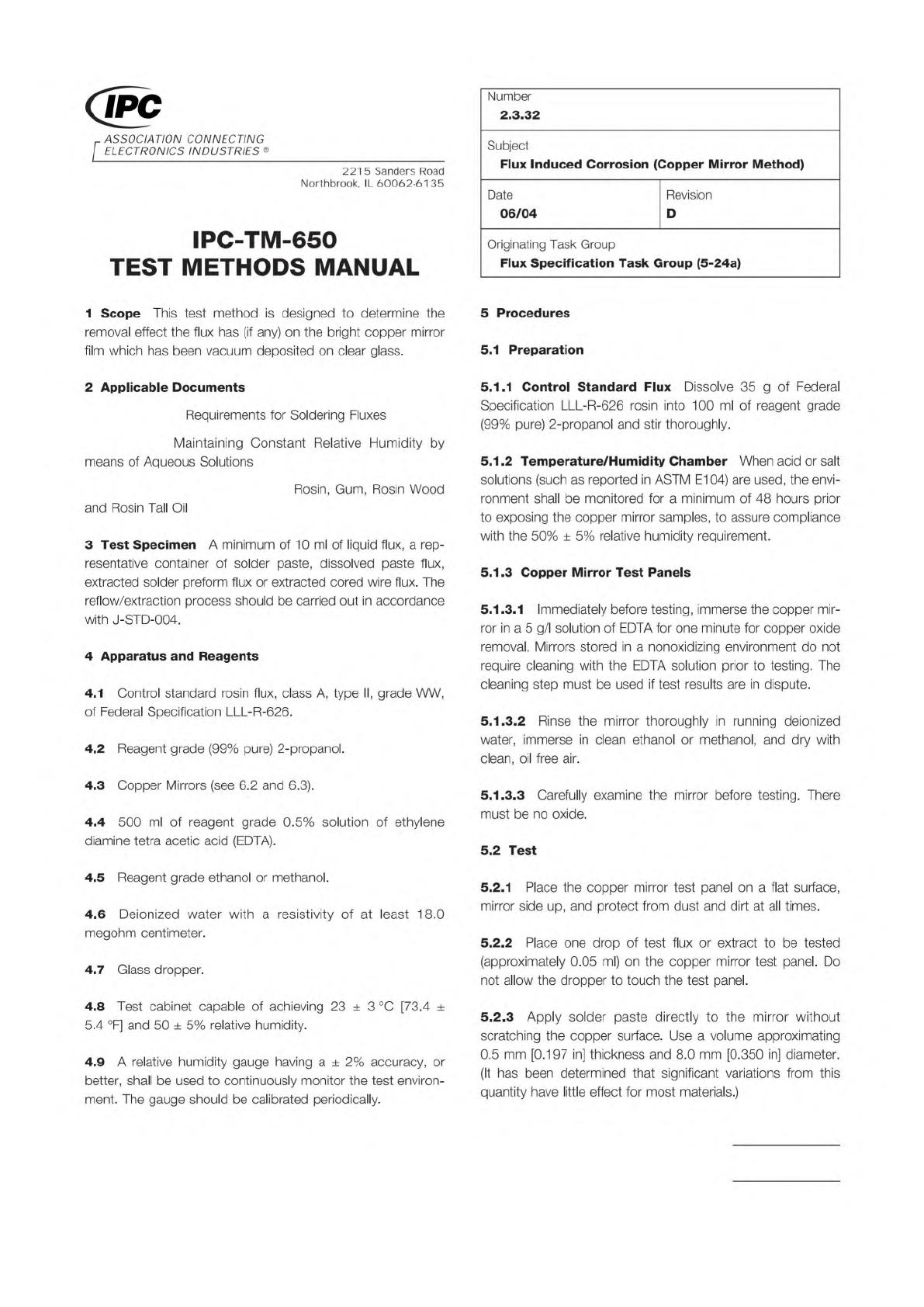
IPC J-STD-004
ASTM E104
Federal Specification LLL-R-626
Material in this Test Methods Manual was voluntarily established by Technical Committees of IPC. This material is advisory only
and its use or adaptation is entirely voluntary. IPC disclaims all liability of any kind as to the use, application, or adaptation of this
material. Users are also wholly responsible for protecting themselves against all claims or liabilities for patent infringement.
Equipment referenced is for the convenience of the user and does not imply endorsement by IPC.
Page 1 of 2
r
ASSOCIATION
CONNECTING
/
ELECTRONICS
INDUSTRIES
®
221
5
Sanders
Road
Northbrook,
IL
60062-6135
IPC-TM-650
TEST
METHODS
MANUAL
1
Scope
This
test
method
is
designed
to
determine
the
removal
effect
the
flux
has
(if
any)
on
the
bright
copper
mirror
film
which
has
been
vacuum
deposited
on
clear
glass.
2
Applicable
Documents
Requirements
for
Soldering
Fluxes
Maintaining
Constant
Relative
Humidity
by
means
of
Aqueous
Solutions
Rosin,
Gum,
Rosin
Wood
and
Rosin
Tall
Oil
3
Test
Specimen
A
minimum
of
1
0
ml
of
liquid
flux,
a
rep¬
resentative
container
of
solder
paste,
dissolved
paste
flux,
extracted
solder
preform
flux
or
extracted
cored
wire
flux.
The
reflow/extraction
process
should
be
carried
out
in
accordance
with
J-STD-004.
4
Apparatus
and
Reagents
4.1
Control
standard
rosin
flux,
class
A,
type
II,
grade
WW,
of
Federal
Specification
LLL-R-626.
4.2
Reagent
grade
(99%
pure)
2-propanol.
4.3
Copper
Mirrors
(see
6.2
and
6.3).
4.4
500
ml
of
reagent
grade
0.5%
solution
of
ethylene
diamine
tetra
acetic
acid
(EDTA).
4.5
Reagent
grade
ethanol
or
methanol.
4.6
Deionized
water
with
a
resistivity
of
at
least
18.0
megohm
centimeter.
4.7
Glass
dropper.
4.8
Test
cabinet
capable
of
achieving
23
±
3
[73.4
土
5.4
°F]
and
50
±
5%
relative
humidity.
4.9
A
relative
humidity
gauge
having
a
土
2%
accuracy,
or
better,
shall
be
used
to
continuously
monitor
the
test
environ¬
ment.
The
gauge
should
be
calibrated
periodically.
Number
2.3.32
Subject
Flux
Induced
Corrosion
(Copper
Mirror
Method)
Date
Revision
06/04
D
Originating
Task
Group
Flux
Specification
Task
Group
(5-24a)
5
Procedures
5.1
Preparation
5.1.1
Control
Standard
Flux
Dissolve
35
g
of
Federal
Specification
LLL-R-626
rosin
into
100
ml
of
reagent
grade
(99%
pure)
2-propanol
and
stir
thoroughly.
5.1.2
Temperature/Humidity
Chamber
When
acid
or
salt
solutions
(such
as
reported
in
ASTM
E104)
are
used,
the
envi¬
ronment
shall
be
monitored
for
a
minimum
of
48
hours
prior
to
exposing
the
copper
mirror
samples,
to
assure
compliance
with
the
50%
±
5%
relative
humidity
requirement.
5.1.3
Copper
Mirror
Test
Panels
5.1
.3.1
Immediately
before
testing,
immerse
the
copper
mir¬
ror
in
a
5
g/l
solution
of
EDTA
for
one
minute
for
copper
oxide
removal.
Mirrors
stored
in
a
nonoxidizing
environment
do
not
require
cleaning
with
the
EDTA
solution
prior
to
testing.
The
cleaning
step
must
be
used
if
test
results
are
in
dispute.
5.1.
3.2
Rinse
the
mirror
thoroughly
in
running
deionized
water,
immerse
in
clean
ethanol
or
methanol,
and
dry
with
clean,
oil
free
air.
5.1.
3.3
Carefully
examine
the
mirror
before
testing.
There
must
be
no
oxide.
5.2
Test
5.2.1
Place
the
copper
mirror
test
panel
on
a
flat
surface,
mirror
side
up,
and
protect
from
dust
and
dirt
at
all
times.
5.2.2
Place
one
drop
of
test
flux
or
extract
to
be
tested
(approximately
0.05
ml)
on
the
copper
mirror
test
panel.
Do
not
allow
the
dropper
to
touch
the
test
panel.
5.2.3
Apply
solder
paste
directly
to
the
mirror
without
scratching
the
copper
surface.
Use
a
volume
approximating
0.5
mm
[0.197
in]
thickness
and
8.0
mm
[0.350
in]
diameter.
(It
has
been
determined
that
significant
variations
from
this
quantity
have
little
effect
for
most
materials.)