IPC-TM-650 EN 2022 试验方法--.pdf - 第208页
IPC-TM-650 Number Subject Date Revision Page 3 of 3 2.4.2.1 Flexural Fatigue and Ductility, Foil 3/91 D 5.3.4 The flexural fatigue life at bend radii other than man¬ drel radius can also be obtained by evaluating the duc…
Note:
Note:
Note:
Note:
Note:
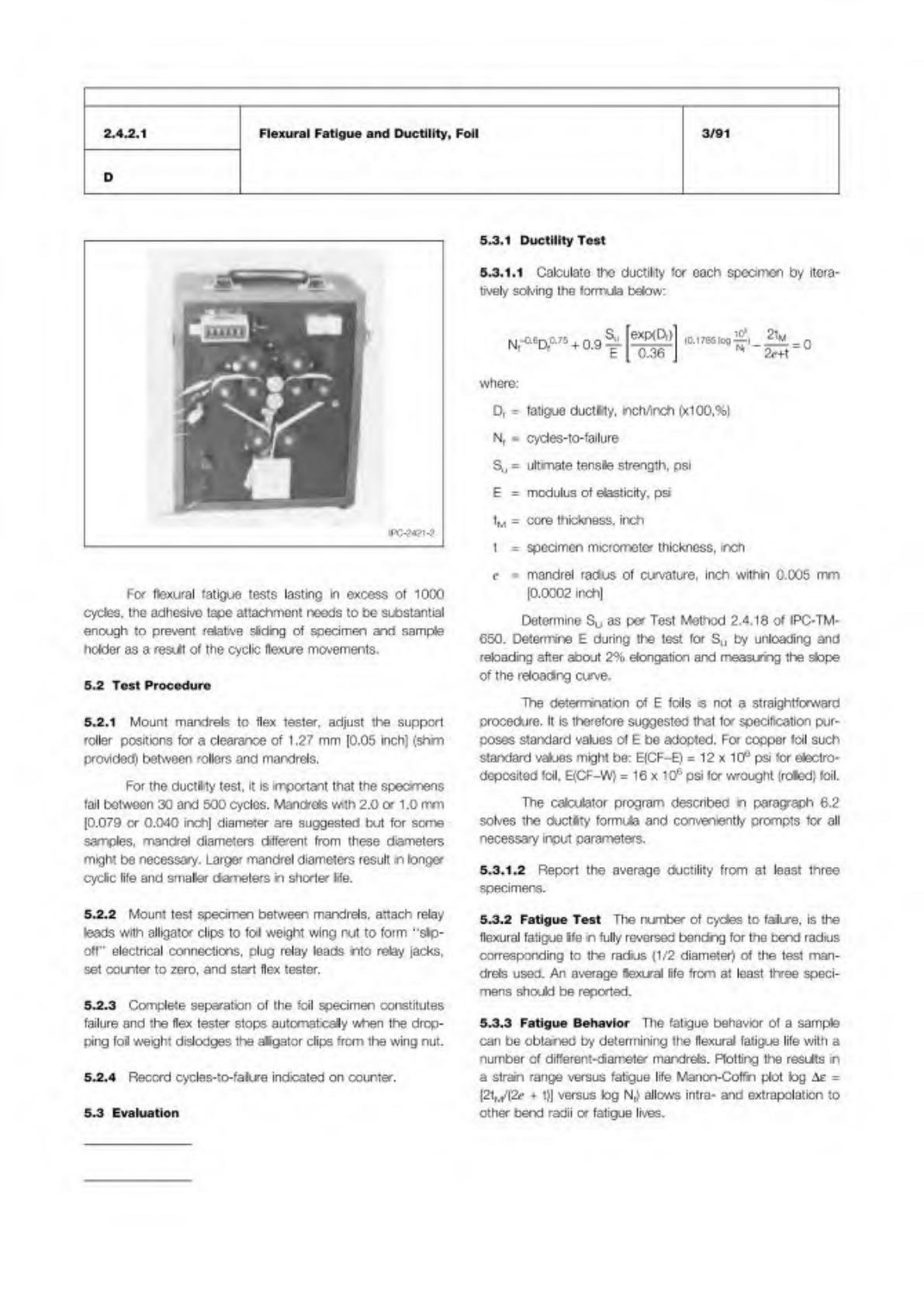
Figure 2 Fatigue ductility flex tester
IPC-TM-650
Number
Subject Date
Revision
Page 2 of 3
2.4.2.1
Flexural
Fatigue
and
Ductility,
Foil
3/91
D
I
PC-2421
-2
For
flexural
fatigue
tests
lasting
in
excess
of
1000
cycles,
the
adhesive
tape
attachment
needs
to
be
substantial
enough
to
prevent
relative
sliding
of
specimen
and
sample
holder
as
a
result
of
the
cyclic
flexure
movements.
5.2
Test
Procedure
5.2.1
Mount
mandrels
to
flex
tester,
adjust
the
support
roller
positions
for
a
clearance
of
1.27
mm
[0.05
inch]
(shim
provided)
between
rollers
and
mandrels.
For
the
ductility
test,
it
is
important
that
the
specimens
fail
between
30
and
500
cycles.
Mandrels
with
2.0
or
1.0
mm
[0.079
or
0.040
inch]
diameter
are
suggested
but
for
some
samples,
mandrel
diameters
different
from
these
diameters
might
be
necessary.
Larger
mandrel
diameters
result
in
longer
cyclic
life
and
smaller
diameters
in
shorter
life.
5.2.2
Mount
test
specimen
between
mandrels,
attach
relay
leads
with
alligator
clips
to
foil
weight
wing
nut
to
form
uslip-
off"
electrical
connections,
plug
relay
leads
into
relay
jacks,
set
counter
to
zero,
and
start
flex
tester.
5.2.3
Complete
separation
of
the
foil
specimen
constitutes
failure
and
the
flex
tester
stops
automatically
when
the
drop¬
ping
foil
weight
dislodges
the
alligator
clips
from
the
wing
nut.
5.2.4
Record
cycles-to-failure
indicated
on
counter.
5.3
Evaluation
5.3.1
Ductility
Test
5.3.1.
1
Calculate
the
ductility
for
each
specimen
by
itera¬
tively
solving
the
formula
below:
0.36
C76
Su
exp(Df)
Nf-O.6Df0.75
+
0.9
优
M
(0.1785
log
峪—
°
Nf
2e+t
—
u
where:
Df
二
fatigue
ductility,
inch/inch
(x100,%)
M
=
cycles-to-failure
Su
=
ultimate
tensile
strength,
psi
E
=
modulus
of
elasticity,
psi
tM
=
core
thickness,
inch
t
=
specimen
micrometer
thickness,
inch
e
=
mandrel
radius
of
curvature,
inch
within
0.005
mm
[0.0002
inch]
Determine
Sd
as
per
Test
Method
2.4.18
of
IPC-TM-
650.
Determine
E
during
the
test
for
Su
by
unloading
and
reloading
after
about
2%
elongation
and
measuring
the
slope
of
the
reloading
curve.
The
determination
of
E
foils
is
not
a
straightforward
procedure.
It
is
therefore
suggested
that
for
specification
pur¬
poses
standard
values
of
E
be
adopted.
For
copper
foil
such
standard
values
might
be:
E(CF-E)
=
1
2
x
1
06
psi
for
electro¬
deposited
foil,
E(CF-W)
=
1
6
x
1
06
psi
for
wrought
(rolled)
foil.
The
calculator
program
described
in
paragraph
6.2
solves
the
ductility
formula
and
conveniently
prompts
for
all
necessary
input
parameters.
5.3.1.
2
Report
the
average
ductility
from
at
least
three
specimens.
5.3.2
Fatigue
Test
The
number
of
cycles
to
failure,
is
the
flexural
fatigue
life
in
fully
reversed
bending
for
the
bend
radius
corresponding
to
the
radius
(1/2
diameter)
of
the
test
man¬
drels
used.
An
average
flexural
life
from
at
least
three
speci¬
mens
should
be
reported.
5.3.3
Fatigue
Behavior
The
fatigue
behavior
of
a
sample
can
be
obtained
by
determining
the
flexural
fatigue
life
with
a
number
of
different-diameter
mandrels.
Plotting
the
results
in
a
strain
range
versus
fatigue
life
Manon-Coffin
plot
log
Ae
=
[2tM/(2e
+
t)]
versus
log
Nf)
allows
intra-
and
extrapolation
to
other
bend
radii
or
fatigue
lives.
IPC-TM-650
Number
Subject Date
Revision
Page 3 of 3
2.4.2.1
Flexural
Fatigue
and
Ductility,
Foil
3/91
D
5.3.4
The
flexural
fatigue
life
at
bend
radii
other
than
man¬
drel
radius
can
also
be
obtained
by
evaluating
the
ductility
for¬
mula
for
the
flex
life
in
cycles-to-failure
using
the
fatigue
duc¬
tility
determined
in
5.3.1
.2
and
the
desired
bend
radius.
6.0
Notes
For
further
technical
details,
reference
the
mate¬
rial
shown
below.
6.1
Document
in
paragraph
2.0
(IPC-TP-204).
6.2
Engelmaier,
W.,
"Fatigue
Ductility
for
Foils
and
Flexible
Printed
Wiring,”
Program
No.
1883D
HP-67/97
User's
Library,
Hewlett
Packard
Co.,
Corvallis,
Oregon,
1978.
6.3
Engelmaier,
W.,
“Fatigue
Ductility
Flex
Tester,”
Drawing
L520163,
Bell
Telephone
Laboratories,
Inc.,
Whippany,
New
Jersey,
1978.
6.4
Test
Equipment
Sources
The
equipment
sources
described
below
represent
those
currently
known
to
the
industry.
Users
of
this
test
method
are
urged
to
submit
addi¬
tional
source
names
as
they
become
available,
so
that
this
list
can
be
kept
as
current
as
possible.
6.4.1
Fatigue
Ductility
Flex
Tester,
Universal
Tool
&
Machine
Inc.,
171
Coit
St.,
Irvington,
NJ
07111;
201-374-4400.
6.4.2
JDC
Precision
Sample
Cutter,
Model
J
DC
125-N
or
equal.
Note:
IPC-TM-650
Note:
Note:
Note:
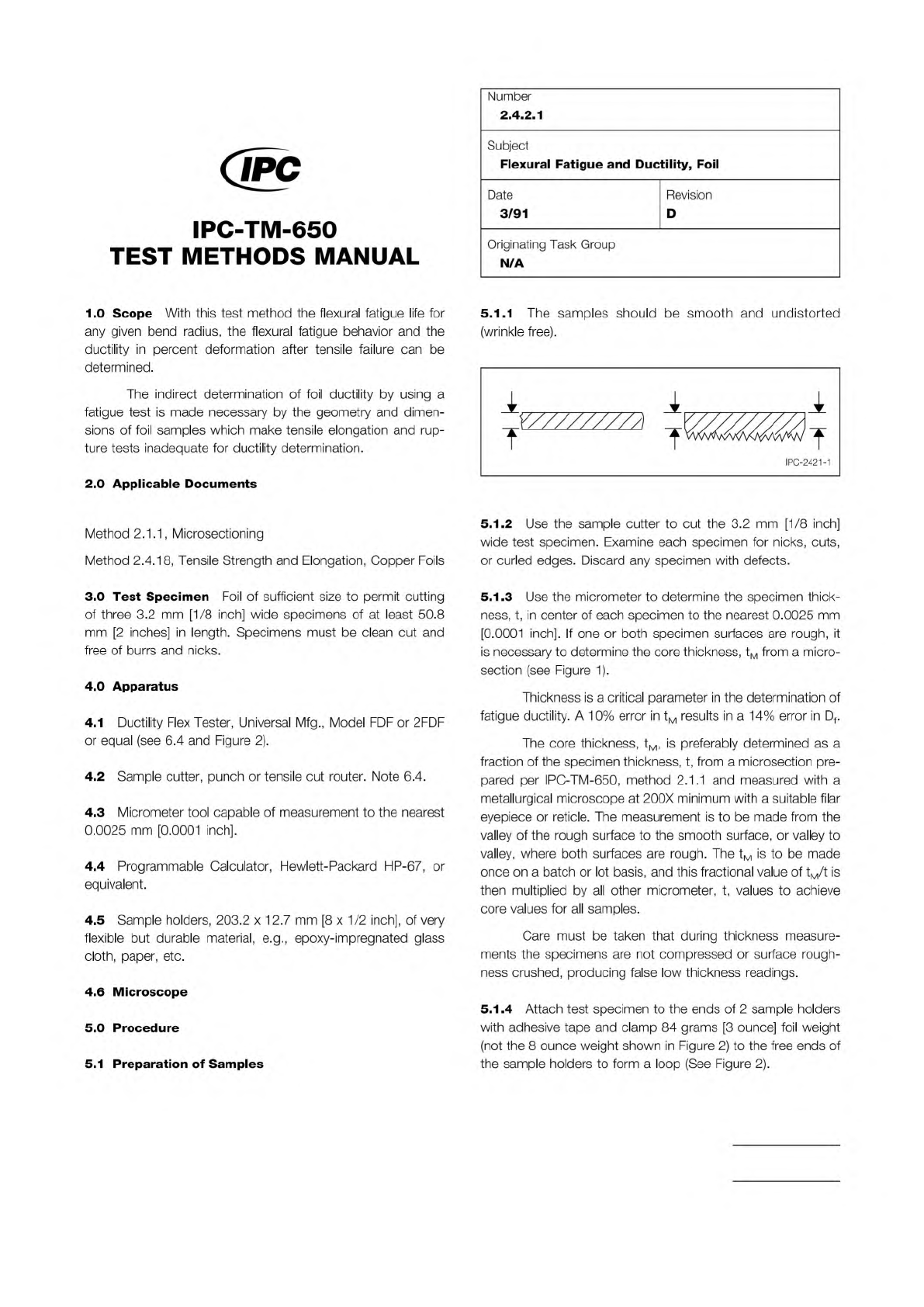
Figure 1 Smooth and rough foil
t
M
t
t = t
M
The Institute for Interconnecting and Packaging Electronic Circuits
2215 Sanders Road • Northbrook, IL 60062-6135
Material in this Test Methods Manual was voluntarily established by Technical Committees of the IPC. This material is advisory only
and its use or adaptation is entirely voluntary. IPC disclaims all liability of any kind as to the use, application, or adaptation of this
material. Users are also wholly responsible for protecting themselves against all claims or liabilities for patent infringement.
Equipment referenced is for the convenience of the user and does not imply endorsement by the IPC.
Page 1 of 3
IPC-TM-650
TEST
METHODS
MANUAL
1
.0
Scope
With
this
test
method
the
flexural
fatigue
life
for
any
given
bend
radius,
the
flexural
fatigue
behavior
and
the
ductility
in
percent
deformation
after
tensile
failure
can
be
determined.
The
indirect
determination
of
foil
ductility
by
using
a
fatigue
test
is
made
necessary
by
the
geometry
and
dimen¬
sions
of
foil
samples
which
make
tensile
elongation
and
rup¬
ture
tests
inadequate
for
ductility
determination.
2
.0
Applicable
Documents
Method
2.1.1,
Microsectioning
Method
2.4.18,
Tensile
Strength
and
Elongation,
Copper
Foils
3
.0
Test
Specimen
Foil
of
sufficient
size
to
permit
cutting
of
three
3.2
mm
[1/8
inch]
wide
specimens
of
at
least
50.8
mm
[2
inches]
in
length.
Specimens
must
be
clean
cut
and
free
of
burrs
and
nicks.
4
.0
Apparatus
4.1
Ductility
Flex
Tester,
Universal
Mfg.,
Model
FDF
or
2FDF
or
equal
(see
6.4
and
Figure
2).
4.2
Sample
cutter,
punch
or
tensile
cut
router.
Note
6.4.
4.3
Micrometer
tool
capable
of
measurement
to
the
nearest
0.0025
mm
[0.0001
inch].
4.4
Programmable
Calculator,
Hewlett-Packard
HP-67,
or
equivalent.
4.5
Sample
holders,
203.2
x
12.7
mm
[8
x
1/2
inch],
of
very
flexible
but
durable
material,
e.g.,
epoxy-impregnated
glass
cloth,
paper,
etc.
4.6
Microscope
5
.0
Procedure
Number
2.4.2.
1
Subject
Flexural
Fatigue
and
Ductility,
Foil
Date
Revision
3/91
D
Originating
Task
Group
N/A
5.1.1
The
samples
should
be
smooth
and
undistorted
(wrinkle
free).
5.1.2
Use
the
sample
cutter
to
cut
the
3.2
mm
[1/8
inch]
wide
test
specimen.
Examine
each
specimen
for
nicks,
cuts,
or
curled
edges.
Discard
any
specimen
with
defects.
5.1.3
Use
the
micrometer
to
determine
the
specimen
thick¬
ness,
t,
in
center
of
each
specimen
to
the
nearest
0.0025
mm
[0.0001
inch].
If
one
or
both
specimen
surfaces
are
rough,
it
is
necessary
to
determine
the
core
thickness,
tM
from
a
micro¬
section
(see
Figure
1).
Thickness
is
a
critical
parameter
in
the
determination
of
fatigue
ductility.
A
10%
error
in
tM
results
in
a
14%
error
in
Df.
The
core
thickness,
tM,
is
preferably
determined
as
a
fraction
of
the
specimen
thickness,
t,
from
a
microsection
pre¬
pared
per
IPC-TM-650,
method
2.1.1
and
measured
with
a
metallurgical
microscope
at
200X
minimum
with
a
suitable
filar
eyepiece
or
reticle.
The
measurement
is
to
be
made
from
the
valley
of
the
rough
surface
to
the
smooth
surface,
or
valley
to
valley,
where
both
surfaces
are
rough.
The
tM
is
to
be
made
once
on
a
batch
or
lot
basis,
and
this
fractional
value
of
tM/t
is
then
multiplied
by
all
other
micrometer,
t,
values
to
achieve
core
values
for
all
samples.
Care
must
be
taken
that
during
thickness
measure¬
ments
the
specimens
are
not
compressed
or
surface
rough¬
ness
crushed,
producing
false
low
thickness
readings.
5.1.4
Attach
test
specimen
to
the
ends
of
2
sample
holders
with
adhesive
tape
and
clamp
84
grams
[3
ounce]
foil
weight
(not
the
8
ounce
weight
shown
in
Figure
2)
to
the
free
ends
of
the
sample
holders
to
form
a
loop
(See
Figure
2).
5.1
Preparation
of
Samples