IPC-TM-650 EN 2022 试验方法--.pdf - 第266页
IPC-249-5 Number 2.4.9 Subject Peel Strength, Flexible Dielectric Mat erials Date 04/14 Revision E IPC-TM-650 — Metal = Polyimide Failure to Metal Foil PS = Polyimide Shatter Figure 5 Failure Modes with Adhesiveless Page…
IPC-249-4
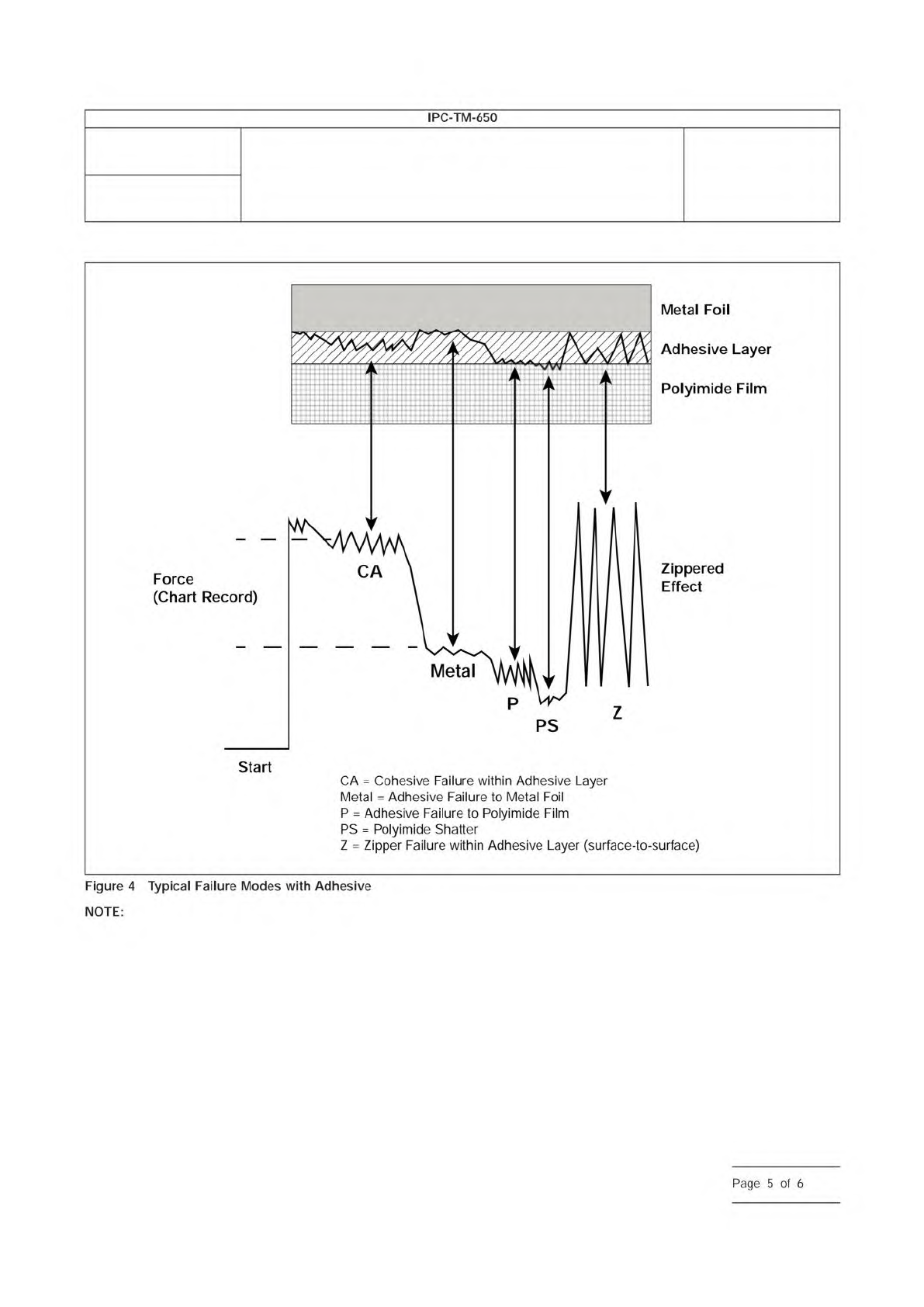
Zipper failure (also termed Slipstick failure): A peel failure that propagates faster than the crosshead speed and oscillates from
the interface between the adhesive layer and the metal foil through the cohesive layer of the adhesive itself to the adhesive interface
with the dielectric film and into the dielectric film where it fails cohesively and reverses this failure. It also exhibits itself by peel strengths
that vary widely from a gradual build to a maximum peel value to a nearly instantaneous drop to no peel value at all in a cyclic manner.
Number
2.4.9
Subject
Peel Strength, Flexible Dielectric Materials
Date
04/14
Revision
E
IPC-TM-650
Figure
4
Typical
Failure
Modes
with
Adhesive
NOTE:
Page
5
of
6
IPC-249-5
Number
2.4.9
Subject
Peel Strength, Flexible Dielectric Materials
Date
04/14
Revision
E
IPC-TM-650
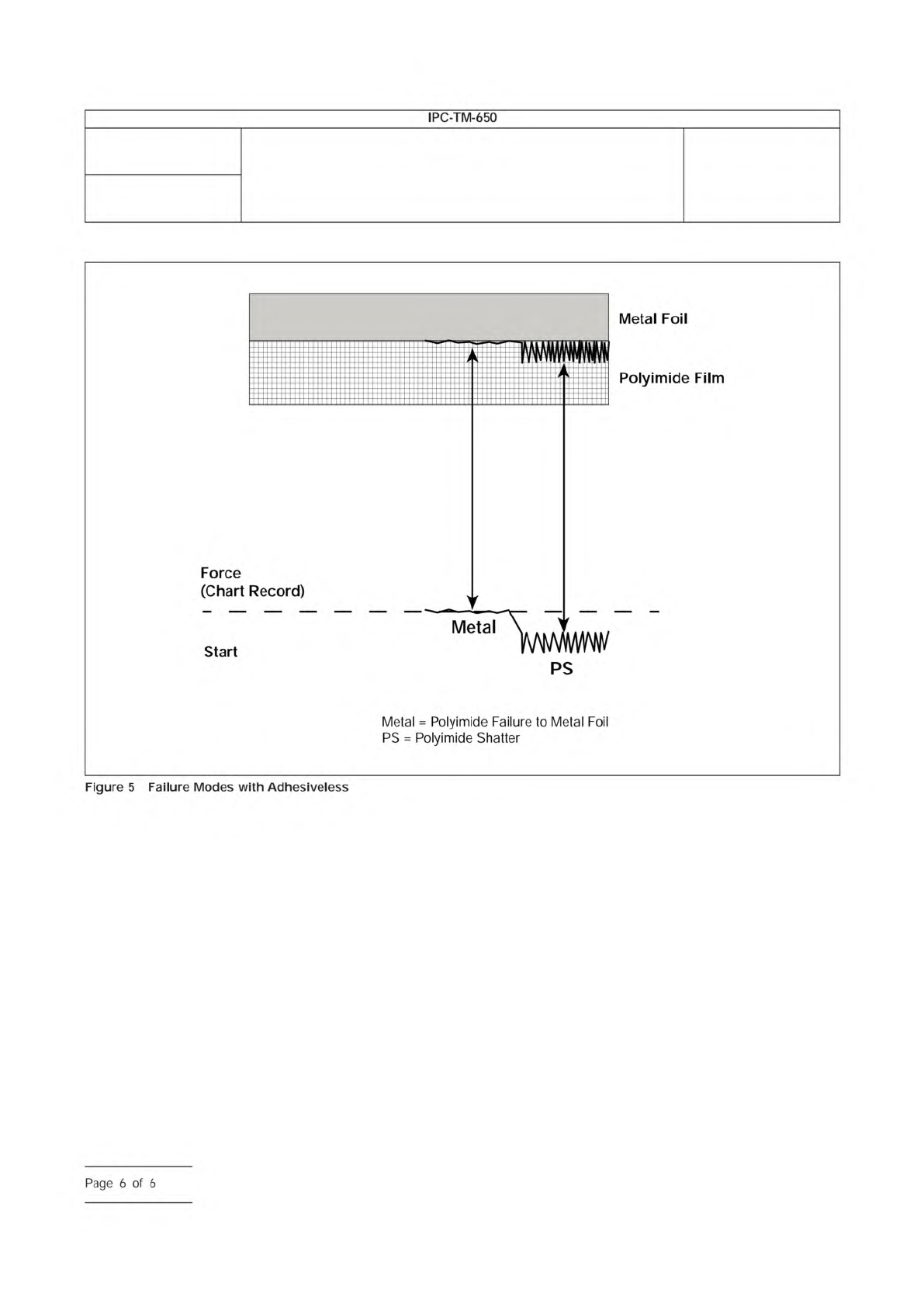
—
Metal
=
Polyimide
Failure
to
Metal
Foil
PS
=
Polyimide
Shatter
Figure
5
Failure
Modes
with
Adhesiveless
Page
6
of
6
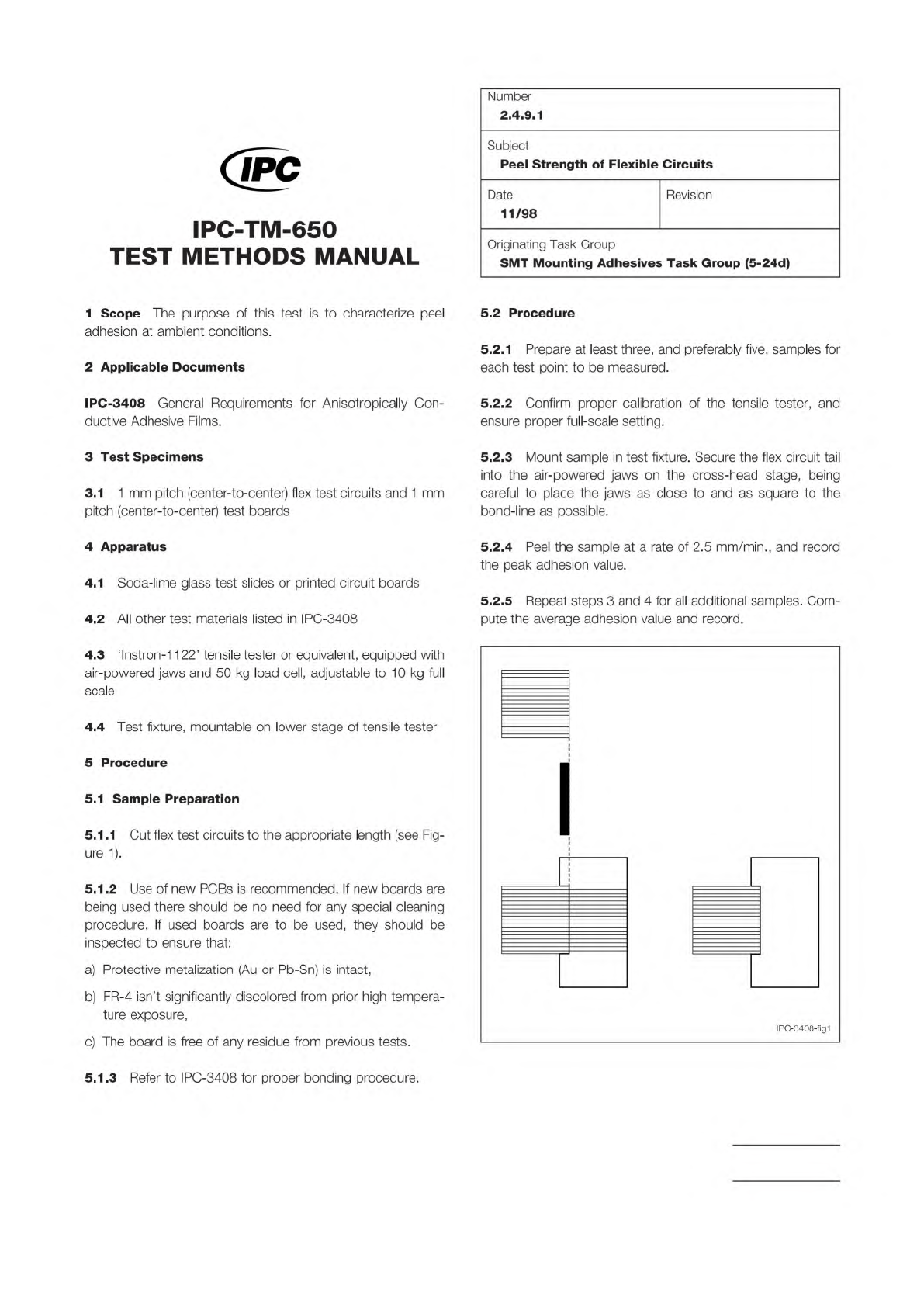
Figure 1 Sample Pattern
1 mm Pitch Flex, 17 traces
20 mm x 20 mm
ACF, 0.050 mm, 3.2 mm x 20 mm
a) Flex-Board b) Flex-Glass
The Institute for Interconnecting and Packaging Electronic Circuits
2215 Sanders Road • Northbrook, IL 60062-6135
Material in this Test Methods Manual was voluntarily established by Technical Committees of the IPC. This material is advisory only
and its use or adaptation is entirely voluntary. IPC disclaims all liability of any kind as to the use, application, or adaptation of this
material. Users are also wholly responsible for protecting themselves against all claims or liabilities for patent infringement.
Equipment referenced is for the convenience of the user and does not imply endorsement by the IPC.
Page 1 of 1
IPC-TM-650
TEST
METHODS
MANUAL
1
Scope
The
purpose
of
this
test
is
to
characterize
peel
adhesion
at
ambient
conditions.
2
Applicable
Documents
IPC-3408
General
Requirements
for
Anisotropically
Con¬
ductive
Adhesive
Films.
3
Test
Specimens
3.1
1
mm
pitch
(center-to-center)
flex
test
circuits
and
1
mm
pitch
(center-to-center)
test
boards
4
Apparatus
4.1
Soda-lime
glass
test
slides
or
printed
circuit
boards
4.2
All
other
test
materials
listed
in
IPC-3408
4.3
1nstron-1
1
22'
tensile
tester
or
equivalent,
equipped
with
air-powered
jaws
and
50
kg
load
cell,
adjustable
to
1
0
kg
full
scale
4.4
Test
fixture,
mountable
on
lower
stage
of
tensile
tester
5
Procedure
5.1
Sample
Preparation
5.1.1
Cut
flex
test
circuits
to
the
appropriate
length
(see
Fig¬
ure
1).
5.1.2
Use
of
new
PCBs
is
recommended.
If
new
boards
are
being
used
there
should
be
no
need
for
any
special
cleaning
procedure.
If
used
boards
are
to
be
used,
they
should
be
inspected
to
ensure
that:
a)
Protective
metalization
(Au
or
Pb-Sn)
is
intact,
b)
FR-4
isn't
significantly
discolored
from
prior
high
tempera¬
ture
exposure,
c)
The
board
is
free
of
any
residue
from
previous
tests.
Number
2.4.9.1
Subject
Peel
Strength
of
Flexible
Circuits
Date
11/98
Revision
Originating
Task
Group
SMT
Mounting
Adhesives
Task
Group
(5-24d)
5.2
Procedure
5.2.1
Prepare
at
least
three,
and
preferably
five,
samples
for
each
test
point
to
be
measured.
5.2.2
Confirm
proper
calibration
of
the
tensile
tester,
and
ensure
proper
full-scale
setting.
5.2.3
Mount
sample
in
test
fixture.
Secure
the
flex
circuit
tail
into
the
air-powered
jaws
on
the
cross-head
stage,
being
careful
to
place
the
jaws
as
close
to
and
as
square
to
the
bond-line
as
possible.
5.2.4
Peel
the
sample
at
a
rate
of
2.5
mm/min.,
and
record
the
peak
adhesion
value.
5.2.5
Repeat
steps
3
and
4
for
all
additional
samples.
Com¬
pute
the
average
adhesion
value
and
record.
5.1.3
Refer
to
IPC-3408
for
proper
bonding
procedure.