IPC-TM-650 EN 2022 试验方法--.pdf - 第288页
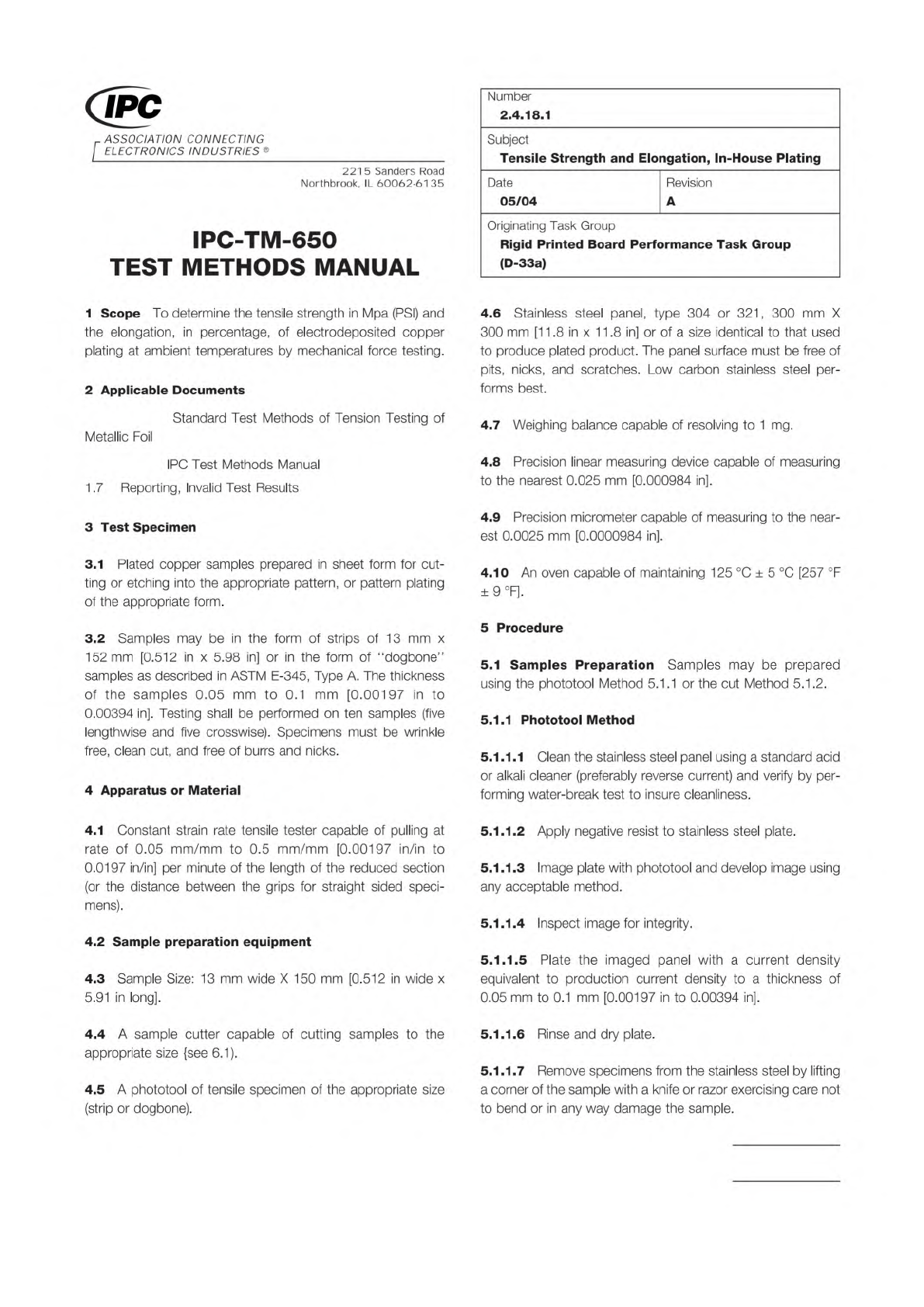
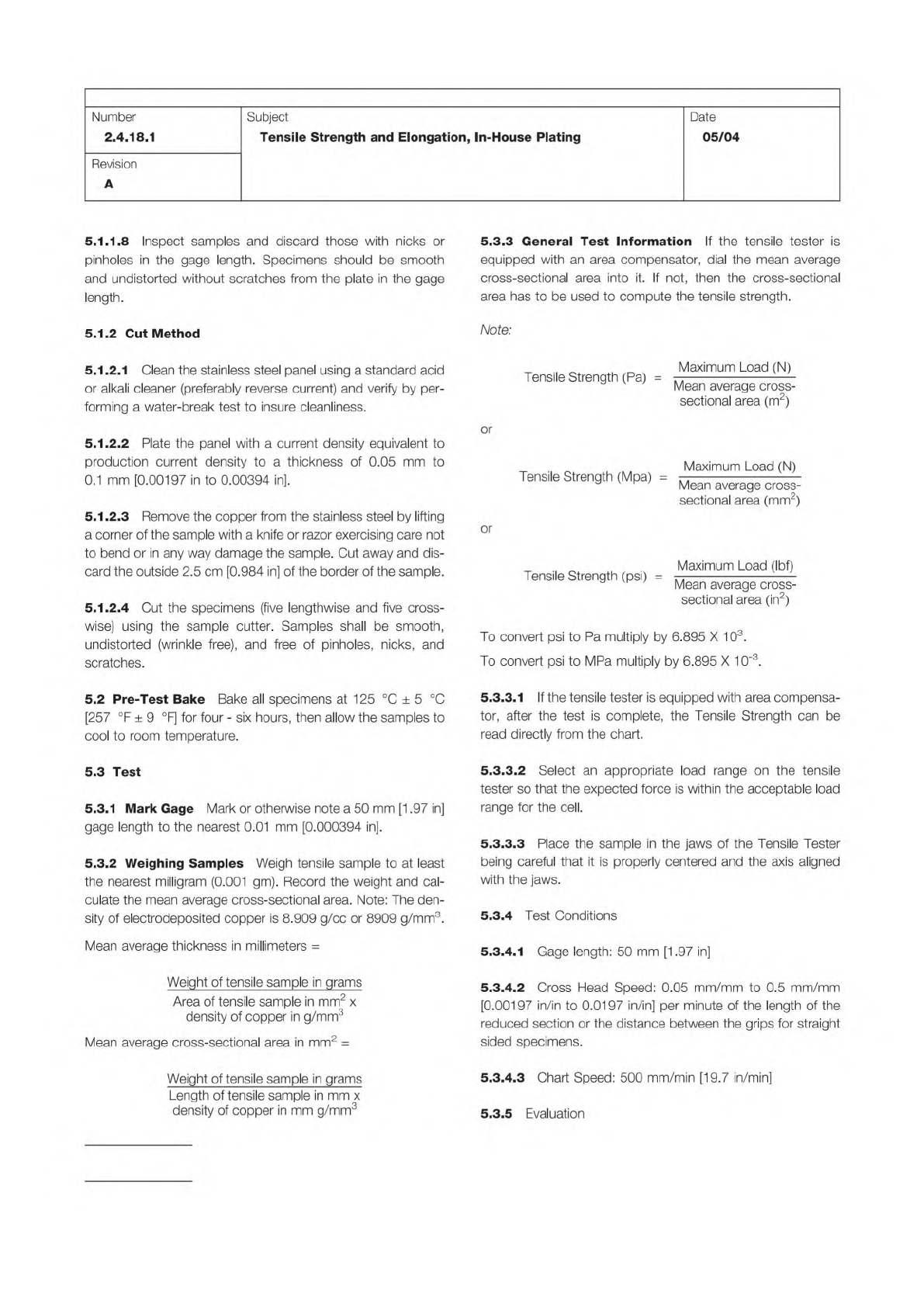
IPC-TM-650 Page 2 of 3 Number 2.4.18.1 Revision A Subject Tensile Strength and Elongation, In-House Plating Date 05/04 5.1. 1.8 Inspect samples and discard those with nicks or pinholes in the gage length. Specimens shoul…
ASTM E-345
IPC-TM-650
Material in this Test Methods Manual was voluntarily established by Technical Committees of IPC. This material is advisory only
and its use or adaptation is entirely voluntary. IPC disclaims all liability of any kind as to the use, application, or adaptation of this
material. Users are also wholly responsible for protecting themselves against all claims or liabilities for patent infringement.
Equipment referenced is for the convenience of the user and does not imply endorsement by IPC.
Page 1 of 3
Number
r
ASSOCIATION
CONNECTING
/
ELECTRONICS
INDUSTRIES
®
221
5
Sanders
Road
Northbrook,
IL
60062-6135
IPC-TM-650
TEST
METHODS
MANUAL
1
Scope
To
determine
the
tensile
strength
in
Mpa
(PSI)
and
the
elongation,
in
percentage,
of
electrodeposited
copper
plating
at
ambient
temperatures
by
mechanical
force
testing.
2
Applicable
Documents
Standard
Test
Methods
of
Tension
Testing
of
Metallic
Foil
IPC
Test
Methods
Manual
1
.7
Reporting,
Invalid
Test
Results
3
Test
Specimen
3.1
Plated
copper
samples
prepared
in
sheet
form
for
cut¬
ting
or
etching
into
the
appropriate
pattern,
or
pattern
plating
of
the
appropriate
form.
3.2
Samples
may
be
in
the
form
of
strips
of
13
mm
x
152
mm
[0.512
in
x
5.98
in]
or
in
the
form
of
“dogbone'
'
samples
as
described
in
ASTM
E-345,
Type
A.
The
thickness
of
the
samples
0.05
mm
to
0.1
mm
[0.001
97
in
to
0.00394
in].
Testing
shall
be
performed
on
ten
samples
(five
lengthwise
and
five
crosswise).
Specimens
must
be
wrinkle
free,
clean
cut,
and
free
of
burrs
and
nicks.
4
Apparatus
or
Material
4.1
Constant
strain
rate
tensile
tester
capable
of
pulling
at
rate
of
0.05
mm/mm
to
0.5
mm/mm
[0.00197
in/in
to
0.01
97
in/in]
per
minute
of
the
length
of
the
reduced
section
(or
the
distance
between
the
grips
for
straight
sided
speci¬
mens).
4.2
Sample
preparation
equipment
4.3
Sample
Size:
13
mm
wide
X
150
mm
[0.512
in
wide
x
5.91
in
long].
4.4
A
sample
cutter
capable
of
cutting
samples
to
the
appropriate
size
{see
6.1).
4.5
A
phototool
of
tensile
specimen
of
the
appropriate
size
(strip
or
dogbone).
2.4.18.1
Subject
Tensile
Strength
and
Elongation,
In-House
Plating
Date
Revision
05/04
A
Originating
Task
Group
Rigid
Printed
Board
Performance
Task
Group
(D-33a)
4.6
Stainless
steel
panel,
type
304
or
321
,
300
mm
X
300
mm
[11.8
in
x
11.8
in]
or
of
a
size
identical
to
that
used
to
produce
plated
product.
The
panel
surface
must
be
free
of
pits,
nicks,
and
scratches.
Low
carbon
stainless
steel
per¬
forms
best.
4.7
Weighing
balance
capable
of
resolving
to
1
mg.
4.8
Precision
linear
measuring
device
capable
of
measuring
to
the
nearest
0.025
mm
[0.000984
in].
4.9
Precision
micrometer
capable
of
measuring
to
the
near¬
est
0.0025
mm
[0.0000984
in].
4.10
An
oven
capable
of
maintaining
1
25
±
5
[257
°F
±9°F]-
5
Procedure
5.1
Samples
Preparation
Samples
may
be
prepared
using
the
phototool
Method
5.1.1
or
the
cut
Method
5.1
.2.
5.1.1
Phototool
Method
5.1
.1.1
Clean
the
stainless
steel
panel
using
a
standard
acid
or
alkali
cleaner
(preferably
reverse
current)
and
verify
by
per¬
forming
water-
break
test
to
insure
cleanliness.
5.1.
1.2
Apply
negative
resist
to
stainless
steel
plate.
5.1
.1.3
Image
plate
with
phototool
and
develop
image
using
any
acceptable
method.
5.1.
1.4
Inspect
image
for
integrity.
5.
1.1.5
Plate
the
imaged
panel
with
a
current
density
equivalent
to
production
current
density
to
a
thickness
of
0.05
mm
to
0.1
mm
[0.001
97
in
to
0.00394
in].
5.1.
1.6
Rinse
and
dry
plate.
5.1.
1.7
Remove
specimens
from
the
stainless
steel
by
lifting
a
corner
of
the
sample
with
a
knife
or
razor
exercising
care
not
to
bend
or
in
any
way
damage
the
sample.
IPC-TM-650
Page 2 of 3
Number
2.4.18.1
Revision
A
Subject
Tensile
Strength
and
Elongation,
In-House
Plating
Date
05/04
5.1.
1.8
Inspect
samples
and
discard
those
with
nicks
or
pinholes
in
the
gage
length.
Specimens
should
be
smooth
and
undistorted
without
scratches
from
the
plate
in
the
gage
length.
5.1.2
Cut
Method
5.
1.2.1
Clean
the
stainless
steel
panel
using
a
standard
acid
or
alkali
cleaner
(preferably
reverse
current)
and
verify
by
per¬
forming
a
water-break
test
to
insure
cleanliness.
5.1.
2.2
Plate
the
panel
with
a
current
density
equivalent
to
production
current
density
to
a
thickness
of
0.05
mm
to
0.1
mm
[0.00197
in
to
0.00394
in].
5.
1.2.3
Remove
the
copper
from
the
stainless
steel
by
lifting
a
corner
of
the
sample
with
a
knife
or
razor
exercising
care
not
to
bend
or
in
any
way
damage
the
sample.
Cut
away
and
dis¬
card
the
outside
2.5
cm
[0.984
in]
of
the
border
of
the
sample.
5.1.2.4
Cut
the
specimens
(five
lengthwise
and
five
cross¬
wise)
using
the
sample
cutter.
Samples
shall
be
smooth,
undistorted
(wrinkle
free),
and
free
of
pinholes,
nicks,
and
scratches.
5.2
Pre-Test
Bake
Bake
all
specimens
at
125
±
5
[257
°F
±
9
°F]
for
four
-
six
hours,
then
allow
the
samples
to
cool
to
room
temperature.
5.3
Test
5.3.1
Mark
Gage
Mark
or
otherwise
note
a
50
mm
[1
.97
in]
gage
length
to
the
nearest
0.01
mm
[0.000394
in].
5.3.2
Weighing
Samples
Weigh
tensile
sample
to
at
least
the
nearest
milligram
(0.001
gm).
Record
the
weight
and
cal¬
culate
the
mean
average
cross-sectional
area.
Note:
The
den¬
sity
of
electrodeposited
copper
is
8.909
g/cc
or
8909
g/mm3.
Mean
average
thickness
in
millimeters
=
Weight
of
tensile
sample
in
grams
Area
of
tensile
sample
in
mm2
x
density
of
copper
in
g/mm3
Mean
average
cross-sectional
area
in
mm2
=
Weight
of
tensile
sample
in
grams
Length
of
tensile
sample
in
mm
x
density
of
copper
in
mm
g/mm3
5.3.3
General
Test
Information
If
the
tensile
tester
is
equipped
with
an
area
compensator,
dial
the
mean
average
cross-sectional
area
into
it.
If
not,
then
the
cross-sectional
area
has
to
be
used
to
compute
the
tensile
strength.
Note:
or
Tensile
Strength
(Pa)
:
Maximum
Load
(N)
Mean
average
cross-
sectional
area
(m2)
Tensile
Strength
(Mpa)
Maximum
Load
(N)
Mean
average
cross-
sectional
area
(mm2)
or
Maximum
Load
(Ibf)
Tensile
Strength
(psi)
二
—
Mean
average
cross-
sectional
area
(in2)
To
convert
psi
to
Pa
multiply
by
6.895
X
103.
To
convert
psi
to
MPa
multiply
by
6.895
X
10-3.
5.3.3.
1
If
the
tensile
tester
is
equipped
with
area
compensa¬
tor,
after
the
test
is
complete,
the
Tensile
Strength
can
be
read
directly
from
the
chart.
5.3.3.2
Select
an
appropriate
load
range
on
the
tensile
tester
so
that
the
expected
force
is
within
the
acceptable
load
range
for
the
cell.
S.3.3.3
Place
the
sample
in
the
jaws
of
the
Tensile
Tester
being
careful
that
it
is
properly
centered
and
the
axis
aligned
with
the
jaws.
5.3.4
Test
Conditions
5.3.4.
1
Gage
length:
50
mm
[1
.97
in]
5.3.4.2
Cross
Head
Speed:
0.05
mm/mm
to
0.5
mm/mm
[0.00197
in/in
to
0.0197
in/in]
per
minute
of
the
length
of
the
reduced
section
or
the
distance
between
the
grips
for
straight
sided
specimens.
5.3.4.3
Chart
Speed:
500
mm/min
[19.7
in/min]
5.3.5
Evaluation
Notes
IPC-TM-650
Page 3 of 3
Number
2.4.18.1
Revision
A
Subject
Tensile
Strength
and
Elongation,
In-House
Plating
Date
05/04
5.3.5.1
Activate
cross
head
to
break
sample
and
make
cal¬
culations
of
tensile
strength
in
Mpa
and
elongation
in
%.
5.3.5.2
Percent
elongation
may
be
determined
by
fitting
the
ends
of
the
fractured
specimen
together
carefully
and
mea¬
suring
the
distance
between
the
original
gage
marks
to
the
nearest
0.25
mm
[0.00984
in].
Elongation
is
the
increase
in
length
of
the
gage
length,
expressed
as
a
percentage
of
the
original
gage
length.
Percent
elongation
=
length
at
break
-
original
gage
length
x
100
original
gage
length
5.3.5.3
Average
all
five
elongation
readings.
See
IPC-TM-
650,
Method
1.7,
for
information
about
discarding
invalid
results.
6
6.1
The
J
DC-50
sample
cutter
has
been
found
suitable
for
cutting
specimens
to
the
appropriate
dimensions.
This
cutter
is
manufactured
by
Thwing-Albert
Instrument
Co.,
10960
Dut¬
ton
Road,
Philadelphia,
PA
19154.
(215-637-0100)