IPC-TM-650 EN 2022 试验方法--.pdf - 第297页
1 Scope This test m etho d is to determine the l and bond strength of u nsupported holes, after repeated soldering and unsoldering, by mechanical pu ll in the p erpe ndicular plan e. 2 Applicable Documents Generic Standa…
IPC-TM-650
Page 2 of 2
Number
2.4.19
Subject
Tensile
Strength
and
Elongation,
Flexible
Printed
Wiring
Materials
Date
5/98
Revision
C
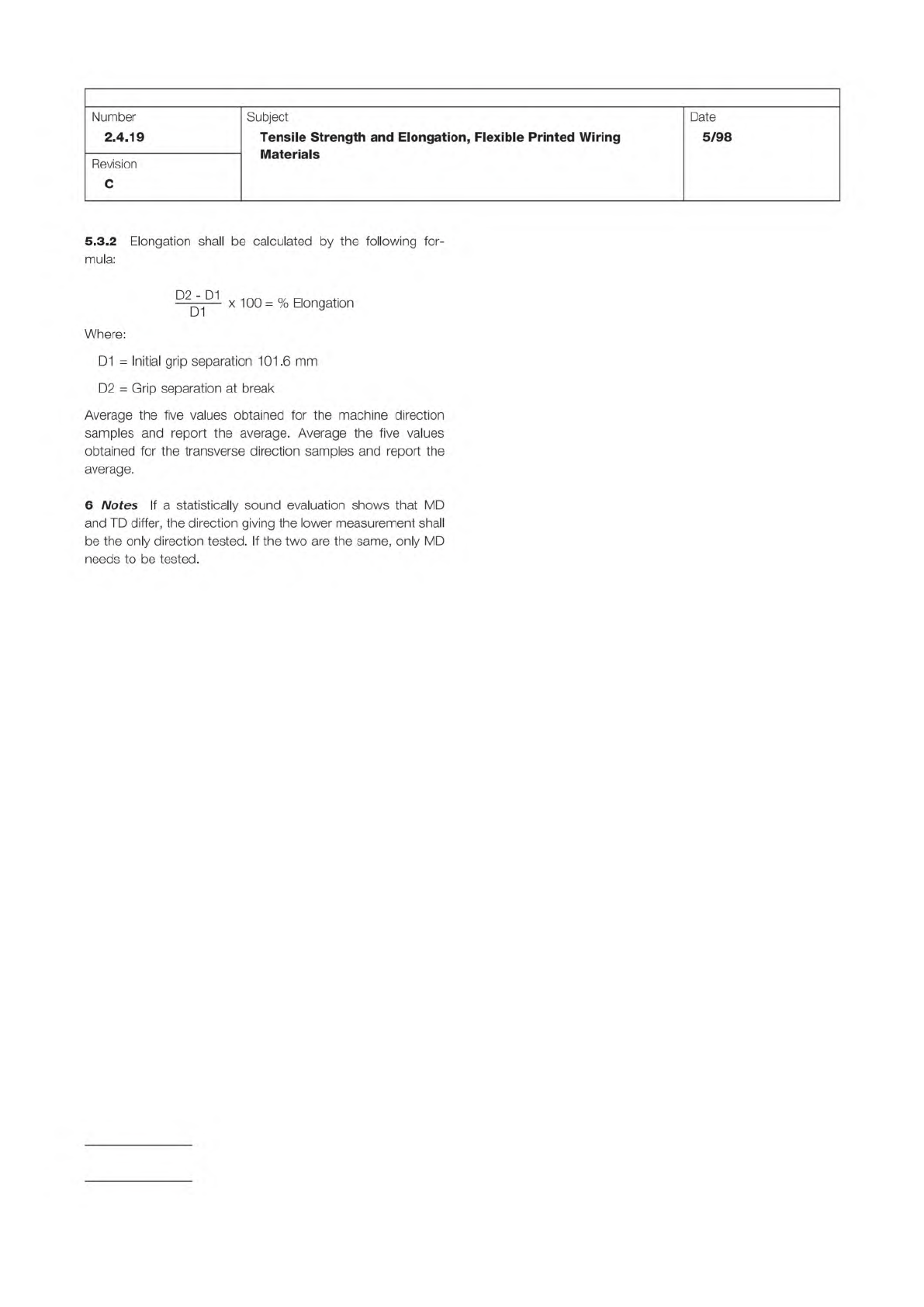
5.3.2
Elongation
shall
be
calculated
by
the
following
for¬
mula:
D2
~
D1
T
cc
0/
i—
I
.•
—
—
—
x
1
00
=
%
Elongation
Where:
D1
二
Initial
grip
separation
101
.6
mm
D2
=
Grip
separation
at
break
Average
the
five
values
obtained
for
the
machine
direction
samples
and
report
the
average.
Average
the
five
values
obtained
for
the
transverse
direction
samples
and
report
the
average.
6
Notes
If
a
statistically
sound
evaluation
shows
that
MD
and
TD
differ,
the
direction
giving
the
lower
measurement
shall
be
the
only
direction
tested.
If
the
two
are
the
same,
only
MD
needs
to
be
tested.
1 Scope
This test method is to determine the land bond
strength of unsupported holes, after repeated soldering and
unsoldering, by mechanical pull in the perpendicular plane.
2 Applicable Documents
Generic Standard on Printed Board Design
3 Test Specimen
Any unsupported component hole
sample or test coupon ‘‘A’’ or ‘‘A/B’’ described in IPC-2221.
Three holes per sample or test coupon shall be tested.
4 Apparatus or Material
4.1 Soldering Iron
60-watt soldering iron capable of pro-
ducing a tip temperature of 232 °C to 260 °C [450 °F to
500 °F].
4.2 Force Tester
Vertical pull force tester capable of oper-
ating at a speed of 50.0 mm [2.0 in] per minute and measur-
ing up to 9 kg [20 pounds] load.
4.3
Tinned or solder coated copper wire.
5 Procedure
5.1 Preparation
5.1.1
If conductors are connected to the land area, the fol-
lowing procedure is to be followed:
Take a sharp model knife and cut conductor at least 6.0 mm
[0.2 in] away from the land. Place blade of knife on edge of
land area where conductor enters. While holding the blade
down, pull conductor to the land and use knife blade as ful-
crum to break conductor from land without disturbing bond of
the land.
5.1.2
Insert wire so that the portion extending from the sol-
dered side of the circuit may be fitted into the gripping mecha-
nism of a tensile tester. The wires shall have a diameter
between 150 µm and 500 µm [5,906 µin and 19,685 µin] less
than the diameter of the hole. The wires shall not be clinched.
Select suitable wire of sufficient length to connect to gripping
mechanism of bond strength tester.
5.1.3
Insert wire in holes in selected lands and solder to
lands by machine or hand, as applicable. The wire shall not be
clinched.
5.2 Soldering Cycles
5.2.1
The hand soldering and desoldering operation of the
wire shall be performed as follows:
Step 1: Solder wire into lands
Step 2: Remove (desolder) wire from lands
Step 3: Resolder wire into lands
Step 4: Remove (desolder) wire from lands
Step 5: Resolder wire into lands
During the desolder and solder steps, solder every other land
in the row and allow the specimen to cool to room tempera-
ture. Then solder the remaining lands.
5.2.2
During the solder and desoldering steps, the soldering
and/or desoldering iron shall have a tip temperature as follows
(see 6.1):
Method A: 260 °C [500 °F] - Default method
Method B: 315 °C [599 °F]
Method C: 371 °C [700 °F]
5.3 Pull Test
5.3.1
Following the fifth cycle, clamp the test specimen suf-
ficiently in the jaws of the bond tester to assure that the test
specimen is perpendicular to the direction of pull.
5.3.2
Apply a pull at the rate of 50.0 mm per minute [2.0 in
per minute] to the wire on the pattern side of the test speci-
men.
5.3.3
The load must be applied perpendicular to the major
surface of the land. The load shall be applied until failure
occurs or the minimum force as specified by the procurement
documentation is reached. The formula to calculate force for
circular lands is as follows:
4L
π (D2
2
– D1
2
)
3000 Lakeside Drive
Bannockburn, IL 60015-1249
IPC-TM-650
TEST METHODS MANUAL
Number
2.4.21
Subject
Land Bond Strength, Unsupported Component Hole
Date
01/07
Revision
F
Originating Task Group
Rigid Printed Board Performance Task Group
(D-33a)
ASSOCIATION CONNECTING
ELECTRONICS INDUSTRIES
®
IPC-2221
Material
/n
this
Test
Methods
Manual
was
voluntarily
established
by
Technical
Committees
of
I
PC.
This
material
/s
advisory
only
and
"s
use
or
adaptation
,
s
entirely
voluntary.
IPC
disclaims
all
liability
of
any
kind
as
to
the
use,
application,
or
adaptation
of
this
material.
Users
are
also
wholly
responsible
for
protecting
themselves
against
all
claims
or
liabilities
for
patent
infringement.
Equipment
referenced
/s
for
the
convenience
of
the
user
and
does
not
imply
endorsement
by
IPC.
Page
1
of
2
Where:
D1 = Hole diameter
D2 = Land diameter
L = Load (force)
The formula given utilizes the diameter of both the land
and the hole in the determination of the area of the land,
rather than the radius of each. Thus, a factor of four is applied
to the numerator as the area of a circle as defined by using
the diameter is (π * (diameter)
2
) / 4.
5.4 Evaluation
Examine test specimen for loosening of
bond and for loosening of the land from the base material. It
shall be considered a failure when a land around an unsup-
ported hole is loosened.
6 Notes
6.1
Breaking of a wire, or wire pull-out, shall not be consid-
ered a failure, but the wire shall be resoldered and pulled
again.
6.2
The following details are to be specified in the applicable
performance specification:
a. Test specimen, if other than specified in 3.
b. Force, if other than specified in 5.3.3.
Number
2.4.21
Subject
Land Bond Strength, Unsupported Component Hole
Date
01/07
Revision
F
IPC-TM-650
Note:
Page
2
of
2