IPC-TM-650 EN 2022 试验方法--.pdf - 第415页
IPC-TM-650 Number S ubject Date Revision Page 3 of 7 2.4.54 TestMethodforThermalTransmissionPropertiesof 09/2022 MetalBasedPrintedBoards(MBPB) N/A observed temperature range. It is recommended t o us…

IPC-TM-650
Number Subject Date
Revision
Page 2 of 7
2.4.54
TestMethodforThermalTransmissionPropertiesof
09/2022
MetalBasedPrintedBoards(MBPB)
N/A
2 Applicable Documents
2.1 IPC Documents
1
IPC-4101C
Specification for Base Materials for Rigid and Multilayer Printed Boards
IPC-TM-650
Test Methods Manual
2.1.1 Microsectioning, Manual and Semi or Automatic
2.1.1.2 Microsectioning—Semi or Automatic Technique Microsection Equipment
2.2 International Organization of Legal Metrology
2
OIMLG14
Density measurement
2.3 ASTM
3
ASTME1461
Standard Test Method for Thermal Diffusivity by the Flash Method
ASTME1269
Standard Test Method for Determining Specific Heat Capacity by Differential Scanning Calorimetry
3 Test Specimens
3.1
The sample thickness can be measured within the machine or before and after measurement. In both cases the accuracy
should be smaller than 10 µm.
3.2
Prepare specimens from its original, treated or aged condition. Clean the surfaces from any kind of dirt. The solvents
have to be chosen carefully as possible adverse reactions with the surface of the sample could occur (see IPC-TM-650
Test Method 2.1.1).
3.3
The specimen has to be manufactured e.g., by milling or other kind of processing. Remove burrs and flashes on the edge
of the specimen.
3.4
Create three specimens from one raw laminate panel. Ensure a distance from the border of about 50 mm to avoid tolerance
deviations of the dielectric material.
3.5
Ensure that the surface of the specimen is free of scratches, waviness or any kind of damage. Photos should be included
into the test report.
4 Apparatus or Material
4.1
Figures 1 and 3 shows parts for an apparatus, which fulfills the requirements for this test method.
4.2
Ensure that the surfaces of the aluminum bars are free from scratches or other damages. The surface has to be smooth
(Ra≤1µm).
4.3
Use a method to measure the total thickness of the specimen like contactless with laser, LED detector or before and after
measurement with a micrometer screw according to IPC-4101C.
4.4
Use insulated heat flow meter bars on both sides, hot and cold in order to prevent heat losses to the environment and thus
improve the measurement accuracy.
4.5
Due to the forced heat flow, the apparatus needs both a heat as well as a cooling source. There are several options for
heating and cooling. The recommended method of heating is the usage of an electrical heater which is embedded in a copper
block. Other options can be liquid heaters. Regardless of the method. It is important to use constant temperatures at heat and
cooling side.
4.6
The heat flow meter bars of the apparatus need to be constructed out of well-known and thermally characterized (see
ASTM E1461 for thermal diffusivity, ASTM E1269 for specific heat capacity, and OIML G 14 for density) material in the
1 www.ipc.org
2 www.oiml.org
3 www.astm.org
―
IPC-TM-650
Number Subject Date
Revision
Page 3 of 7
2.4.54
TestMethodforThermalTransmissionPropertiesof
09/2022
MetalBasedPrintedBoards(MBPB)
N/A
observed temperature range. It is recommended to use high conductive metals for the heat flow meter bars when measuring
high conductive specimens e.g., aluminum alloy with a thermal conductivity of 100 W/(mK) or higher.
4.7
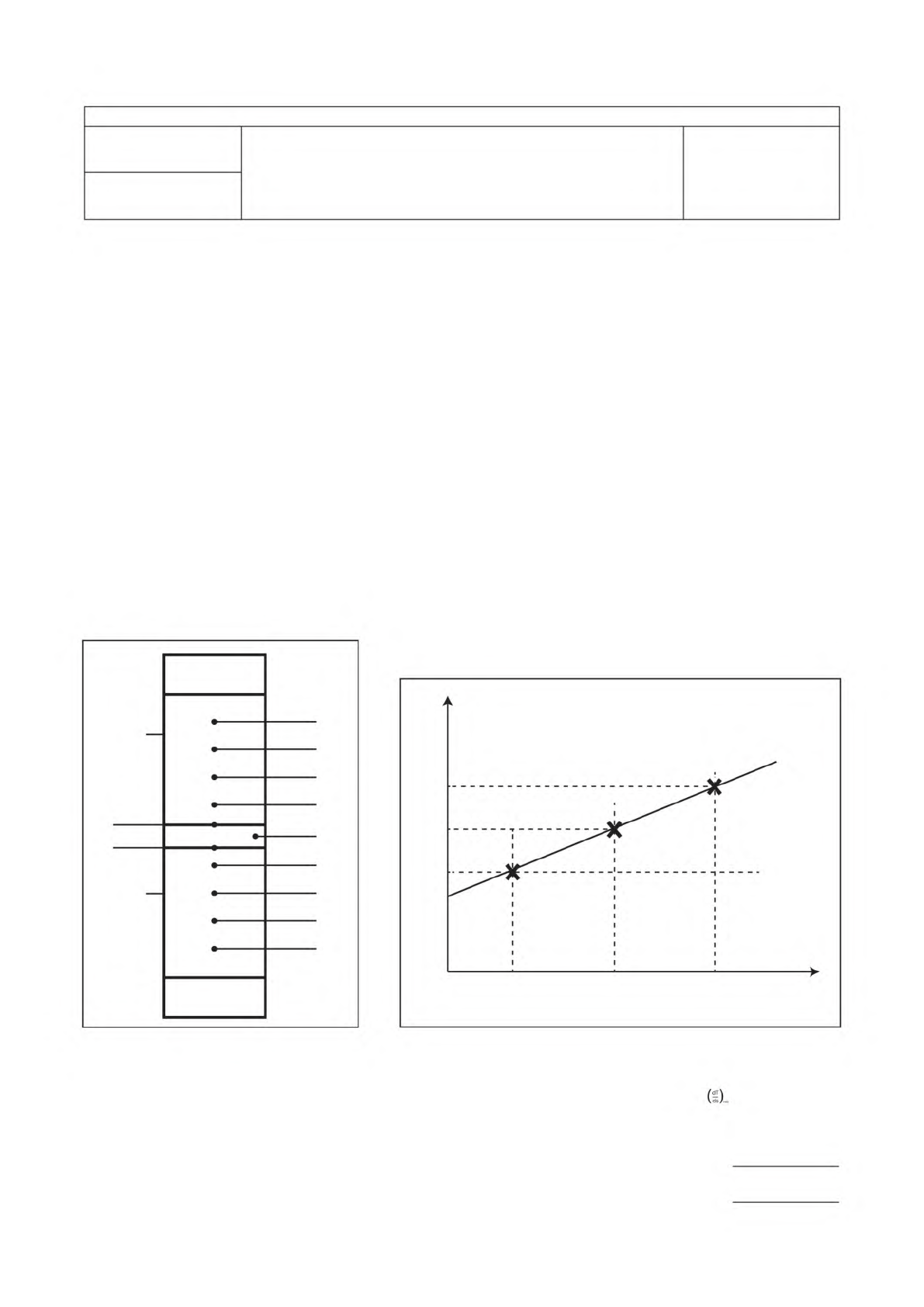
Use more than two thermocouples for the heat flow measurement on each meter bar. It is recommended to use four
thermocouples on every bar. This reduces the error in the slope (Figure 2). The thermocouples should be located in extreme
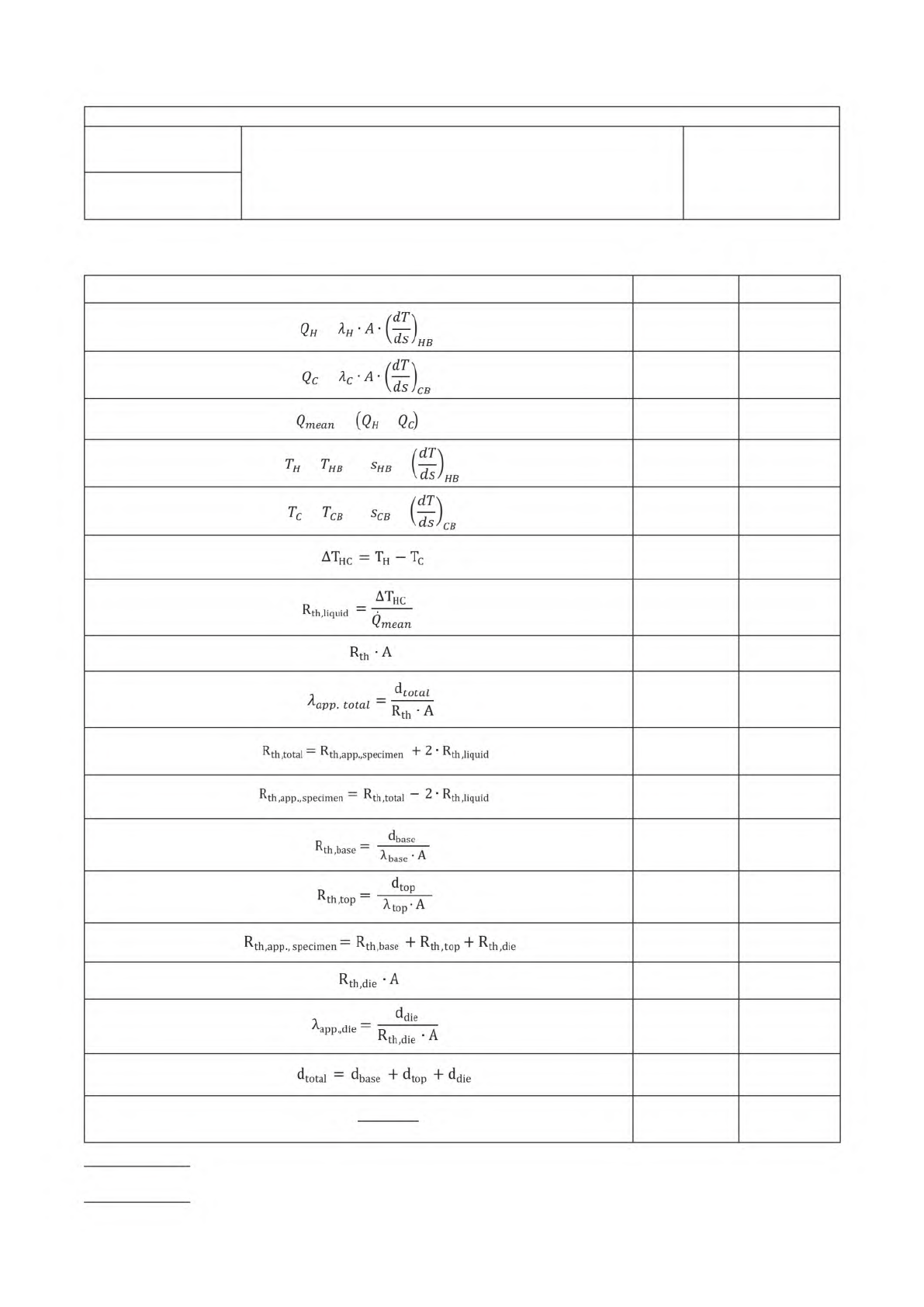
proximity to the surfaces (about 1.5 mm) (Table 1 Equations 1 to 3). Use thin calibrated thermocouples with a diameter of
< 0.6 mm and a measurement accuracy smaller than +/- 0.1 K. This increases the measurement accuracy significantly.
4.8
The heat flow meter bars are used to determine the temperature of the test surfaces by extrapolating the linear array of meter
bar temperatures to the test surfaces (Table 1 Equations 4, 5 and 6). This should be done for both, the hot side and cold side
meter bars (see Figure 1 Notes 2 and 3).
4.9
The recommended way to create a cooling source in the apparatus is with a metal block cooled by a temperature controlled
circulating liquid (e.g., silicone oil or even water, depending on the temperatures, which should be measured).
4.10
The temperature stability of both, the heating and cooling source, should be very high due to stationary conditions during
the test. Typical stabilities are +/- 0.1 K/(300 seconds).
4.11
The thermal contact resistances between the specimen and the heat flow meter bars is highly dependent on the contact
pressure, which is the reason why this parameter is important. A high contact pressure reduces the thermal contact resistances
and maintains the parallelism and alignment of the surfaces.
4.12
ForMBPBahighpressure≥2.0N/mm²shouldbeappliedduetoasignificantreductionofthethermalcontactresistant.
This guarantees more accurate testing results.
1
2
3
4
8
9
10
11
12
13
14
15
16
7
5
6
Figure1HotandColdMeterBardswithMore
ThanTwoThermocouples
Note1 – Hot Meter Bar,
see 1.3.1
Note2 – T
H
Note3 – T
C
Note4 – Cold Meter Bar
Note5 – Heat Source
Note6 – Specimen
Note7 – Heat Sink
Note8 – T
HB,1
Note9 – T
HB,2
Note10 – T
HB,3
Note11 – T
HB,4
Note12 – T
S
,
see 6.4.2 and
Table 1
Equation 18
Note13 – T
CB,1
Note14 – T
CB,2
Note15 – T
CB,3
Note16 – T
CB,4
1
2
3
4
5 6
8
7 x
y
Figure2LinearRegressiontoDeterminetheHeatFlowintheHotMeterBar
OutofThreeorMoreThermocouples
Note1 – T
HB,1
Note2 – T
HB,2
Note3 – T
HB,3
Note4 – T
H
Note5 – S
HB,3
Note6 – S
HB,2
Note7 – S
HB,1
Note8 – Slope:
Note9 – x – Path s in m
Note10 – y – Temperature in K
IPC-TM-650
Number Subject Date
Revision
Page 4 of 7
2.4.54
TestMethodforThermalTransmissionPropertiesof
09/2022
MetalBasedPrintedBoards(MBPB)
N/A
Table 1 Equations
Equation Unit Reference
̇
=
W 1
̇
=
W 2
̇
=
̇
+
̇
/2
W 3
=
,3
−
,3
∙
°C 4
=
,1
+
,1
∙
°C 5
K 6
K/W 7
mm²K/W 8
W/(mK) 9
K/W 10
K/W 11
K/W 12
K/W 13
K/W 14
mm²K/W 15
W/(mK) 16
µm 17
T
S
=
(T
H
+ T
C
)
2
°C 18
—
/dT、
Qh
y
小(茄).
Qc
死
4
偿)
\ds
/CB
Qmean
(Q“
Qc)
(dT、
除
THB
Shb
庆脑
Tc
%
Scb
(给
—
Th
—
Tc
_
AThc
Rth,liquid
—
A
xmean
%
-
A
7
_
dtotaB
4a
pp.
total
—
p
T
Kth
'
a
Rth,
total
—
Rth,app.,
specimen
+
2
'
Rth,
liquid
Rth,app.,
specimen
=
Rth,
total
—
2
'
Rth,
liquid
D
dbase
Ease-
入
base・
A
二
dtop
—top-
入
top
•
A
Rth,app.,
specimen
—
th,
base
+
th,
top
+
th,
die
th,
die
A
3
_
ddie
—
R
.
a
Kth,
die
dtotal
—
dbase
+
^top
+
ddie
—