IPC-TM-650 EN 2022 试验方法--.pdf - 第422页
5.2.1.2 Verif ication Fi eld C heck The method inclu de s a verification procedure to test the success of the measurement set-up in determining propagation delay. The ve rification pro- cedure f ollows t he same steps us…
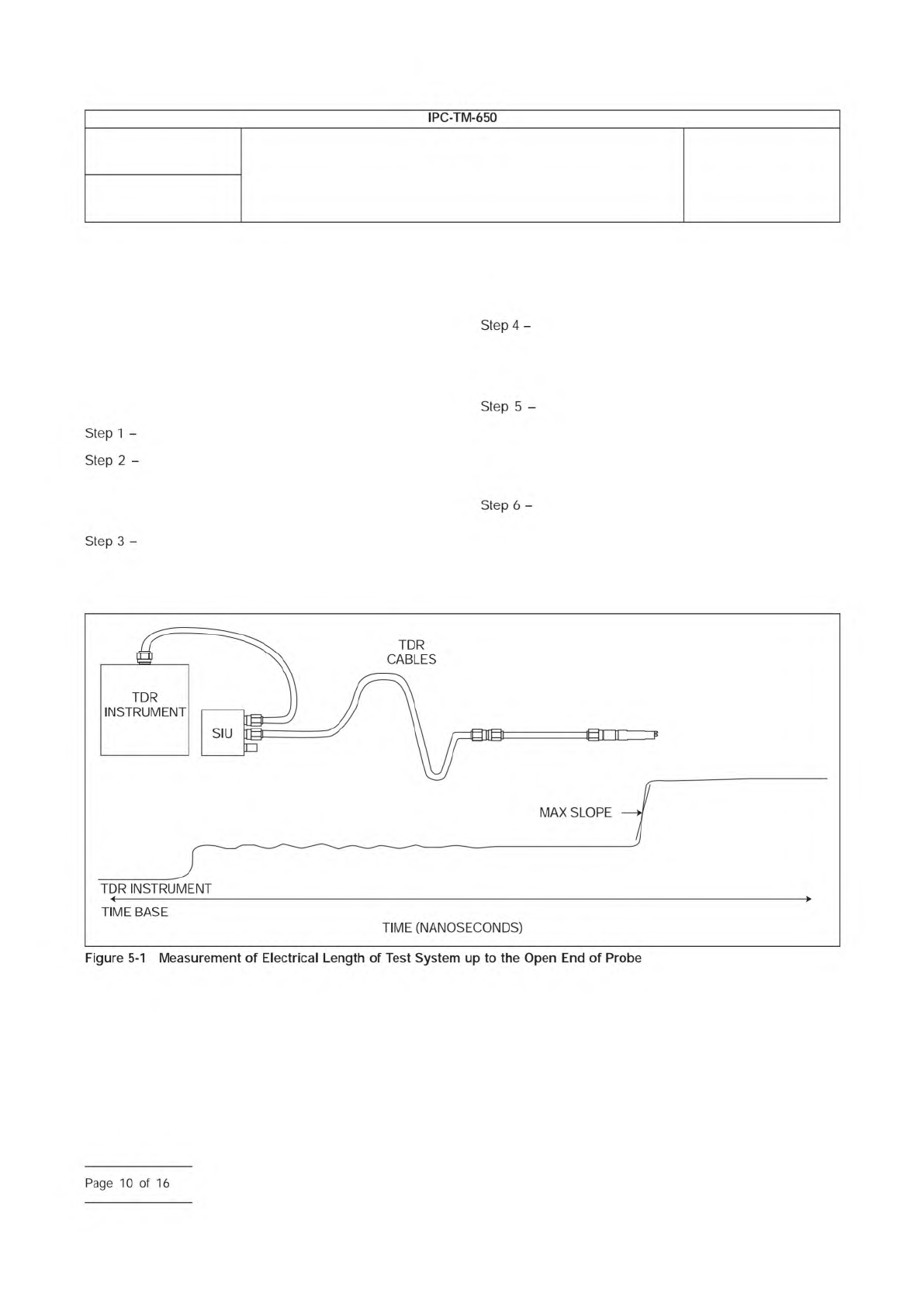
5.2.1.1 Establishing the Electrical Length of the Mea-
surement System
To assist in tracking the repeatability and
suitability of the measurement system, the method includes
the following procedure to determine the electrical length of
the TDR measurement system from the TDR sampler to the
end of the probe tip. The user may record this time value for
a given set-up over subsequent measurement sessions in
order to verify consistency in system performance over long
time periods.
Turn on the TDR source and enable triggering.
Hold the probe in the air away from other objects
and surfaces and set the waveform epoch to include both the
incident signal from the TDR source and the superimposed
reflection signal from the probe tip (see Figure 5-1).
For this epoch, adjust the number of sample points
to achieve a sample density of no less than 2 S/ps. For
example, this is achieved with a time record of 4,000 sample
points and a waveform epoch that is 2,000 ps long (10 divi-
sion x 200 ps/div).
Identify the arrival time t
inc
of the incident pulse edge
as 50% of the incident amplitude. For step signals, use the
difference of average pre- and post-step voltage levels to
establish the incident amplitude.
Identify the arrival time t
refl
of the reflection pulse
edge as 50% of the reflection amplitude. For step signals, use
the difference of average pre- and post-step voltage levels to
establish the reflection amplitude (this is often near the region
of maximum dV/dt.)
Record the system’s electrical length as one half of
the round-trip time: t
syslen
= (t
ref
- t
inc
)/2.
IPC-25511-5-1
(Note: The optional static isolation unit (SIU) is a protection device designed to eliminate static discharge damage to the TDR sampling
head.)
Number
2.5.5.11
Subject
Propagation Delay of Lines on Printed Boards by TDR
Date
04/2009
Revision
IPC-TM-650
Step
1
-
Step
2
-
Step
3
-
Step
4
-
Step
5
-
Step
6
-
Page
10
of
16
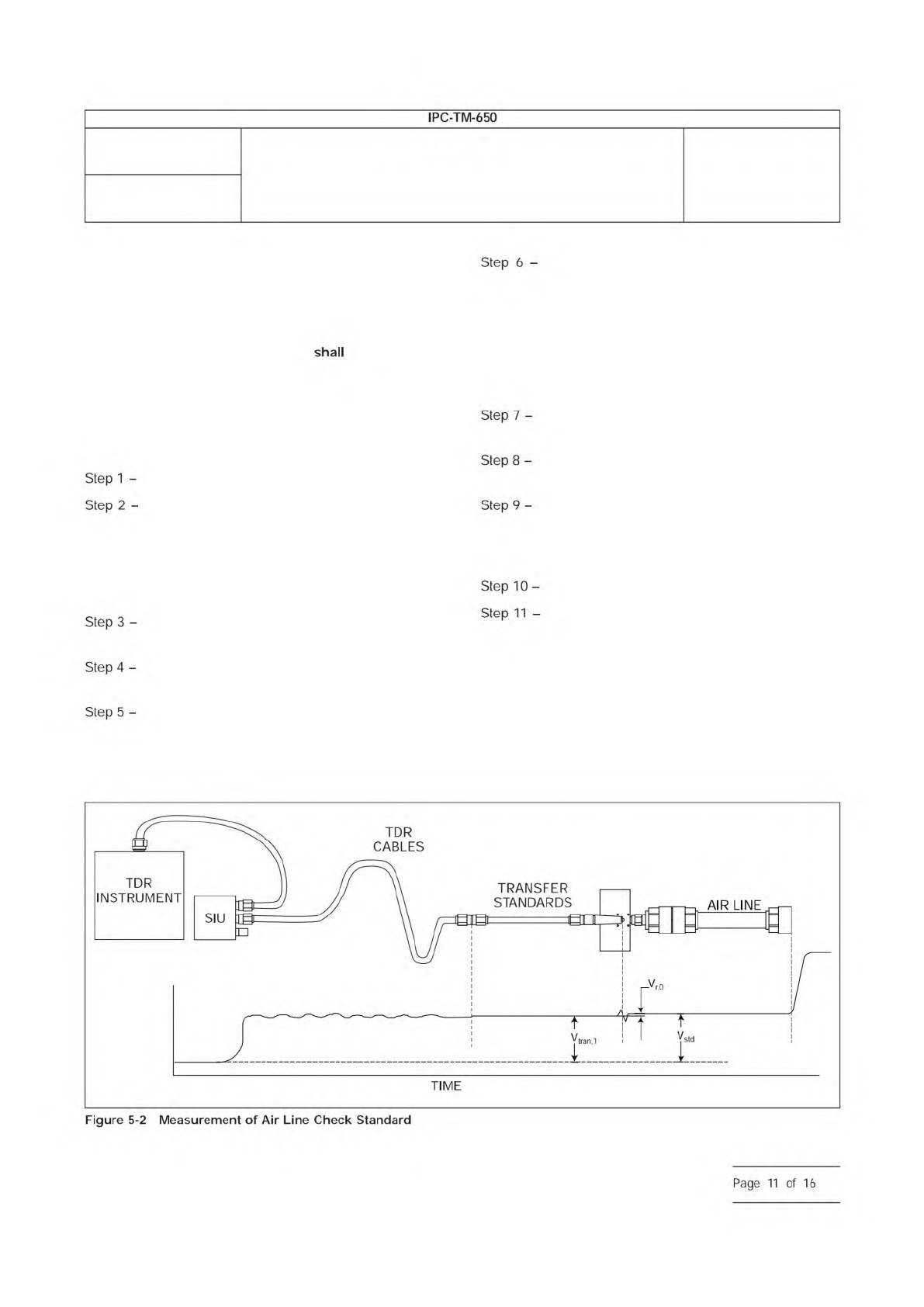
5.2.1.2 Verification Field Check
The method includes a
verification procedure to test the success of the measurement
set-up in determining propagation delay. The verification pro-
cedure follows the same steps used when characterizing test
specimens, but uses known and precise delay verification ele-
ments (as described in 4.3.7.) The user
perform this field
check prior to reporting delay results from the test specimens.
The user must fabricate their own transition cards that allow
electrical connection to the end of the coaxial air lines using
the probes of the measurement set-up. Figure 5-2 shows the
probe contacting a transition to coaxial adapter.
Turn on the TDR source and enable triggering.
Connect the probe-to-coax adapter to one end of
the longer air line check standard, leaving the opposite end
open circuit. For beadless air lines, this requires the addition
of an open circuit coax adapter at the far end in order to hold
the center conductor in place. As with all coax connections,
use the appropriate connection torque (see 4.3.1).
Connect the probe to the contact pads of the tran-
sition adapter.
Adjust the waveform epoch to capture the reflection
signal from the far end of the longer open circuit air line.
Measure the arrival time of the reflection signal from
the open circuit by testing when the reflection signal crosses
V
REF
as defined above for the user-selected value of x. Record
the arrival time value as t
T1
.
Connect the same probe-to-coax adapter used
above in Step 2 to one end of the shorter air line check stan-
dard, leaving the opposite end open circuit. For beadless air
lines, this requires the addition of an open circuit coax adapter
at the far end in order to hold the center conductor in place.
Use the same open circuit coax adapter used in Step 2. As
with all coax connections, use the appropriate connection
torque (see 4.3.1).
Connect the probe to the contact pads of the tran-
sition adapter.
Adjust the waveform epoch to capture the reflection
signal from the far end of the shorter open circuit air line.
Measure the arrival time of the reflection signal from
the open circuit by testing when the reflection signal crosses
V
REF
as defined above for the user-selected value of x. Record
the arrival time value as t
T2
.
Calculate the propagation time t
p
= t
T1
- t
T2
.
Compare t
p
to the difference in delay values pro-
vided by the air line manufacturer or calibration lab, and test
whether or not the measurement system t
p
agrees with the
standards to within the uncertainty target of the measurement
system or desired uncertainty required by the test specimens.
The propagation time will not be known to contain a better
resolution than that established in 4.1.2.
IPC-25511-5-2
Number
2.5.5.11
Subject
Propagation Delay of Lines on Printed Boards by TDR
Date
04/2009
Revision
SIU
TIME
TDR
INSTRUMENT
Step
1
-
Step
2
-
Step
3
-
Step
4
-
Step
5
-
Step
6
-
Step
7
-
Step
8
-
Step
9
-
Step
10
-
Step
11
-
Figure
5-2
Measurement
of
Air
Line
Check
Standard
IPC-TM-650
—
Page
11
of
16
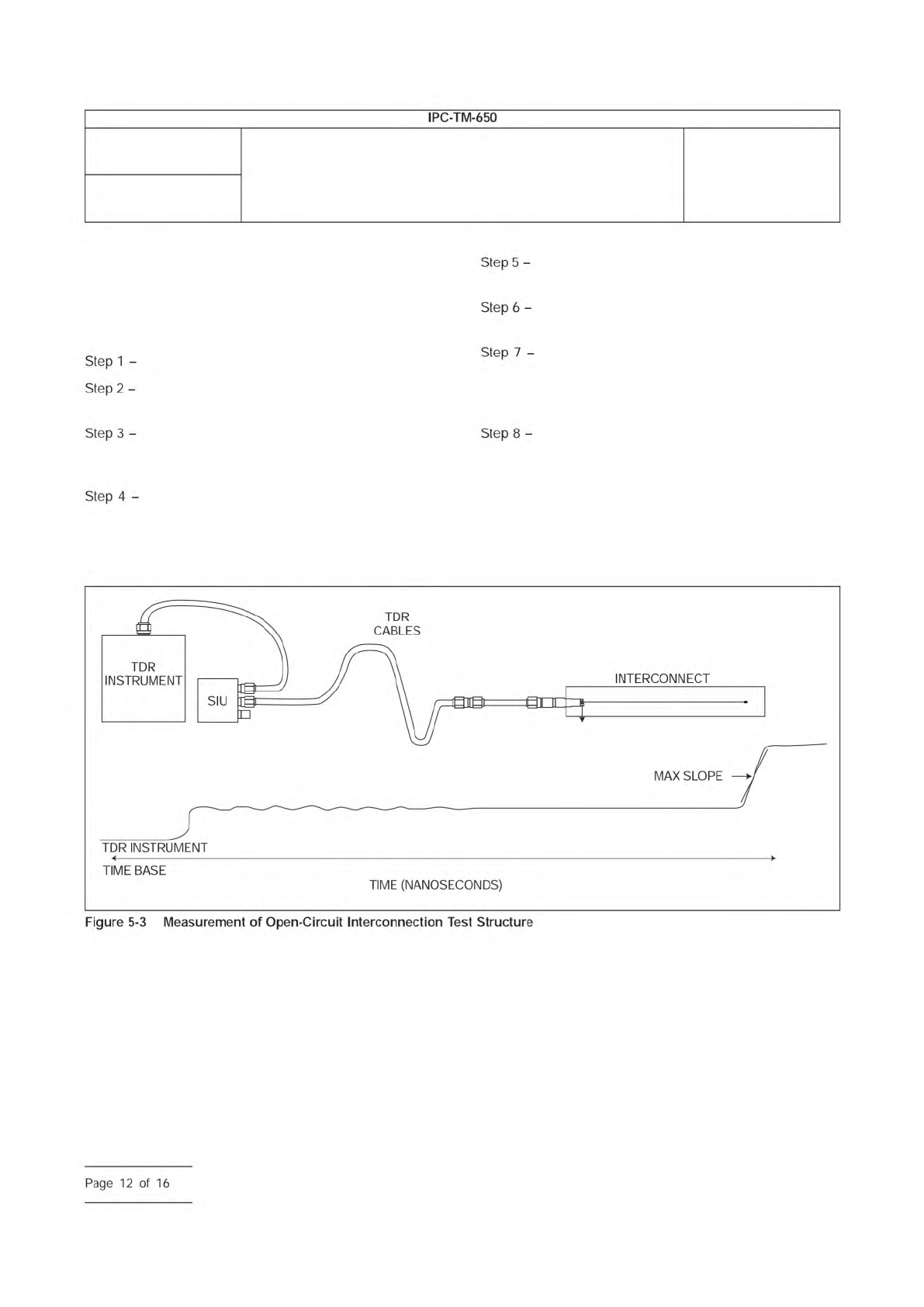
5.2.1.3 Test Specimen Measurement Process
This pro-
cedure will measure two interconnection test structures of dif-
ferent lengths. The propagation delay is calculated from the
measurements of the difference in TDR reflections from the
two test structures that differ in physical and electrical length.
Turn on the TDR source and enable triggering.
Connect the probe to the contact pads of the longer
interconnection test structure.
Adjust the waveform epoch to capture the reflection
signal from the far end of the longer test line. Figure 5-3
shows the case for an open circuit test structure.
Measure the arrival time of the reflection signal by
testing when the reflection signal crosses V
REF
as defined
above for the user-selected value of x. Record the arrival time
value as t
T1
.
Connect the probe to the contact pads of the shorter
interconnection test structure.
Adjust the waveform epoch to capture the reflection
signal from the far end of the shorter test line.
Measure the arrival time of the reflection signal by
testing when the reflection signal crosses V
REF
as defined
above for the user-selected value of x. Record the arrival time
value as t
T2
.
Calculate and record the Propagation Delay for this
test structure pair:
t
d
= t
p
/ 2L
p
where the propagation time is t
p
= t
T1
- t
T2
and the propaga-
tion length is the difference in the physical lengths of the test
structures, L
p
= L
1
- L
2
.
IPC-25511-5-3
Number
2.5.5.11
Subject
Propagation Delay of Lines on Printed Boards by TDR
Date
04/2009
Revision
IPC-TM-650
Step
1
-
Step
2
-
Step
3
-
Step
4
-
Step
5
-
Step
6
-
Step
7
-
Step
8
-
TDR
INSTRUMENT
<
TIME
BASE
TIME
(NANOSECONDS)
Figure
5-3
Measurement
of
Open-Circuit
Interconnection
Test
Structure
Page
12
of
16