IPC-TM-650 EN 2022 试验方法--.pdf - 第442页
operation is s pecified in Equation 5-2. I_R j = RB j − RB j − 1 t j − t j − 1 I_T j = TB j − TB j − 1 t j − t j − 1 [5-2] 5.2.2.4 RIE Results The r eference st ructure, RIE reference , is the square root of the square o…
4.4.11 TDR ESD Protection
TDR equipment pro-
vide ESD protection commensurate with the test environment.
It is recommended that samples be grounded to remove any
residual static to protect against static discharge with in the
test environments.
Static can be built up on samples prior to test and can dam-
age the sampling heads in the TDR/TDT equipment. There-
fore, it is recommended that ESD protection be used. Such
protection must be supplied internally to the TDR system.
Samples should be grounded to remove any residual static
and/or passed through some type of deionization device prior
to testing. This can be done by shorting each line to ground
with a simple connection between one end of the lines and
the instrument ground. Keeping the relative humidity in the
test area between 45% and 55% may minimize the buildup of
static. Operators are always required to have a grounding
strap around one wrist having a 1 MΩ resistor in series with it.
Special waxing can be used on the lab floor to prevent body
charge build-up. Always use a grounded, conductive table
mat. Always wear a heel strap. Always ground the center con-
ductor of a test cable before making a connection to static-
sensitive equipment.
4.5 SPP Test Apparatus
4.5.1 Other SPP Equipment Requirements
An LCR
meter is required that can measure capacitance at 1 MHz.
4.5.2 SPP Software
The following software is required for
implementation of the SPP technique:
a) Gamma-Z software for signal processing or equivalent
b) 2D field solver such as CZ2D, which can be downloaded
from: www.alphaworks.ibm.com/tech/gammazandcz2d,
or equivalent
4.6 FD Test Apparatus
The measurement equipment
needed includes a VNA, cabling, a probing solution, and a
calibration structure and calibration coefficients that are
acquired from the probe or connector manufacturer. The
probing solution should match the test sample chosen from
the above described samples. High performance connectors
and cables are recommended in performing VNA measure-
ments. Optionally, a TDT system may be used in place of a
VNA to acquire frequency domain attenuation and loss data.
5 Procedures
5.1 EBW Measurements Procedure
5.1.1 Measurement Process
This procedure will measure
the maximum slope of the rise time of the combined measure-
ment system and DUT and determine a loss factor. Recom-
mended resolution is 4000 points with a horizontal scale of
200 ps/div.
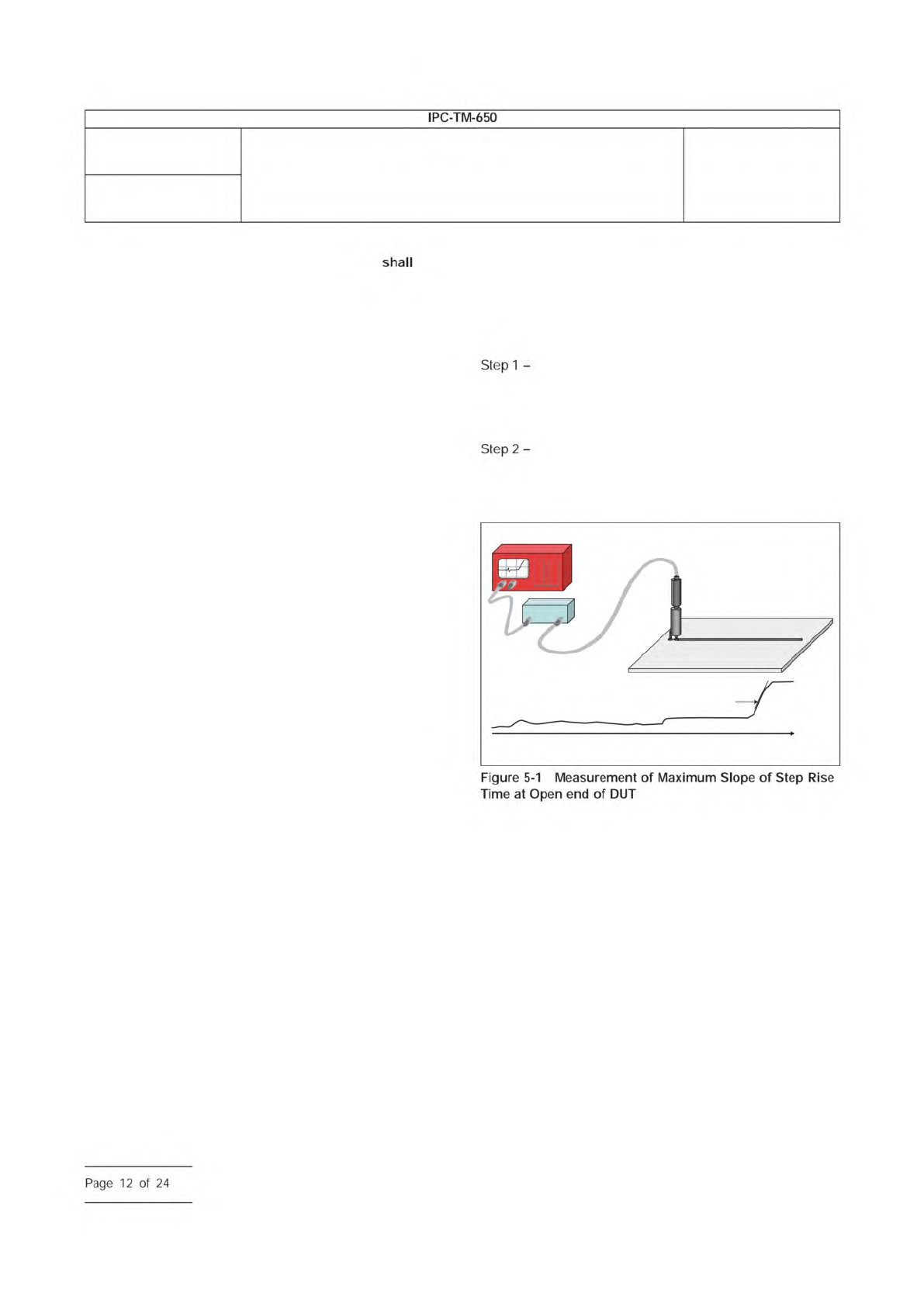
Probe the interconnect (see Figure 5-1) and measure
the maximum slope of the step response in Megavolts/second
(e.g., 430 Megavolts/second). The maximum slope may be
directly acquired from TDR equipment with that capability.
Report the Loss Factor at the test system bandwidth
(as measured within 4.4.5.1) (e.g., 430 Megavolts/second @
14.5 GHz).
5.2 RIE Measurement Procedures
Figure 5-2 summa-
rizes the RIE measurement procedure.
The RIE method utilizes a comparison between a reference
loss (line) measurement and a test conductor (line) measure-
ment. The reference measurement may be a calibration stan-
dard or short length of conductor in the neighborhood and on
the same layer as the conductor to be measured.
5.2.1 TDR – Open or Unterminated Line Requirement
The RIE method requires a measurement of lines where one
end is a probe launch and the other end is left unterminated
or open. The probe injects a fast step at the launch point in
much the same manner specified in IPC-TM-650, Method
2.5.5.7. The injected step causes a wave to propagate down
the line; most of the wave is reflected by the open end of the
line and travels back to the source where it is measured as the
superposition of the incident wave and all the reflections.
IPC-25512-5-1
TDR Instrument
probe
SIU
Maximum
risetime
DUT
(interconnect)
Time
Number
2.5.5.12
Subject
Test Methods to Determine the Amount of Signal Loss on
Printed Boards
Date
07/12
Revision
A
IPC-TM-650
—
shall
Step
1
-
Step
2
-
Figure
5-1
Measurement
of
Maximum
Slope
of
Step
Rise
Time
at
Open
end
of
DUT
Page
12
of
24
operation is specified in Equation 5-2.
I_R
j
=
RB
j
− RB
j−1
t
j
− t
j−1
I_T
j
=
TB
j
− TB
j−1
t
j
− t
j−1
[5-2]
5.2.2.4 RIE Results
The reference structure, RIE
reference
, is
the square root of the square of the integral of the square of
the impulse response I_R, and can be calculated from J
samples as show in Equation 5-3. The test structure, RIE
test
,
is the square root of the square of the integral of the square
of the impulse response I_T, and is calculated from J samples
as show in Equations 5-3 and 5-4.
RIE
reference
=
√
Σ
j=1
J
I_R
j
2
(t
1
− t
0
)
[5-3]
RIE
test
=
√
Σ
j=1
J
I_T
j
2
(t
1
− t
0
)
[5-4]
The RIE loss in dB, RIE
loss_dB
, is calculated by dB ratio of the
RIE
test
to RIE
reference
as show in Equation 5-5.
RIE
loss_db
= 20 * log
(
RIE
test
RIE
reference
)
[5-5]
5.3 SPP Procedure
Figure 5-4 summarizes the SPP mea-
surement extraction process.
5.3.1 Selecting Optimum SPP Transmission Lines
SPP
utilizes measurements on two lines of different lengths such as
2.0 cm and 8.0 cm. The pair
be designed to be identi-
cal in every way except for length. The SPP is used to extract
parameters such as α(f) β(f), Γ(f) and Z
0
(f) by utilizing the dif-
ference between the two specimen line lengths. Effects due to
the connectors, cables, probes, and oscilloscope circuitry can
be minimized using this method. Screening the two lines
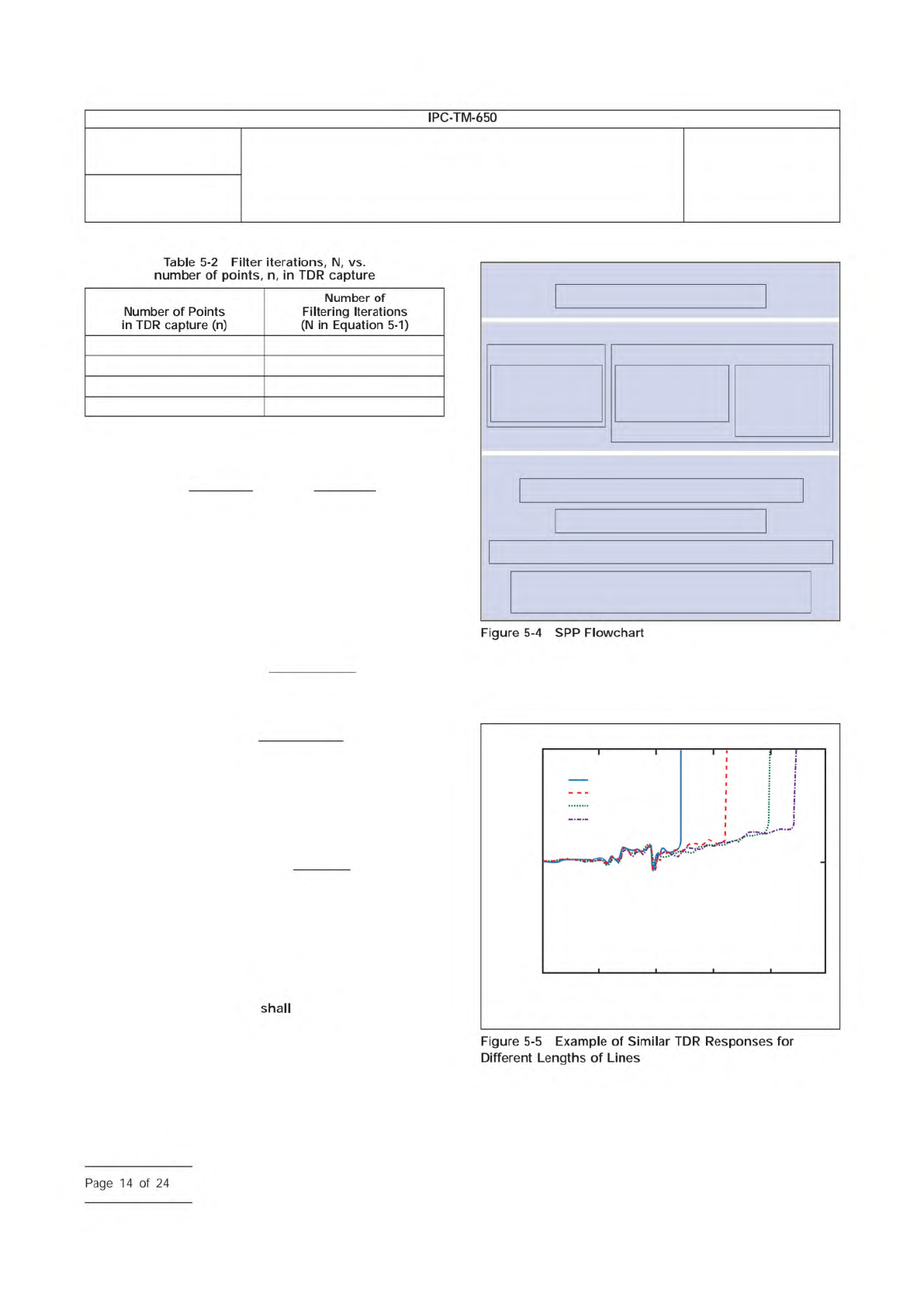
improves accuracy. Figure 5-5 illustrates lines of similar
design. Accuracy is improved when the slope and deviation
along the lengths of overlaid portions of the respective TDR
waveforms are coincident.
5.3.1.1 Additional SPP Step for Differential Lines
There
are a few additional steps needed when analyzing differential
lines. The TDR screening still needs to be performed first. In
0 > n ≥750 1
750 > n ≥1500 2
1500 > n ≥3000 6
> n >3000 21
TDR
Select best candidates for line pairs
Low Freq
TDT
disc
Determine
1MHzε
r
and Tan δ
(LCR meter)
Determine
Capacitance/unit
length (LCR meter)
Determine
Resistance/unit
length ρ and
(LCR meter)
Lines
Acquire Impulse response for 2 lines of 2 lengths
Window and filter Impulse response
FFT to get Propagation Constant Γ (Attenuation and Phase)
Use itrative matching of Γ, Att, and low freq
parameters to determine tline modeling parameters
IPC-25512-5-5
0.3
0.2
0.25
1.5 2.5
Time (nsec)
Voltage (V)
3.52
1=2 cm
1=5 cm
1=8 cm
1=9.8 cm
3 4
Number
2.5.5.12
Subject
Test Methods to Determine the Amount of Signal Loss on
Printed Boards
Date
07/12
Revision
A
IPC-TM-650
—
Table
5-2
Filter
iterations,
N,
vs.
number
of
points,
n,
in
TDR
capture
Number
of
Points
in
TDR
capture
(n)
Number
of
Filtering
Iterations
(N
in
Equation
5-1)
Figure
5-4
SPP
Flowchart
shall
Figure
5-5
Example
of
Similar
TDR
Responses
for
Different
Lengths
of
Lines
Page
14
of
24
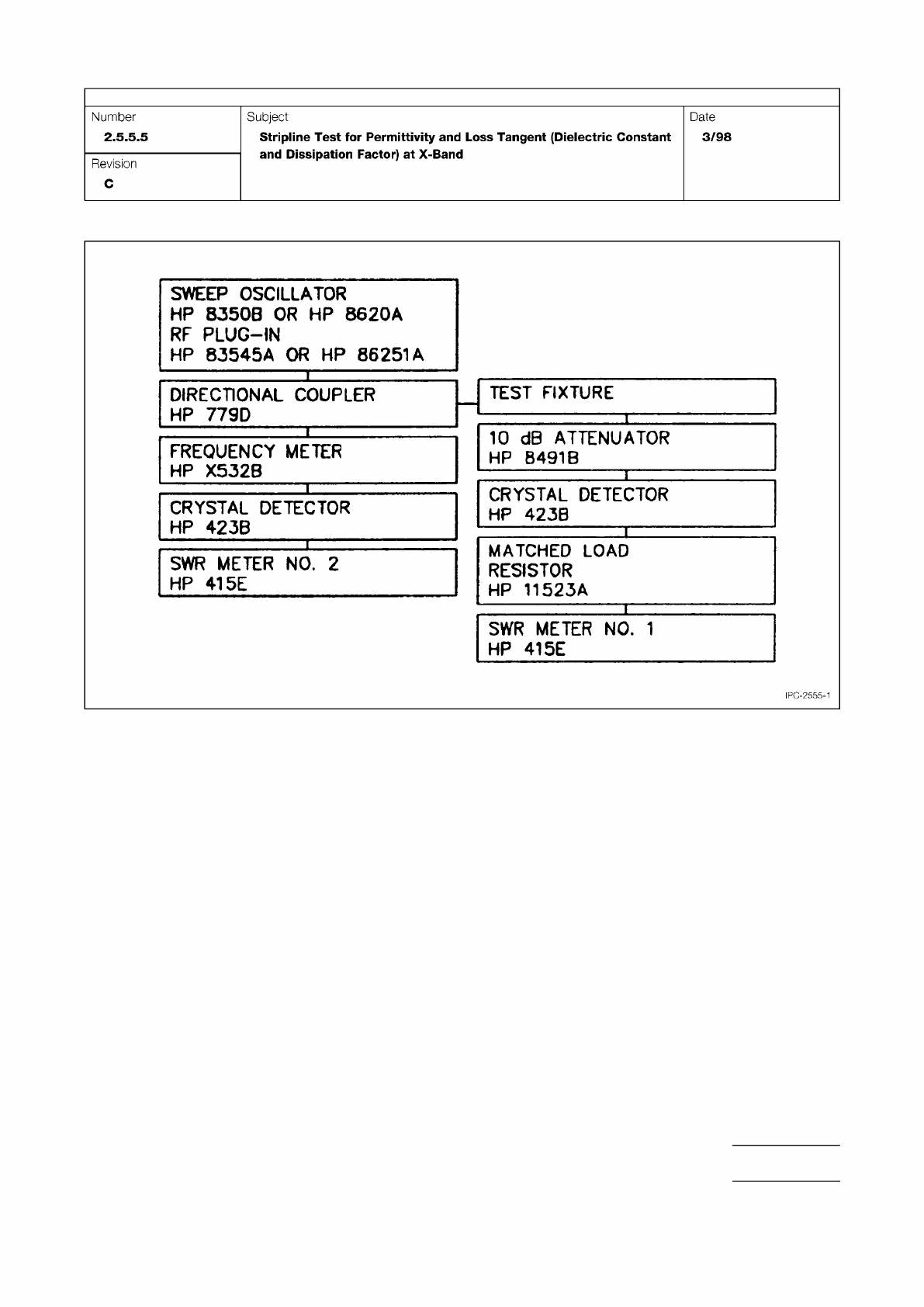
Figure 1 X-Band Permittivity Test Setup
IPC-TM-650
Page 11 of 25
Number
2.5.5.5
Subject
Stripline
Test
for
Permittivity
and
Loss
Tangent
(Dielectric
Constant
and
Dissipation
Factor)
at
X-Band
Date
3/98
Revision
C
SWEEP
OSCILLATOR
HP
8350B
OR
HP
8620A
RF
PLUG-IN
HP
83545A
OR
HP
86251
A
DIRECTIONAL
COUPLER
HP
779D
—
TEST
FIXTURE
I
1
10
dB
ATTENUATOR
HP
8491
B
FREQUENCY
METER
HP
X532B
1
1
CRYSTAL
DETECTOR
HP
423B
CRYSTAL
DETECTOR
HP
423B
1
MATCHED
LOAD
RESISTOR
HP
11523A
SWR
METER
NO.
2
HP
41
5E
1
SWR
METER
NO.
1
HP
41
5E
IPC-2555-1