IPC-TM-650 EN 2022 试验方法--.pdf - 第464页
available based on equation ( 1). No te tha t the de-embedded insertion loss is defined with a referenc e impedance of the transmission line. 1.3 Gen eral Cali brati on/de-embedding Metho d s to Set up Correct Reference …
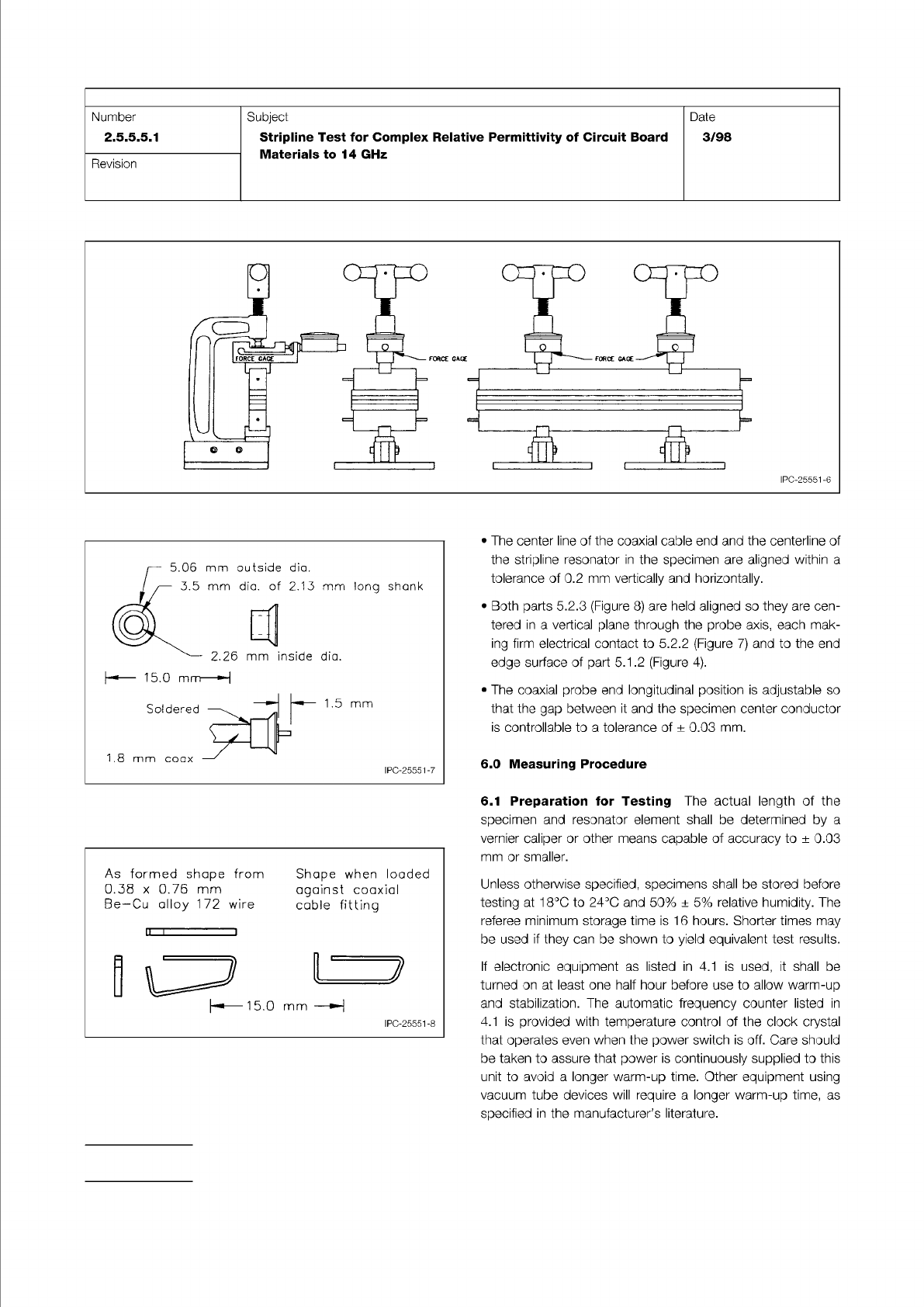
Figure 6 Clamp Arrangement (See 5.1.5) Showing Side and Front Views for Specimen Lengths of 76.2 mm and 304.8 mm
Figure 7 Copper Fitting with Reverse Bevel (See 5.2.2)
Soldered to the 1.8 mm Semi-Rigid Coaxial Cable Probe
Figure 8 Formed Be-Cu Alloy Wire for Ground Continuity
from Coaxial Cable Fitting to Copper Ground Plate
IPC-TM-650
Page 6 of 11
Number
2.5.5.5.1
Revision
Subject
Stripline
Test
for
Complex
Relative
Permittivity
of
Circuit
Board
Materials
to
14
GHz
Date
3/98
IPC-25551-6
As
formed
shape
from
0.33
x
0.76
mm
Be—
Cu
alloy
1
72
wire
Shape
when
loaded
against
coaxial
cable
fitting
H
—
1
5.0
mm
—
H
IPC-25551-8
•
The
center
line
of
the
coaxial
cable
end
and
the
centerline
of
the
stripline
resonator
in
the
specimen
are
aligned
within
a
tolerance
of
0.2
mm
vertically
and
horizontally.
•
Both
parts
5.2.3
(Figure
8)
are
held
aligned
so
they
are
cen¬
tered
in
a
vertical
plane
through
the
probe
axis,
each
mak¬
ing
firm
electrical
contact
to
5.2.2
(Figure
7)
and
to
the
end
edge
surface
of
part
5.1.2
(Figure
4).
•
The
coaxial
probe
end
longitudinal
position
is
adjustable
so
that
the
gap
between
it
and
the
specimen
center
conductor
is
controllable
to
a
tolerance
of
土
0.03
mm.
6.0
Measuring
Procedure
6.1
Preparation
for
Testing
The
actual
length
of
the
specimen
and
resonator
element
shall
be
determined
by
a
vernier
caliper
or
other
means
capable
of
accuracy
to
土
0.03
mm
or
smaller.
Unless
otherwise
specified,
specimens
shall
be
stored
before
testing
at
18℃
to
24℃
and
50%
±
5%
relative
humidity.
The
referee
minimum
storage
time
is
16
hours.
Shorter
times
may
be
used
if
they
can
be
shown
to
yield
equivalent
test
results.
If
electronic
equipment
as
listed
in
4.1
is
used,
it
shall
be
turned
on
at
least
one
half
hour
before
use
to
allow
warm-up
and
stabilization.
The
automatic
frequency
counter
listed
in
4.1
is
provided
with
temperature
control
of
the
clock
crystal
that
operates
even
when
the
power
switch
is
off.
Care
should
be
taken
to
assure
that
power
is
continuously
supplied
to
this
unit
to
avoid
a
longer
warm-up
time.
Other
equipment
using
vacuum
tube
devices
will
require
a
longer
warm-up
time,
as
specified
in
the
manufacturer's
literature.
available based on equation (1). Note that the de-embedded
insertion loss is defined with a reference impedance of the
transmission line.
1.3 General Calibration/de-embedding Methods to Set
up Correct Reference Plane for Printed Board Conduc-
tor Insertion Loss Characterization
As mentioned earlier,
there are existing calibration/de-embedding methods for gen-
eral purpose interconnect characterization to move the cali-
bration reference plane to printed board interfaces. These
methods are validated by the industry, and therefore included
herein, although they are either more complicated or costly
than the Eigen-value based method.
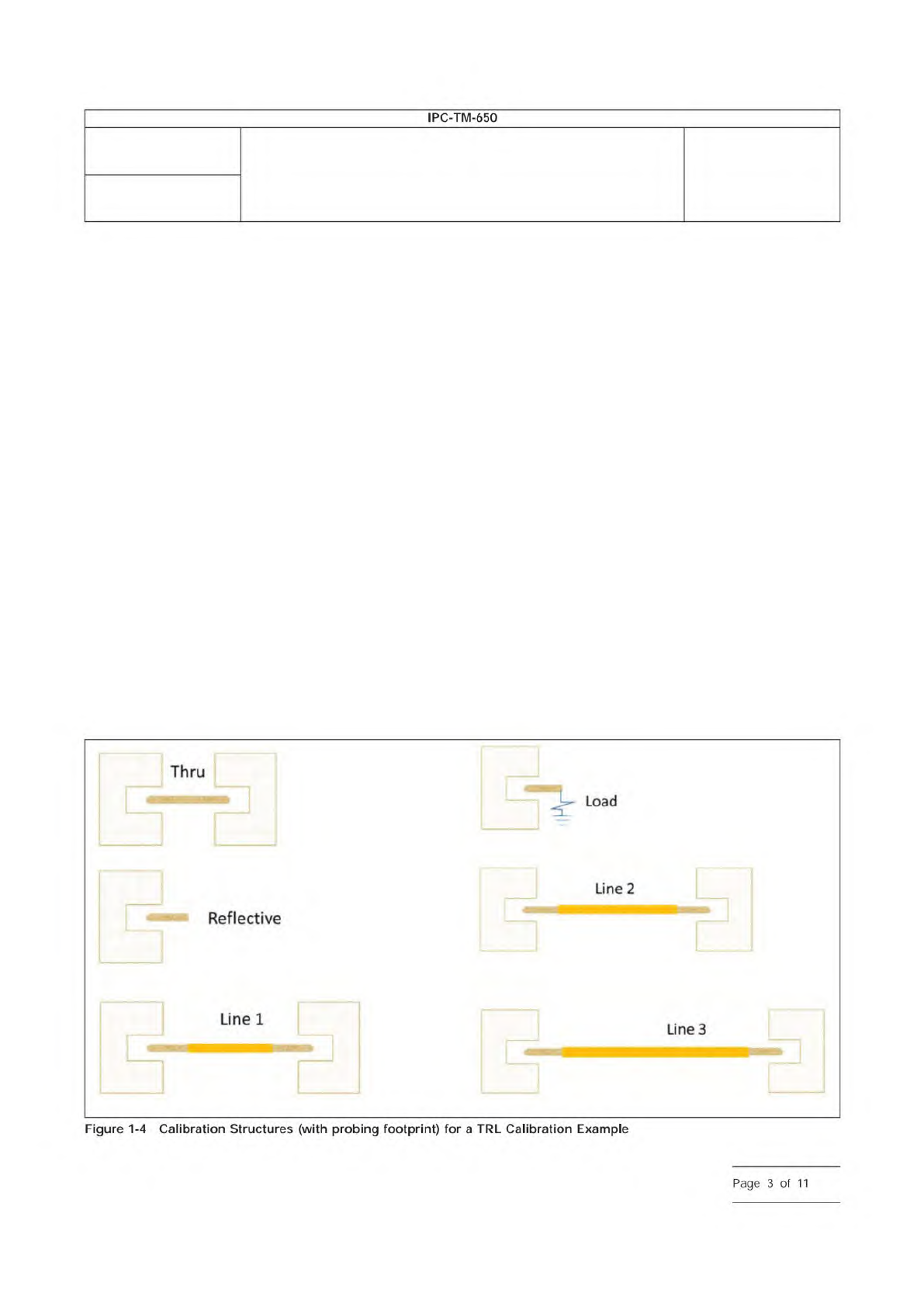
1.3.1 TRL Calibration
The TRL (and its variants such as
LRM) method [7] is a general approach to move the calibra-
tion reference plane from the coaxial connector to printed
board interfaces. Figure 1-4 shows the typical calibration
structures for a TRL calibration, with microwave probe foot-
print (with single-ended probing as an example). The TRL cali-
bration technique only relies on the characteristic impedance
of the transmission line and does NOT need the parasitics of
Reflective Standard to be known, nor propagation delay of
Line. A typical TRL calibration structure may also include a
Load structure that works only at very low frequencies, and
additional Line structures to cover a wide frequency range.
Most VNAs offer TRL calibration options, please refer to the
manual or application note for your specific equipment to per-
form a TRL calibration.
TRL calibration has been widely used in the industry since the
technique no longer requires accurate calibration termination
standards. This overcomes the difficulties of SOLT calibration,
and the reference plane can be moved to the printed board.
However, there are still some disadvantages to the TRL cali-
bration. For example, there are many components of the cali-
bration standard to handle. This takes substantial printed
board area and requires tedious calibration process in the lab,
while being prone to the operator error. Additionally, the TRL
technique requires accurate characteristic impedance specifi-
cation for the line standard, which is problematic to determine
in a dispersive environment.
1.3.2 2X-Thru De-embedding
In the last decade, the
2X-thru de-embedding methodology is gaining popularity due
to its simplicity of test fixture design and de-embedding pro-
cedures [8]. In contrast to the TRL calibration technique,
which requires measurement of multiple structures as shown
in Figure 1-4, 2X-Thru De-embedding requires only one
de-embedding structure.
The basic idea of the 2X-Thru de-embedding approach is
shown in Figure 1-5. The S-parameters of the 2X-thru
IPC-25514-1-4
Number
2.5.5.14
Subject
Measuring High Frequency Signal Loss and Propagation on
Printed Boards with Frequency Domain Methods
Date
02/2021
Revision
IPC-TM-650
—
Thru
Reflective
Line
1
Figure
1-4
Calibration
Structures
(with
probing
footprint)
for
a
TRL
Calibration
Example
Page
3
of
11
IPC-TM-650
Page 8 of 11
Number
2.5.5.5.1
Revision
Subject
Stripline
Test
for
Complex
Relative
Permittivity
of
Circuit
Board
Materials
to
14
GHz
Date
3/98
An
alternate
method
for
trimming
the
copper
strip
is
to
use
a
sharp
scalpel.
However,
this
can
smear
the
copper
across
that
the
specimen
end
surface,
especially
with
thin
speci¬
mens,
and
may
introduce
end
fringing
errors
on
short
L
val¬
ues.
6.1.5
Fasten
the
probe
assemblies
to
the
clamped
stack
at
both
ends
so
that
the
coaxial
cable
probe
end
is
centered
on
the
stripline
resonator
center
line.
Adjust
the
assembly
so
the
contact
areas
on
the
soldered
copper
fitting
make
firm
electri¬
cal
contact
by
the
wires
to
both
top
and
bottom
copper
plates.
Figure
9
shows
by
vertical
and
horizontal
sectional
views
through
the
stripline
resonator
centerline
this
relation¬
ship
among:
•
the
copper
ground
plates
(see
5.1.2).
•
the
specimen
with
conductors
(see
3.0).
•
the
coaxial
cable
with
extended
center
conductor
end
(see
5.2.1).
•
the
copper
fitting
(see
5.2.2)
soldered
to
the
coaxial
cable.
•
the
wire
connection
(see
5.2.3).
For
the
purpose
of
this
method
horizontal
orientation
is
paral¬
lel
to
the
plane
of
the
specimen
surface
in
the
fixture.
See
three
requirements
under
5.2.4.
6.1.6
Adjust
the
position
of
the
coaxial
cable
probe
ends
so
the
air
gaps
they
form
with
the
stripline
resonator
element
are
equal.
This
may
be
done
with
the
help
of
a
network
analyzer
set
for
lowest
frequency
by
adjusting
the
gaps
smaller
until
each
causes
a
sudden
shift
in
reflected
or
transmitted
power,
then
adjusting
them
back
to
a
small
gap
value,
equal
on
both
ends.
6.1.7
With
the
probe's
longitudinal
position
set
to
a
small
air
gap
such
as
0.05
mm,
use
an
appropriate
means
with
the
electronic
instrumentation
to
identify
the
approximate
location
of
the
lowest
resonant
frequency
(the
fundamental
where
the
resonator
length
is
half
the
wavelength
in
the
material
being
tested)
and
a
series
of
resonances
(harmonics)
up
to
the
high¬
est
frequency
of
interest.
Ideally
harmonic
resonances
occur
at
each
integer
multiple
of
the
fundamental
resonance.
The
integer
multiples
are
the
values
of
n
in
formula
1
of
section
7.1
.
Select
which
of
these
resonances
will
be
measured
as
discussed
in
section
6.3,
6.4,
or
6.5.
6.2
Adjustment
of
Air
Gap
for
Each
Resonance
Before
the
measurement
at
each
resonance,
adjust
the
air
gaps
at
each
probe
an
equal
amount
to
get
the
dB
insertion
loss
at
the
maximum
transmission
to
a
recommended
value
between
49.5
and
51.5
dB.
As
resonant
frequency
is
increased
from
resonance
to
resonance
for
a
given
specimen,
the
gap
required
for
a
nominal
50
dB
insertion
loss
at
resonance
tends
to
increase.
A
high
value
dB
minimizes
the
correction
for
unloaded
Q
and
makes
this
correction
less
sensitive
to
poor
data
on
the
baseline
dB
of
the
instrumentation.
Too
high
a
dB
value
will
put
the
measurements
down
in
the
noise
region
of
the
instrumentation,
making
results
less
certain
and
less
reproducible.
6.3
Manual
Measurement
of
the
Specimen
The
follow¬
ing
procedure
is
most
applicable
where
only
equipment
as
described
in
4.1
is
available.
The
equipment
of
4.2
could
also
be
operated
manually.
6.3.1
The
resonant
frequency
shall
be
found
by
scanning
frequency
over
the
expected
transmission
range
of
the
test
resonator.
The
frequency
shall
be
precisely
adjusted
to
get
a
maximum
reading
of
power
in
dB.
6.3.2
Determine
half
power
points
by
adjusting
frequency
to
give
three
dB
readings
both
above
and
below
the
maximum
transmission
frequency.
Measure
each
frequency
with
the
fre¬
quency
meter
and
record
the
results:
•
f1
-
3
dB
down,
below
the
maximum
transmission
fre¬
quency.
•
f2
-
3
dB
down,
above
the
maximum
transmission
fre¬
quency.
6.4
Automated
Measurement
of
the
Specimen
For
an
automated
system
to
be
used
in
performing
the
measure¬
ment,
computer
software
is
needed
that
will
collect
paired
values
of
frequency
and
transmitted
power.
From
this
data,
the
frequency
for
maximum
power
transmission
and
the
fre¬
quencies
of
the
half
power
points
are
determined.
The
com¬
puter
program
may
optionally
include
computation
of
permit¬
tivity
and
loss
tangent
as
described
in
section
7.0.
Results
and
collected
data
may
be
displayed
on
the
screen,
stored
in
a
disk
file,
sent
to
a
printer,
or
any
combination
of
these.
In
one
possible
mode
of
operation,
with
the
equipment
described
in
4.2,
the
sequence
of
steps
described
in
6.4.1
through
6.4.4
is
performed
as
many
times
as
necessary
to
get
enough
data
to
complete
the
test
procedure.
The
computer
is
designated
as
the
controller
on
the
GPIB.