IPC-TM-650 EN 2022 试验方法--.pdf - 第476页
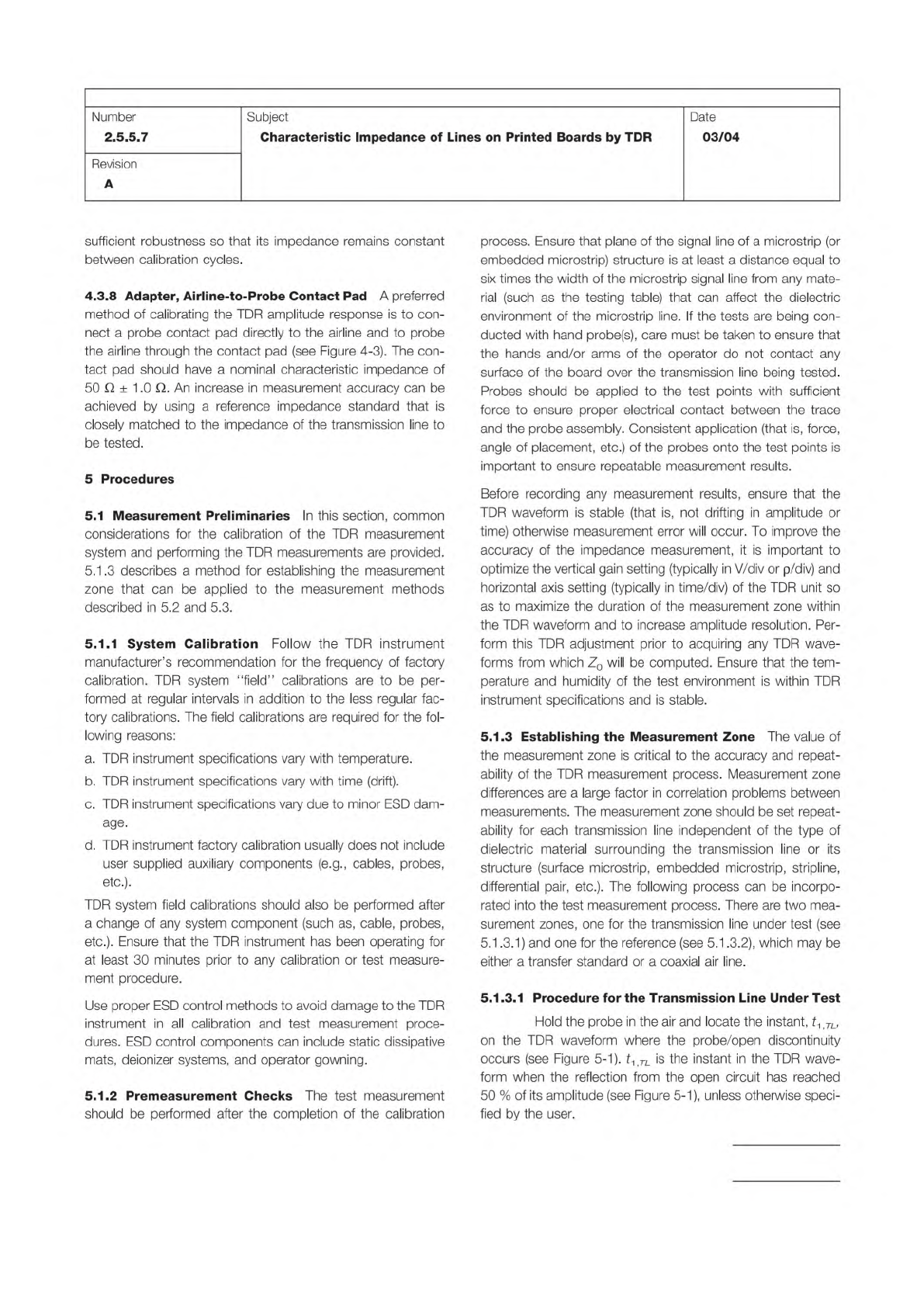
Step 2 – Step 3 – Step 4 – Step 5 – Figure 5-1 Determination of instant in the TDR wav eform corresponding to th e be ginning of the t ransmission line. A R,1 is the amplitude of the sign al reflected fro m the op en end …
Step 1 –
IPC-TM-650
Page 7 of 23
Number
2.5.5.7
Subject
Characteristic
Impedance
of
Lines
on
Printed
Boards
by
TDR
Date
03/04
Revision
A
sufficient
robustness
so
that
its
impedance
remains
constant
between
calibration
cycles.
4.3.8
Adapter,
Airline-to-Probe
Contact
Pad
A
preferred
method
of
calibrating
the
TDR
amplitude
response
is
to
con¬
nect
a
probe
contact
pad
directly
to
the
airline
and
to
probe
the
airline
through
the
contact
pad
(see
Figure
4-3).
The
con¬
tact
pad
should
have
a
nominal
characteristic
impedance
of
50
Q
±
1
.0
Q.
An
increase
in
measurement
accuracy
can
be
achieved
by
using
a
reference
impedance
standard
that
is
closely
matched
to
the
impedance
of
the
transmission
line
to
be
tested.
5
Procedures
5.1
Measurement
Preliminaries
In
this
section,
common
considerations
for
the
calibration
of
the
TDR
measurement
system
and
performing
the
TDR
measurements
are
provided.
5.1
.3
describes
a
method
for
establishing
the
measurement
zone
that
can
be
applied
to
the
measurement
methods
described
in
5.2
and
5.3.
5.1.1
System
Calibration
Follow
the
TDR
instrument
manufacturer's
recommendation
for
the
frequency
of
factory
calibration.
TDR
system
"field"
calibrations
are
to
be
per¬
formed
at
regular
intervals
in
addition
to
the
less
regular
fac¬
tory
calibrations.
The
field
calibrations
are
required
for
the
fol¬
lowing
reasons:
a.
TDR
instrument
specifications
vary
with
temperature.
b.
TDR
instrument
specifications
vary
with
time
(drift).
c.
TDR
instrument
specifications
vary
due
to
minor
ESD
dam¬
age.
d.
TDR
instrument
factory
calibration
usually
does
not
include
user
supplied
auxiliary
components
(e.g.,
cables,
probes,
etc.).
TDR
system
field
calibrations
should
also
be
performed
after
a
change
of
any
system
component
(such
as,
cable,
probes,
etc.).
Ensure
that
the
TDR
instrument
has
been
operating
for
at
least
30
minutes
prior
to
any
calibration
or
test
measure¬
ment
procedure.
Use
proper
ESD
control
methods
to
avoid
damage
to
the
TDR
instrument
in
all
calibration
and
test
measurement
proce¬
dures.
ESD
control
components
can
include
static
dissipative
mats,
deionizer
systems,
and
operator
gowning.
5.1.2
Premeasurement
Checks
The
test
measurement
should
be
performed
after
the
completion
of
the
calibration
process.
Ensure
that
plane
of
the
signal
line
of
a
microstrip
(or
embedded
microstrip)
structure
is
at
least
a
distance
equal
to
six
times
the
width
of
the
microstrip
signal
line
from
any
mate¬
rial
(such
as
the
testing
table)
that
can
affect
the
dielectric
environment
of
the
microstrip
line.
If
the
tests
are
being
con¬
ducted
with
hand
probe(s),
care
must
be
taken
to
ensure
that
the
hands
and/or
arms
of
the
operator
do
not
contact
any
surface
of
the
board
over
the
transmission
line
being
tested.
Probes
should
be
applied
to
the
test
points
with
sufficient
force
to
ensure
proper
electrical
contact
between
the
trace
and
the
probe
assembly.
Consistent
application
(that
is,
force,
angle
of
placement,
etc.)
of
the
probes
onto
the
test
points
is
important
to
ensure
repeatable
measurement
results.
Before
recording
any
measurement
results,
ensure
that
the
TDR
waveform
is
stable
(that
is,
not
drifting
in
amplitude
or
time)
otherwise
measurement
error
will
occur.
To
improve
the
accuracy
of
the
impedance
measurement,
it
is
important
to
optimize
the
vertical
gain
setting
(typically
in
V/div
or
p/div)
and
horizontal
axis
setting
(typically
in
time/div)
of
the
TDR
unit
so
as
to
maximize
the
duration
of
the
measurement
zone
within
the
TDR
waveform
and
to
increase
amplitude
resolution.
Per¬
form
this
TDR
adjustment
prior
to
acquiring
any
TDR
wave¬
forms
from
which
Zo
will
be
computed.
Ensure
that
the
tem¬
perature
and
humidity
of
the
test
environment
is
within
TDR
instrument
specifications
and
is
stable.
5.1.3
Establishing
the
Measurement
Zone
The
value
of
the
measurement
zone
is
critical
to
the
accuracy
and
repeat¬
ability
of
the
TDR
measurement
process.
Measurement
zone
differences
are
a
large
factor
in
correlation
problems
between
measurements.
The
measurement
zone
should
be
set
repeat¬
ability
for
each
transmission
line
independent
of
the
type
of
dielectric
material
surrounding
the
transmission
line
or
its
structure
(surface
microstrip,
embedded
microstrip,
stripline,
differential
pair,
etc.).
The
following
process
can
be
incorpo¬
rated
into
the
test
measurement
process.
There
are
two
mea¬
surement
zones,
one
for
the
transmission
line
under
test
(see
5.1
.3.1)
and
one
for
the
reference
(see
5.1
.3.2),
which
may
be
either
a
transfer
standard
or
a
coaxial
air
line.
5.1.
3.1
Procedure
for
the
Transmission
Line
Under
Test
Hold
the
probe
in
the
air
and
locate
the
instant,
tA
TL,
on
the
TDR
waveform
where
the
probe/open
discontinuity
occurs
(see
Figure
5-1).
力
兀
is
the
instant
in
the
TDR
wave¬
form
when
the
reflection
from
the
open
circuit
has
reached
50
%
of
its
amplitude
(see
Figure
5-1),
unless
otherwise
speci¬
fied
by
the
user.
Step 2 –
Step 3 –
Step 4 –
Step 5 –
Figure 5-1 Determination of instant in the TDR waveform corresponding to the beginning of the transmission line. A
R,1
is
the amplitude of the signal reflected from the open end of the probe. SPD is the static protection device (see 4.3.5).
PROBE
SPD
TDR
INSTRUMENT
PRECISION
RF CABLE
TRANSFER
STANDARD
TIME
0.5A
R,1
t
1,TL
A
R,1
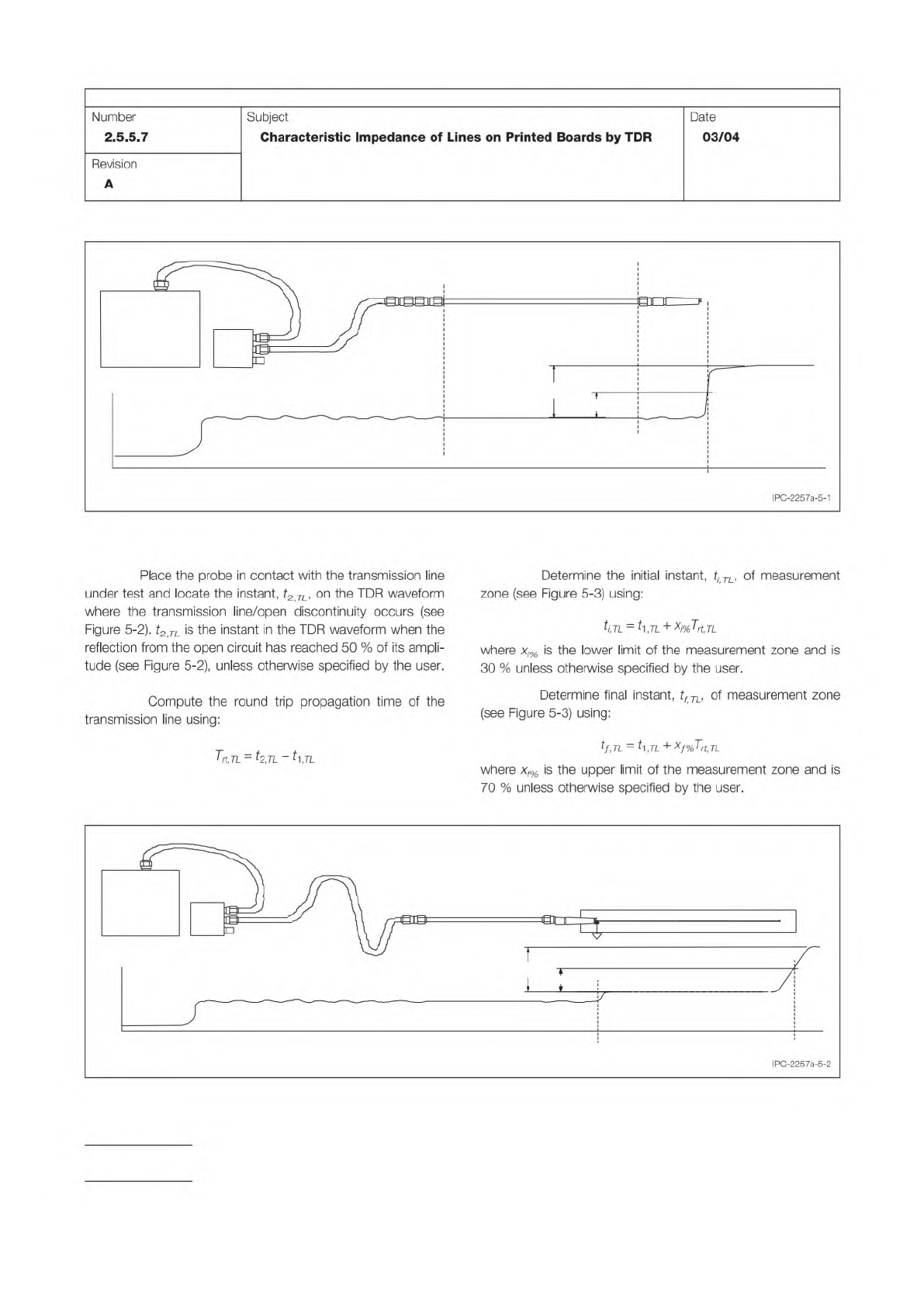
Figure 5-2 Determination of instant in TDR waveform corresponding to the end of the transmission line.
A
R,2
is the
amplitude of the signal reflected from the open end of the transmission line under test.
SPD
TRANSFER
STANDARD
TDR
INSTRUMENT
TRANSMISSION LINE UNDER TEST
0.5
A
R2
TIME
t
1,TL
t
2,TL
A
R2
PRECISION
RF CABLE
IPC-TM-650
Page 8 of 23
Number
2.5.5.7
Subject
Characteristic
Impedance
of
Lines
on
Printed
Boards
by
TDR
Date
03/04
Revision
A
Place
the
probe
in
contact
with
the
transmission
line
under
test
and
locate
the
instant,
t2
TL,
on
the
TDR
waveform
where
the
transmission
line/open
discontinuity
occurs
(see
Figure
5-2).
t2
TL
is
the
instant
in
the
TDR
waveform
when
the
reflection
from
the
open
circuit
has
reached
50
%
of
its
ampli¬
tude
(see
Figure
5-2),
unless
otherwise
specified
by
the
user.
Compute
the
round
trip
propagation
time
of
the
transmission
line
using:
Trt,TL
=
—71
-
力
,71
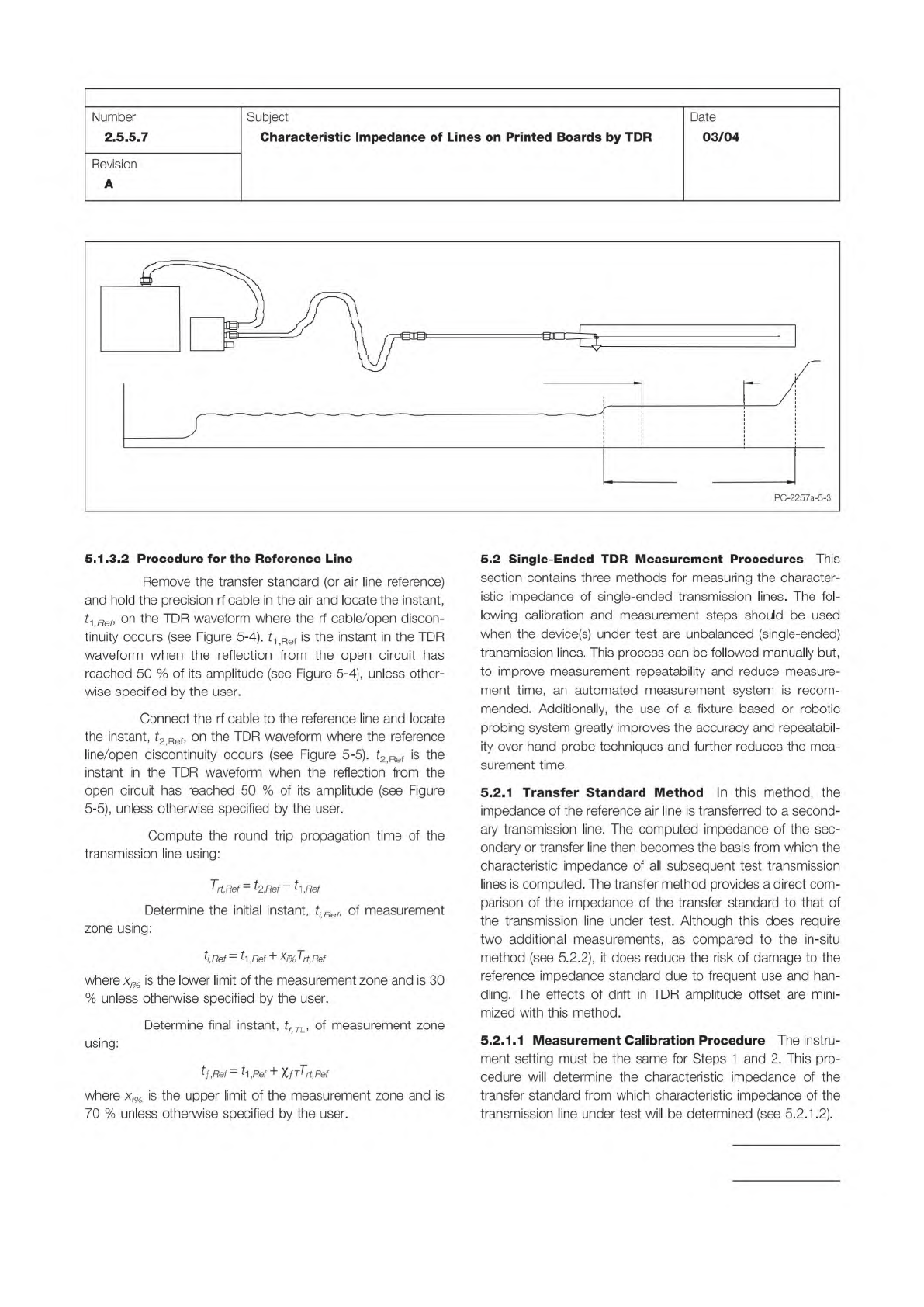
Determine
the
initial
instant,
tj
TL,
of
measurement
zone
(see
Figure
5-3)
using:
ti,TL
=
力,71
+
Xj%T
也
tl
where
xj%
is
the
lower
limit
of
the
measurement
zone
and
is
30
%
unless
otherwise
specified
by
the
user.
Determine
final
instant,
tf
TU
of
measurement
zone
(see
Figure
5-3)
using:
tf,TL
=
片,几
+xf%Trt,TL
where
xf%
is
the
upper
limit
of
the
measurement
zone
and
is
70
%
unless
otherwise
specified
by
the
user.
IPC-2257a-5-2
Step 1 –
Step 2 –
Step 3 –
Step 4 –
Step 5 –
Figure 5-3 Determination of Measurement Zone
T
rt
,TL
TIME
t
1,TL
t
2,TL
SPD
TRANSFER
STANDARD
TDR
INSTRUMENT
TRANSMISSION LINE UNDER TEST
t
i,TL
t
f,TL
MEASUREMENT ZONE
for TRANSMISSION LINE UNDER TEST
PRECISION
RF CABLE
IPC-TM-650
Page 9 of 23
Number
2.5.5.7
Subject
Characteristic
Impedance
of
Lines
on
Printed
Boards
by
TDR
Date
03/04
Revision
A
5.1.
3.2
Procedure
for
the
Reference
Line
Remove
the
transfer
standard
(or
air
line
reference)
and
hold
the
precision
rf
cable
in
the
air
and
locate
the
instant,
L
Ref,
on
the
TDR
waveform
where
the
rf
cable/open
discon¬
tinuity
occurs
(see
Figure
5-4).
^1Ref
is
the
instant
in
the
TDR
waveform
when
the
reflection
from
the
open
circuit
has
reached
50
%
of
its
amplitude
(see
Figure
5-4),
unless
other¬
wise
specified
by
the
user.
Connect
the
rf
cable
to
the
reference
line
and
locate
the
instant,
t2
Ref,
on
the
TDR
waveform
where
the
reference
line/open
discontinuity
occurs
(see
Figure
5-5).
^‘Ref
is
the
instant
in
the
TDR
waveform
when
the
reflection
from
the
open
circuit
has
reached
50
%
of
its
amplitude
(see
Figure
5-5),
unless
otherwise
specified
by
the
user.
Compute
the
round
trip
propagation
time
of
the
transmission
line
using:
Trt,Ref
=
bkef
-
,Ref
Determine
the
initial
instant,
tiRef,
of
measurement
zone
using:
L,Ref
—
^1
,Ref
+
X/%7^,Aef
where
xi%
is
the
lower
limit
of
the
measurement
zone
and
is
30
%
unless
otherwise
specified
by
the
user.
Determine
final
instant,
tf
TL,
of
measurement
zone
using:
tf,Ref
=
t[Ref
+
XfT^rt.Ref
where
x
侠
is
the
upper
limit
of
the
measurement
zone
and
is
70
%
unless
otherwise
specified
by
the
user.
5.2
Single-Ended
TDR
Measurement
Procedures
This
section
contains
three
methods
for
measuring
the
character¬
istic
impedance
of
single-ended
transmission
lines.
The
fol¬
lowing
calibration
and
measurement
steps
should
be
used
when
the
device(s)
under
test
are
unbalanced
(single-ended)
transmission
lines.
This
process
can
be
followed
manually
but,
to
improve
measurement
repeatability
and
reduce
measure¬
ment
time,
an
automated
measurement
system
is
recom¬
mended.
Additionally,
the
use
of
a
fixture
based
or
robotic
probing
system
greatly
improves
the
accuracy
and
repeatabil¬
ity
over
hand
probe
techniques
and
further
reduces
the
mea¬
surement
time.
5.2.1
Transfer
Standard
Method
In
this
method,
the
impedance
of
the
reference
air
line
is
transferred
to
a
second¬
ary
transmission
line.
The
computed
impedance
of
the
sec¬
ondary
or
transfer
line
then
becomes
the
basis
from
which
the
characteristic
impedance
of
all
subsequent
test
transmission
lines
is
computed.
The
transfer
method
provides
a
direct
com¬
parison
of
the
impedance
of
the
transfer
standard
to
that
of
the
transmission
line
under
test.
Although
this
does
require
two
additional
measurements,
as
compared
to
the
in-situ
method
(see
5.2.2),
it
does
reduce
the
risk
of
damage
to
the
reference
impedance
standard
due
to
frequent
use
and
han¬
dling.
The
effects
of
drift
in
TDR
amplitude
offset
are
mini¬
mized
with
this
method.
5.2.1.
1
Measurement
Calibration
Procedure
The
instru¬
ment
setting
must
be
the
same
for
Steps
1
and
2.
This
pro¬
cedure
will
determine
the
characteristic
impedance
of
the
transfer
standard
from
which
characteristic
impedance
of
the
transmission
line
under
test
will
be
determined
(see
5.2.1
.2).