IPC-TM-650 EN 2022 试验方法--.pdf - 第510页
Intermediate v alues can be linearly interpolated from Table 4-1 or using: t sys ≤ L TL 2 1 v p . For example, if the test structure was a 32.0 m m [1.26 in] long transmission line, then a TDR system with t sys ≤ 80 ps m…
3.14 Additional Guidelines for Testing Panel Coupons
Test interconnects may be contained within one or more
panel coupons. It is recommended that there be at least one
coupon per PB on the panel as long as it does not adversely
affect panel utilization. With this configuration, the following
additional design guidelines apply. More than one coupon
may be necessary on a PB to ensure uniformity. Also, more
test interconnects may be required than can fit inside one test
coupon. In that case, more than one test coupon is neces-
sary.
3.14.1 Reference and Ground Planes
All reference
planes existing in the coupon are to be connected together
within the coupon area and be electrically independent of con-
ductor planes in the functional circuit area.
3.14.2 Surface Condition
The panel test coupons
have the same surface plating and use the same solder mask
requirements as the functional PB.
3.14.3 Thieving
Differences in circuit density between the
inside of a panel coupon and the functional area may produce
surface plating and etching differences. In order to compen-
sate for these differences, thieving (the use of nonterminated
copper structures, such as planes, pads, and/or traces adja-
cent to test lines) may be used. All thieving structures
be
kept at least six times the width of the signal conductor (of the
test interconnect) or 2.5 mm [0.0984 in], whichever is greater,
from each test interconnect.
4 Apparatus and Instrumentation
The TDR measure-
ment system contains a step generator, a high-speed sam-
pling oscilloscope, and all the necessary accessories for con-
necting the TDR unit to the test structures under test. IPC-
2141 provides a discussion of the TDR system architecture,
system considerations, and the TDR measurement processes
used herein.
4.1 Measurement System Requirements
4.1.1 Voltage Measurement Accuracy
The voltage mea-
surement accuracy and linearity of the TDR sampling oscillo-
scope
be sufficient to provide the required accuracy in
the value of propagation delay. Nominally, the voltage mea-
surement accuracy should be better than ± 1%.
4.1.2 Temporal/Spatial Resolution
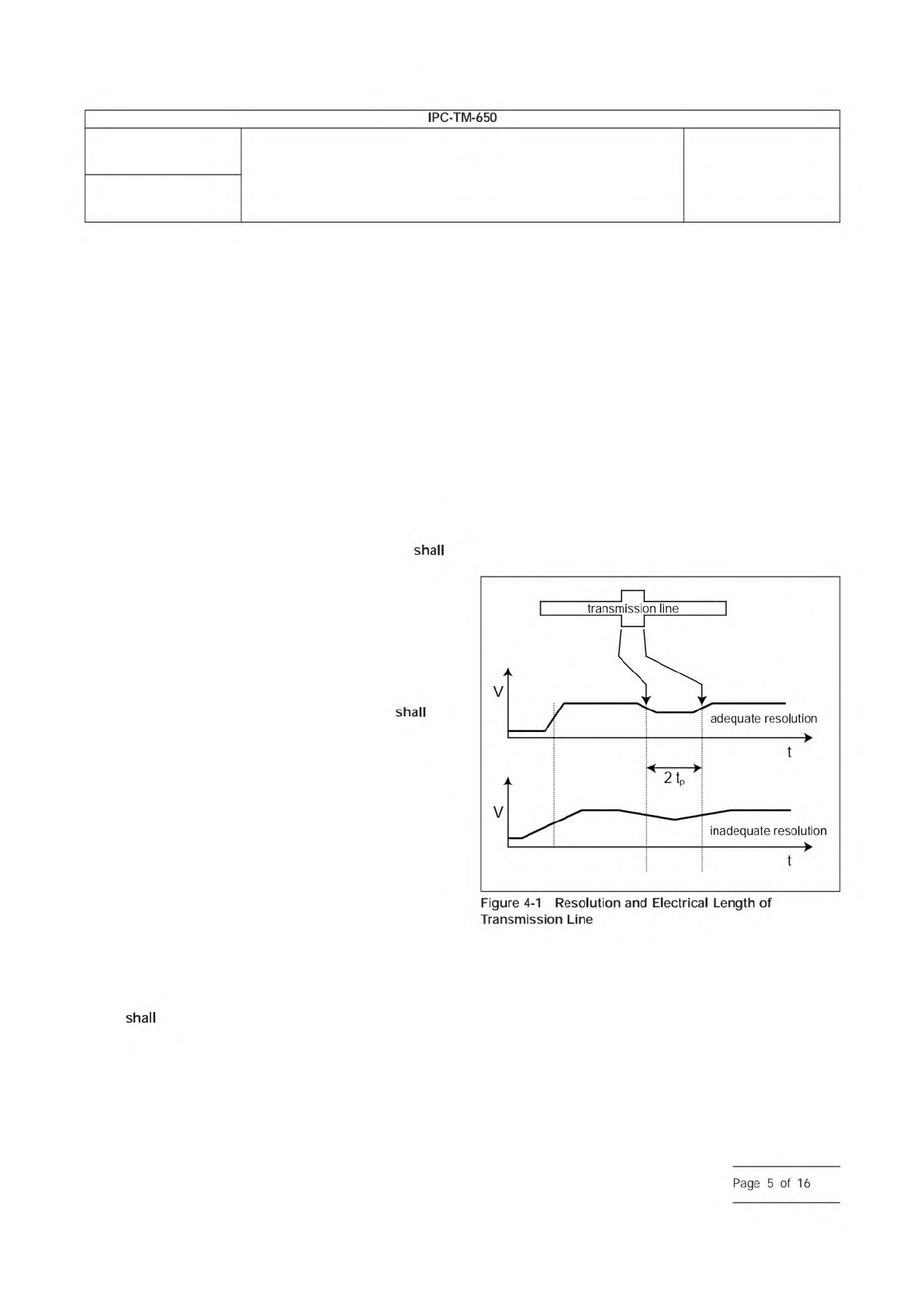
The resolution limit of
a given TDR unit is defined as that particular time or distance
wherein two discontinuities or changes on the transmission
line being measured, that would normally be individually dis-
cernable, begin to merge together because of limited TDR
system bandwidth, timing jitter, or a reduced signal-to-noise
ratio. The resolution limit is specified in either time or distance,
and is always related to the one-way propagation time
between the two discontinuities t
P
(see Figure 4-1), and not
the round trip propagation time 2 t
P
.
Per this definition, the temporal resolution limit is:
a. one half of the system risetime, that is 0.5 t
sys
, where t
sys
is the 10 to 90% risetime or 90% to 10% falltime depend-
ing on the propagating edge of the TDR signal;
and the spatial resolution limit is:
b. 0.5 t
sys
x v
p
, where v
p
is the signal propagation velocity in
the transmission line being measured.
For a given length of transmission line to be measured, the
resulting spatial resolution of the TDR measurement set-up
should not exceed one fourth (0.25) of the available length of
the transmission line L
TL
. In other words, L
TL
should be at
least four times the spatial resolution of the measurement sys-
tem.
Table 4-I relates TDR system risetime values to minimum
L
TL
for typical surface microstrip lines in air on FR4 PB mate-
rial (v
p
≈ 2x10
8
m/s).
IPC-25511-4-1
Number
2.5.5.11
Subject
Propagation Delay of Lines on Printed Boards by TDR
Date
04/2009
Revision
IPC-TM-650
shall
shall
Page
5
of
16
Intermediate values can be linearly interpolated from Table 4-1
or using:
t
sys
≤
L
TL
2
1
v
p
.
For example, if the test structure was a 32.0 mm [1.26 in] long
transmission line, then a TDR system with t
sys
≤ 80 ps must
be used. Note that, if the probe launch and test set-up cables
cause excessive ringing in the TDR waveform, or if the vari-
ance in connection delay is significant, then t
sys
must be made
sufficiently small to clearly observe the desired discontinuities
in the TDR waveforms.
4.2 TDR Requirements
4.2.1 Impedance
The TDR source and measurement ports
be electrically terminated with precision 50 Ω loads. This
is normally the case with high-quality TDR instrumentation
maintained on the manufacturer’s maintenance and calibra-
tion schedules.
4.2.2 Voltage Step Repeatability
For all passive electrical
terminations, the TDR source
repeat its voltage wave-
form to within 0.5% of the TDR pulse amplitude V
step
.
4.2.3 Timebase Accuracy
When oscilloscopes are used
in the TDR measurement system, errors in the reported time
of the samples may arise due to imperfections in the counters
and clock sources used to establish the timebase. These are
systematic errors and may depend on the exact time/div and
delay settings of the scope. When applying this method, the
TDR system’s timebase accuracy must be better than 8 ps +
0.01% of the measured interval.
4.2.4 Timebase Repeatability (Jitter)
The RMS value of
random timing uncertainty in measured voltage samples
be less than 10% of t
sys
.
4.2.5 Waveform Averaging
The TDR equipment
perform waveform or sample averaging to reduce jitter and
electrical noise effects in the recorded waveform measure-
ments.
4.2.6 Step Aberrations
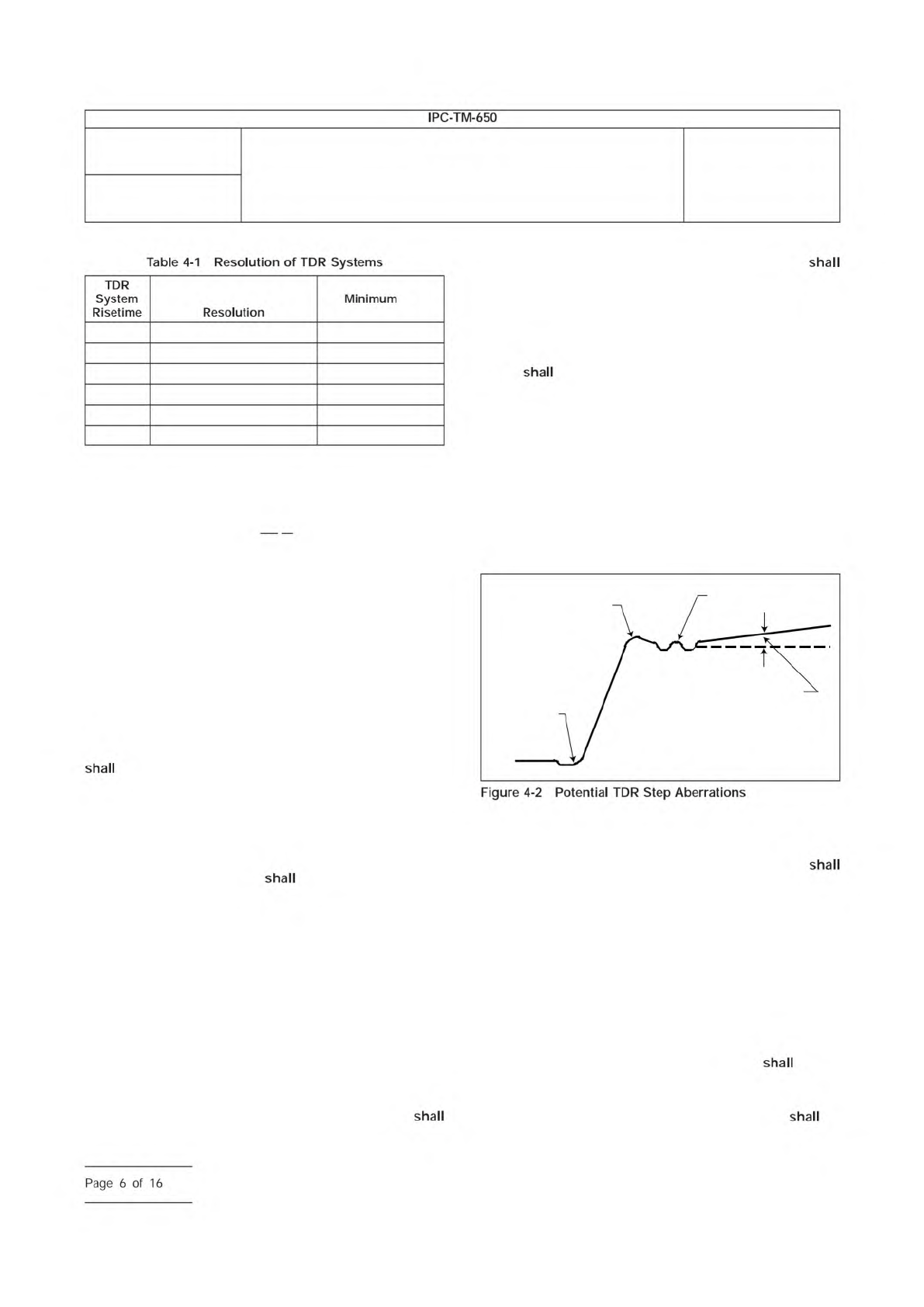
The TDR source waveform aber-
rations
be less than 1% of the total step amplitude V
step
.
The ability of the TDR instrument to measure transmission line
discontinuities is related to how well the instrument can mini-
mize aberrations (ringing, overshoot, undershoot, settling,
etc.). These aberrations (see Figure 4-2) can cause significant
errors in determining the instant that the waveform crosses a
user-defined voltage value. Additionally, low frequency step
aberrations may produce a ramp in measurement zone and
this can cause a significant bias in the computed propagation
delay value.
4.3 Other Equipment Requirements
4.3.1 Connectors
Propagation delay test set-ups
use precision coaxial connectors whenever possible. TDR
systems typically come with SMA, 3.5 mm [0.138 in],
2.92 mm [0.115 in], or 2.4 mm [0.094 in] connectors at their
measurement ports. These connectors are all 50 Ω connec-
tors. They are precision connectors (they have a low imped-
ance uncertainty due to their mechanical precision) whose
bandwidth must be great enough so that the connectors do
not limit the accuracy of the TDR measurement. The useable
bandwidth of these connectors are approximately 33 GHz,
40 GHz, and 50 GHz, respectively. The reflection and insertion
losses of all connectors used in the test set up
be less
than 27 dB and 0.3 dB, respectively. Other connectors with
comparable or better performance may be used, but must be
specified and documented. All coaxial connections
be
tightened with a calibrated torque wrench to specification of
L
TL
4x Resolution
10 ps 5 ps / 1.0 mm [0.04 in] 4.0 mm [0.16 in]
20 ps 10 ps / 2.0 mm [0.08 in] 8.0 mm [0.31 in]
30 ps 15 ps / 3.0 mm [0.12 in] 12.0 mm [0.47 in]
100 ps 50 ps / 10.0 mm [0.39 in] 40.0 mm [1.57 in]
200 ps 100 ps / 20.0 mm [0.79 in] 80.0 mm [3.15 in]
500 ps 250 ps / 50.0 mm [1.97 in] 200.0 mm [7.87 in]
IPC-25511-4-2
overshoot
undershoot
ringing
low frequency drift
Number
2.5.5.11
Subject
Propagation Delay of Lines on Printed Boards by TDR
Date
04/2009
Revision
IPC-TM-650
—
Table
4-1
Resolution
of
TDR
Systems
TDR
System
Risetime
Resolution
Minimum
shall
shall
shall
shall
shall
shall
shall
Page
6
of
16
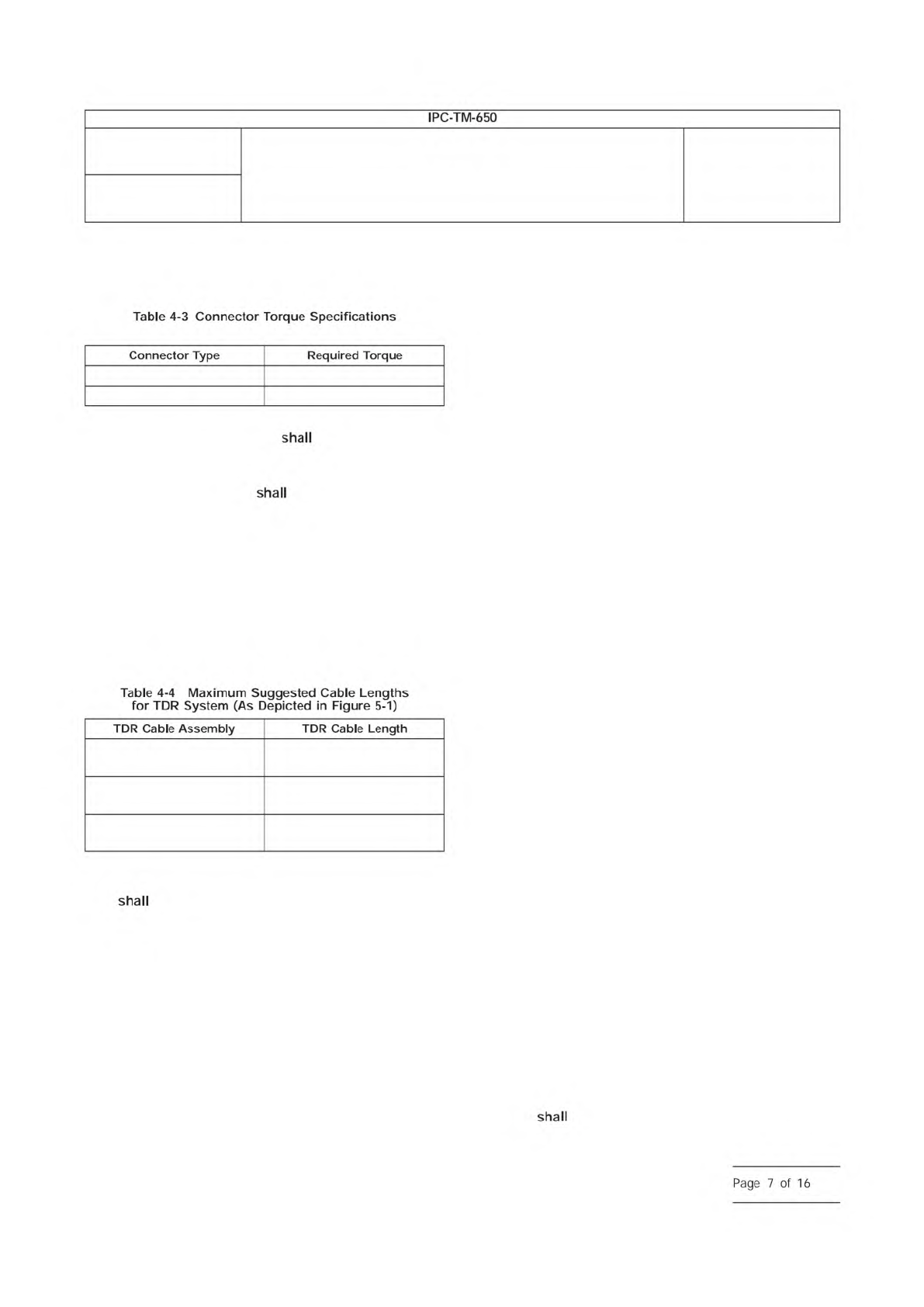
the connector. Table 4-3 provides the typical connector
torque specifications.
4.3.2 Cabling
All test cables be high-quality, low-
phase delay coax and with a nominal characteristic imped-
ance of 50 Ω. Cables used in the measurement circuit of the
transmission line under test
have connectors that are
compatible with the instrument and probes. The bandwidth of
the cable must be great enough so that the cable does not
limit the accuracy of the propagation delay measurement. The
length of the cables should be kept to a minimum. The total
insertion loss (including connector loss) of the cabling con-
necting the transmission line under test to the TDR should be
kept to less than 3.3 dB/m (1db/foot) at 26.5 GHz. Table 4-4
contains suggested maximum cable lengths for the TDR test
set up as depicted in Figure 5-1 and described in 5.2.
4.3.3 Probes
The probe assembly characteristic imped-
ance
either be 50 Ω or the same value as the charac-
teristic impedance of the transmission line under test, with an
uncertainty of ± 1.0 Ω or less. The probe tips should be of
sufficient diameter and pitch (spacing between signal and
ground tips) to provide accurate and repeatable connections
to the desired probe contact pad geometry (see IPC-2141 for
additional recommendations on probe landing layouts for TDR
coupons). Single-ended probes should contain two electrode
tips, one each for the signal and ground lines. The probe tips
should have moderately sharp edges to cut through any
oxides. The probe bandwidth should be sufficient for the
desired temporal/spatial resolution (see 4.1.2). The probe
response time should be sufficiently short so as not to
increase the duration of the measurement period. The overall
performance of the probe can be incorporated into the TDR
system response for computing TDR system temporal/spatial
resolution (see 4.1.2). Inconsistent probe force and placement
is common and can cause a significant yet unknown error in
t
d
. Probe connections to the measurement system cables
should be tightened with a torque wrench following the con-
nector specifications. For hand held probe assemblies, the
probe handle should be ergonomically shaped.
4.3.4 Terminations
TDR sources are not perfect voltage
source generators; they may perform differently under differ-
ent electrical load conditions. Therefore, the termination con-
ditions of any verification experiments should match those of
the interconnection test structures, and all test structures in a
given specimen should be of the same design. For example, if
the propagation delay test is to be performed on lines that are
electrically open at their far end, all lines should be terminated
in electrically open circuits, and any TDR field verification tests
(see 5.2.1.2) should be made using open circuit terminations.
4.3.5 ESD Protection
Static build up on specimens and
test cables prior to test can damage the signal samplers in the
TDR equipment; ESD protection and transmission line dis-
charging procedures must be used. ESD protection can be
supplied internally to the TDR system or externally using a
Static Isolation Unit (SIU). If supplied externally using a coaxial
switch (as shown in Figure 5-1), the switch should be placed
between the transmission line under test and the TDR instru-
mentation. The SIU should have a return loss and insertion
loss less than 16 dB and 0.3 dB, respectively, at 18 GHz. A
maximum of 30.0 cm [11.8 in] of high quality, high frequency
cable may be used to connect the TDR instrument to the SIU
protection switch. Test interconnections should be first
grounded with the SIU and/or passed through some type of
deionization device prior to testing to remove any residual
static electrical charge. Use of proper ESD control methods,
control components and humidity control will help reduce
electrostatic discharge damage to the measurement system.
Automation software can be used to enhance the effective-
ness of the static isolation unit by switching the static isolation
unit on/off as required to minimize the amount of time that the
TDR sampling unit is exposed to potential ESD.
4.3.6 Transfer Standard
The TDR measurement system
(see Figure 5-1) specified for measuring propagation delay
requires a precision coaxial transmission line to set the refer-
ence impedance of the reflectometer measurements. This
standard
be a rigid, or semi-rigid, cable not more than
10 cm long with a uniform impedance profile along its length.
[The conversion factor is 0.1128 N-m/(lb-in)]
SMA 0.56 N-m (5 lb-in)
3.5, 2.92, and 2.4 mm 0.90 N-m (8 lb-in)
Sampling Unit to Static
Isolation Unit
30.0 cm [11.8 in]
Static Isolation Unit to In-Line
Secondary Standard
91.0 cm [35.83 in]
Transfer Standard (such as
semi-rigid coaxial cable)
10.0 cm [3.94 in]
Number
2.5.5.11
Subject
Propagation Delay of Lines on Printed Boards by TDR
Date
04/2009
Revision
IPC-TM-650
―
Table
4-3
Connector
Torque
Specifications
Connector
Type
Required
Torque
Table
4-4
Maximum
Suggested
Cable
Lengths
for
TDR
System
(As
Depicted
in
Figure
5-1)
TDR
Cable
Assembly
TDR
Cable
Length
shall
Page
7
of
16