IPC-TM-650 EN 2022 试验方法--.pdf - 第548页
1 Scope The fungus resistance test is used to determine the resis tance of materials t o fungi and to determine if such material is adversely affected by fungi under conditions favor- able for their devel opment, namely …
5.4.1
Measure the length L of each of the two split-cylinder
resonator sections over several locations and compute the
mean length of both sections.
5.4.2
With the split-cylinder empty (no substrate) and closed
(d=0), find the TE
011
resonance with the network analyzer.
To reduce the coupling losses to a negligible level, adjust
the radial position of the coupling loops so that the peak of
the resonance curve is less than -40 dB. For the particular
10 GHz split-cylinder resonator described in this method, the
resonant frequency should be approximately 10.04 GHz. If
another split-cylinder geometry is being used, use the follow-
ing approximation to estimate the TE
011
resonant frequency of
an empty split-cylinder resonator:
ƒ
011
=
c
2π
√
(
j
1
a
)
2
+
(
π
2L
)
2
where c is the speed of light in a vacuum, j
1
is the first zero of
the Bessel function of the first kind J
1
, a is the split-cylinder
radius in meters and L is the length, in meters, of each of the
split-cylinder sections as shown in Figure 2.
5.4.3
Once the TE
011
resonance has been identified and
displayed on the network analyzer display, measure the reso-
nant frequency f
011
and quality factor Q of the resonance and
use the following expressions to compute the radius a and the
conductivity σ of the empty split-cylinder’s resonator sections:
a = j
1
[
(
2πƒ
011
c
)
2
−
(
π
2L
)
2
]
−
1
2
σ =
2πƒ
011
µ
0
2R
s
2
where µ
0
is the permeability of free space and
√
µ
0
ε
0
[
(
j
1
a
)
2
+
(
π
2L
)
2
]
3
2
R
s
=
2Q
[
1
2L
(
π
2L
)
2
+
1
a
(
j
1
a
)
2
]
5.5 Estima te the TE
01 1
Resonant Freq uen cy of
Substrate-Loaded Split-Cylinder Resonator
In addition
to the desired TE
011
resonant mode, other modes are excited
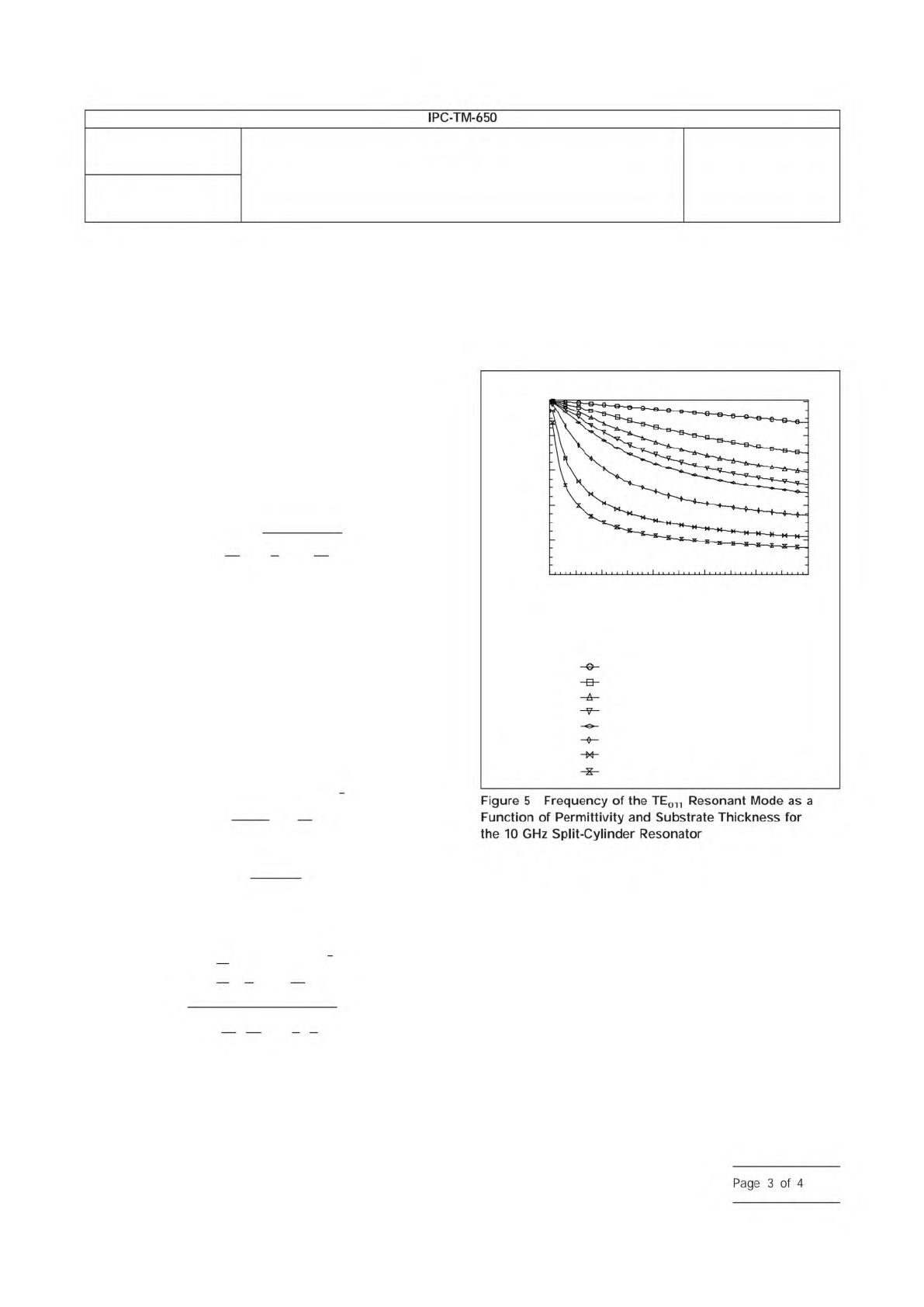
in the split-cylinder resonator as shown in Figure 5. Depend-
ing on the thickness and relative permittivity of the dielectric
substrate being measured, the resonant frequency for the
split-cylinder plus substrate can be significantly lower than the
resonant frequency of the empty split-cylinder resonator as
shown in Figure 6.
In order to identify the correct mode, one can use Figure 6 to
predict the resonant frequency of the TE
011
resonant mode.
For a more accurate estimate of this resonant frequency and
the frequencies of the higher-order resonant modes, software
is available from the National Institute of Standards and Tech-
nology (NIST) which calculates the split-cylinder resonator
dimensions, substrate thickness, and provides an estimate of
the relative permittivity of the substrate. As of the publication
of this method, additional commercial vendors are developing
similar software and will be listed through the IPC-TM-650
Test Methods web page.
5.6 Measure the Relative Permittivity and Loss Tangent
5.6.1
Place the substrate in the gap separating the two cav-
ity sections of the split-cylinder resonator in such a way that
IPC-25513-5
Substrate Thickness (mm)
Sample Relative Permittivity
2
4
6
8
10
20
50
100
10
8
6
4
2
0
0 1 2 3 4
5
TE
011
Resonant Frequency (GHz)
Number
2.5.5.13
Subject
Relative Permittivity and Loss Tangent Using a Split-Cylinder
Resonator
Date
01/07
Revision
IPC-TM-650
Figure
5
Frequency
of
the
TE011
Resonant
Mode
as
a
Function
of
Permittivity
and
Substrate
Thickness
for
the
10
GHz
Split-Cylinder
Resonator
Page
3
of
4

1 Scope
The fungus resistance test is used to determine
the resistance of materials to fungi and to determine if such
material is adversely affected by fungi under conditions favor-
able for their development, namely high humidity, warm atmo-
sphere, and presence of inorganic salts.
2 Applicable Documents
None
3 Test Specimen
Specimens must be a minimum size of
50 mm x 50 mm [1.97 in x 1.97 in] with copper foil (if appli-
cable) removed by etching using standard commercial prac-
tices.
4 Apparatus and Reagents
4.1 Test Chamber
The incubator shall be capable of main-
taining 30 ± 1 °C [86 ± 2 °F] and 95 ± 2% relative humidity
and have an ultraviolet (360 nm) source for subsequent
decontamination. Provisions shall be made to prevent con-
densation from dripping on the test item. There shall be free
circulation of air around the test item and the contact area of
fixtures supporting the test item shall be kept to a minimum.
4.2 Sterilizer
4.3 Centrifuge
4.4 pH Meter
4.5 Colony Counter
4.6 Incubator
4.7 Dishwasher
4.8 Petri Dishes
4.9 Filter Paper
4.10 Media Solutions
4.11 Microorganisms
4.12 Atomizer, 15,000 ± 3000 spores
5 Procedures
5.1 Preparation of Test Media
5.1.1 Mineral-Salts Solution
Prepare the solution to contain the following:
Potassium dihydrogen orthophosphate (KH
2
PO
4
) .......... 0.7g
Potassium monohydrogen orthophosphate (K
2
HPO
4
) ... 0.7g
Magnesium sulfate heptahydrate (MgSO
4
c7H
2
O) ........... 0.7g
Ammonium Nitrate (NH
4
NO
3
) ......................................... 1.0g
Sodium chloride (NaCl) .............................................. 0.005g
Ferrous sulfate heptahydrate (FeSO
4
c7H
2
O) ............... 0.002g
Zinc sulfate heptahydrate (ZnSO
4
c7H
2
O) .................... 0.002g
Manganous sulfate monohydrate (MnSO
4
cH
2
O) ......... 0.001g
Distilled water ........................................................... 1000 ml
Sterilize the mineral salt solution by incubating at 121 °C [250
°F] for a minimum of 20 minutes. Adjust the pH of the solution
by the addition of 0.01 normal solution of NaOH so that after
sterilization the pH is between 6.0 and 6.5. Prepare sufficient
salt solutions for the required tests.
5.1.2 Purity of Reagents
Reagent grade chemicals shall
be used in all tests. Unless otherwise specified, it is intended
that all reagents shall conform to the specification of the Com-
mittee on Analytical Reagents of the American Chemical Soci-
ety, where such specifications are available.
5.1.3 Purity of Water
Unless otherwise specified, refer-
ences to water shall be understood to mean distilled water or
water of equal purity.
5.1.4 Preparation of Mixed Spore Suspension
The following test fungi shall be used:
Description .................................................................. ATCC
Aspergillus niger ............................................................ 9642
Chaetomium globosum ................................................. 6205
Gliocladium virens ......................................................... 9645
Aureobasidium pullulans ............................................... 9348
Penicillium funiculosum ................................................. 9644
5.1.5
Maintain cultures of these fungi separately on an
appropriate medium such as potato dextrose agar. However,
the culture of Chaetomium globosum shall be cultured on
3000 Lakeside Drive, Suite 309S
Bannockburn, IL 60015-1249
IPC-TM-650
TEST METHODS MANUAL
Number
2.6.1
Subject
Fungus Resistance of Printed Board Materials
Date
03/07
Revision
G
Originating Task Group
Solder Mask Performance Task Group (5-33b)
ASSOCIATION CONNECTING
ELECTRONICS INDUSTRIES
®
Material
/n
this
Test
Methods
Manual
was
voluntarily
established
by
Technical
Committees
of
I
PC.
This
material
/s
advisory
only
and
"s
use
or
adaptation
,
s
entirely
voluntary.
IPC
disclaims
all
liability
of
any
kind
as
to
the
use,
application,
or
adaptation
of
this
material.
Users
are
also
wholly
responsible
for
protecting
themselves
against
all
claims
or
liabilities
for
patent
infringement.
Equipment
referenced
/s
for
the
convenience
of
the
user
and
does
not
imply
endorsement
by
IPC.
Page
1
of
3
1 Scope and Purpose
1.1 Scope
This document describes the frequency domain
test methods to accurately determine the amount of signal
propagation loss and delay for electrical printed boards, to
meet the demand of high speed applications nowadays. As
the data rate of high speed IO continues to increase (e.g., 10
Gbps and above), production testing and development testing
require more precise and accurate high frequency methods.
(Existing IPC-TM-650 Test Methods such as Method
2.5.5.12A are not adequate). Additionally, previous IPC test
methods do not encompass traditional industry methods
using VNA, such as thru-reflect-line (TRL), and recent devel-
opments of 2X-Thru test methods, etc. This test method is
defined to close the gaps.
The scope of this test method includes:
• Calibration and/or de-embedding techniques
• Probing/test fixture choices that impact measurement
quality
• Coupon Design
• Test sample pre-conditioning
• Environmental impact, etc.
1.2 Purpose
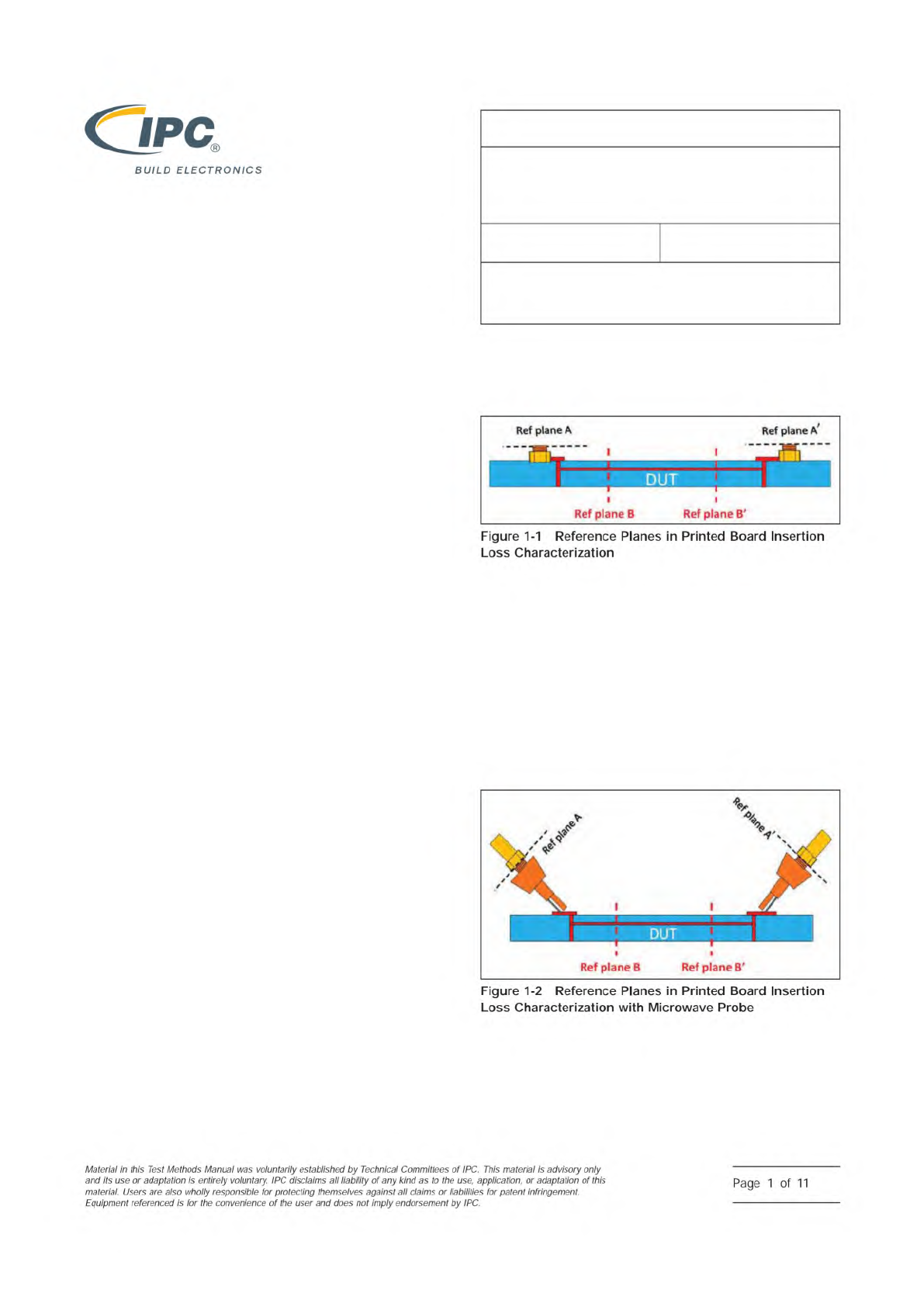
1.2.1 The importance of Setting up Correct Reference
Plane for Printed Board Characterization
The impor-
tance of setting up a correct reference plane in a typical inter-
connect measurement setup is illustrated in Figure 1-1. The
vector network analyzer (VNA) has been the de-facto standard
for accurate passive interconnect characterization including
the printed circuit board, connector, cables, etc. Making high
quality VNA measurement is straight-forward with standard
coaxial connectors and precision SOLT (short, open, load,
through) calibration kits. However, test fixtures are usually
required to connect the standard coaxial connectors to the
non-coaxial device under test (DUT). SOLT calibration can
readily move the reference plane to Ref plane A and Ref plane
A’ in the figure, while the intended DUT is the printed board
conductor only (between Ref plane B and Ref plane B’). The
test fixtures (between A and B, A’ and B’) need to be charac-
terized and then de-embedded to recover the insertion loss of
DUT.
Microwave probes are often used to probe interconnect struc-
tures for quick measurement, as shown Figure 1-2. A similar
calibration or de-embedding procedure is needed to move the
reference plane to the target location (Ref plane B and B’
shown in the figure). Note that sometimes, an SOLT calibra-
tion procedure can be carried out using calibration substrates
provided by probe vendor, to move the reference plane to the
probe tip, but it does not move the reference plane to the tar-
get location and additional de-embedding procedure is still
needed.
In a general calibration/de-embedding process, specialized
calibration standards with known electrical properties are
inserted at the end of the test fixture, and a calibration pro-
cess is performed to move the reference plane to the end of
IPC-25514-1-1
IPC-25514-1-2
3000 Lakeside Drive, Suite 105N
Bannockburn, IL 60015-1249
IPC-TM-650
TEST METHODS MANUAL
Number
2.5.5.14
Subject
Measuring High Frequency Signal Loss and
Propagation on Printed Boards with Frequency
Domain Methods
Date
02/2021
Revision
Originating Task Group
High Frequency Signal Loss Test Methods Task
Group (D-24D)
C/PC@
BUILD
ELECTRONICS
Ref
plane
A
Ref
plane
A’
Ref
plane
B
Ref
plane
B'
Figure
1-1
Reference
Planes
in
Printed
Board
Insertion
Loss
Characterization
Ref
plane
B
Ref
plane
B*
Figure
1-2
Reference
Planes
in
Printed
Board
Insertion
Loss
Characterization
with
Microwave
Probe
Material
/n
this
Test
Methods
Manual
was
voluntarily
established
by
Technical
Committees
of
I
PC.
This
material
/s
advisory
only
and
"s
use
or
adaptation
,
s
entirely
voluntary.
IPC
disclaims
all
liability
of
any
kind
as
to
the
use,
application,
or
adaptation
of
this
material.
Users
are
also
wholly
responsible
for
protecting
themselves
against
all
claims
or
liabilities
for
patent
infringement.
Equipment
referenced
/s
for
the
convenience
of
the
user
and
does
not
imply
endorsement
by
IPC.
Page
1
of
11