IPC-TM-650 EN 2022 试验方法--.pdf - 第551页
available based on equation ( 1). No te tha t the de-embedded insertion loss is defined with a referenc e impedance of the transmission line. 1.3 Gen eral Cali brati on/de-embedding Metho d s to Set up Correct Reference …
the test fixture. The accuracy of the measurement relies highly
on the quality of the physical calibration standards, especially
for SOLT type of calibration standards, where the parasitics of
the SOLT calibration standard must be known a priori. How-
ever, for printed board structures, it is not feasible to build an
accurate broadband SOLT structure right after the test fixture.
Hence the on-board SOLT calibration process usually does
not work well above a few GHz.
There are existing calibration/de-embedding methods in the
industry for general purpose interconnect characterization to
move the calibration reference plane from the coaxial connec-
tor to printed board interfaces. These methods are proven by
the industry and are applicable to printed board characteriza-
tion as well. Two of such methods are outlined in 1.3.1 and
1.3.2. However, for the accurate characterization of propaga-
tion constant of the uniform transmission line section, simpler
and more universal technique can be used as outlined in
1.2.2.
1.2.2 Eigenvalue based De-embedding Methodology for
Printed Board Trace Insertion Loss Measurement
For
printed board trace characterization, there are simple
approaches to derive the printed board insertion loss, when
the DUT is a uniform transmission line. There are multiple pub-
lications proposed that using T-matrix of an ideal transmission
line segment can significantly simplify the de-embedding algo-
rithm. The T-matrix is diagonal exponential in the modal space
when normalized to the modal characteristic impedance of the
transmission line [1]-[6]. If T-matrix of a multi-conductor line
segment is converted to S-matrix, the result is an
S-parameters (where reference impedance is defined as the
characteristic impedance of the transmission line):
S
DUT
=
[
0
e
−γ L
e
−γ L
0
]
(Eq.1)
where γ is the complex propagation constant, and L the line
length. An eigenvalue based de-embedding procedure can be
carried out utilizing the above assumptions, by measuring S
parameters of two different routing lengths. There are various
(similar) derivations procedures, and below is one example:
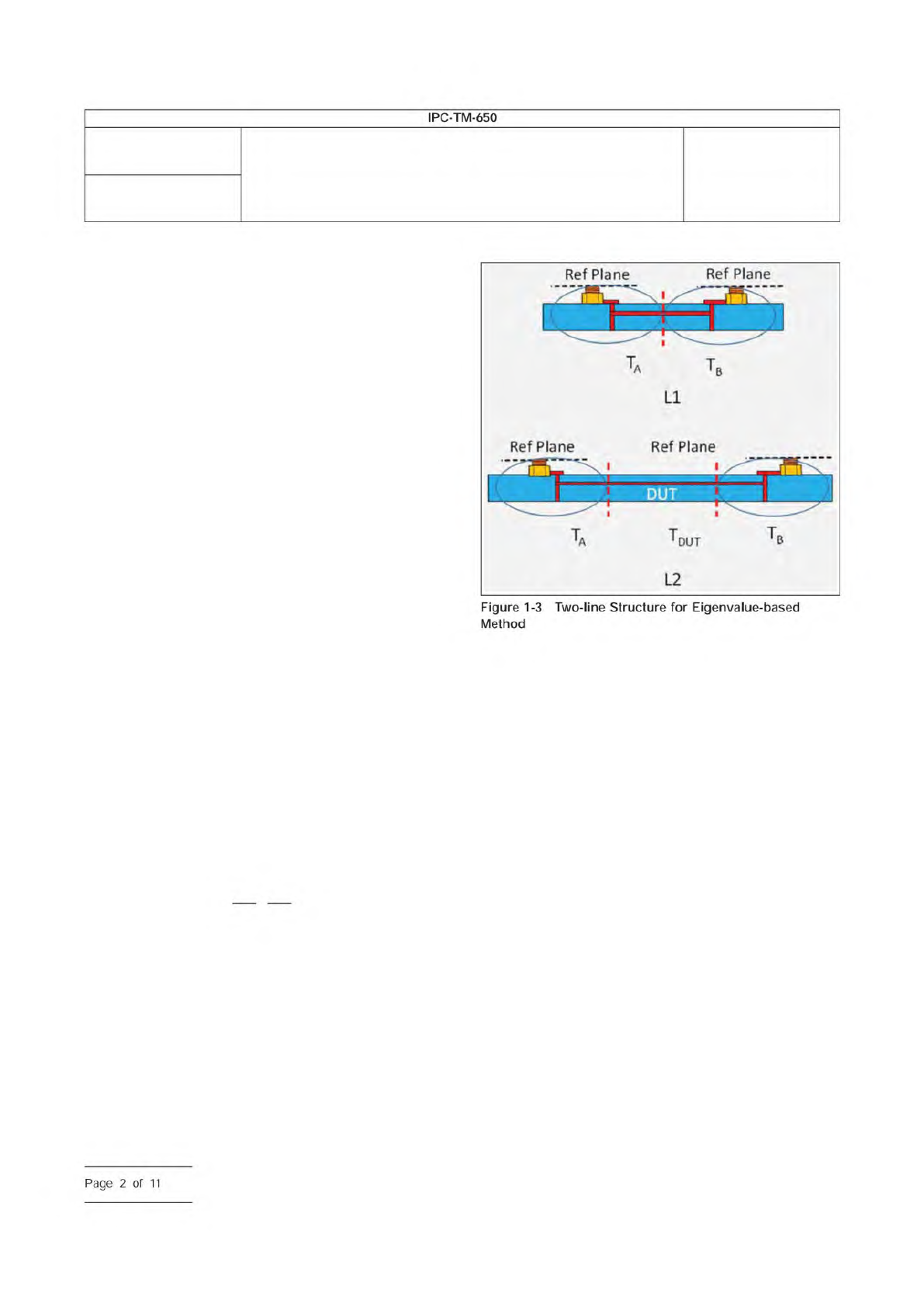
In Figure 1-3, two printed board conductors with different
lengths (L1 and L2) are fabricated on the same test coupon.
If we pick the mid-point of L1 structure, and use T-matrices to
describe the network parameter of left and right portion of the
structure as T
A
and T
B
, then we have
T
L1
= T
A
x T
B
(Eq. 2)
T
L2
= T
A
x T
DUT
x T
B
(Eq. 3)
where DUT is the transmission line with length of L2-L1. From
(1) and (2) we can easily get
T
L2
x T
L1
-1
= T
A
x T
DUT
x T
B
x T
B
-1
x T
A
-1
= T
A
x T
DUT
x T
A
-1
(Eq. 4)
Therefore, T
L2
x T
L1
-1
and T
DUT
are similar matrices and should
have the same eigenvalue. Meanwhile, assuming the DUT is a
uniform transmission line, we have:
T
DUT
=
[
e
γ (L2-L1)
0
0
e
−γ (L2-L1)
]
(Eq.5)
Where γ is the complex propagation constant of the trans-
mission line. There are two eigenvalues of the matrix
T
L2
x T
L1
-1
(the two non-zero diagonal terms in equation 4),
where the one with absolute value <1 is the printed board
conductor loss corresponding to the routing length of (L2-L1).
Once the eigenvalue is identified, the insertion loss is readily
IPC-25514-1-3
Number
2.5.5.14
Subject
Measuring High Frequency Signal Loss and Propagation on
Printed Boards with Frequency Domain Methods
Date
02/2021
Revision
IPC-TM-650
Figure
1-3
Two-line
Structure
for
Eigenvalue-based
Method
Page
2
of
11
available based on equation (1). Note that the de-embedded
insertion loss is defined with a reference impedance of the
transmission line.
1.3 General Calibration/de-embedding Methods to Set
up Correct Reference Plane for Printed Board Conduc-
tor Insertion Loss Characterization
As mentioned earlier,
there are existing calibration/de-embedding methods for gen-
eral purpose interconnect characterization to move the cali-
bration reference plane to printed board interfaces. These
methods are validated by the industry, and therefore included
herein, although they are either more complicated or costly
than the Eigen-value based method.
1.3.1 TRL Calibration
The TRL (and its variants such as
LRM) method [7] is a general approach to move the calibra-
tion reference plane from the coaxial connector to printed
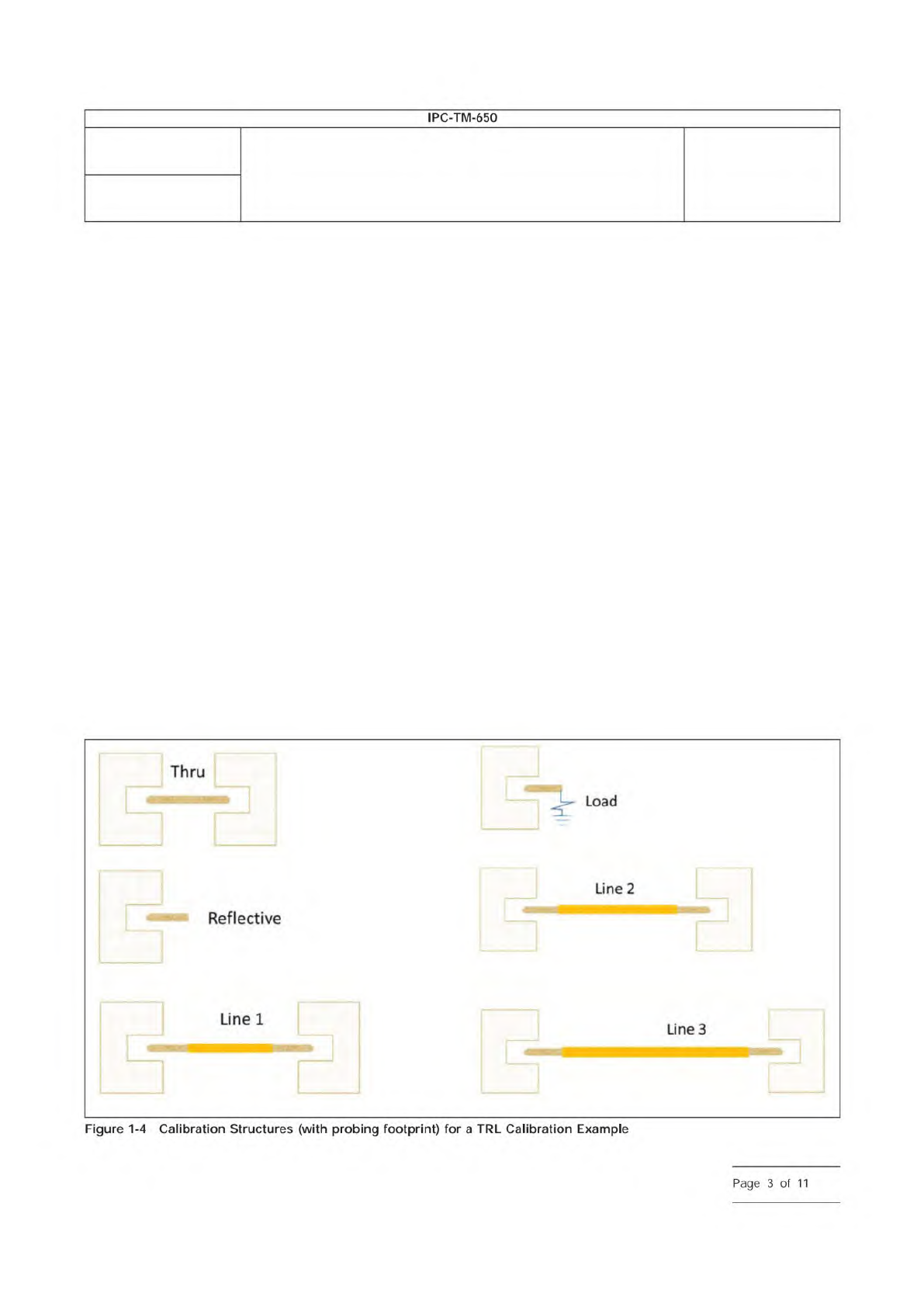
board interfaces. Figure 1-4 shows the typical calibration
structures for a TRL calibration, with microwave probe foot-
print (with single-ended probing as an example). The TRL cali-
bration technique only relies on the characteristic impedance
of the transmission line and does NOT need the parasitics of
Reflective Standard to be known, nor propagation delay of
Line. A typical TRL calibration structure may also include a
Load structure that works only at very low frequencies, and
additional Line structures to cover a wide frequency range.
Most VNAs offer TRL calibration options, please refer to the
manual or application note for your specific equipment to per-
form a TRL calibration.
TRL calibration has been widely used in the industry since the
technique no longer requires accurate calibration termination
standards. This overcomes the difficulties of SOLT calibration,
and the reference plane can be moved to the printed board.
However, there are still some disadvantages to the TRL cali-
bration. For example, there are many components of the cali-
bration standard to handle. This takes substantial printed
board area and requires tedious calibration process in the lab,
while being prone to the operator error. Additionally, the TRL
technique requires accurate characteristic impedance specifi-
cation for the line standard, which is problematic to determine
in a dispersive environment.
1.3.2 2X-Thru De-embedding
In the last decade, the
2X-thru de-embedding methodology is gaining popularity due
to its simplicity of test fixture design and de-embedding pro-
cedures [8]. In contrast to the TRL calibration technique,
which requires measurement of multiple structures as shown
in Figure 1-4, 2X-Thru De-embedding requires only one
de-embedding structure.
The basic idea of the 2X-Thru de-embedding approach is
shown in Figure 1-5. The S-parameters of the 2X-thru
IPC-25514-1-4
Number
2.5.5.14
Subject
Measuring High Frequency Signal Loss and Propagation on
Printed Boards with Frequency Domain Methods
Date
02/2021
Revision
IPC-TM-650
—
Thru
Reflective
Line
1
Figure
1-4
Calibration
Structures
(with
probing
footprint)
for
a
TRL
Calibration
Example
Page
3
of
11
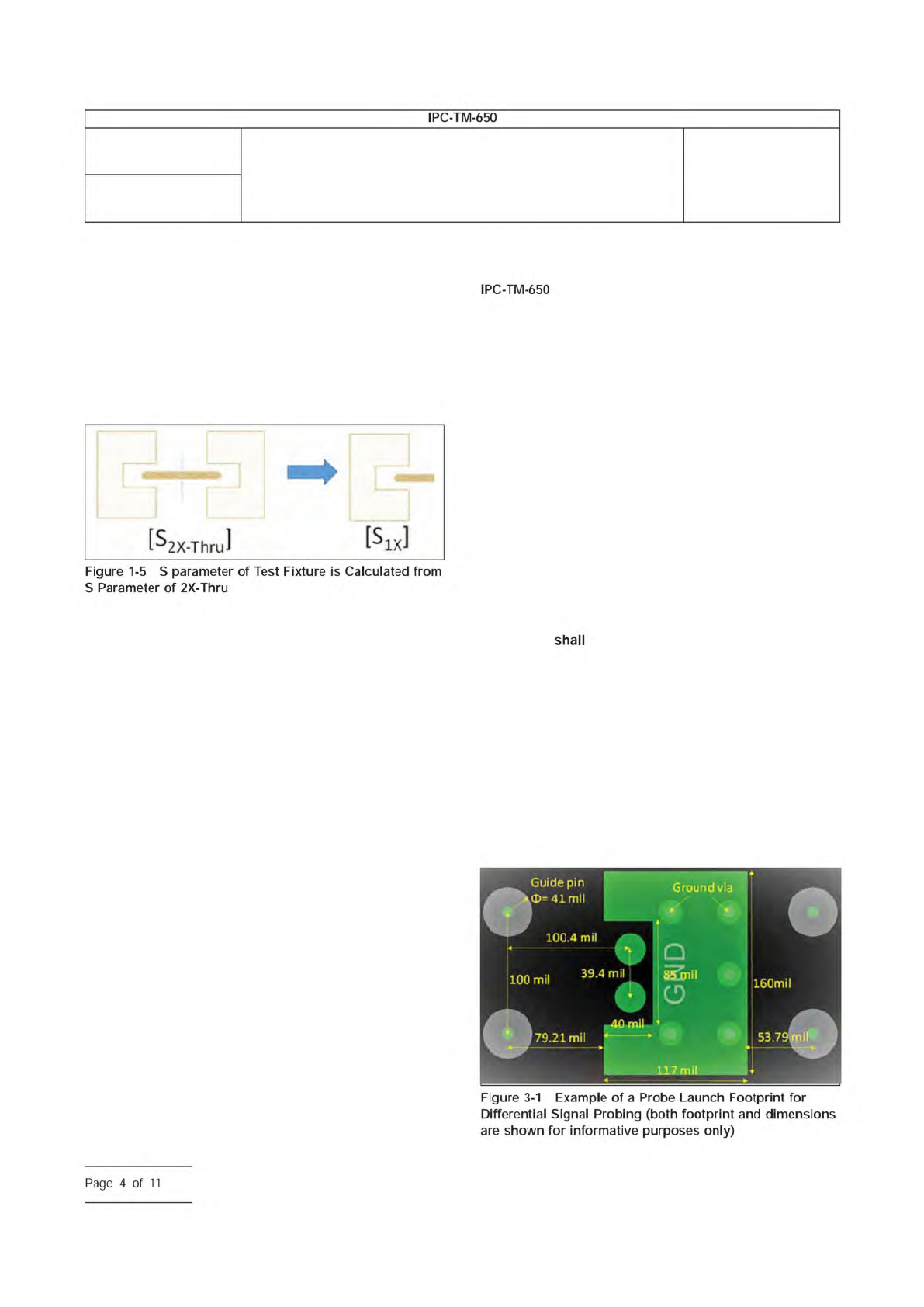
structure are measured first. Assuming the 2X-Thru structure
is symmetric, the S-parameters of a 1X structure can be cal-
culated directly from the 2X-Thru measurement. Once the
S-parameters of the 1X structure on both sides on the DUT
are obtained, the S-parameters of the DUT can be readily cal-
culated. This significantly simplifies calibration/de-embedding
procedures as compared to a traditional TRL calibration
where six calibration structures are typically needed.
There are various 2X-Thru de-embedding tools available at
time of publication of this test method, such as [9][10][11]. The
accuracy of 2X-Thru de-embedding tool is has been shown to
be comparable to TRL [13]. However, since the algorithm of
commercially available 2X-Thru methods are often proprietary,
it is up to the users to validate the tool for their printed board
insertion loss measurements. IEEE 370-2020 addressing this
issue by setting up a process to validate the de-embedding
tools [12]. Below is the general process of using 2X-Thru
de-embedding process to measure the insertion loss:
1) Manufacture two printed board conductors with different
lengths (L1 and L2).
2) Perform SOLT calibration to move reference plane to the
end of coaxial connector.
3) Perform VNA measurement and to acquire the S param-
eters of the shorter conductor (L1) and longer trace (L2).
4) Use 2X-Thru tool to de-embed the S parameters of L2,
while treating the shorter conductor L1 as test fixture. This
end up with S parameters of a transmission line DUT of
length L2-L1.
5) Renormalize the S parameter using the characteristic
impedance of transmission line.
6) The renormalized S21 represents the insertion loss of DUT
(length of L2-L1).
2 Applicable Documents
Test Methods Manual
2.5.5.12 Test Methods to Determine the Amount of Signal
Loss on Printed Boards
3 Test Specimens
3.1 Common Test Coupon Characteristics
The test
coupon contains two or more transmission lines. The follow-
ing are general guidelines for designing transmission line test
structures for the test methods within this document. These
transmission line test structures may be placed within the
functional area of the printed board or within test coupons. It
is recommended that coupons have labels that contain infor-
mation about the associated test line signal layer; for example,
L1, L3, etc. Labeling of the contact land for differential
conductors shall clearly indicate the matched pair. It is recom-
mended that test coupons include a printed board serial num-
ber, part number, and date code.
3.2 Ground and Reference Planes
All reference planes in
the coupon
be connected together within the coupon
area and be independent of those planes in the functional cir-
cuit area.
3.3 Probe Launch Footprint
The probe launch footprint is
comprised of signal pads and ground contact. Each probe
vendor can specify its optimized probe launch footprint. How-
ever, it is desirable to have footprint that is compatible with
multiple probes. Figure 3-1 shows an example of a differential
probe launch footprint compatible with both micro- and hand-
held probes. A similar single-ended probe launch footprint is
shown in Figure 3-2, with the same guide pin design.
IPC-25514-1-5
IPC-25514-3-1
Number
2.5.5.14
Subject
Measuring High Frequency Signal Loss and Propagation on
Printed Boards with Frequency Domain Methods
Date
02/2021
Revision
IPC-TM-650
—
IPC-TM-650
Figure
1-5
S
parameter
of
Test
Fixture
is
Calculated
from
S
Parameter
of
2X-Thru
Figure
3-1
Example
of
a
Probe
Launch
Footprint
for
Differential
Signal
Probing
(both
footprint
and
dimensions
are
shown
for
informative
purposes
only)
Page
4
of
11