IPC-TM-650 EN 2022 试验方法--.pdf - 第560页
Number Subject Date Revision Originating T ask Gr oup MaterialinthisT estM ethodsManualwasvoluntarilyestablis hedby T echnicalCommitteesofIPC.Thismaterialisadvisoryonly anditsuseoradaptationisen…
9) Conduct the short trace characterization from Step 4.
10) Post-process the results using methods described in
Section 1.2.2.
Note:
The humidity is controlled at RH of 50% (±5%) for all
data points, except for 0 and 100 °C.
5.7 Test Report
Below is an example of the list of informa-
tion to be included in the test report. The actual format and
information to be included in the test report may vary based
on the requirement of specific customer:
• VNA Settings: test frequency range, step size, IF bandwidth,
etc.
• Probing method: handheld probe, microwave probe, or
printed board mounted co-axial connector without probes
• Manufacturer and part number of the probe (if used), and
the bandwidth of the probe per 4.2
• Condition of test samples per 3.8.1 or 3.8.2
• Temperature and humidity of testing condition for Room-
Temperature test
• Temperature and humidity of testing condition for Varying-
Temperature test per 5.6
• Calibration or de-embedding method per 1.2.2 or 1.3.1 or
1.3.2
• Insertion loss fitting method per 5.4.2 or 5.4.3
• Values of the insertion loss at test frequencies, in dB/inch or
dB/cm
• Uncertainty estimate at test frequencies per 5.4.4
• Any anomalies in the test or variations from this test method
6 Reference Documents
[1] N. R. Franzen, R. A. Speciale, ‘‘A New Procedure for
System Calibration and Error Removal in Automated
S-Parameter Measurements,’’ Proceedings of the 5th
European Microwave Conference, Hamburg, Germany,
1-4 September 1975, pp. 69-73.
[2] R. A. Soares, P. Gouzien, P. Legaud, G. Follot ‘‘A Unified
mathematical approach to two-port calibration tech-
niques and some applications,’’ IEEE Trans. on MTT, v.
37, N 11 1989, pp. 1669-1674.
[3] R. B. Marks, ‘‘A Multiline Method of Network Analyzer
Calibration,‘‘ IEEE Transactions on Microwave Theory
and Techniques 39, pp. 1205-1215, July 1991.
[4] C. Seguinot et al.: – Multimode TRL ‘‘A new concept in
microwave measurements’’
[5] D. Degroot, J. Jargon, R. Marks, ‘‘Multiline TRL
revealed,’’ 60th ARFTG Conference Digest, Fall 2002.
[6] Y. Shlepnev, ‘‘Broadband material model identification
with GMS-parameters’’, 2015 IEEE 24th Conference on
Electrical Performance of Electronic Packaging and Sys-
tems (EPEPS’2015), October 25-28, 2015, San Jose,
CA.
[7] G. F. Engen and C. A. Hoer, ‘‘Thru-Reflect-Line: An
Improved Technique for Calibrating the Dual Six-Port
Automatic Network Analyzer,‘‘ Microwave Theory and
Techniques, IEEE Transactions on, vol. 27, pp.987-993,
1979.
[8] V. Adamian, B. Cole, ‘‘A Novel Procedure for Character-
ization of Multiport High Speed Balanced Devices,’’
DesignCon, San Jose, CA, 2007.
[9] H. Barnes, E. Bogatin, J. Moreira, J. Ellison, et al. ‘‘A
NIST Traceable PCB Kit for Evaluating the Accuracy of
DeEmbedding Algorithms and Corresponding Metrics,’’
DesignCon 2018.
[10] X. Ye, J. Fan and J. Drewniak, ‘‘New De-embedding
Techniques for PCB Transmission-Line Characteriza-
tion’’, DesignCon 2015.
[11] IEEE P370 open-source 2X-Thru de-embedding code,
https://gitlab.com/IEEE-SA/ElecChar/P370.
[12] https://standards.ieee.org/standard/370-2020.html
[13] S. Moon, X. Ye, R. Smith, ‘‘Comparison of TRL Calibra-
tion vs. 2X-Thru De-embedding Methods,’’ IEEE Interna-
tional Symposium on EMC and SI, 2015.
[14] A. Koul, M. Koledintseva, S. Hinaga, J. Drewniak, ‘‘Dif-
ferential Extrapolation Method for Separating Dielectric
and Rough Conductor Losses in Printed Circuit
Boards,’’ IEEE Transaction on Electromagnetic Compat-
ibility, Vol. 54, No. 2, April 2012.
[15] X. Ye, M. Balogh, ‘‘Physics-Based Fitting to Improve
PCB Loss Measurement Accuracy,’’ IEEE International
Symposium on EMC, 2017.
Number
2.5.5.14
Subject
Measuring High Frequency Signal Loss and Propagation on
Printed Boards with Frequency Domain Methods
Date
02/2021
Revision
IPC-TM-650
Page
11
of
11
Number
Subject
Date Revision
Originating Task Group
MaterialinthisTestMethodsManualwasvoluntarilyestablishedbyTechnicalCommitteesofIPC.Thismaterialisadvisoryonly
anditsuseoradaptationisentirelyvoluntary.IPCdisclaimsallliabilityofanykindastotheuse,application,oradaptationofthis
material.Usersarealsowhollyresponsibleforprotectingthemselvesagainstallclaimsorliabilitiesforpatientinfringement.
EquipmentreferencedisfortheconvenienceoftheuseranddoesnotimplyendorsementbyIPC.
3000 Lakeside Drive, Suite 105 N
Bannockburn, Illinois 60015-1249
IPC-TM-650
TEST METHODS MANUAL
1 Scope
This test method describes a way to measure the relative permittivity
(
e
r
) and loss tangent (tan
d
) (also called dielectric constant,
Dk, and dissipation factor, Df) of base materials for printed boards at frequencies from 1 GHz to 20 GHz using a split post
dielectric resonator (SPDR).
2 Applicable Documents
2.1 IPC-TM-650 Method 2.5.5.2 Dielectric Constant and Dissipation Factor of Printed Wiring Board Material –
Clip Method
2.2 IPC-TM-650 Method 2.5.5.3 Permittivity (Dielectric Constant) and Loss Tangent (Dissipation Factor) of Materials
(Two Fluid Cell Method)
2.3 IPC-TM-650 Method 2.5.5.5 Stripline Test for Permittivity and Loss Tangent (Dielectric Constant and Dissipation Factor)
at X-Band
2.4 IPC-TM-650 Method 2.5.5.5.1 Stripline Test for Complex Relative Permittivity of Circuit Board Materials to 14 GHz
2.5 IPC-TM-650 Method 2.5.5.9 Permittivity and Loss Tangent, Parallel Plate, 1MHz to 1.5 GHz
3 Test Specimens
3.1
All base materials specimens shall have the metallic foil layer removed by etching or other suitable means and shall be
thoroughly cleaned. Each specimen shall be marked in the upper left corner with an engraving pencil or equivalent.
3.2
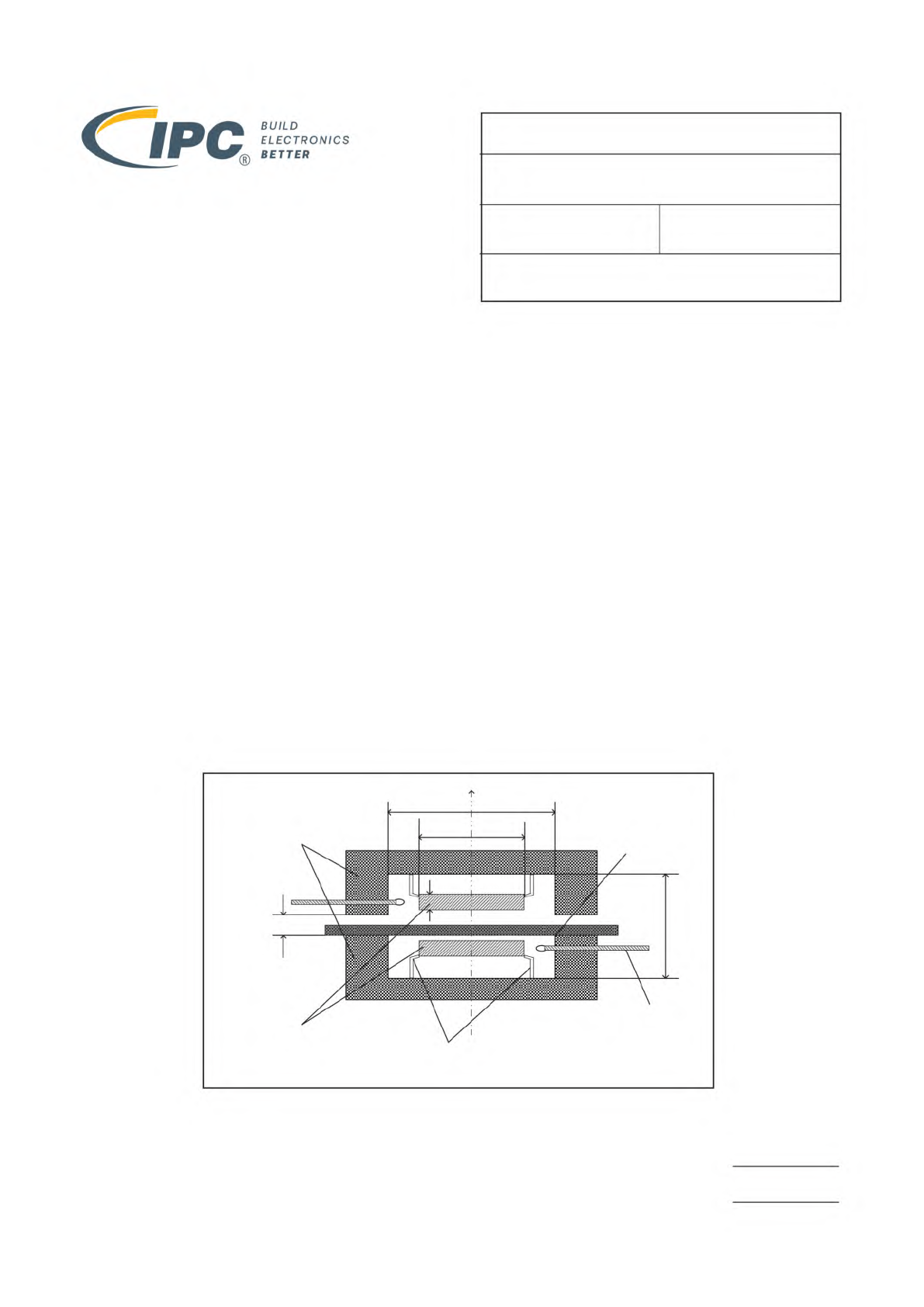
The dimensions of the test specimen shall be larger than the outer dimension of the fixture. See Figure 1.
The size of the specimen shall be larger than the internal diameter D of the metal enclosures, and the maximum thickness of the
specimen shall be smaller than the distance h
g
between the metal enclosures of the fixture.
support
coupling loop
metal enclosure
dielectric resonators
sample
D
h
g
z
h
r
L
dr
Figure1–DiagramofSPDRTestFixture
Page 1 of 7
2.5.5.15
06/22 N/A
3-11aIPC-4101TaskGroup
RelativePermittivityandLossTangentUsinga
Split-PostDielectricResonator
BUILD
ELECTRONICS
BETTER
个
1 Scope
This test method is used to quantify the deleteri-
ous effects of fabrication, process or handling residues on
Surface Insulation Resistance (SIR) in the presence of mois-
ture. The electrodes are long parallel traces (printed inter-
digitated comb patterns) on a standardized printed board or
assembly. Samples shall be conditioned and measurements
taken at a high humidity. Electrodes are electrically biased
during conditioning to facilitate electrochemical reactions.
Specifically, this method is designed to:
• Simultaneously assess
a) leakage current caused by ionized water films and
b) electrochemical degradation of test vehicle, (corrosion,
dendritic growth).
• Provide metric(s) that can appropriately be used for binary
classification (e.g., go/no go, pass/fail).
• Compare, rank or characterize materials and processes.
2 Applicable Documents
2.1 IPC
Surface Insulation Resistance - Gerber Kit
Requirements for Soldering Fluxes
Acceptability of Printed Boards
Surface Insulation Resistance Handbook
2.2 American Society for Testing and Materials (ASTM)
Standard Test Methods for DC Resistance or
Conductance of Insulating Materials
2.3 American National Standards Institute (ANSI)/NCSL
International
Calibration Laboratories and Measuring
and Test Equipment - General Requirements
American National Standard for
Expressing Uncertainty - U.S. Guide to the Expression of
Uncertainty in Measurement
2.4 International Electrotechnical Commission
Test methods for electrical materials, intercon-
nection structures and assemblies - Test methods for printed
board assemblies
3 Test Samples
The type and number of test samples
(coupons) as well as method of preparation and test require-
ments should be described in the governing specification
(e.g., J-STD-004) or procurement documentation.
If this test method is being used as a stand-alone document,
decisions should be made regarding what samples might be
the most appropriate for test. This SIR method should not be
considered standard unless standard test vehicles are used.
Vehicles prepared for flux qualification shall be handled in a
way that minimizes the possibility of ionic contamination. Use
of ion-free gloves and wrap/bags is required. If testing a pro-
cess, standard shipping and handling procedures shall be
used.
For further information about sampling and sampling sizes see
7.1 and 7.1.2.
The IPC-A-24-G-KIT artwork package provides the necessary
Gerber files for the fabrication of the standard IPC-B-24 test
board used with this test method.
3.1 Test Controls
Two cleaned bare IPC-B-24 test boards
(bare copper on FR-4) shall be used as chamber controls.
3.1.1
Visually inspect the boards for any obvious defects, as
described in IPC-A-600. If there is any doubt about the over-
all quality of any test sample, the board should be discarded.
3.1.2
Clean each control board by using deionized or dis-
tilled water and scrubbing with a soft bristle brush for a mini-
mum of 30 seconds. Spray rinse thoroughly with deionized or
distilled water. Rinse cleaned area thoroughly with virgin
2-propanol.
An alternative cleaning method is to place the test board in an
ionic contamination tester containing 75% 2-propanol, 25%
deionized water and process the solution until all ionics have
been removed.
1. www.ipc.org/onlinestore
3000 Lakeside Drive, Suite 309S
Bannockburn, IL 60015-1249
IPC-TM-650
TEST METHODS MANUAL
Number
2.6.3.7
Subject
Surface Insulation Resistance
Date
03/07
Revision
Originating Task Group
SIR Task Group (5-32b)
ASSOCIATION CONNECTING
ELECTRONICS INDUSTRIES
®
IEC-61189-5
IPC-A-24-G-KIT1
J-STD-004
IPC-A-600
IPC-9201
ASTM
D
257
ANSI/NCSL
Z540-1
ANSI/NCSL
Z540-2
Material
/n
this
Test
Methods
Manual
was
voluntarily
established
by
Technical
Committees
of
I
PC.
This
material
/s
advisory
only
and
"s
use
or
adaptation
,
s
entirely
voluntary.
IPC
disclaims
all
liability
of
any
kind
as
to
the
use,
application,
or
adaptation
of
this
material.
Users
are
also
wholly
responsible
for
protecting
themselves
against
all
claims
or
liabilities
for
patent
infringement.
Equipment
referenced
/s
for
the
convenience
of
the
user
and
does
not
imply
endorsement
by
IPC.
Page
1
of
4