IPC-TM-650 EN 2022 试验方法--.pdf - 第575页
IPC-TM-650 Number Subject Date Revision Page 2 of 3 10/86 Dielectric Breakdown Voltage and Dielectric Strength opposing cylindrical rods 6.4 mm in diameter, with edges rounded to a radius of 0.75 mm. The upper movable el…
The Institute for Interconnecting and Packaging Electronic Circuits
2215 Sanders Road • Northbrook, IL 60062
Material in this Test Methods Manual was voluntarily established by Technical Committees of the IPC. This material is advisory only
and its use or adaptation is entirely voluntary. IPC disclaims all liability of any kind as to the use, application, or adaptation of this
material. Users are also wholly responsible for protecting themselves against all claims or liabilities for patent infringement.
Equipment referenced is for the convenience of the user and does not imply endorsement by the IPC.
Page 1 of 3
IPC-TM-650
TEST
METHODS
MANUAL
Number
2.5.6.3
Subject
Dielectric
Breakdown
Voltage
and
Dielectric
Strength
Date
Revision
10/86
Originating
Task
Group
N/A
1
Scope
These
methods
are
designed
for
use
in
determin¬
ing
the
dielectric
strength
of
solid
electrical
insulating
materi¬
als.
2
Applicable
Documents
None
3
Test
Specimens
3.1
Dimensions
The
specimens
shall
be
of
such
a
diam¬
eter
that
flashover
will
not
occur.
This
usually
means
that
the
diameter
should
be
76
mm
or
more.
3.2
Thick
Solid
Materials
The
breakdown
voltage
of
thick
solid
materials
may
be
so
high
that
special
test
specimens
cut
or
molded
in
reduced
thickness
may
be
required.
3.3
At
Various
Thicknesses
When
it
is
desired
to
deter¬
mine
the
dielectric
strength
for
different
thicknesses
of
a
mate¬
rial,
it
is
necessary
to
test
each
different
thickness,
unless
the
variation
due
to
thickness
is
already
known.
3.4
Exceptional
Conditions
The
special
sizes
of
speci¬
mens
required
for
determining
dielectric
strength
under
exceptional
conditions
shall
be
as
specified
in
the
material
specification.
4
Equipment/Apparatus
4.1
Transformer
The
desired
test
voltage
may
be
most
readily
obtained
by
a
step-up
transformer
energized
from
a
variable
low-voltage
source.
The
transformer
and
its
control¬
ling
equipment
shall
be
of
such
size
and
design
that
the
test
specimen
in
circuit,
the
crest
factor
(ratio
of
maximum
to
mean
effective)
of
the
test
voltage
shall
not
differ
by
more
than
土
5%
from
that
of
a
sinusoidal
wave
over
the
upper
half
of
the
range
of
test
voltage.
The
crest
factor
may
be
checked
by
means
of
a
sphere
gap
or
peak-reading
voltmeter
in
conjunc¬
tion
with
a
r.m.s.
voltmeter.
For
test
specimens
of
small
capacitance,
a
testing
transformer
as
small
as
500-volt-
ampere
rating
must
be
used.
Where
the
wave-form
cannot
be
determined
conveniently,
a
transformer
having
a
rating
of
not
less
than
2
kilovolt
amperes
shall
be
used
for
voltages
not
exceeding
50,000
volts.
Tests
shall
be
made
at
commercial
power
frequencies.
When
a
transformer
is
used
at
voltages
lower
than
its
full
rating,
the
current
drawn
from
the
high-
voltage
winding
should
not
exceed
the
full-load
full-voltage
current
rating.
4.2
Circuit
Breaker
The
test
transformer
circuit
shall
be
protected
by
an
automatic
circuit-breaking
device
designed
to
open
instantaneously
on
the
current
produced
by
breakdown
of
the
test
specimen.
Excessive
flow
of
current
at
the
time
of
breakdown
causes
pitting
and
heating
of
the
electrodes
and
thereby
increases
the
work
of
electrode
maintenance
and
time
of
testing.
4.3
Voltage
Control
The
rate
of
voltage
rise
shall
not,
for
short
time
tests,
vary
more
than
±
25%
from
the
specified
rate.
Control
of
voltage
may
be
secured
in
one
of
several
ways:
a.
Variable-ratio
autotransformer
b.
Resistance-potential
divider
c.
Generator-field
regulation
d.
Induction
regulator
Preference
should
be
given
to
equipment
having
an
approxi¬
mately
straight-line
voltage-time
curve
over
the
desired
oper¬
ating
range.
Motor
drive
with
variable
speed
control
should
be
preferred
to
manual
drive
because
of
the
difficulty
in
maintain¬
ing
reasonable
uniform
rate
of
voltage
rise
with
the
latter.
4.4
Voltmeter
The
voltage
shall
be
measured
by
an
approved
method,
which
gives
root-mean-square
values,
preferably
by
means
of
a.
A
voltmeter
connected
to
the
secondary
of
a
separate
potential
transformer
b.
An
electrostatic
voltmeter
in
the
secondary
circuit
c.
A
voltmeter
connected
to
a
well-designed
tertiary
coil
in
the
test
transformer.
A
voltmeter
connected
to
the
primary
side
of
the
testing
transformer
may
be
used
only
if
the
ratio
of
transformer
does
not
change
appreciably
with
load.
4.5
Electrodes
The
electrodes
used
for
thin
solid
materials
(sheets
and
plates)
shall
be
metal
disks
5
mm
in
diameter
and
25
mm
in
length,
with
the
edges
rounded
to
a
radius
of
6.4
mm.
The
electrodes
used
for
thick
solid
materials
shall
be
metal
disks
25
mm
in
diameter
and
25
mm
in
length,
with
edges
rounded
to
a
radius
of
3.2
mm.
The
electrodes
for
tapes
and
sheet
materials
to
be
compared
with
tapes
shall
be
IPC-TM-650
Number
Subject Date
Revision
Page 2 of 3
10/86
Dielectric
Breakdown
Voltage
and
Dielectric
Strength
opposing
cylindrical
rods
6.4
mm
in
diameter,
with
edges
rounded
to
a
radius
of
0.75
mm.
The
upper
movable
elec¬
trodes
shall
weigh
45.35g
±
2g.
When
6.4
mm
electrodes
are
used,
it
is
advisable
that
they
be
surrounded
by
guard
elec¬
trodes
or
shrouds.
4.5.1
The
dielectric
strength
of
an
insulating
material
varies
with
the
thickness
of
the
material
and
the
area
and
geometry
of
the
test
electrodes,
and
these
should
be
specified
in
the
specification.
Tests
made
with
different
electrodes
are
not
comparable.
Where
materials
are
made
up
into
forms
of
uni¬
form
thickness,
such
as
sheets
and
plates,
tests
shall
be
made
upon
that
thickness
of
material.
In
other
cases,
a
thick¬
ness
of
the
test
specimen
and
diameter
and
shape
of
the
electrode
have
been
selected,
which
are
compatible
with
con¬
venience
of
testing.
4.6
Equipment
Testing
Apparatus
4.6.1
For
Tests
Made
in
Air
Use
may
be
made
of
any
well
designed
oven
of
sufficient
size
to
hold
the
test
equipment.
It
should
be
provided
with
some
means
of
circulating
air
so
that
approximately
constant
temperature
is
maintained
around
the
test
specimen
and
with
a
thermometer
or
thermocouple
for
measuring
the
temperature
as
near
the
point
of
test
as
prac¬
ticable
to
the
nearest
1
℃.
4.6.2
For
Test
Under
Oil
Use
may
be
made
of
an
oil
bath,
provided
with
some
means
for
circulating
the
oil
so
that
the
temperature
is
substantially
uniform
around
the
test
speci¬
mens
and
with
a
thermometer
or
thermocouple
for
measuring
the
temperature
as
near
the
point
of
test
as
practicable
to
the
nearest
1
℃.
5
Procedure
5.1
Test
Medium
The
medium
to
be
used
in
the
tests
should
be
specified
in
the
specification.
In
general,
it
is
prefer¬
able
to
test
materials
in
the
medium,
whether
air
or
oil,
in
which
they
are
to
be
used.
Where
conditions
of
use
are
not
well
defined,
materials
should
be
tested
in
air
up
to
the
point
where
the
breakdown
is
so
high
that
an
excessive
amount
of
material
is
required
to
prevent
flashover
to
excessive
burning
of
the
surface.
For
specimens
having
a
high
breakdown,
such
as
the
thicker
and
highgrade
materials,
it
is
usually
necessary
to
make
dielectric
strength
tests
under
oil:
however;
it
should
be
understood
that
breakdown
values
obtained
under
oil
are
not
comparable
with
those
obtained
in
air.
5.2
Preparing
Specimens
5.2.1
In
the
preparation
of
test
specimens,
care
shall
be
taken
to
have
the
surfaces
adjacent
to
the
electrodes
parallel
and
as
plane
and
smooth
as
the
material
permits.
The
dielec¬
tric
strength
of
an
insulating
material
varies
with
the
thickness
of
the
test
specimen.
Therefore,
tests
on
specimens
of
differ¬
ent
thicknesses
are
not
comparable.
The
thickness
used
shall
be
the
average
thickness
of
the
sample
measured
as
specified
in
the
specification
involved.
5.2.2
The
dielectric
strength
of
most
insulating
materials
var¬
ies
with
temperature
and
humidity.
The
test
coiditions
to
be
used
should
be
specified
in
the
specification.
Usually
it
is
desirable
to
determine
the
dielectric
behavior
of
a
material
over
the
range
of
temperature
and
humidity
to
which
it
is
likely
to
be
subjected
in
use.
When
required,
materials
may
be
con¬
ditioned
in
a
suitably
controlled
chamber.
The
test
specimen
shall
be
kept
in
the
chamber
long
enough
to
reach
a
uniform
temperature
and
humidity
prior
to
testing.
When
required,
the
dielectric
strength
tests
shall
be
made
on
the
specimen
while
still
in
the
conditioning
chamber.
For
purpose
of
tests,
a
high-
voltage
conductor
may
be
conveniently
carried
into
the
cham¬
ber
through
an
insulating
bushing.
5.3
Positioning
and
Care
of
Electrodes
Electrodes
shall
be
held
truly
coaxial.
Where
electrodes
have
flat
test
faces,
the
latter
shall
be
parallel
to
each
other.
The
test
faces
shall
be
kept
smooth
and
polished
and
free
from
pitting.
5.4
Application
of
Voltage
5.4.1
Test
for
Specified
Minimum
Requirement
The
voltage
shall
be
applied
and
increased
at
a
uniform
rate
from
zero
to
the
value
specified
in
the
material
specification
and
shall
be
held
at
the
value
for
the
specified
time.
Unless
other¬
wise
specified,
the
rate
of
rise
per
second
shall
be
5%
of
the
specified
voltage.
Note
that
this
test
is
to
check
for
ability
to
withstand
a
specified
voltage
and
not
to
determine
the
break¬
down
value.
5.4.2
Test
to
Breakdown,
Short-time
Test
The
voltage
shall
be
increased
from
zero
to
breakdown
at
a
uniform
rate.
The
rate
of
rise
shall
be
0.5
or
1
.0
kilovolts
per
second,
depending
on
the
total
test
time
required
and
the
voltage-time
characteristic
of
the
material.
The
rate
of
rise
of
voltage
should
be
specified
in
the
material
specification.
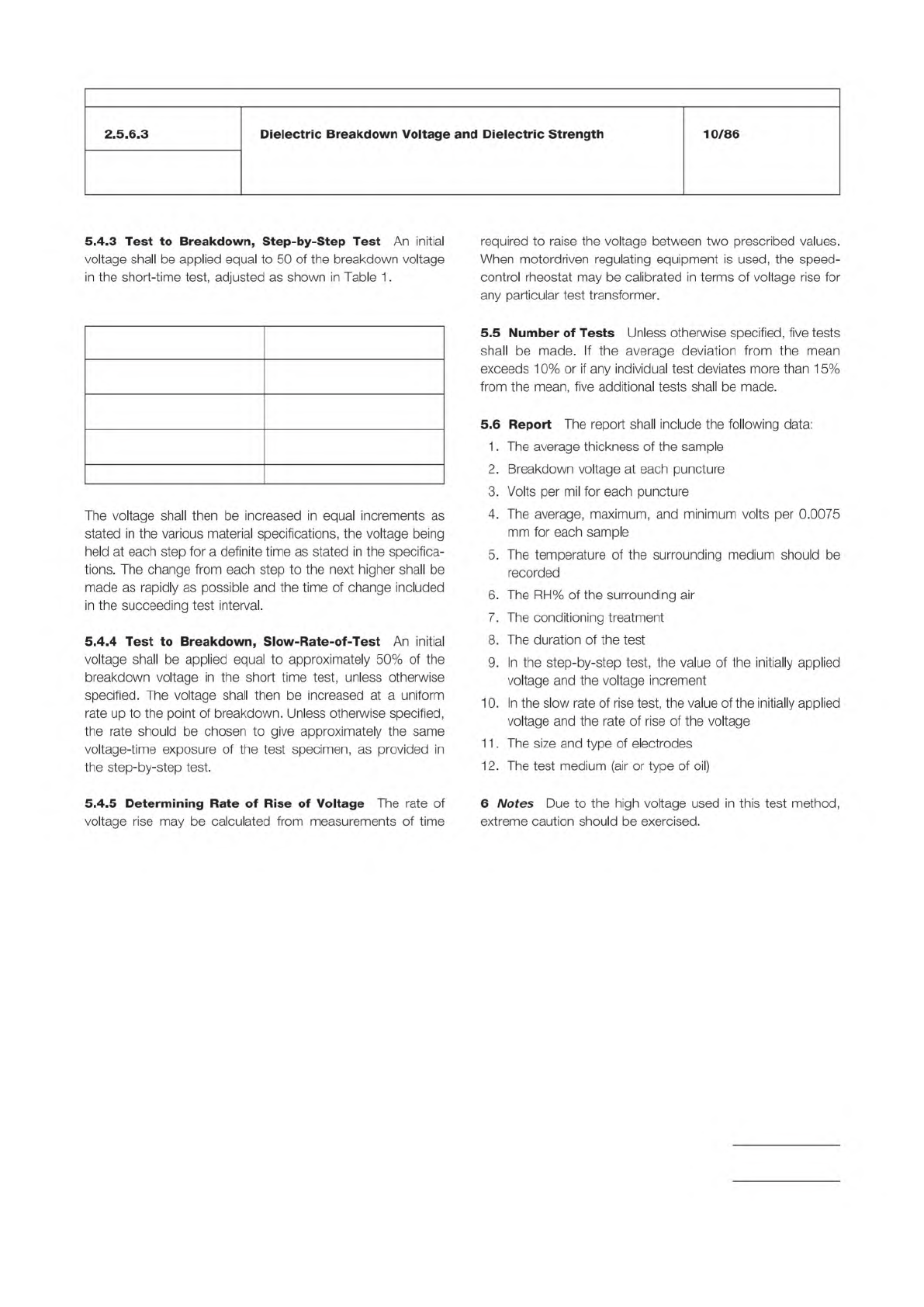
Table 1 Application of Initial Voltage
Breakdown voltage by
short-time method
Adjust 50% of breakdown
voltage to nearest
25 kilovolts or less 1.0 kilovolt (unless
otherwise specified)
Over 25 to 50 kilovolts.
inclusive
2.0 kilovolts
Over 50 to 100 kilovolts,
inclusive
5.0 kilovolts
Over 100 kilovolts 10.0 kilovolts
IPC-TM-650
Number
Subject Date
Revision
Page 3 of 3
2.5.6.3
Dielectric
Breakdown
Voltage
and
Dielectric
Strength
10/86
5.4.3
Test
to
Breakdown,
Step-by-Step
Test
An
initial
voltage
shall
be
applied
equal
to
50
of
the
breakdown
voltage
in
the
short-time
test,
adjusted
as
shown
in
Table
1
.
The
voltage
shall
then
be
increased
in
equal
increments
as
stated
in
the
various
material
specifications,
the
voltage
being
held
at
each
step
for
a
definite
time
as
stated
in
the
specifica¬
tions.
The
change
from
each
step
to
the
next
higher
shall
be
made
as
rapidly
as
possible
and
the
time
of
change
included
in
the
succeeding
test
interval.
5.4.4
Test
to
Breakdown,
Slow-Rate-of-T
est
An
initial
voltage
shall
be
applied
equal
to
approximately
50%
of
the
breakdown
voltage
in
the
short
time
test,
unless
otherwise
specified.
The
voltage
shall
then
be
increased
at
a
uniform
rate
up
to
the
point
of
breakdown.
Unless
otherwise
specified,
the
rate
should
be
chosen
to
give
approximately
the
same
voltage-time
exposure
of
the
test
specimen,
as
provided
in
the
step-by-step
test.
5.4.5
Determining
Rate
of
Rise
of
Voltage
The
rate
of
voltage
rise
may
be
calculated
from
measurements
of
time
required
to
raise
the
voltage
between
two
prescribed
values.
When
motord
riven
regulating
equipment
is
used,
the
speed¬
control
rheostat
may
be
calibrated
in
terms
of
voltage
rise
for
any
particular
test
transformer.
5.5
Number
of
Tests
Unless
otherwise
specified,
five
tests
shall
be
made.
If
the
average
deviation
from
the
mean
exceeds
1
0%
or
if
any
individual
test
deviates
more
than
1
5%
from
the
mean,
five
additional
tests
shall
be
made.
5.6
Report
The
report
shall
include
the
following
data:
1
.
The
average
thickness
of
the
sample
2.
Breakdown
voltage
at
each
puncture
3.
Volts
per
mil
for
each
puncture
4.
The
average,
maximum,
and
minimum
volts
per
0.0075
mm
for
each
sample
5.
The
temperature
of
the
surrounding
medium
should
be
recorded
6.
The
RH%
of
the
surrounding
air
7.
The
conditioning
treatment
8.
The
duration
of
the
test
9.
In
the
step-by-step
test,
the
value
of
the
initially
applied
voltage
and
the
voltage
increment
1
0.
In
the
slow
rate
of
rise
test,
the
value
of
the
initially
applied
voltage
and
the
rate
of
rise
of
the
voltage
1
1
.
The
size
and
type
of
electrodes
12.
The
test
medium
(air
or
type
of
oil)
6
Notes
Due
to
the
high
voltage
used
in
this
test
method,
extreme
caution
should
be
exercised.