IPC-TM-650 EN 2022 试验方法--.pdf - 第581页
1 Scope The d ielec tri c withstanding voltage test (Hipot te st) consists of th e application of a voltage high e r than the oper- ating voltage for a specific time across the thickness of the test spe cim e n’s dielect…
IPC-TM-650
Page 2 of 2
Number
2.5.7.1
Subject
Dielectric
Withstanding
Voltage
-
Polymeric
Conformal
Coating
Date
07/00
Revision
5.1.2
Immerse
and
agitate
the
test
specimens
in
2-propanol
for
30
seconds.
Scrub
with
a
soft
bristle
brush
and
spray
with
clean
2-propanol.
5.1.3
Place
the
cleaned
specimens
in
an
oven
maintained
at
50℃
[1
22°F]
for
three
to
five
hours
to
dry.
5.1.4
Remove
the
specimens
from
the
oven
and
place
in
a
desiccator
to
cool.
5.1.5
Conformal
coat
the
test
specimens
and
cure
in
accor¬
dance
with
the
suppliers
recommendations.
If
the
specimens
are
not
used
immediately,
seal
the
specimens
in
Kapac®
bags.
5.2
Procedure
5.2.1
For
each
individual
specimen,
secure
all
the
positive
leads
(1
,
3
and
5)
together
and
the
negative
(2
and
4)
together.
5.2.2
Attach
the
leads
of
the
Hi-Pot
Tester
to
the
wires
of
the
test
specimen.
5.2.3
Raise
the
test
voltage
from
zero
to
1,500
VAC
at
1
00
VAC
per
second.
5.2.4
Apply
the
test
voltage
of
1
,500
VAC
at
50-60
Hz
for
one
minute
and
record
any
leakage
rate.
5.2.5
After
the
one-minute
duration,
turn
off
the
voltage
and
disconnect
the
test
specimen
from
the
Hi-Pot
Tester.
6.0
Evaluate
6.1
Record
if
the
specimen
exhibits
flashover,
sparkover
or
breakdown.
6.1.1
Record
the
leakage
current
of
each
specimen.
1 Scope
The dielectric withstanding voltage test (Hipot test)
consists of the application of a voltage higher than the oper-
ating voltage for a specific time across the thickness of the
test specimen’s dielectric layer. This is used to prove that a
printed board can operate safely at its rated voltage and with-
stand momentary voltage spikes due to switching, surges,
and other similar phenomena. Although this test is similar to a
voltage breakdown test, it is not intended for this test to cause
insulation breakdown. Rather, it serves to determine whether
the test specimen’s layers have adequate withstanding volt-
age. This document is applicable to thin dielectric materials
such as those defined by IPC-4821.
The results can be indicative of a change or a deviation from
the normal material characteristics resulting from manufactur-
ing, processing or aging conditions. The test is useful for qual-
ity acceptance and in the determination of the suitability of the
material for a given application and may be adapted for pro-
cess control.
2 Applicable Documents
Specification for Embedded Passive Device
Capacitor Materials for Rigid and Multilayer Printed Boards
3 Test Specimen
3.1 Qualification Testing
For laminate-like capacitor
materials, test specimens
be 50 mm [1.97 in] diameter
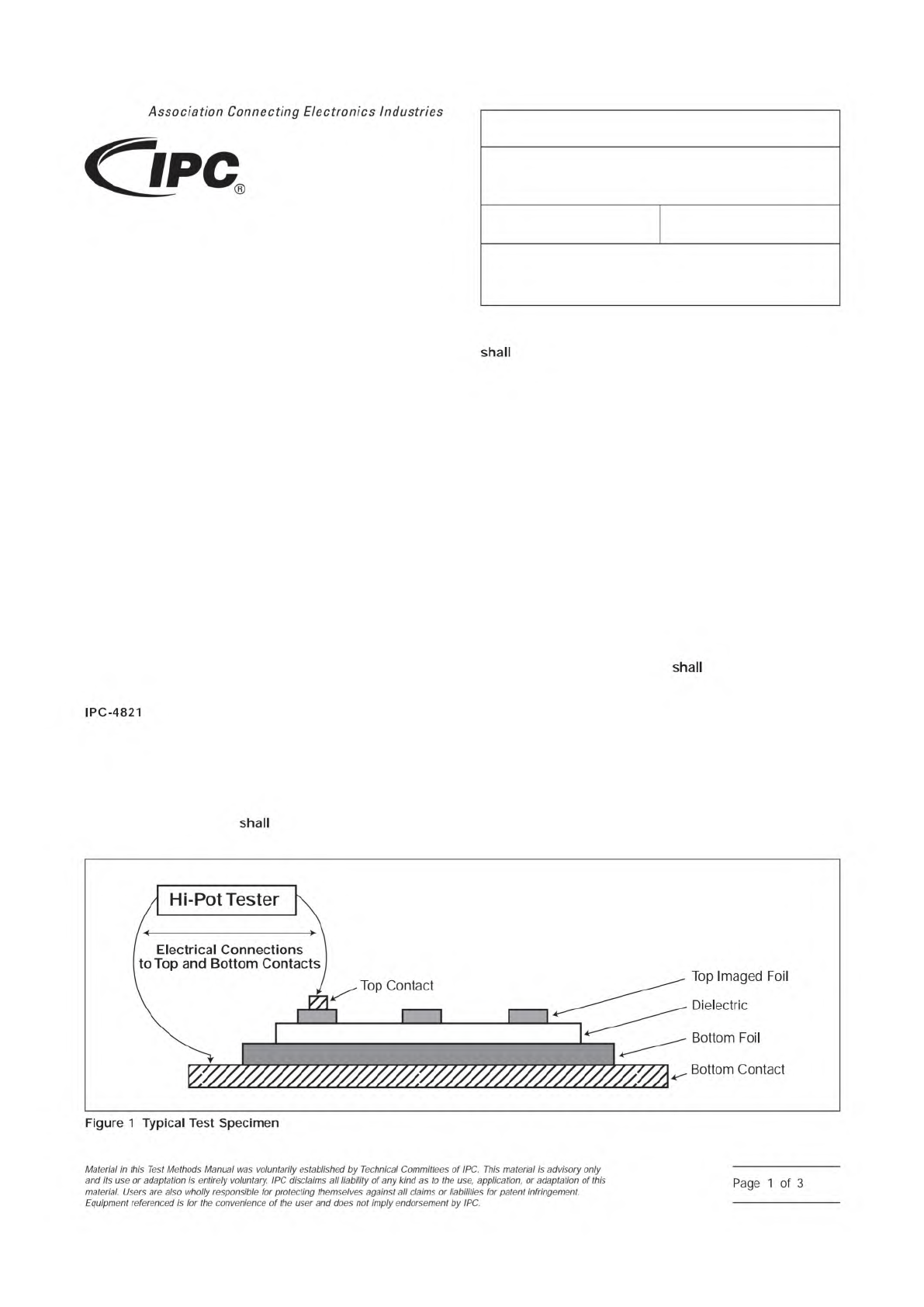
circular electrodes (see ‘‘Top Imaged Foil’’ in Figure 1) that
be formed by imaging and then etching the copper foil,
unless otherwise as agreed upon by user and supplier
(AABUS). Spacing between adjacent Top Imaged Foil con-
ductors is recommended to be ≥100 times the dielectric thick-
ness. In order to avoid field gradient and mechanical stress
concentration, which can cause faulty dielectric breakdown,
the Bottom Foil can be either a circle larger than the Top
Imaged Foil or can be a continuous copper sheet. The con-
tinuous copper sheet will be required for very thin capacitor
dielectric layers that are not self-supporting.
For nonlaminate-like capacitor materials, the test specimen’s
Top Imaged Foil can be a size other than a 50 mm [1.97 in]
diameter circle, if this size is not practical or typical. The test
specimen’s Top Imaged Foil size for these nonlaminate-like
materials should be set to the largest size normally recom-
mended for this product (see 5.2.4). The thickness for the test
specimens should be the typical/recommended thickness. A
minimum of five test specimens
be tested for qualifica-
tion.
3.2 Conformance Testing
Test specimens can be the
same as used for qualification testing or can be other sizes or
shapes. For testing in printed board environments, actual
innerlayer power and ground features are typically used,
although other board features or test specimens can also be
used. Please note that adjustments for capacitor plate size are
required in the test procedure (see Section 6).
IPC-2572-1.eps
3000 Lakeside Drive, Suite 309S
Bannockburn, IL 60015-1249
IPC-TM-650
TEST METHODS MANUAL
Number
2.5.7.2
Subject
Dielectric Withstanding Voltage (Hipot Method) -
Thin Dielectric Layers for Printed Boards
Date
11/2009
Revision
A
Originating Task Group
Embedded Devices Test Methods Subcommittee
(D-54)
Association
Connecting
Electronics
Industries
shall
IPC-4821
shall
shall
Top
Imaged
Foil
Dielectric
Bottom
Foil
Bottom
Contact
Figure
1
Typical
Test
Specimen
Material
/n
this
Test
Methods
Manual
was
voluntarily
established
by
Technical
Committees
of
I
PC.
This
material
/s
advisory
only
and
"s
use
or
adaptation
,
s
entirely
voluntary.
IPC
disclaims
all
liability
of
any
kind
as
to
the
use,
application,
or
adaptation
of
this
material.
Users
are
also
wholly
responsible
for
protecting
themselves
against
all
claims
or
liabilities
for
patent
infringement.
Equipment
referenced
/s
for
the
convenience
of
the
user
and
does
not
imply
endorsement
by
IPC.
Page
1
of
3

3.3 Test Specimen Conditioning
All qualification test
specimens
be conditioned at 23 °C ± 3 °C and 50% ±
10% RH for 24 hours, before testing. For conformance test-
ing, such conditioning is optional.
4 Apparatus
4.1 Hipot Test Instrument
A Hipot test instrument is a
piece of equipment capable of supplying a range of DC test
voltages appropriate for the materials under test with adjust-
able ramp rate and hold-time settings. The Hipot equipment
have an adjustable threshold current setting. (see 5.2.4)
The user
ensure that the Hipot test instrument satisfies
the original manufacturer’s technical specifications.
4.2 High Voltage Connections
Contacts (conductor
plates) apply the voltage from the Hipot test instrument to the
test specimen’s Top Imaged Foil and Bottom Foil (see Figure
1). These contacts should not contain sharp points that could
damage either the copper foil or the dielectric layers of the test
specimens.
Dangerous voltages may be present on the test
connections. Use proper machine guarding and/or machine
interlocking.
5 Procedure
5.1
This test method be performed on fresh test
specimens. Hipot testing
be conducted on test
specimens that have previously been exposed to high voltage
levels or other similar testing.
Some dielectrics may show acceptable Hipot results
(i.e., ‘‘Pass’’) after defects have been ‘‘burned out’’ at high
voltage (see Section 6).
5.2
Program the Hipot test instrument with the appropriate
peak voltage, voltage ramp rate, hold time at peak voltage
and current threshold level. These values
be recorded.
5.2.1
The peak voltage should be as specified in the mate-
rial Specification Sheet (see IPC- 4821) under the parameter
‘‘Hipot (Volts DC).’’
5.2.2
For qualification testing, the voltage ramp rate
be 5% of the peak voltage per second, unless otherwise
specified. For conformance testing, the voltage ramp rate
be 5% of the peak voltage per second or AABUS.
5.2.3
For qualification testing, the hold time at peak voltage
be 30 seconds +3 / -0 seconds. For conformance test-
ing, the hold time at peak voltage
be a minimum of 10
seconds or AABUS.
5.2.4
The threshold settings be set to a value greater
than the in-rush current (due to the charging of the test speci-
men) observed when the voltage is increased (see 6.1). Many
commercial Hipot test instruments display the current during
the test. The in-rush current can be determined by setting the
threshold current to a high value and then observing the cur-
rent spikes as the voltage is ramped to the peak voltage. After
several test specimens have been tested and the currents
observed, set the threshold current to be greater than the
highest current observed. For example, if the in-rush current is
20 microamperes and the current at peak voltage is 1 micro-
ampere, set the threshold current to 40 microamperes.
5.3
The test specimen be placed between the con-
tacts of the Hipot test equipment (see Figure 1). Start the
Hipot sequence.
5.4
Upon completion of the test, the Hipot sequence should
include the discharge of the test specimen.
Larger test specimens, with high capaci-
tance density, may take more time than expected to dis-
charge.
5.5 Reporting
The Hipot test instrument indicates either
Pass or Fail of the material under test. A current surge above
the threshold current setting indicates a Failure. This includes
very short term current surges or ‘‘arcs’’ that occur due to the
burnout of defects. Such unacceptable current surges may
also be the result of dielectric failure or manufacturing defects.
For qualification testing, if the test specimen Passes, record
the leakage current per unit area and the passing voltage. If
the qualification test specimen Fails, record the failure voltage
and threshold current per unit area of each test specimen.
For conformance testing, reporting requirements should be
AABUS.
6 Notes
6.1
When the Hipot test instrument voltage changes from
one level to the next higher level during the ramp-up to the
final voltage, the in-rush current will initially surge above the
steady state current because the capacitor is charging. It is
possible that this surge in current could exceed the threshold
Number
2.5.7.2
Subject
Dielectric Withstanding Voltage (Hipot Method) - Thin Dielectric
Layers for Printed Boards
Date
11/2009
Revision
A
IPC-TM-650
—
shall
shall
shall
shall
shall
shall
shall
CAUTION:
SAFETY
NOTE:
NOTE:
shall
shall
not
shall
shall
Page
2
of
3