IPC-TM-650 EN 2022 试验方法--.pdf - 第6页
The IPC T est Methods Manual , IPC-TM-650, is divided into several major sections to provide a systematic means of displaying a variety of information pertinent to testing all types of printed circuits and connectors. Th…
PROCEDURE
The procedure section is to be used to detail the specific steps necessary to perform the actual test. It
will include any specific conditioning requirements, or other specimen preparation not previously detailed. It will then
detail the successive steps of the procedure, grouping related operations into logical divisions in a concise manner. It
will include times, temperatures, voltages, pressures, concentrations, linear measurements, and quantitative criteria
when necessary in metric units.
It will then describe how to evaluate the samples under test, providing examples when necessary. It will also include
any calculations or conversion tables necessary to complete or evaluate the test. The calculations should use numeri-
cal values for any physical constants and letter symbols to describe variables. The letter symbols must then be imme-
diately identified under the equation.
It will also state any detailed information required in reporting the test results. When two or more procedures are
described in the test method, the report will indicate which of the procedures was used. When a test method allows
variations in operating or other conditions, the report will state the particular conditions utilized for the test.
NOTES
The notes section is to be used to discuss any special considerations, or detail other reference documents
necessary or recommended for the test. This section should include any safety precautions, hazard information, or
warning statements necessary for the safe completion of the test method. This section should also be used to show
sources of obtaining specialized test apparatus or materials for the test.
SECTION
5.
0
SECTION
6.
0
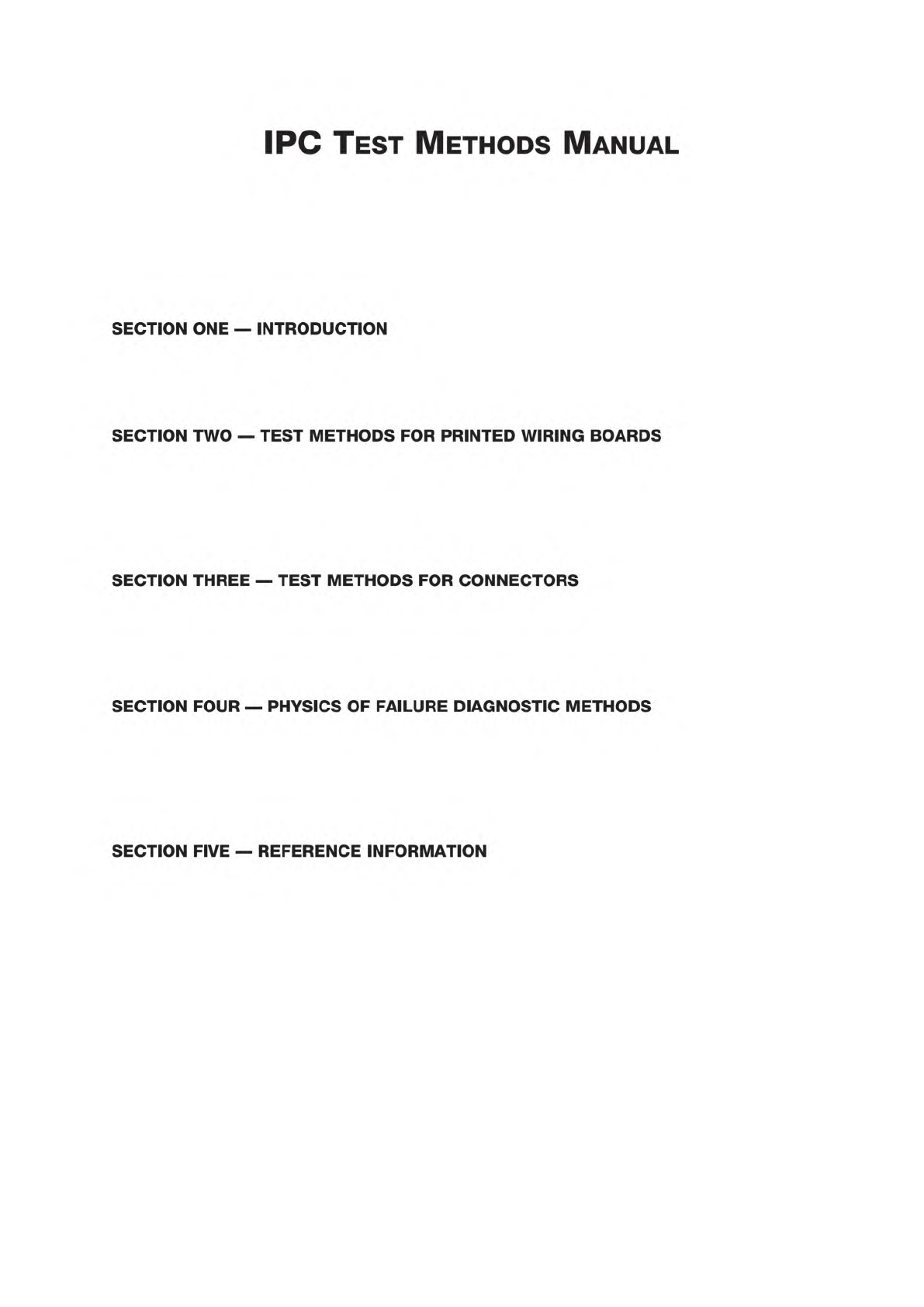
The IPC Test Methods Manual, IPC-TM-650, is divided into several major sections to provide a systematic means of
displaying a variety of information pertinent to testing all types of printed circuits and connectors. The following is a
general description of the information contained in each major section of the IPC-TM-600. A more detailed listing of
the contents of each major section appears as the Table of Contents at the beginning of each major section.
Section One contains a listing of the Test Methods Subcommittee members, an explanation of the use of this volume,
information of general interest relative to calibration of test equipment, reporting formats and practices, organizational
abbreviations and sources, compliance certification, and review board procedures.
Section Two contains the specific test methods, together with appropriate illustrations, sketches, and tables necessary
for the performance of chemical, mechanical, electrical, and environmental tests on all forms of printed circuits. It is
divided into subsections so that each test method can be found easily under the broad titles mentioned above. These
test methods are also intended for use by adapting them for testing materials or end products similar to those for which
these test methods were specifically written.
Section Three contains the specific test methods, together with appropriate illustrations, sketches, and tables necessary
for the performance of chemical, mechanical, electrical, and environmental tests on connectors used in printed cir-
cuitry. These test methods are abstracted from the EIA-IPC agreed upon test methods appearing in the EIA-RS-364
Standard.
Section Four contains information on diagnostic techniques for failure analyses. These are not standard test methods
because the methods and procedures vary, depending on the condition or behavior of the test specimen. This section
is intended to provide a feel for the capabilities of diagnostic testing for the relatively sophisticated equipment and
training required, as well as the cost of diagnostic analyses. Most of these analytical test techniques are not feasible
for routine incoming inspection, in-process inspection, or end-product evaluation.
Section Five contains related information to supplement and support the previous sections. It provides a listing of
related test methods that may be utilized even though not yet officially concurred with by the IPC, a listing of related
publications, a subsection dedicated to the metric system, information on preparing samples for testing, and specifi-
cations and sketches of test pattern artwork for all forms of printed circuitry.
I
PC
Test
Methods
Manual
SECTION
ONE
—
INTRODUCTION
SECTION
TWO
—
TEST
METHODS
FOR
PRINTED
WIRING
BOARDS
SECTION
THREE
—
TEST
METHODS
FOR
CONNECTORS
SECTION
FOUR
—
PHYSICS
OF
FAILURE
DIAGNOSTIC
METHODS
SECTION
FIVE
—
REFERENCE
INFORMATION
Development and/or revision of test methods is encouraged. This procedure has been developed to simplify the pro-
cess, and to assure timely and efficient processing.
Every newly proposed or revised proposal to an existing test method must have a cover sheet. The cover sheet can be
found in the front of the IPC Test Methods Manual, IPC-TM-650, or can be obtained from the IPC.
1. Complete the heading with the appropriate information. If the method is new, a number will be assigned by the
IPC.
2. Section 1 needs to be filled out and returned to the IPC. You need the following information for this section.
• Reason for initiating or revising the test method(s). Include whether the test method(s) was the result of a round
robin program.
• All standards/specifications that the originating task group is aware of that will be affected by the method(s).
3. The cover sheet will be returned to the originating committee with a number assigned to the new method(s)s and
a disk containing the template and test method outline that needs to be followed. The IPC will verify that all
affected groups have been identified and notify the chairman of all affected groups.
The originating task group can now set up as many meetings as they feel necessary to work on the test method(s).
The test method(s) will be circulated among the task group as many times as needed until the task group is satis-
fied.
4. Section 3 of the cover sheet is then filled out and returned to the IPC along with the test method(s). The follow-
ing will then occur:
• The test method(s) are sent to the Test Methods Subcommittee and all subcommittees and task groups affected by
the test method(s) for comment. Any test method(s) revising any current method(s) will be circulated with the
current method for comparison purposes.
• The comments are then compiled and returned to the originating task group for disposition. All of those who
comment will be informed of the schedule for this meeting so that they may attend.
• Depending upon the level of comments or if the originating task group makes significant technical changes to the
method(s) as a result of these comments, a second circulation may be necessary. The IPC staff and the Test Meth-
ods Subcommittee Chairman will make this determination.
• Test method(s) accepted by one committee and rejected by another will be returned to the Test Methods Subcom-
mittee. The subcommittee will then schedule a meeting to resolve the conflicts and disposition of the method(s).
• If approved or if no comments are received, then the test method(s) will be submitted for typesetting.
5. The final typeset version of the test method(s) must be reviewed and released by the originating task group chair-
man and the chairman of the Test Methods Subcommittee prior to its printing in the IPC-TM-650.
IPC
Procedure
for
Approving
Test
Methods
for
IPC-TM-650