IPC-TM-650 EN 2022 试验方法--.pdf - 第651页
IPC-TM-650 Page 3 of 3 Number 2.6.1. 1 Subject Fungus Resistance - Conformal Coating Date 07/00 Revision fine mist from a previously sterilized atomizer or nebulizer. In spraying the test and control items, care should b…
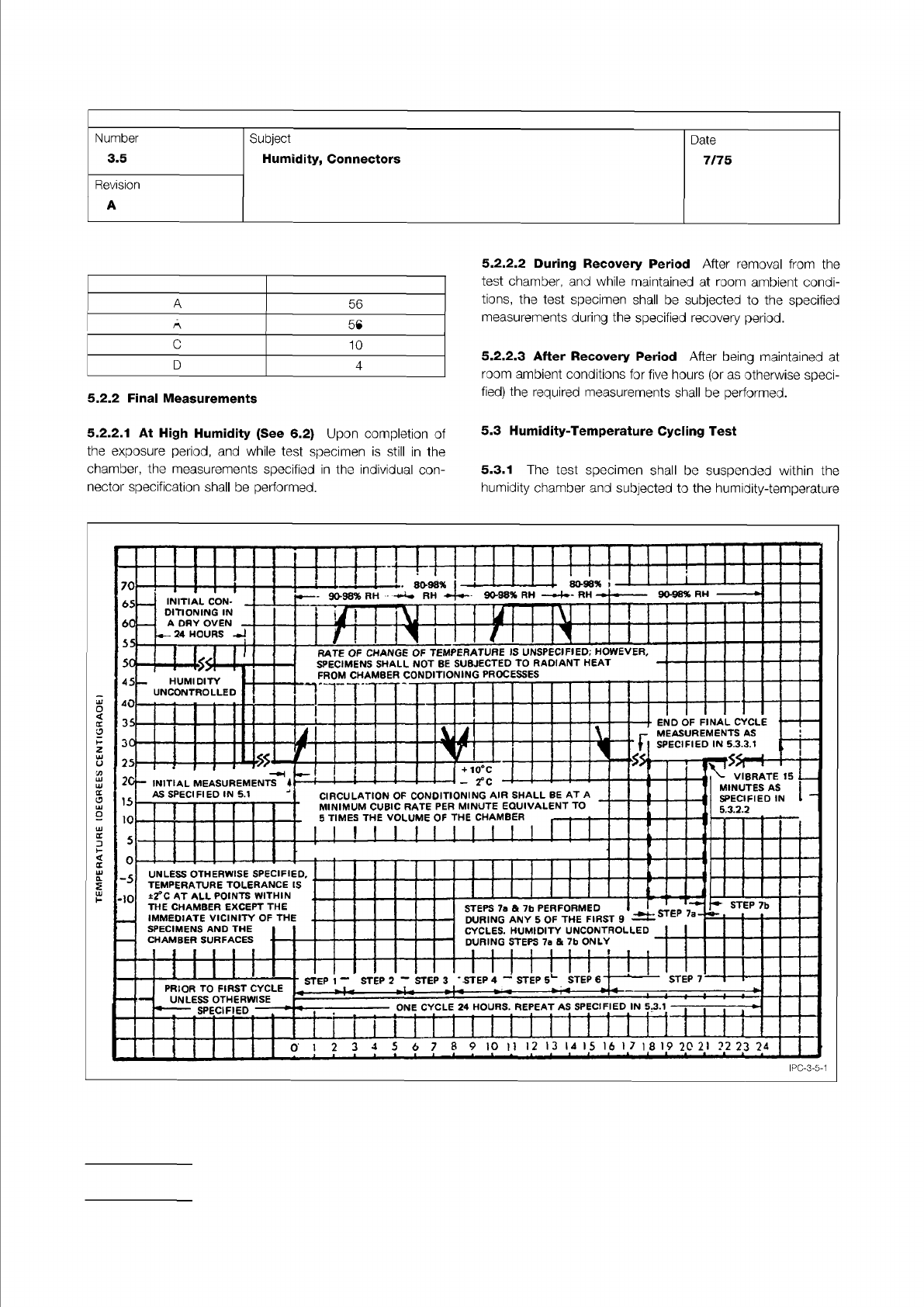
Table I Test Duration
Condition Length of Test (Days)
Figure 1 Graphical Representation of Moisture-Resistance Test
IPC-TM-650
Page 2 of 3
IPC-3-5-1
.
80-98%
70
65
60
55
50
45
40
35
25
10
5
0
-5
-10
STEP
7b
STEP
7
ONE
CYCLE
24
HOURS.
REPEAT
AS
SPECIFIED
IN
5.3.1
ED
SPECIF
0
PRIOR
TO
FIRST
CYCLE
UNLESS
OTHERWISE
INITIAL
CON-
.
DITIONING
IN
A
DAY
OVEN
-
一
24
HOURS
7
END
OF
FINAL
CYCLE
MEASUREMENTS
AS
SPECIFIED
IN
5.3.3.1
rate
of
change
of
temperature
is
unspecified;
however,
SPECIMENS
SHALL
NOT
BE
SUBJECTED
TO
RADIANT
HEAT
FROM
CHAMBER
CONDITIONING
PROCESSES
STEPS
7a
&
7b
PERFORMED
DURING
ANY
5
OF
THE
FIRST
9
CYCLES.
HUMIDITY
UNCONTROLLED
DURING
STEPS
7a
&
7b
ONLY
3
HUMIDITY
UNCONTROLLED
UNLESS
OTHERWISE
SPECIFIED,
TEMPERATURE
TOLERANCE
IS
±2°C
AT
ALL
POINTS
WITHIN
THE
CHAMBER
EXCEPT
THE
IMMEDIATE
VICINITY
OF
THE
SPECIMENS
AND
THE
CHAMBER
SURFACES
5
6
7
8
9
iO
11
12
13
14
15
16
I
7
1
8
19
20
21
?2
23
24
1
l
i
一
・
l
।
•
l
I
一八
A
匕
i
VIBRATE
15
_
MINUTES
AS
SPECIFIED
IN
—
532.2
20-
INITIAL
measurements
…
AS
SPECIFIED
IN
5.1
」
+
10℃
-
20c
CIRCULATION
OF
CONDITIONING
AIR
SHALL
BE
AT
A
MINIMUM
CUBIC
RATE
PER
MINUTE
EQUIVALENT
TO
5
TIMES
THE
VOLUME
OF
THE
CHAMBER
A
56
B
21
C
10
D
4
5.2.2
Final
Measurements
5.2.2.
1
At
High
Humidity
(See
6.2)
Upon
completion
of
the
exposure
period,
and
while
test
specimen
is
still
in
the
chamber,
the
measurements
specified
in
the
individual
con¬
nector
specification
shall
be
performed.
5.2.2.2
During
Recovery
Period
After
removal
from
the
test
chamber,
and
while
maintained
at
room
ambient
condi¬
tions,
the
test
specimen
shall
be
subjected
to
the
specified
measurements
during
the
specified
recovery
period.
S.2.2.3
After
Recovery
Period
After
being
maintained
at
room
ambient
conditions
for
five
hours
(or
as
otherwise
speci¬
fied)
the
required
measurements
shall
be
performed.
5.3
Humidity-Temperature
Cycling
Test
5.3.1
The
test
specimen
shall
be
suspended
within
the
humidity
chamber
and
subjected
to
the
humidity-temperature
Number
3.5
Subject
Humidity,
Connectors
Date
7/75
Revision
A
A
56
B
21
C
10
D
4
IPC-TM-650
Page 3 of 3
Number
2.6.1.
1
Subject
Fungus
Resistance
-
Conformal
Coating
Date
07/00
Revision
fine
mist
from
a
previously
sterilized
atomizer
or
nebulizer.
In
spraying
the
test
and
control
items,
care
should
be
taken
to
spray
all
surfaces
which
are
exposed
during
use
or
mainte¬
nance.
If
the
surfaces
are
nonwetting,
spray
until
initiation
of
droplet
coalescence.
Incubation
is
to
be
started
immediately
following
the
inoculation.
5.5
Test
Incubation
of
Test
Items
5.5.1
Incubate
test
items
under
static
temperature
of
28-30℃
[82.4-86°F]
with
a
minimum
85%
relative
humidity.
5.5.2
After
seven
days,
inspect
the
growth
on
the
control
items
to
be
assured
that
the
environmental
conditions
are
suitable
for
growth.
If
inspection
reveals
that
the
environmen¬
tal
conditions
are
unsuitable
for
growth,
the
entire
test
shall
be
repeated.
5.5.3
If
the
control
items
show
satisfactory
fungus
growth,
continue
the
test
for
a
period
of
28
days
from
the
time
of
inoculation,
or
as
specified.
5.6
Evaluation
5.6.1
Report
those
specimens
which
were
found
to
be
nutri¬
ent
to
fungus
growth.
5.6.2
Corrosion
should
be
noted
separately
from
the
fungus
test
results.
6.0
Notes
6.1
Source
for
Micro-organisms
6.1.1
American
Type
Culture
Collection
10801
University
Blvd.
Manassas,
VA
20110-2209
(USA)
703-365-2700
http://www.atcc.org
6.2
Secondary
Sources
for
Microorganisms
6.2.1
Pioneering
Research
Division
U.S.
Army
Natick
Laboratories
Natick,
Massachusetts
01
760
6.2.2
North
University
St.
Peoria,
IL
61604
Contact:
Dr.
Stephen
Peterson
309-685-401
1
6.3
After
evaluation,
the
materials
and
the
test
chamber
must
be
decontaminated
by
exposure
on
all
sides
to
ultravio¬
let
rays
(360
nm)
for
a
minimum
of
two
hours,
or
sprayed
with
a
solution
of
1:750
zephiran
chloride
solution.
(One
part
zephi-
ran
chloride
to
750
parts
distilled
water).
6.4
Safety
Observe
all
appropriate
precautions
on
MSDS
for
chemicals
involved
in
this
test
method.
1 Scope
This test method defines the procedures to deter-
mine the moisture absorption properties of metal clad or
unclad flexible dielectrics.
2 Applicable Documents
None
3 Test Specimen
Prepare three specimens 10 cm x 10 cm
[approx.4 in x 4 in].
4 Apparatus
4.1 Test Chamber
Oven capable of maintaining the speci-
men at 105 - 110 °C [221 - 230 °F].
4.2 Analytical Balance
Analytical balance having an accu-
racy of ± 0.001 gram.
4.3 Miscellaneous
4.3.1
Vessel for holding distilled water
4.3.2
Etcher
4.3.3
Chemical etchants
4.3.4
Desiccator - Capable of holding 30% RH at 23 °C ±
2 °C [73.4 °F ± 3.6 °F]
4.3.5
40 mm dia. x 125 mm long (minimum size) glass-
stoppered evaluating bottles
4.3.6
Absorbent, lint-free paper
4.3.7
25-30 mm [approx. 5-6 in] wide, 25 mm [approx.1 in]
diameter, elastomeric (70-80 durometer hardness Shore A)
roller
4.3.8
Dry polyethylene film that is cut larger in size than
work area
4.3.9
Hard, flat, non-absorbent surface (e.g., plate glass)
4.3.10
Distilled Water
4.3.11
Thermometer for distilled water
5 Procedure
5.1 Preparation
5.1.1
If the specimen under test is a metal clad dielectric,
proceed to 5.1.2. If it is an adhesive coated dielectric, lami-
nate it with a release sheet next to adhesive or laminate to
copper foil using time, temperature, and pressure, which will
impart a normal state of cure to the adhesive. If the specimen
is a bare dielectric, proceed directly to 5.1.3.
5.1.2
Etch away all copper from the specimen using the
chemical etchants and etcher and wash thoroughly with dis-
tilled water.
5.1.3 Weighing Bottle Tare Weight
Dry a weighing bottle
and its glass stopper for each specimen at 105 °C - 110 °C
[221 °F - 230 °F] for a minimum of one hour. Immediately
place both the bottle and its stopper in a desiccator, allow
both to cool to room temperature, stopper the bottle and then
weigh and record to nearest 0.001 gram. Return each stop-
pered weighing bottle to desiccator.
5.2 Test
5.2.1
Dry the specimen(s) from 5.1.3 in an oven at 105 °C -
110 °C [221 °F - 230 °F] for one hour ± 5 minutes. Place each
specimen in a tared weighing bottle, re-stopper and then
weigh to nearest 0.001 gram. Repeat the drying cycle at least
once or until constant weight is reached. Record this constant
weight. Return weighing bottles to desiccator.
5.2.2
Immerse the specimen for 24 hours - 0 minutes/+30
minutes in a container filled with distilled water at a tempera-
ture of 23 °C ± 2 °C [73.4 °F ± 3.6 °F]. Specimens should rest
individually on edge, supported by a racking system in the
container and
be in surface-to-surface contact with
each other.
5.2.3
Remove the specimens individually from the water and
lay on a panel of dry polyethylene film, which, in turn, is laid on
a flat surface. Using an elastomeric roller, roll the surface of
the specimen three or four times in one direction until the sur-
face is free of water. Turn the specimen over on a dry area of
the polyethylene film and repeat the preceding step. Place the
3000 Lakeside Drive, Suite 309S
Bannockburn, IL 60015-1249
IPC-TM-650
TEST METHODS MANUAL
Number
2.6.2
Subject
Moisture Absorption, Flexible Printed Wiring
Date
2/12
Revision
D
Originating Task Group
Flexible Circuits Test Methods Subcommittee
(D-15)
Association
Connecting
Electronics
Industries
shall
not
Material
/n
this
Test
Methods
Manual
was
voluntarily
established
by
Technical
Committees
of
I
PC.
This
material
/s
advisory
only
and
"s
use
or
adaptation
,
s
entirely
voluntary.
IPC
disclaims
all
liability
of
any
kind
as
to
the
use,
application,
or
adaptation
of
this
material.
Users
are
also
wholly
responsible
for
protecting
themselves
against
all
claims
or
liabilities
for
patent
infringement.
Equipment
referenced
/s
for
the
convenience
of
the
user
and
does
not
imply
endorsement
by
IPC.
Page
1
of
2