IPC-TM-650 EN 2022 试验方法--.pdf - 第780页
NOTE: NOTE: Material in this T est Methods Manual was voluntarily established by T echnical Committees of the IPC. Thi s mate rial is ad visory o nly and its use or adaptation is entirely voluntary . IPC disclaims all li…
NOTE:
IPC-TM-650
Page 2 of 2
Number
3.1
Subject
Contact
Resistance,
Connectors
Date
7/75
Revision
A
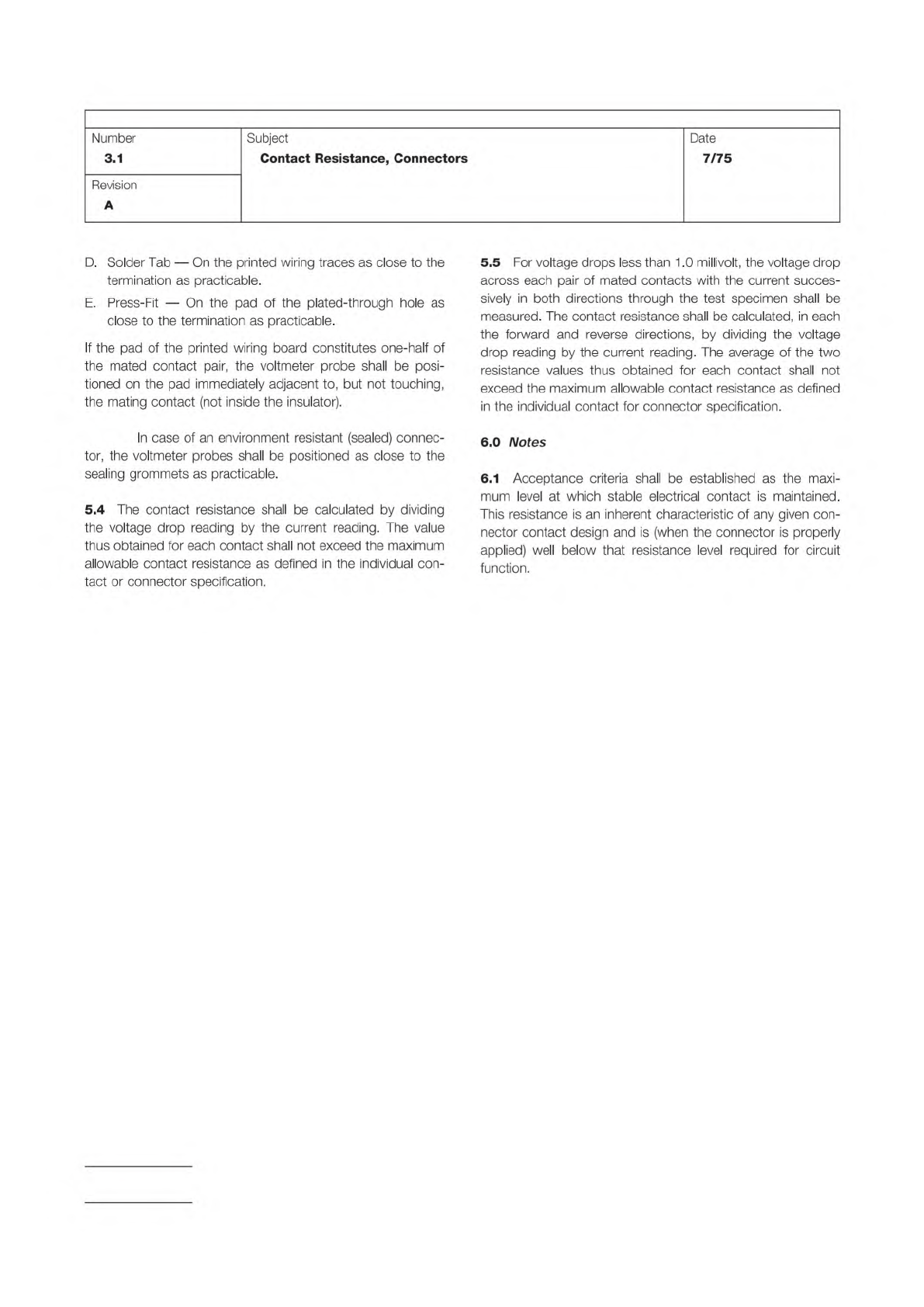
D.
Solder
Tab
—
On
the
printed
wiring
traces
as
close
to
the
termination
as
practicable.
E.
Press-Fit
—
On
the
pad
of
the
plated-through
hole
as
close
to
the
termination
as
practicable.
If
the
pad
of
the
printed
wiring
board
constitutes
one-half
of
the
mated
contact
pair,
the
voltmeter
probe
shall
be
posi¬
tioned
on
the
pad
immediately
adjacent
to,
but
not
touching,
the
mating
contact
(not
inside
the
insulator).
In
case
of
an
environment
resistant
(sealed)
connec¬
tor,
the
voltmeter
probes
shall
be
positioned
as
close
to
the
sealing
grommets
as
practicable.
5.4
The
contact
resistance
shall
be
calculated
by
dividing
the
voltage
drop
reading
by
the
current
reading.
The
value
thus
obtained
for
each
contact
shall
not
exceed
the
maximum
allowable
contact
resistance
as
defined
in
the
individual
con¬
tact
or
connector
specification.
5.5
For
voltage
drops
less
than
1.0
millivolt,
the
voltage
drop
across
each
pair
of
mated
contacts
with
the
current
succes¬
sively
in
both
directions
through
the
test
specimen
shall
be
measured.
The
contact
resistance
shall
be
calculated,
in
each
the
forward
and
reverse
directions,
by
dividing
the
voltage
drop
reading
by
the
current
reading.
The
average
of
the
two
resistance
values
thus
obtained
for
each
contact
shall
not
exceed
the
maximum
allowable
contact
resistance
as
defined
in
the
individual
contact
for
connector
specification.
6.0
Notes
6.1
Acceptance
criteria
shall
be
established
as
the
maxi¬
mum
level
at
which
stable
electrical
contact
is
maintained.
This
resistance
is
an
inherent
characteristic
of
any
given
con¬
nector
contact
design
and
is
(when
the
connector
is
properly
applied)
well
below
that
resistance
level
required
for
circuit
function.
NOTE:
NOTE:
Material in this Test Methods Manual was voluntarily established by Technical Committees of the IPC. This material is advisory only
and its use or adaptation is entirely voluntary. IPC disclaims all liability of any kind as to the use, application, or adaptation of this
material. Users are also wholly responsible for protecting themselves against all claims or liabilities for patent infringement.
Equipment referenced is for the convenience of the user and does not imply endorsement by the IPC.
Page 1 of 1
ASSOCIATION
CONNECTING
/
ELECTRONICS
INDUSTRIES
221
5
Sanders
Road
Northbrook,
IL
60062-61
35
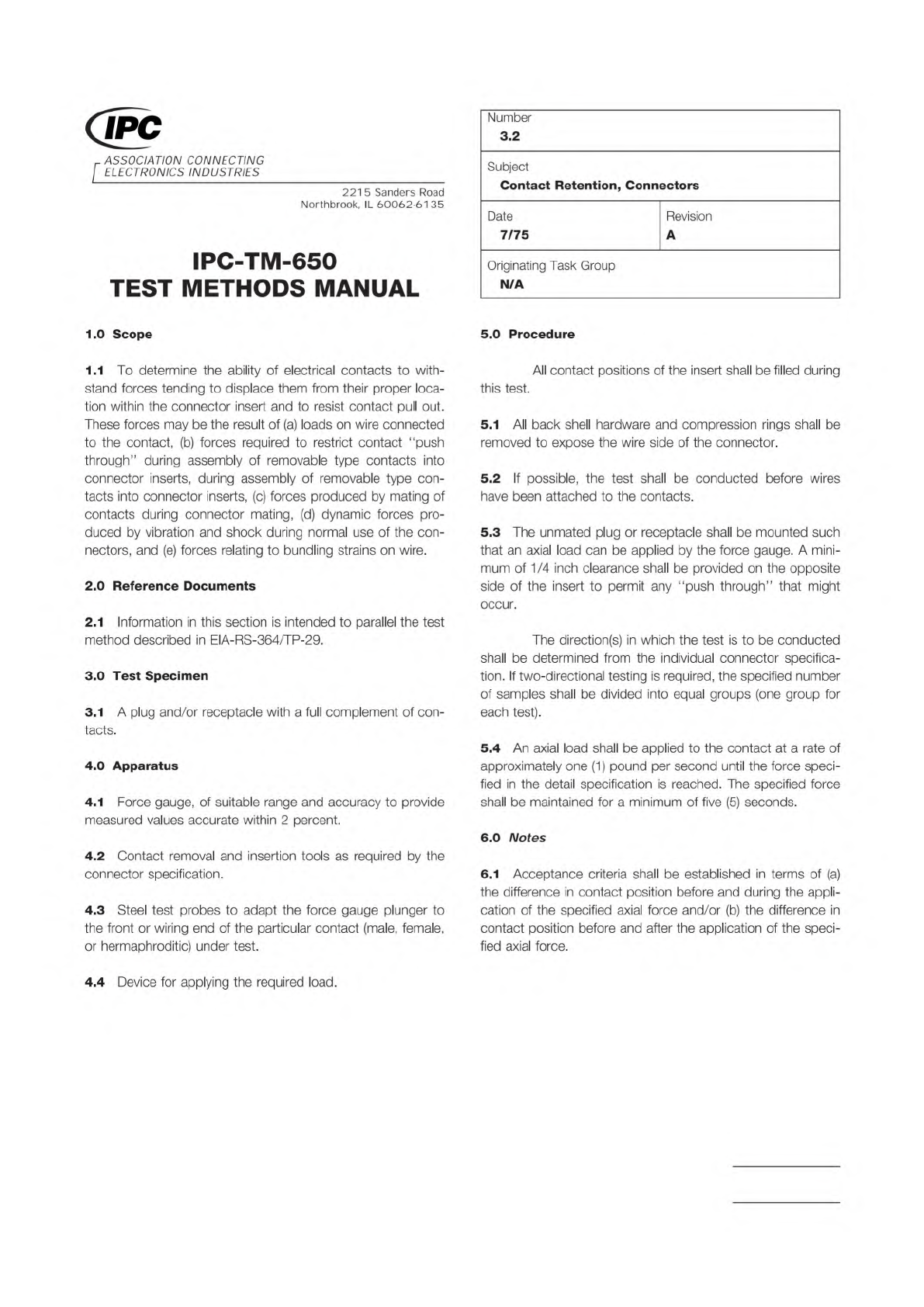
IPC-TM-650
TEST
METHODS
MANUAL
1
.0
Scope
1.1
To
determine
the
ability
of
electrical
contacts
to
with¬
stand
forces
tending
to
displace
them
from
their
proper
loca¬
tion
within
the
connector
insert
and
to
resist
contact
pull
out.
These
forces
may
be
the
result
of
(a)
loads
on
wire
connected
to
the
contact,
(b)
forces
required
to
restrict
contact
"push
through"
during
assembly
of
removable
type
contacts
into
connector
inserts,
during
assembly
of
removable
type
con¬
tacts
into
connector
inserts,
(c)
forces
produced
by
mating
of
contacts
during
connector
mating,
(d)
dynamic
forces
pro¬
duced
by
vibration
and
shock
during
normal
use
of
the
con¬
nectors,
and
(e)
forces
relating
to
bundling
strains
on
wire.
2
.0
Reference
Documents
2.1
Information
in
this
section
is
intended
to
parallel
the
test
method
described
in
EIA-RS-364/TP-29.
3
.0
Test
Specimen
3.1
A
plug
and/or
receptacle
with
a
full
complement
of
con¬
tacts.
4
.0
Apparatus
4.1
Force
gauge,
of
suitable
range
and
accuracy
to
provide
measured
values
accurate
within
2
percent.
4.2
Contact
removal
and
insertion
tools
as
required
by
the
connector
specification.
4.3
Steel
test
probes
to
adapt
the
force
gauge
plunger
to
the
front
or
wiring
end
of
the
particular
contact
(male,
female,
or
hermaphroditic)
under
test.
Number
3.2
Subject
Contact
Retention,
Connectors
Date
Revision
7/75
A
Originating
Task
Group
N/A
5
.0
Procedure
All
contact
positions
of
the
insert
shall
be
filled
during
this
test.
5.1
All
back
shell
hardware
and
compression
rings
shall
be
removed
to
expose
the
wire
side
of
the
connector.
5.2
If
possible,
the
test
shall
be
conducted
before
wires
have
been
attached
to
the
contacts.
5.3
The
un
mated
plug
or
receptacle
shall
be
mounted
such
that
an
axial
load
can
be
applied
by
the
force
gauge.
A
mini¬
mum
of
1/4
inch
clearance
shall
be
provided
on
the
opposite
side
of
the
insert
to
permit
any
"push
through”
that
might
occur.
The
direction(s)
in
which
the
test
is
to
be
conducted
shall
be
determined
from
the
individual
connector
specifica¬
tion.
If
two-directional
testing
is
required,
the
specified
number
of
samples
shall
be
divided
into
equal
groups
(one
group
for
each
test).
5.4
An
axial
load
shall
be
applied
to
the
contact
at
a
rate
of
approximately
one
pound
per
second
until
the
force
speci¬
fied
in
the
detail
specification
is
reached.
The
specified
force
shall
be
maintained
for
a
minimum
of
five
(5)
seconds.
6
.0
Notes
6.1
Acceptance
criteria
shall
be
established
in
terms
of
(a)
the
difference
in
contact
position
before
and
during
the
appli¬
cation
of
the
specified
axial
force
and/or
(b)
the
difference
in
contact
position
before
and
after
the
application
of
the
speci¬
fied
axial
force.
4.4
Device
for
applying
the
required
load.
NOTE:
Material in this Test Methods Manual was voluntarily established by Technical Committees of the IPC. This material is advisory only
and its use or adaptation is entirely voluntary. IPC disclaims all liability of any kind as to the use, application, or adaptation of this
material. Users are also wholly responsible for protecting themselves against all claims or liabilities for patent infringement.
Equipment referenced is for the convenience of the user and does not imply endorsement by the IPC.
Page 1 of 1
ASSOCIATION
CONNECTING
/
ELECTRONICS
INDUSTRIES
221
5
Sanders
Road
Northbrook,
IL
60062-61
35
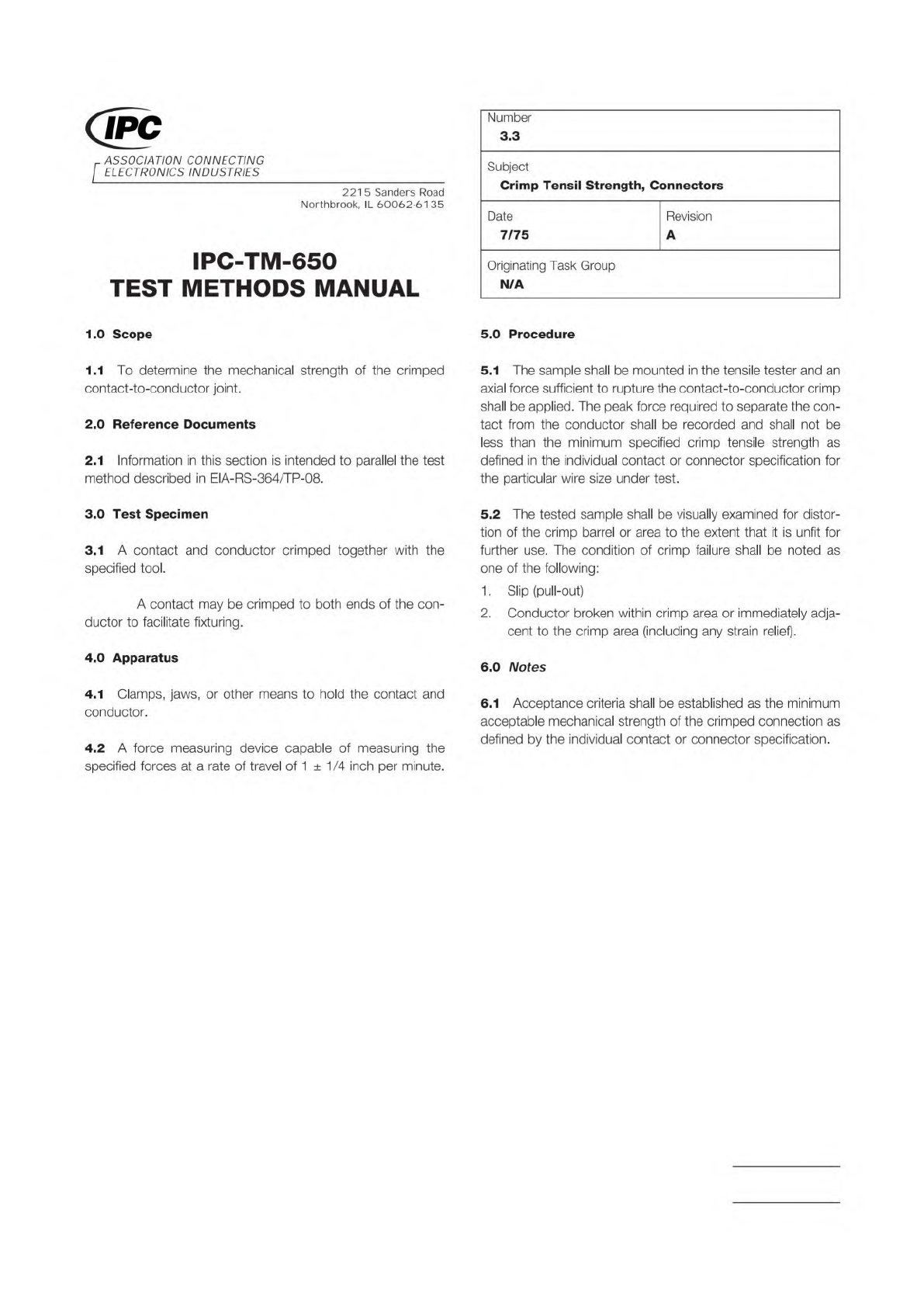
IPC-TM-650
TEST
METHODS
MANUAL
1
.0
Scope
1.1
To
determine
the
mechanical
strength
of
the
crimped
contact
-to-conductor
joint.
2
.0
Reference
Documents
2.1
Information
in
this
section
is
intended
to
parallel
the
test
method
described
in
EIA-RS-364/TP-08.
3
.0
Test
Specimen
3.1
A
contact
and
conductor
crimped
together
with
the
specified
tool.
A
contact
may
be
crimped
to
both
ends
of
the
con¬
ductor
to
facilitate
fixturing.
4
.0
Apparatus
4.1
Clamps,
jaws,
or
other
means
to
hold
the
contact
and
conductor.
4.2
A
force
measuring
device
capable
of
measuring
the
specified
forces
at
a
rate
of
travel
of
1
±
1/4
inch
per
minute.
Number
3.3
Subject
Crimp
Tensil
Strength,
Connectors
Date
Revision
7/75
A
Originating
Task
Group
N/A
5
.0
Procedure
5
J
The
sample
shall
be
mounted
in
the
tensile
tester
and
an
axial
force
sufficient
to
rupture
the
contact-to-conductor
crimp
shall
be
applied.
The
peak
force
required
to
separate
the
con¬
tact
from
the
conductor
shall
be
recorded
and
shall
not
be
less
than
the
minimum
specified
crimp
tensile
strength
as
defined
in
the
individual
contact
or
connector
specification
for
the
particular
wire
size
under
test.
5.2
The
tested
sample
shall
be
visually
examined
for
distor¬
tion
of
the
crimp
barrel
or
area
to
the
extent
that
it
is
unfit
for
further
use.
The
condition
of
crimp
failure
shall
be
noted
as
one
of
the
following:
1.
Slip
(pull-out)
2.
Conductor
broken
within
crimp
area
or
immediately
adja¬
cent
to
the
crimp
area
(including
any
strain
relief).
6.
0
Notes
6.1
Acceptance
criteria
shall
be
established
as
the
minimum
acceptable
mechanical
strength
of
the
crimped
connection
as
defined
by
the
individual
contact
or
connector
specification.