4OM-1003-007.pdf - 第395页
0305-001 2-207 AIL01ETRP 5. Troubleshooting related to Component Pick and Placements 5. T roubleshooting related to Component Pick and Placements 5.1 Classification of Failure Symptoms and Helpful Hints on Countermeasure…
4.3.7 Lighting Control Board-to-Board Communication Errors
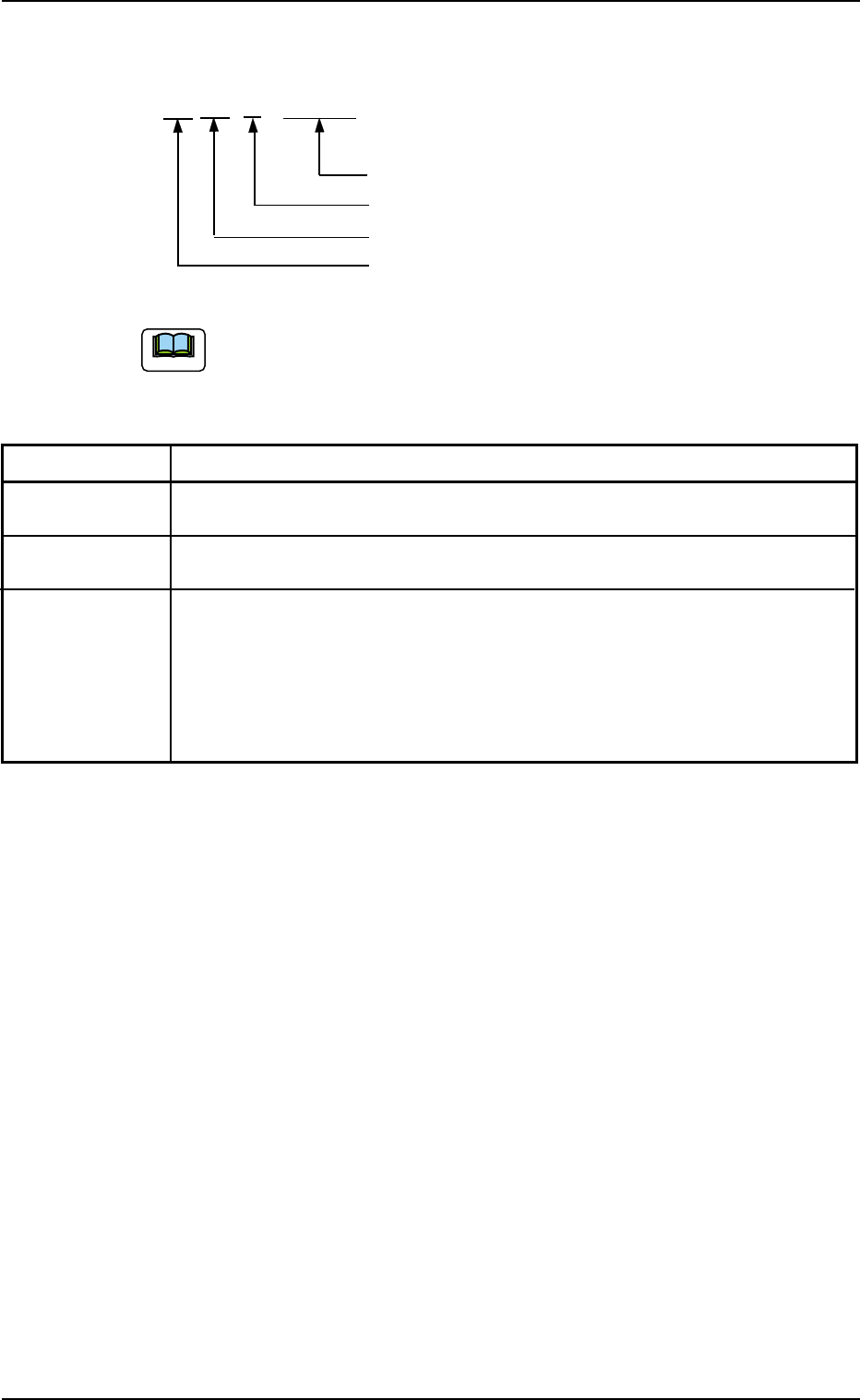
AA BB C DDDDD
Detail Code
Secondary Error Classification (0)
Primary Error Classification (0)
Classification (14) of Recognition Functions
When an error ID other than the described ones is issued, con-
tact our service personnel for some advice.
Table 4B20
Recognition Error ID Recognition Error Contents, Cause, and Remedy
1400000000 Other Errors in Communication between Lighting Control Boards
1400000001 An error occurred during data transfer between recognition and lighting control boards.
(Cause 1) Self-Diagnostics Error Message
(Remedy 1) Contact our service personnel for details.
0511-002 2-206 AIL01ETRP
4.3 Recognition Error IDs and Remedial Procedures
Note
0305-001 2-207 AIL01ETRP
5. Troubleshooting related to Component Pick and Placements
5. Troubleshooting related to Component Pick and
Placements
5.1 Classification of Failure Symptoms and Helpful
Hints on Countermeasures against Failure
5.1.1 Classification of Failure Symptoms
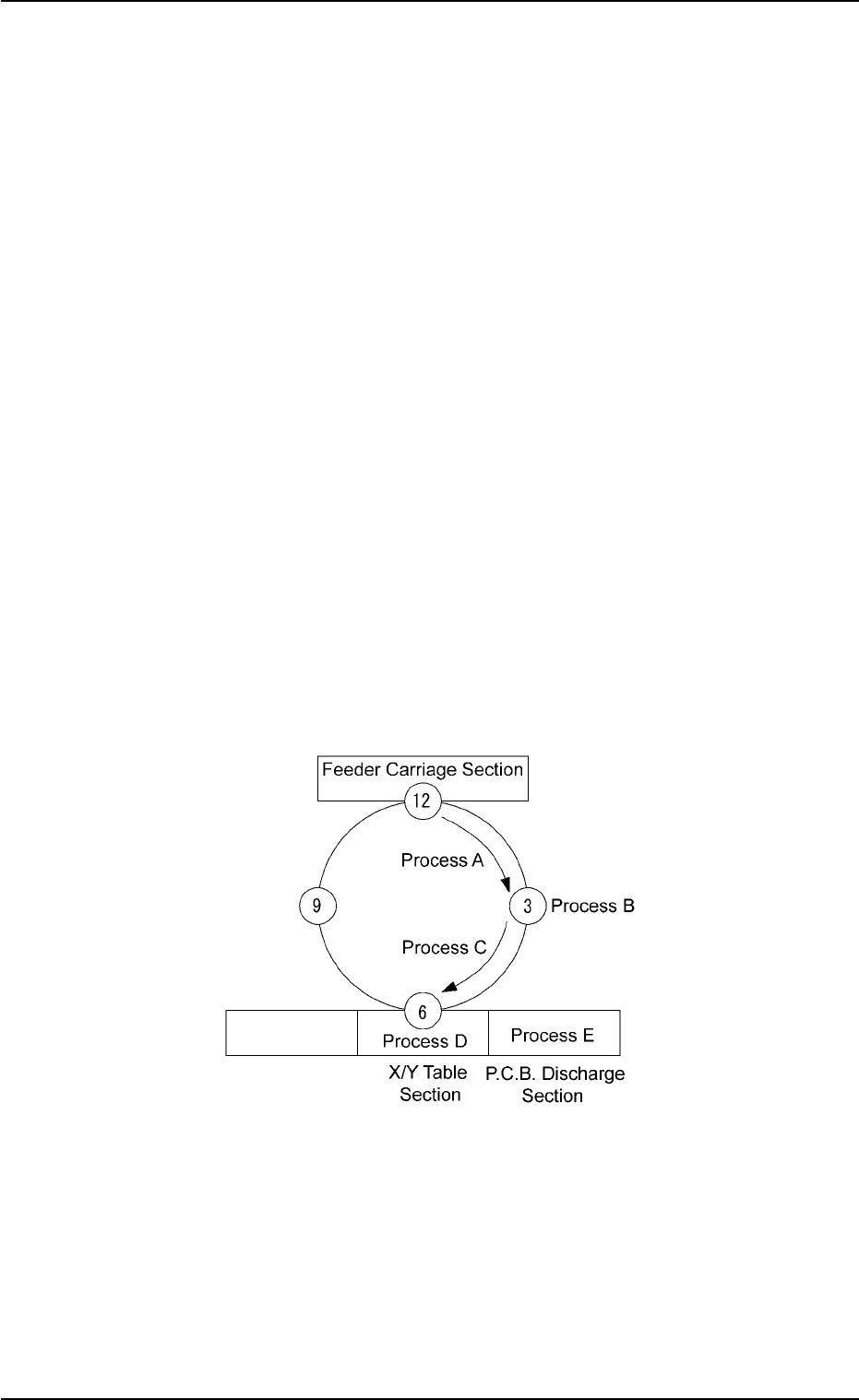
The turret movement can be classified into Processes A, B, C, D, and
E as shown below.
Refer to "1. Outline of Actions" in "Section 2" of the instruction manual
(Volume 2: Operation (Supervisor)) for the outline of actions.
Process A : A component is picked up at Station #12 and transferred
to Station #3.
Process B : The component recognition function is implemented on
the component at Station #3.
Process C : The placement angle is corrected at Station #3 and the
subsequent stations and the component is placed on the
P.C.B. at Station #6.
Process D : The component is placed on the P.C.B. along with the
movement of the X/Y table.
Process E : The component-placed P.C.B. is discharged.
Fig. 4B29
Based on these processes, failures can be divided roughly into the
following two types.
• Failure before Component Placement
This type of failure occurs mainly in Processes A, B, and C.
• Failure after Component Placement
This type of failure occurs mainly in Processed D and E.
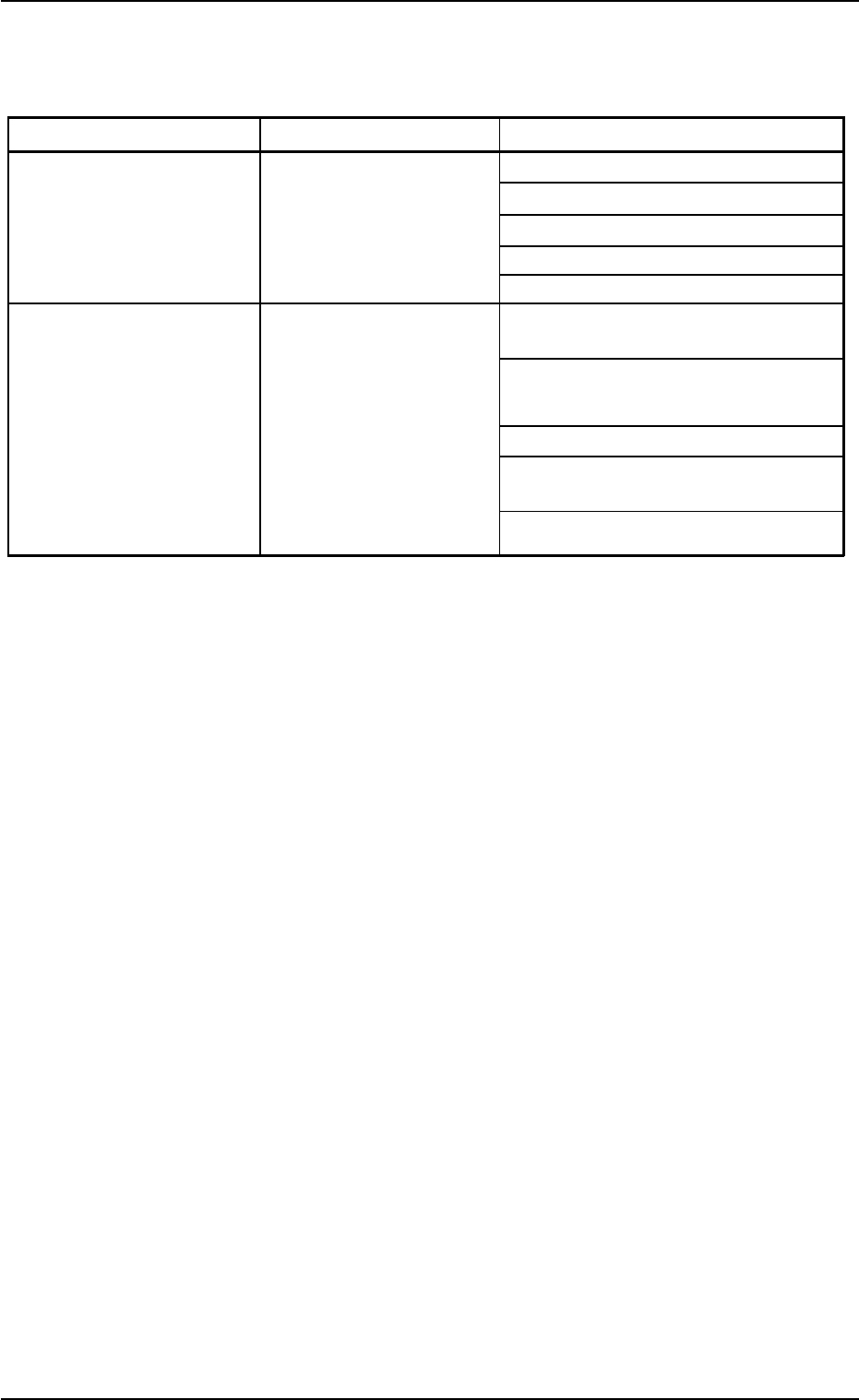
Failures can further be classified as shown in the table below.
Table 4B21
Classification of Failures Contents of Failures Symptom of Failures
Failure before Component Component Pick-Up Components cannot be picked up.
Placement Error Components are turned vertically.
A recognition error occurs.
Components drop.
Others
Failure after Component Component Placement The positional or angular deviation
Placement Error of component occurs.
Components are turned over and
placed.
Some components are missing.
Some components are cracked or
nicked.
Others
5.1.2 Helpful Hints on Countermeasures against Failure
• The first helpful hint on countermeasures against failure is to catch
precisely what kind of symptom is produced and how frequently the
symptom appears.
• The second helpful hint is to grasp the tendency (environment and
condition) of a failure.
Shown below are the concrete items to be checked.
(1) Check if the failure occurs on specific components.
(2) Check if the failure occurs on a specific production lot.
(3) Check if the failure occurs on a specific machine.
(4) Check if the failure occurs at a limited stage.
• The third helpful hint is to find in which process the failure occurs.
In normal cases, a failure after component placement is found in
the final inspection process. In such a case, it is required to track
the failure by checking all processes and specify the process in
which the failure has occurred.
It is very important to grasp a failure symptom precisely on these
helpful hints. Precise capture of a failure symptom makes it pos-
sible to track the factor and make a plan to take countermeasures
against the failure. If a failure symptom is grasped negligently,
ineffectual countermeasures may be taken and it may take much
time before the proper countermeasures are determined.
Especially, as for less failures (low generation rate), it is necessary
to take data accurately, examine the factors as a result, and ex-
ecute measures against such failures.
0305-001 2-208 AIL01ETRP
5.1 Classification of Failure Symptoms and Helpful Hints on Countermeasures against Failure