7_PO-CON1691E
PO-CON1691E Integration of steroids analysis in serum using LC-MS/MS with full-automated sample preparation MSACL 2016 EU Stéphane Moreau 1 , Daisuke Kawakami 2 , Toshikazu Minohata 2 1 Shimadzu Europe GmbH, Duisburg, Ge…

PO-CON1691E
Integration of steroids analysis
in serum using LC-MS/MS with
full-automated sample preparation
MSACL 2016 EU
Stéphane Moreau
1
, Daisuke Kawakami
2
,
Toshikazu Minohata
2
1
Shimadzu Europe GmbH, Duisburg, Germany,
2
Shimadzu Corporation, Kyoto, Japan
2
Integration of steroids analysis in serum using LC-MS/MS
with full-automated sample preparation
Introduction
Currently sample preparation for the detection of steroids
in serum by liquid chromatography-mass spectrometry
(LC-MS/MS) involves complex ofine extraction methods
such as solid phase extraction or liquid/liquid extraction,
all of which require additional sample concentration and
reconstitution in an appropriate solvent. These sample
preparation methods are time-consuming, often taking
one hour or more per sample, and are more vulnerable to
variability due to analyst errors during manual
preparation. Our approach is offering a high sensitivity
steroid detection fully automated for multiple samples. It
is using an automated sample preparation coupled to the
detection capabilities of a high sensitivity triple stage
quadrupole mass spectrometer, that requires no human
intervention from loading the samples to obtaining the
results.
Method
10 steroid hormones (cortisol, aldosterone,
11-deoxycortisol, corticosterone,
17-alpha-hydroxyl-progesterone (17-OHP),
4-androstene-3,17-dione (androstenedione),
dehydroepiandrosterone (DHEA),
dehydroepi-androsterone sulfate (DHEAS), progesterone
and testosterone) in serum were veried using CHS™
MSMS Steroids Kit (PerkinElmer, USA).
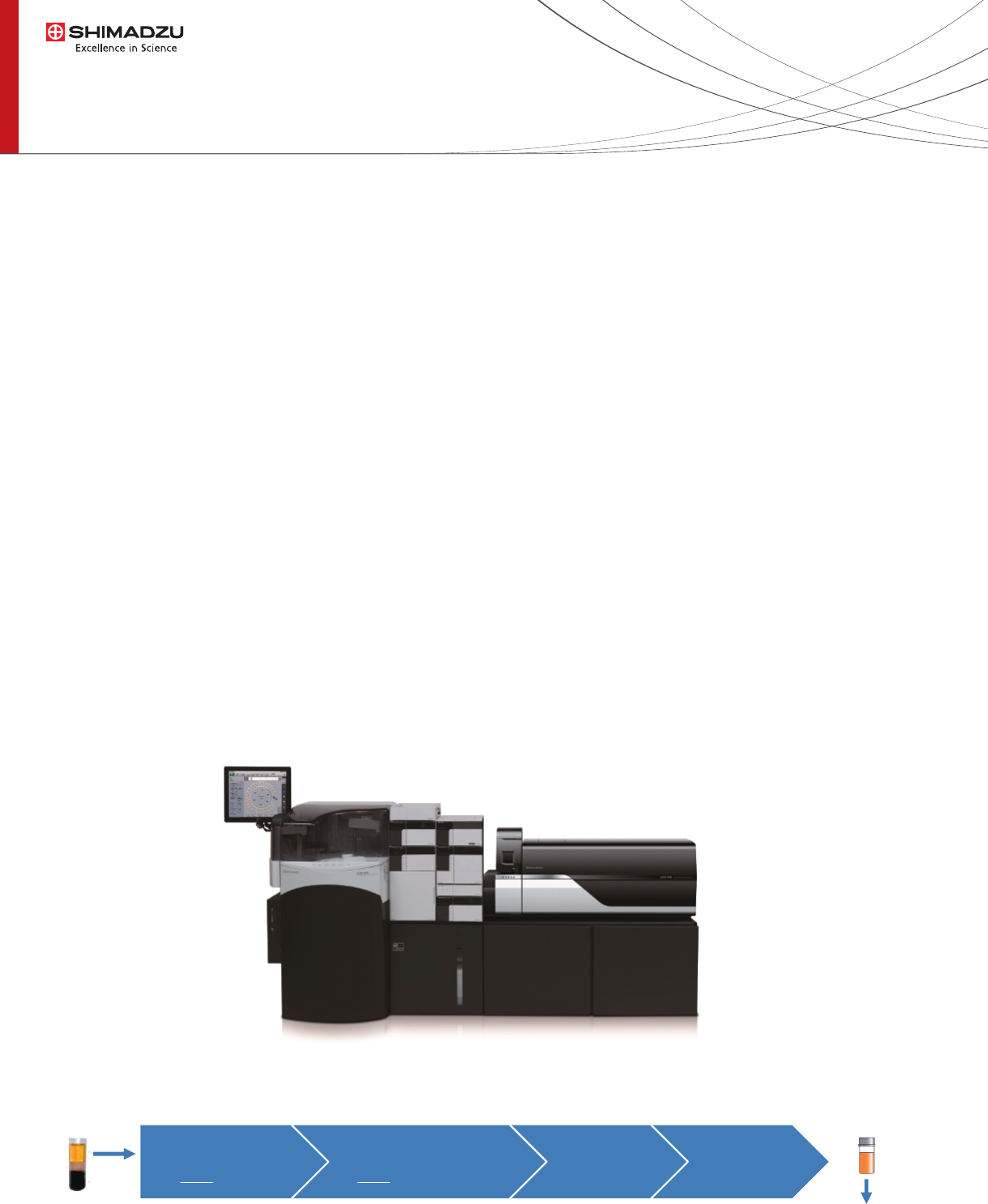
Serum sample was loaded directly into the automated
sample preparation system (CLAM-2000 Shimadzu,
Japan). The CLAM-2000 was programmed to perform
protein precipitation using acetonitrile followed by
ltration and sample collection. The sample is then
transported using an arm from the CLAM-2000 to the
HPLC without human intervention for LC-MS/MS analysis.
Fig. 1 CLAM-2000 and LCMS-8060 system
To AutoSampler
Sample
Dispensing
• 30 µL of serum
Reagent
Dispensing
• 60 µL of ACN with IS
Shaking
• 150 sec
Filtration
• 120sec
3
Integration of steroids analysis in serum using LC-MS/MS
with full-automated sample preparation
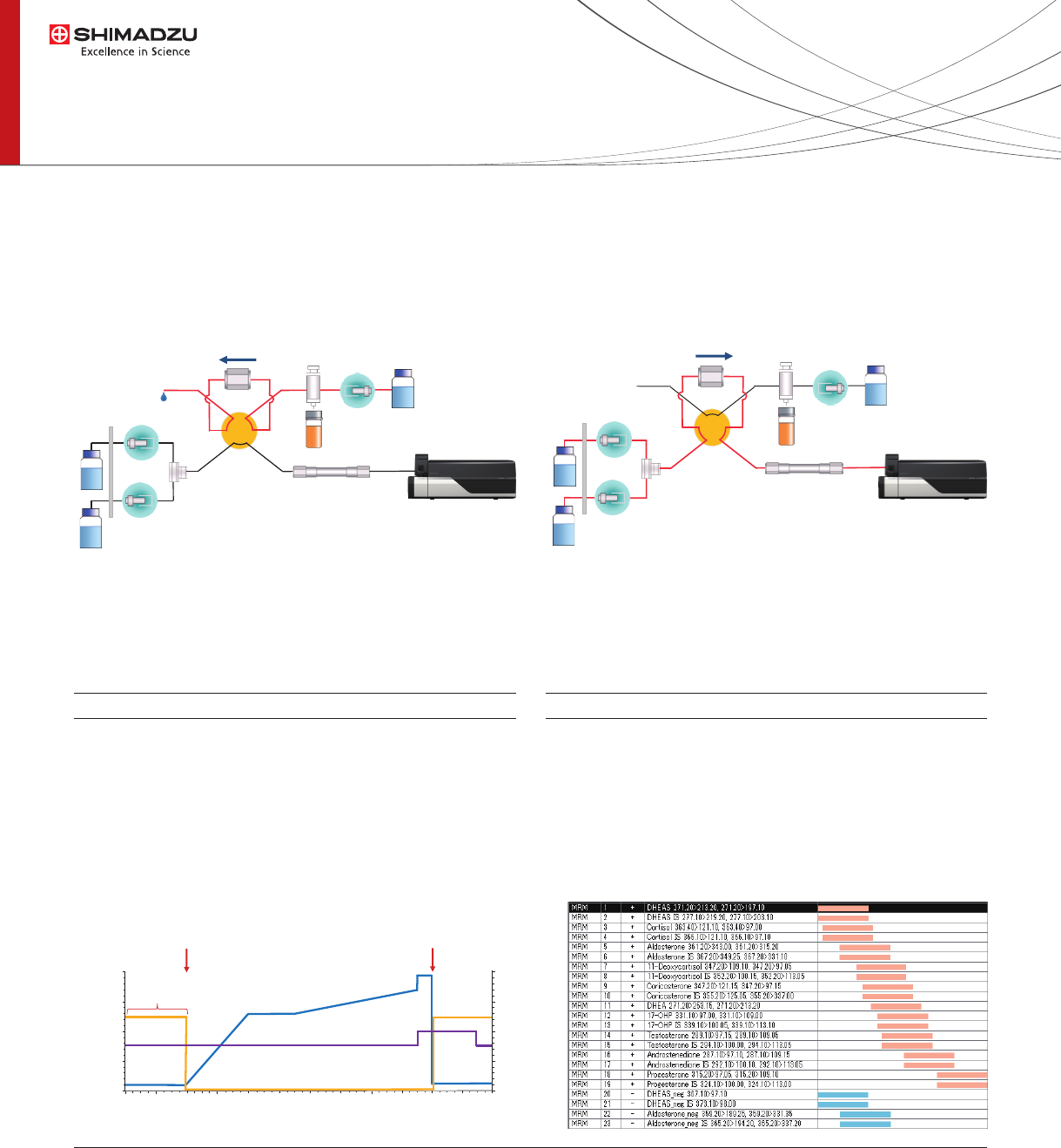
The treated samples were trapped using a MAYI-ODS column and then separated by Core-Shell Biphenyl HPLC column
at 40 ºC with a binary gradient system at a ow rate of 0.3 ml/min in 12 min.
Fig. 2 Flow Diagram of Trapping system
Mobile Phase A : 1mM ammonium uoride – water
Mobile Phase B : Methanol
Mobile Phase C : 10mM ammonium formate – water
Column temperature : 40 ºC
Analytical Column : Kinetex Biphenyl
(100mm L x 2mm I.D. , 2.6μm)
Guard Column : MAYI-ODS column (5mm L x 2mm I.D.)
Injection Volume : 30 µL
Gradient Program :
HPLC
Ionization : heated ESI
Nebulizing Gas Flow : 3 L / min
Drying Gas Pressure : 7 L / min
Heating gas ow : 13 L/min
DL Temperature : 120 ºC
BH Temperature : 450 ºC
Interface Temperature : 370 ºC
MRM parameter :
Mass (LCMS-8060 triple quadrupole mass spectrometry)
Table 1 Analytical Condition
Trap Analysis
pump B
analytical column
LCMS
pump A
pump C
waste
Trap column
12
3 6
54
12
3 6
54
0 4.02.0 6.0
50
100
B Conc. (%)
8.0 10.0
trapping
12.0
Flow (mL/min)
0.2
0.4
0.6
Pump C Flow
Pump A/B Flow
B Conc.
FCV(1-2) FCV(1-6)