7_PO-CON1691E - 第3页
3 Integration of steroids analysis in serum using LC-MS/MS with full-automated sample preparation The treated samples were trapped using a MAYI-ODS column and then separated by Core-Shell Biphenyl HPLC column at 40 ºC wi…
2
Integration of steroids analysis in serum using LC-MS/MS
with full-automated sample preparation
Introduction
Currently sample preparation for the detection of steroids
in serum by liquid chromatography-mass spectrometry
(LC-MS/MS) involves complex ofine extraction methods
such as solid phase extraction or liquid/liquid extraction,
all of which require additional sample concentration and
reconstitution in an appropriate solvent. These sample
preparation methods are time-consuming, often taking
one hour or more per sample, and are more vulnerable to
variability due to analyst errors during manual
preparation. Our approach is offering a high sensitivity
steroid detection fully automated for multiple samples. It
is using an automated sample preparation coupled to the
detection capabilities of a high sensitivity triple stage
quadrupole mass spectrometer, that requires no human
intervention from loading the samples to obtaining the
results.
Method
10 steroid hormones (cortisol, aldosterone,
11-deoxycortisol, corticosterone,
17-alpha-hydroxyl-progesterone (17-OHP),
4-androstene-3,17-dione (androstenedione),
dehydroepiandrosterone (DHEA),
dehydroepi-androsterone sulfate (DHEAS), progesterone
and testosterone) in serum were veried using CHS™
MSMS Steroids Kit (PerkinElmer, USA).
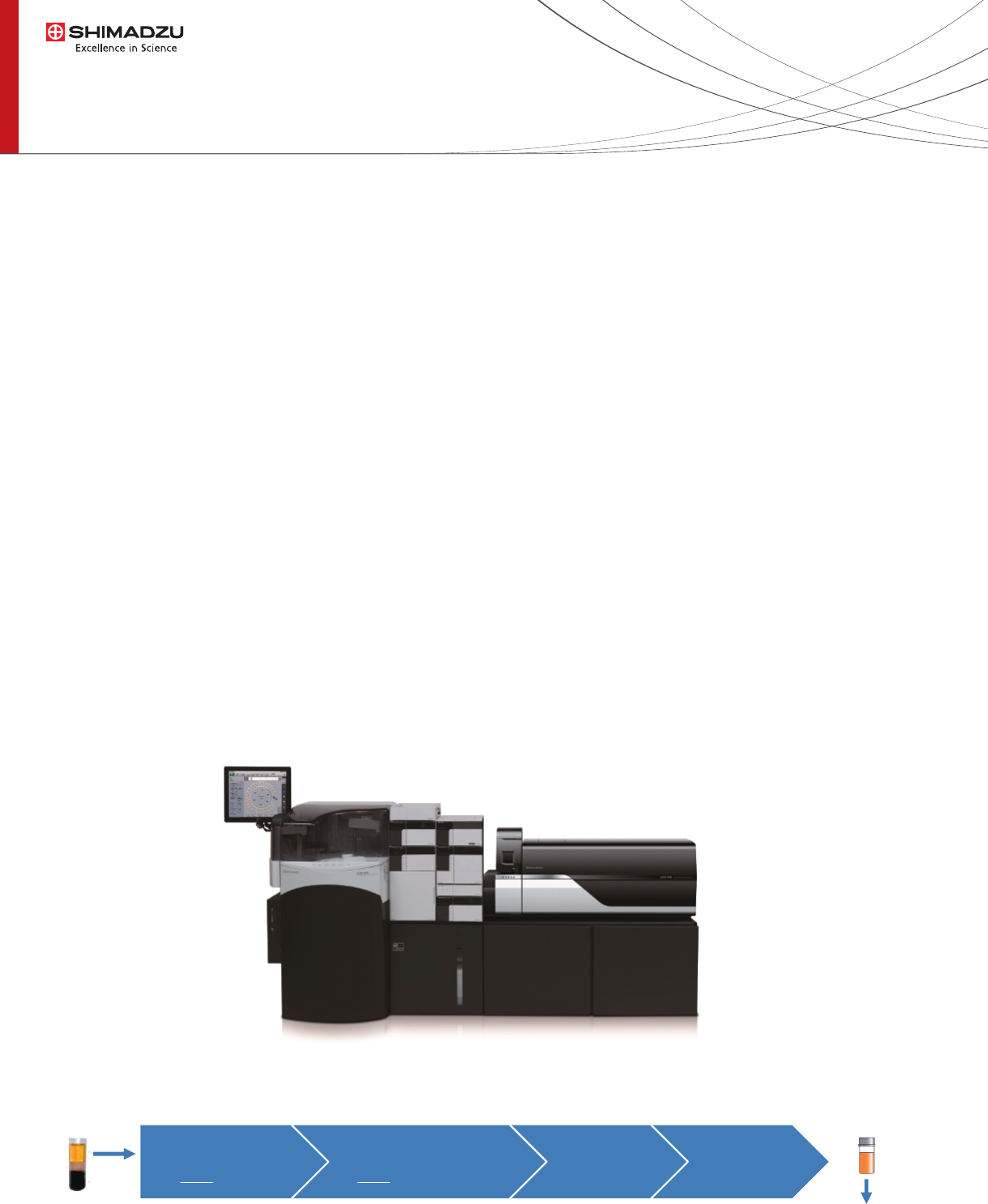
Serum sample was loaded directly into the automated
sample preparation system (CLAM-2000 Shimadzu,
Japan). The CLAM-2000 was programmed to perform
protein precipitation using acetonitrile followed by
ltration and sample collection. The sample is then
transported using an arm from the CLAM-2000 to the
HPLC without human intervention for LC-MS/MS analysis.
Fig. 1 CLAM-2000 and LCMS-8060 system
To AutoSampler
Sample
Dispensing
• 30 µL of serum
Reagent
Dispensing
• 60 µL of ACN with IS
Shaking
• 150 sec
Filtration
• 120sec
3
Integration of steroids analysis in serum using LC-MS/MS
with full-automated sample preparation
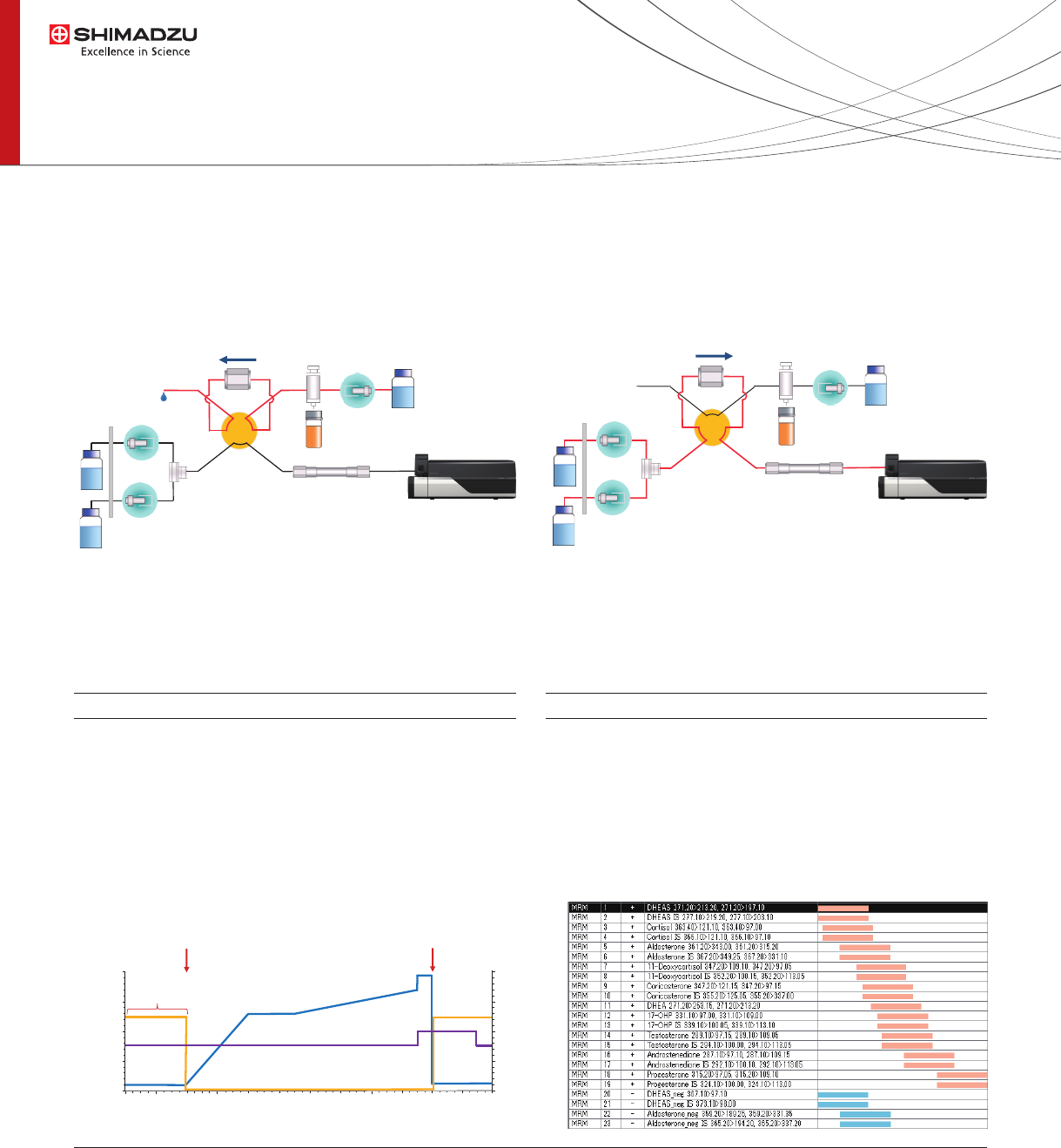
The treated samples were trapped using a MAYI-ODS column and then separated by Core-Shell Biphenyl HPLC column
at 40 ºC with a binary gradient system at a ow rate of 0.3 ml/min in 12 min.
Fig. 2 Flow Diagram of Trapping system
Mobile Phase A : 1mM ammonium uoride – water
Mobile Phase B : Methanol
Mobile Phase C : 10mM ammonium formate – water
Column temperature : 40 ºC
Analytical Column : Kinetex Biphenyl
(100mm L x 2mm I.D. , 2.6μm)
Guard Column : MAYI-ODS column (5mm L x 2mm I.D.)
Injection Volume : 30 µL
Gradient Program :
HPLC
Ionization : heated ESI
Nebulizing Gas Flow : 3 L / min
Drying Gas Pressure : 7 L / min
Heating gas ow : 13 L/min
DL Temperature : 120 ºC
BH Temperature : 450 ºC
Interface Temperature : 370 ºC
MRM parameter :
Mass (LCMS-8060 triple quadrupole mass spectrometry)
Table 1 Analytical Condition
Trap Analysis
pump B
analytical column
LCMS
pump A
pump C
waste
Trap column
12
3 6
54
12
3 6
54
0 4.02.0 6.0
50
100
B Conc. (%)
8.0 10.0
trapping
12.0
Flow (mL/min)
0.2
0.4
0.6
Pump C Flow
Pump A/B Flow
B Conc.
FCV(1-2) FCV(1-6)
4
Integration of steroids analysis in serum using LC-MS/MS
with full-automated sample preparation
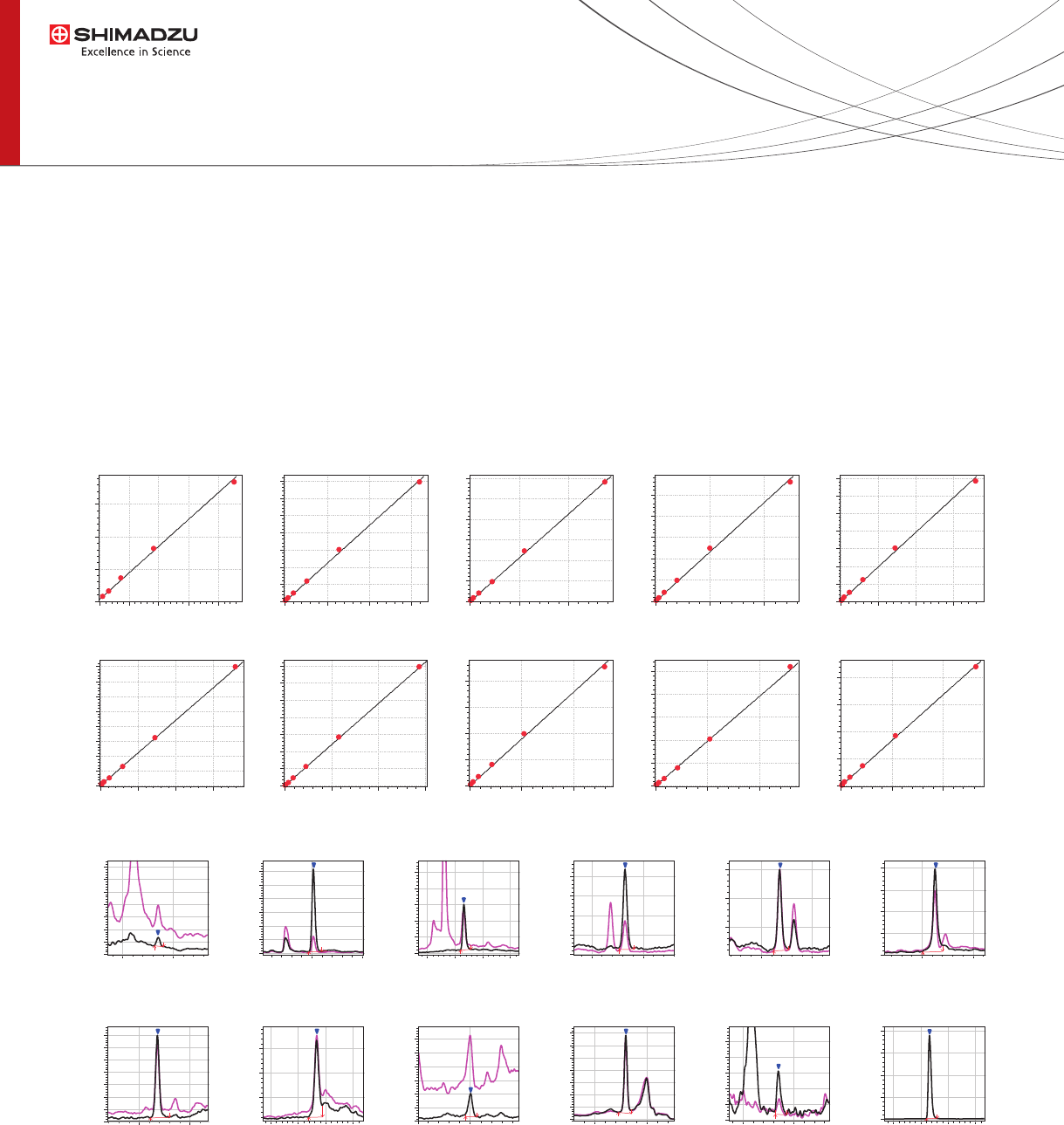
Fig. 3 Calibration Curves (L1-L7) and MRM Chromatograms (L1) of 10 Steroids
Result and discussion
We evaluated this system using calibrator and control
serum spiked with 10 steroids contained in the kit and
carried out concurrent analysis over a range of
concentrations for each steroid: cortisol (1.51-320
ng/mL), aldosterone (0.03-1.14 ng/mL), 11-deoxycortisol
(0.08-18 ng/mL), corticosterone (0.29-62 ng/mL), 17-OHP
(0.12-26 ng/mL), androstenedione (0.08-18 ng/mL),
DHEA (0.31-65 ng/mL), DHEAS (12.9-2750 ng/mL),
progesterone (0.12-26.5 ng/mL) and testosterone
(0.03-7.2 ng/mL). The calibration curves that were
generated had linear regression values of r2 >0.997 for
each curve. The reproducibility (N=3) at seven
concentrations, including LLOQ of each compounds was
excellent (CV<10%).
Aldosterone Cortisol DHEAS Coricosterone 11-Deoxycortisol
Androstenedione Testosterone 17-OHP DHEA Progesterone
0.00 0.25 0.50 0.75 Conc. Ratio
0.00
0.25
0.50
0.75
Area Ratio
0 100 200 Conc. Ratio
0.0
2.5
5.0
7.5
10.0
12.5
15.0
17.5
Area Ratio
0 1000 2000Conc. Ratio
0
10
20
30
40
50
60
Area Ratio
0.0 25.0 Conc. Ratio
0.0
2.5
5.0
7.5
10.0
12.5
Area Ratio
0.0 5.0 10.0 Conc. Ratio
0
1
2
3
4
5
6
7
Area Ratio
0.0 5.0 10.0 Conc. Ratio
0
5
10
15
20
25
30
35
40
Area Ratio
0.0 2.5 5.0 Conc. Ratio
0.0
2.5
5.0
7.5
10.0
12.5
15.0
17.5
Area Ratio
0 10 Conc. Ratio
0
5
10
15
20
Area Ratio
0.0 25.0 Conc. Ratio
0
1
2
3
4
5
Area Ratio
0 10 20Conc. Ratio
0
10
20
30
40
Area Ratio
Aldosterone
(0.03 ng/mL)
Cortisol
(1.51 ng/mL)
DHEAS
(12.9 ng/mL)
Coricosterone
(0.29 ng/mL)
11-Deoxycortisol
(0.08 ng/mL)
Androstenedione
(0.08 ng/mL)
Testosterone
(0.03 ng/mL)
17-OHP
(0.12 ng/mL)
DHEA
(0.31 ng/mL)
Progesterone
(0.12 ng/mL)
Aldosterone (neg)
(0.03 ng/mL)
DHEAS (neg)
(12.9 ng/mL)
5.0 6.0
0.0
1.0
2.0
3.0
4.0
5.0
6.0
7.0
(x10,000)
361.20>343.00(+)
361.20>315.20(+)
5.0 6.0
0.0
0.5
1.0
1.5
2.0
2.5
3.0
(x100,000)
363.40>97.00(+)
363.40>121.10(+)
4.0 4.5 5.0 5.5
0.00
0.25
0.50
0.75
1.00
1.25
(x100,000)
271.20>197.10(+)
271.20>213.20(+)
6.0 7.0
0.00
0.25
0.50
0.75
1.00
(x100,000)
347.20>97.15(+)
347.20>121.15(+)
6.0 7.0
2.5
5.0
7.5
(x10,000)
347.20>97.05(+)
347.20>109.10(+)
8.0 9.0
0.0
0.5
1.0
1.5
2.0
(x100,000)
287.10>109.15(+)
287.10>97.10(+)
4.0 4.5 5.0 5.5
0.0
0.5
1.0
1.5
2.0
(x1,000,000)
367.10>97.10(-)
5.0 6.0
0.0
0.5
1.0
1.5
2.0
2.5
(x1,000)
359.20>331.35(-)
359.20>189.25(-)
9.0 10.0
0.0
0.5
1.0
1.5
2.0
2.5
3.0
3.5
(x100,000)
315.20>109.10(+)
315.20>97.05(+)
7.06.0
0.0
1.0
2.0
3.0
4.0
5.0
6.0
(x10,000)
271.20>253.15(+)
271.20>213.20(+)
6.5 7.0 7.5 8.0
2.5
5.0
7.5
(x10,000)
331.10>109.00(+)
331.10>97.00(+)
7.0 8.0
0.0
1.0
2.0
3.0
4.0
5.0
6.0
7.0
(x10,000)
289.10>109.05(+)
289.10>97.15(+)
r
2
=0.997
r
2
=0.999
r
2
=0.999
r
2
=0.998
r
2
=0.997
r
2
=0.999
r
2
=0.999
r
2
=0.998 r
2
=0.999
r
2
=0.999
CV=6.3%
(N=3)
1.6%
3.9%
4.6%
5.5%
4.6%
3.7%
6.2% 6.5%
3.9%
6.6%
2.1%