2OM-1075-002.pdf - 第178页
AHB01ESPP 5 . 4 "Place Pos T each" T ab 5.4.1 Scope By capturing the image of P .C.B. patterns in the recognition window with the P .E.C. recognition camera, it can be checked if wrong parameters are specified …
AHB01ESPP
(8) Check the temporarily registered data in the placement step.
Press the [Place Pos] button (*1).
(9) Use the vertical scroll bar in the step data area until the step to be
checked appears. After that, select the step.
When the [Desig Step] button (*11) is pressed, the desired
step can be keyed in directly.
(10) Press the [Move to Teach Pt] button (*5) and the [ON] button (*10
entitled "MOVE"). In 2 seconds, press the [ENABLE] button on the
operation panel. The head moves to the position of the selected
step.
(11) To formally (not temporarily) register the new P.C.B. origin offsets,
press the [End] button (*9).
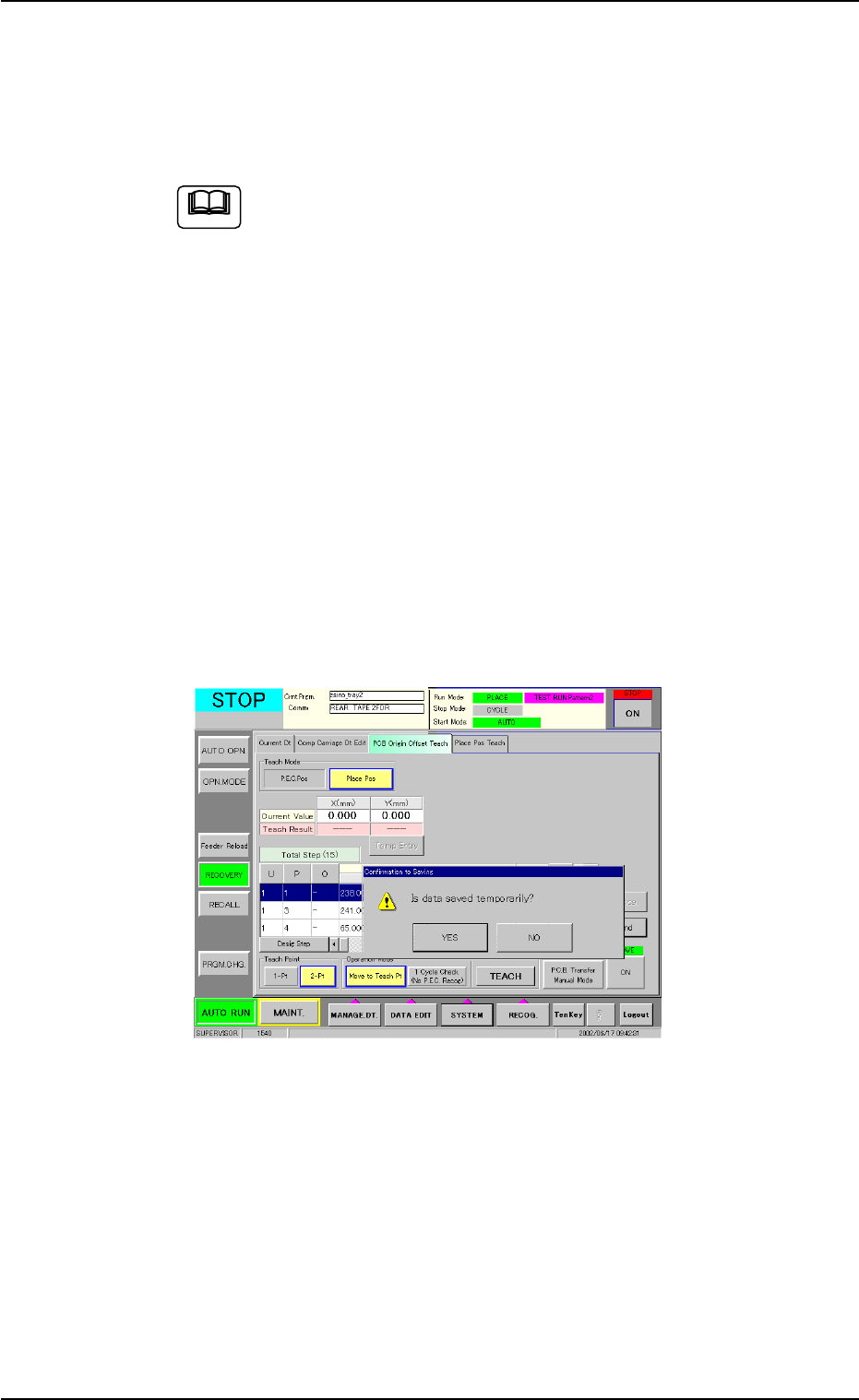
The "Confirmation to Saving" dialog box appears.
To replace the current pattern program data with the new one
(Save)
When the [YES] button is selected in the "Confirmation to Saving"
dialog box, the P.C.B. origin offsets are replaced with the tempo-
rarily saved ones.
Fig. 2E23-5 "Confirmation to Saving" Dialog Box
To keep the current pattern program data unchanged (Save
As)
When the [NO] button is selected in the "Confirmation to Saving"
dialog box, the "Input File Name" dialog box opens.
Enter a new file name and press the [Set] button.
The temporarily saved P.C.B. origin offsets are saved in a new file
having the newly entered name.
To discard the taught data (Cancellation of All Taught Data)
Press the [NO] button in the "Confirmation to Saving" dialog box.
0308-002 5-25-17
5.3 "PCB Origin Offset Teach" Tab
Note

AHB01ESPP
5.4 "Place Pos Teach" Tab
5.4.1 Scope
By capturing the image of P.C.B. patterns in the recognition window with
the P.E.C. recognition camera, it can be checked if wrong parameters
are specified individually as placement coordinates in the pattern pro-
gram.
When a mistake is found, this function can be used to correct the pat-
tern program data, using the manual alignment function (matching op-
eration of displayed component outlines and P.C.B. patterns with the
pointing device).
••
••
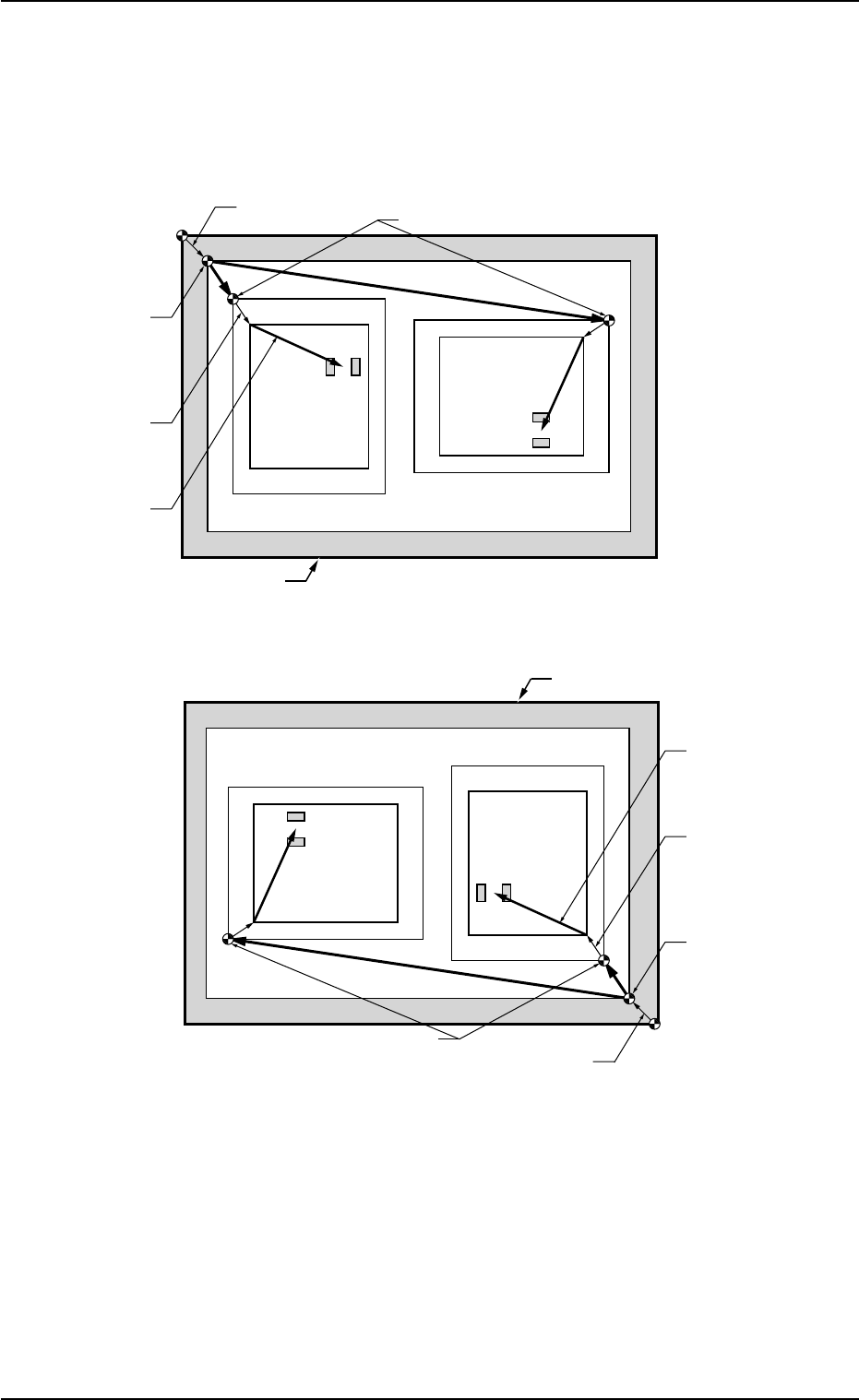
• Objective Data for Teaching
Placement Coordinates P1 to Pn Steps (X, Y) in Placement Data
(P-data)
Coordinates (X, Y) of Pattern Origin O1 to On in Placement Data
(O-data)
5.4.2 Cautionary Items on Teaching
••
••
• Before performing a teaching operation on the placement coordinates,
be sure to check if normal P.C.B. origin offsets are set or not in the
"PCB Origin Offset Teach" tab sheet.
If not, perform a teaching operation on the P.C.B. origin offsets be-
forehand.
••
••
• When the P.E.C. recognition is designated in the pattern program
data, all P.E.C. recognition processing must be completed before the
placement coordinates verification in the placement coordinates
teaching.
When the P.E.C. recognition is designated and a teaching operation
is started with the machine in the "STOP" mode, the machine ex-
ecutes the P.E.C. recognition function first.
••
••
• When the unit P.C.B. B.B.R. function (option) is designated in the
pattern program, the movement to the bad mark position and the
detection will not be made in the placement coordinates verification
of the placement coordinates teaching. The objects for teaching are
all unit P.C.B.’s.
5.4 "Place Pos Teach" Tab
0308-002 5-25-18
AHB01ESPP
5.4.3 Examples
Pn and On must be taught as follows.
Fig. 2E23-6 Objects for Placement Coordinates Teaching
0308-002 5-25-19
5.4 "Place Pos Teach" Tab
O
1
O
2
Pn
TIM-X100R
P.C.B. Positioning
Reference
P.C.B. Origin Offset
Pattern Origin
P.C.B. Origin
Unit Control
Offset
Outermost Outline of P.C.B.
Placement
Coordinates
Angle of Divided Pattern: 0°
Angle of Divided Pattern: 270°
Pn
O
1
O
2
Pn
TIM-X100R
P.C.B. Positioning
Reference
P.C.B. Origin Offset
Pattern Origin
P.C.B. Origin
Unit Control
Offset
Outermost Outline of P.C.B.
Angle of Divided Pattern: 0°
Angle of Divided Pattern: 270°
Pn
Placement
Coordinates