2OM-1075-002.pdf - 第358页
AHB01ESPP (3) Select a component type. When the [Non Leaded] but- ton is pressed, the window in Step (4) opens. When the [Leaded] button is pressed, the window in Step (5) opens. When the [Area Array] but- ton is pressed…
AHB01ESPP
••
••
• New Data Creation
Operation Procedure
(1) When the teaching operation
starts, a window opens and
shows an image of the com-
ponent to determine if the
size of the component is
proper or not for a teaching
operation with the minimum
view function.
When the machine is not
equipped with the minimum
view function (option), this
window does not open. In
this case, the window in
Step (2) opens.
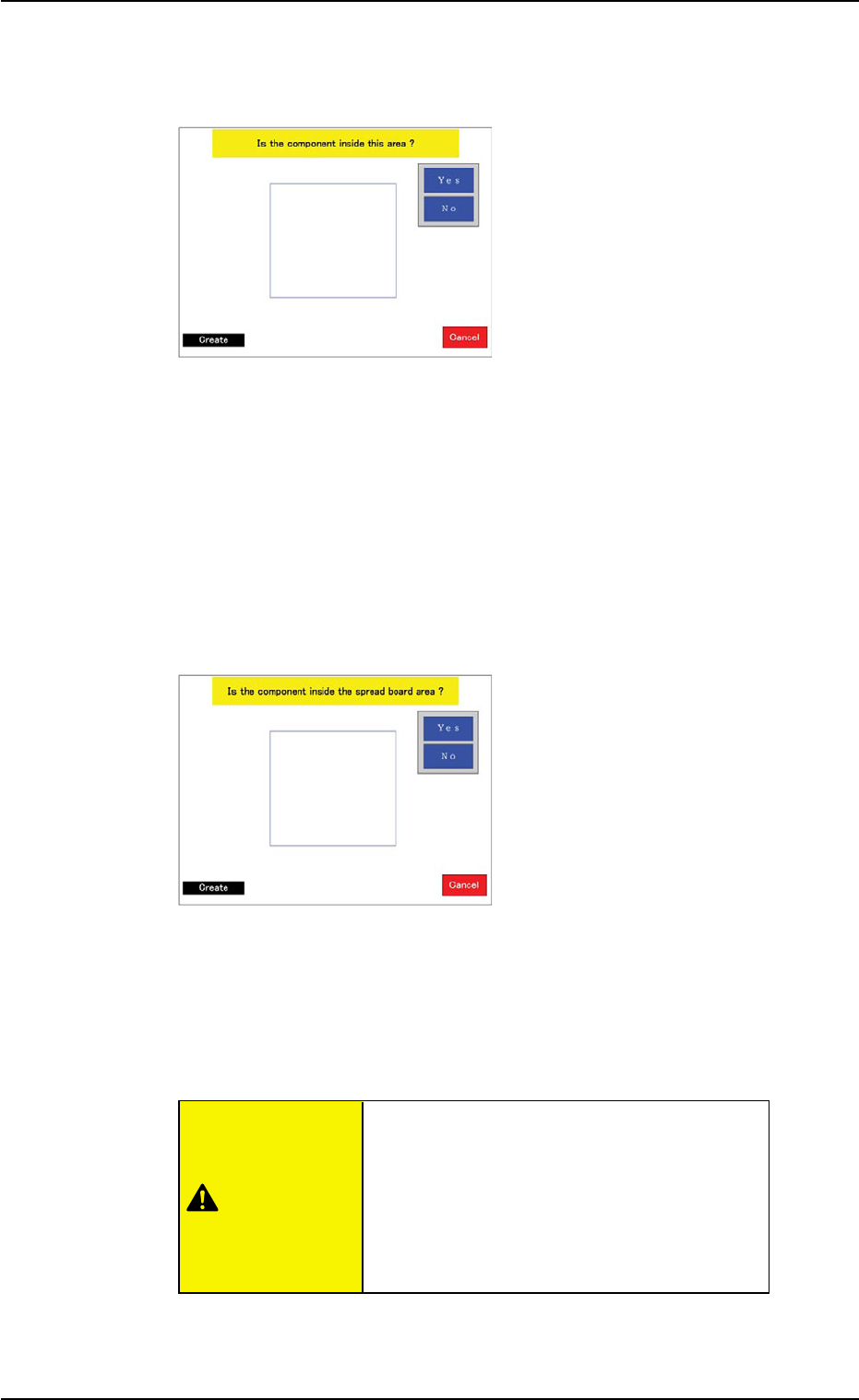
Confirm that the whole image of the component is inside the light
blue frame.
When the [Yes] button is pressed, "MIN VIEW" is selected and the
window in Step (3) opens.
When the [No] button is pressed, the window in Step (2) opens.
(2) A window opens and shows
an image of the component
to determine if the size of
the component is proper or
not for a teaching operation
with the minimum view func-
tion.
When the thickness (t + Ut)
of the component exceeds
"5 mm", this window does
not open. Instead, the win-
dow in Step (3) opens.
Confirm that the whole im-
age of the component is in-
side the light blue frame.
Check the component thickness data.
When a wrong component thickness (data)
is used and the [Yes] button is pressed in
this window, the movable camera might in-
terfere with the component, depending on
the size of the component.
When the [Yes] button is pressed, "MIN VIEW" is selected and the
window in Step (3) opens.
When the [No] button is pressed, the window in Step (3) opens.
5.2 Library Teaching
0308-004 6-125
Fig. 2F89
Fig. 2F90
CAUTION
AHB01ESPP
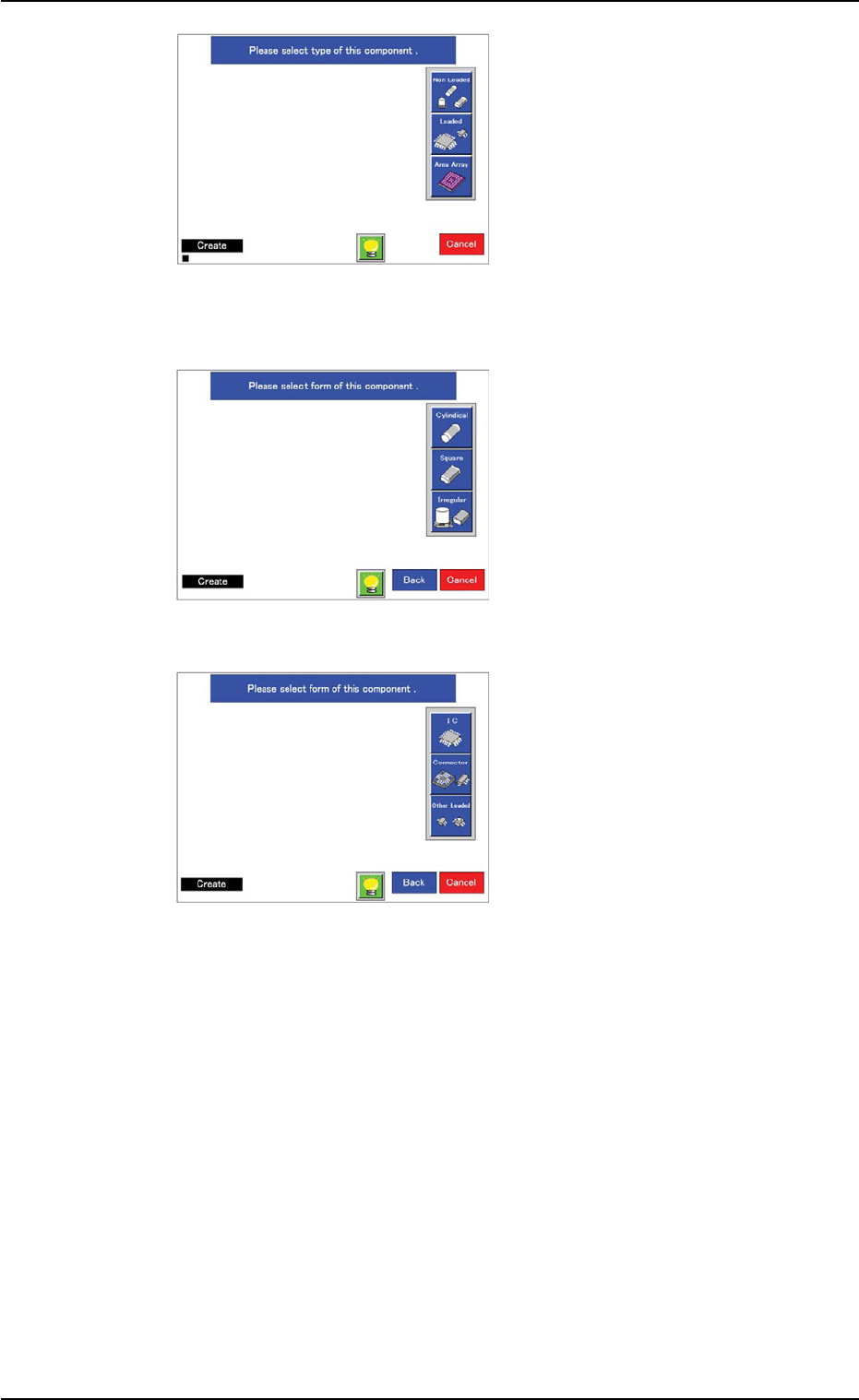
(3) Select a component type.
When the [Non Leaded] but-
ton is pressed, the window
in Step (4) opens.
When the [Leaded] button is
pressed, the window in Step
(5) opens.
When the [Area Array] but-
ton is pressed, the window
in Step (6) opens.
(4) Select the shape and type of
the component.
After the selection, the win-
dow in Step (7) opens.
(5) Select the shape, lead ar-
rangement, lead type (or
shape) of the component.
When all leads can be clas-
sified as one kind of leads
and the ends of the leads on
each side are arrayed in line,
"Simple" must be selected
for "Lead Arrangement".
Ref.: "Simple" can be ap-
plied to almost all com-
ponents.
When connectors (compo-
nents) are used, select
"Standard" as "Lead Type".
The window in Step (7)
opens.
5.2 Library Teaching
0308-004 6-126
Fig. 2F91
Fig. 2F92
Fig. 2F93
AHB01ESPP
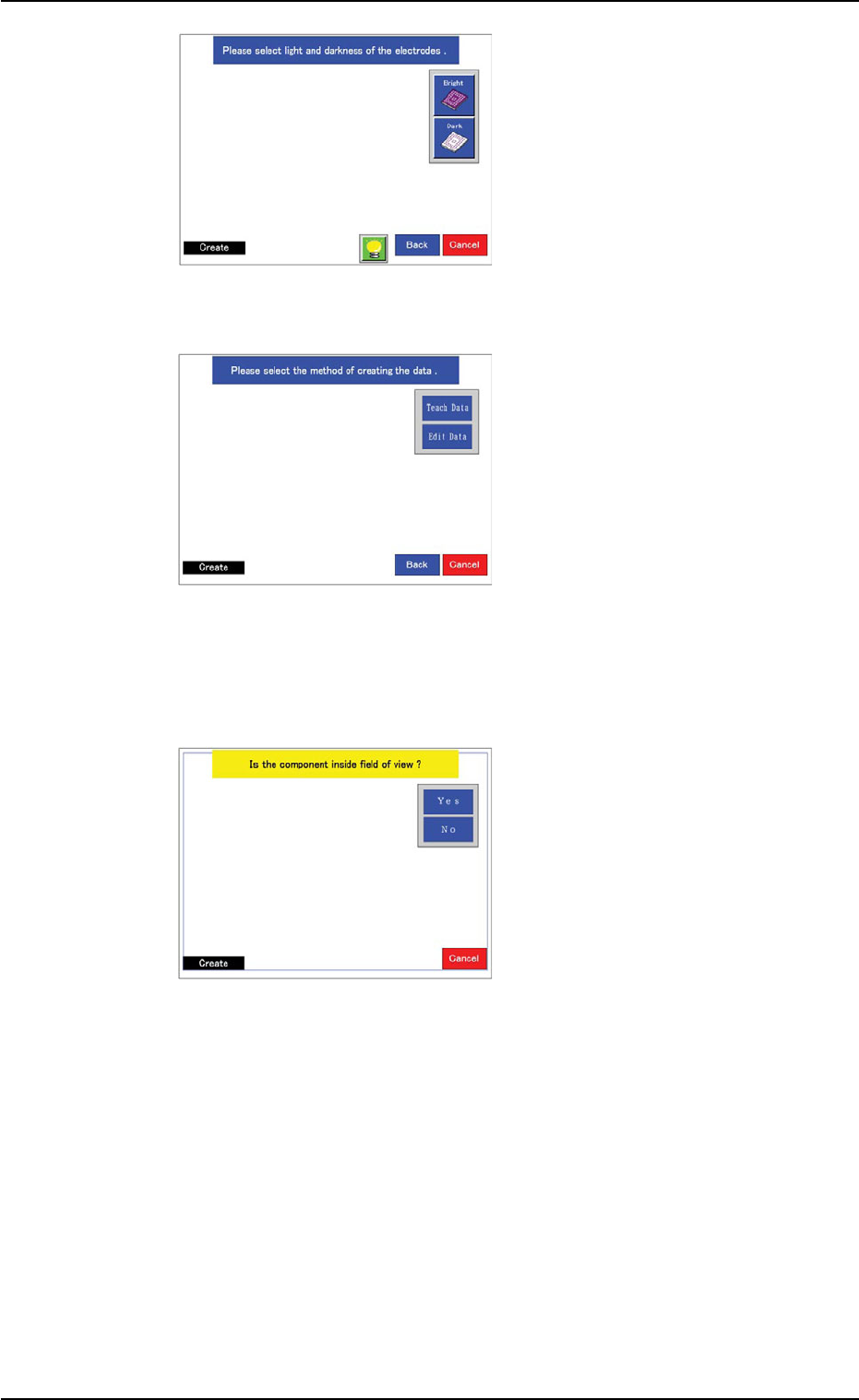
(6) Select the brightness of the
electrodes, compared with
the mold.
Select "Bright" in normal
cases.
When the molded area looks
almost white, select "Dark".
The window in Step (7)
opens.
(7) Specify how to create data.
When the [Teach Data] but-
ton is selected, the window
in Step (8) opens.
When the [Edit Data] button
is selected and the large
view function is used, the
window in Step (8) opens.
When a function other than
the large view one is used,
the window in Step (16)
opens.
(8) Confirm that the image of
the component is inside the
view.
When part of the image is
out of the view, press the
[No] button.
The divided images are cap-
tured.
When a function other than
the large view one is used,
this window does not open.
In this case, the window in
Step (12) opens.
Confirm that the whole image of the component is inside the light
blue frame.
When the [Yes] button is selected, the window in Step (10) opens.
When the [No] button is selected, the divided images are captured
and the window in Step (9) opens.
5.2 Library Teaching
0308-004 6-127
Fig. 2F94
Fig. 2F95
Fig. 2F96