2OM-1075-002.pdf - 第64页
2 . 3 Priority Sorting Function When components different in height are used in a repetitive pattern program, this priority sorting function controls the machine to start its placement operation with the shorter componen…
2.2 Multi-Model Repetitive Pattern Function for
Mixed Programs
By creating several placement patterns in one pattern program, compo-
nents for different patterns can easily be placed on unit P.C.B.’s of a
multi-unit P.C.B.
• Because several placement data can be set in one pattern program,
the related operation and placement feeder location data can be used
commonly.
• Each placement data can be set independently for a repetitive pat-
tern, making it possible to create pattern program data efficiently.
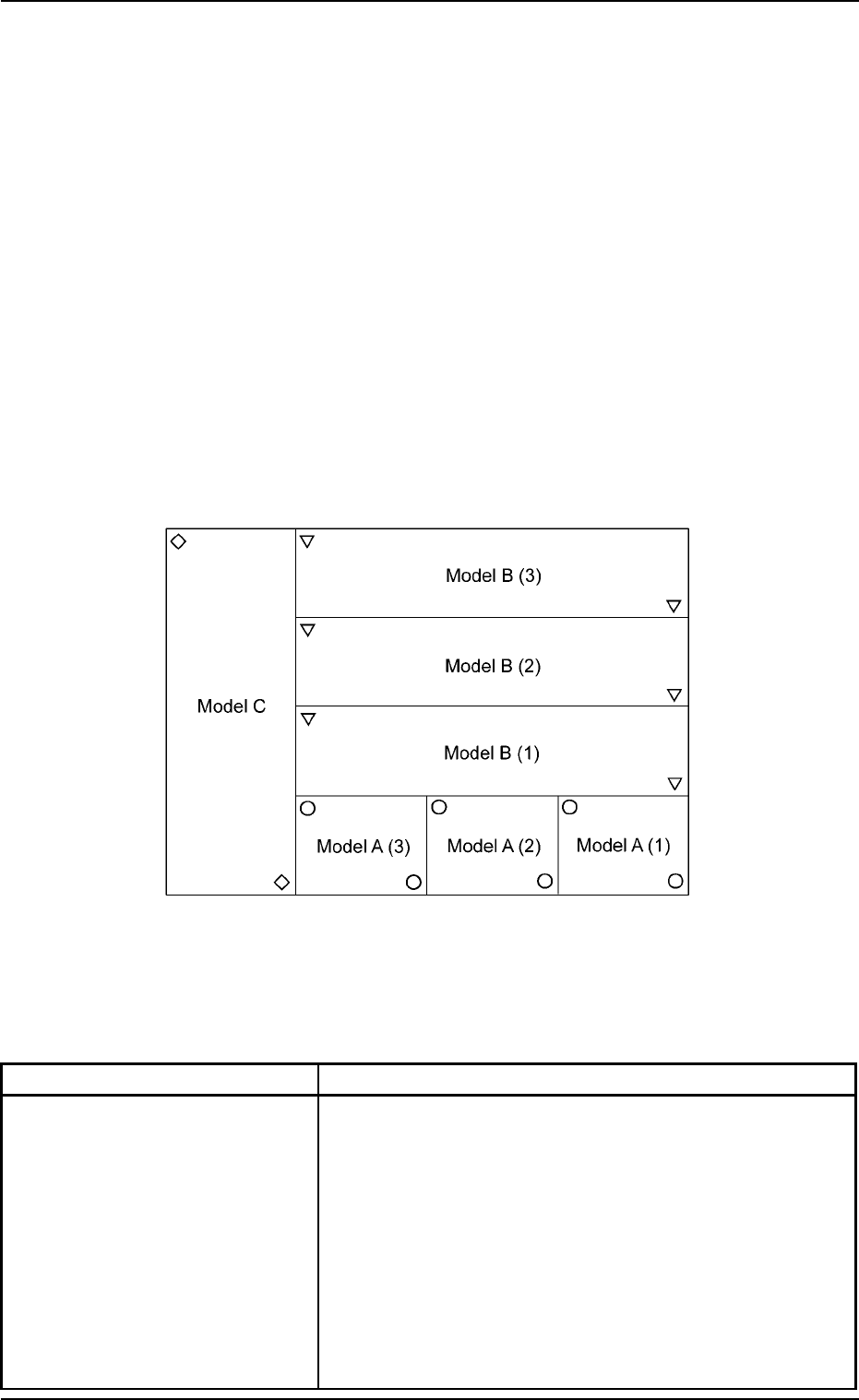
• When components are placed diversely on Patterns A, B, and C as
shown below (example), the multi-model repetitive pattern function
can be used for mixed programs.
Example:
Fig. 2B20
• How to use the multi-model repetitive pattern function for mixed
programs
Table 2B2
Step Reference
1. Creating a Pattern Program
(1) "2.1 Types of P.C.B.’s and Required Data" in "Section
2" of "Vol. 3: Programming and Machine Data"
(2) "2.5 Placement Data" in "Section 2" of "Vol. 3: Program-
ming and Machine Data"
• C01 Placement Data Un
• C02 Placement Data (P-data)
• C03 Placement Data (O-data)
(3) "3. Example of Pattern Program Creation" in "Section
2" of "Vol. 3: Programming and Machine Data"
• "3.8 Multi-Model Repetitive Patterns"
0206-002 2-14 AHB01ESPP
2.2 Multi-Model Repetitive Pattern Function for Mixed Programs
2.3 Priority Sorting Function
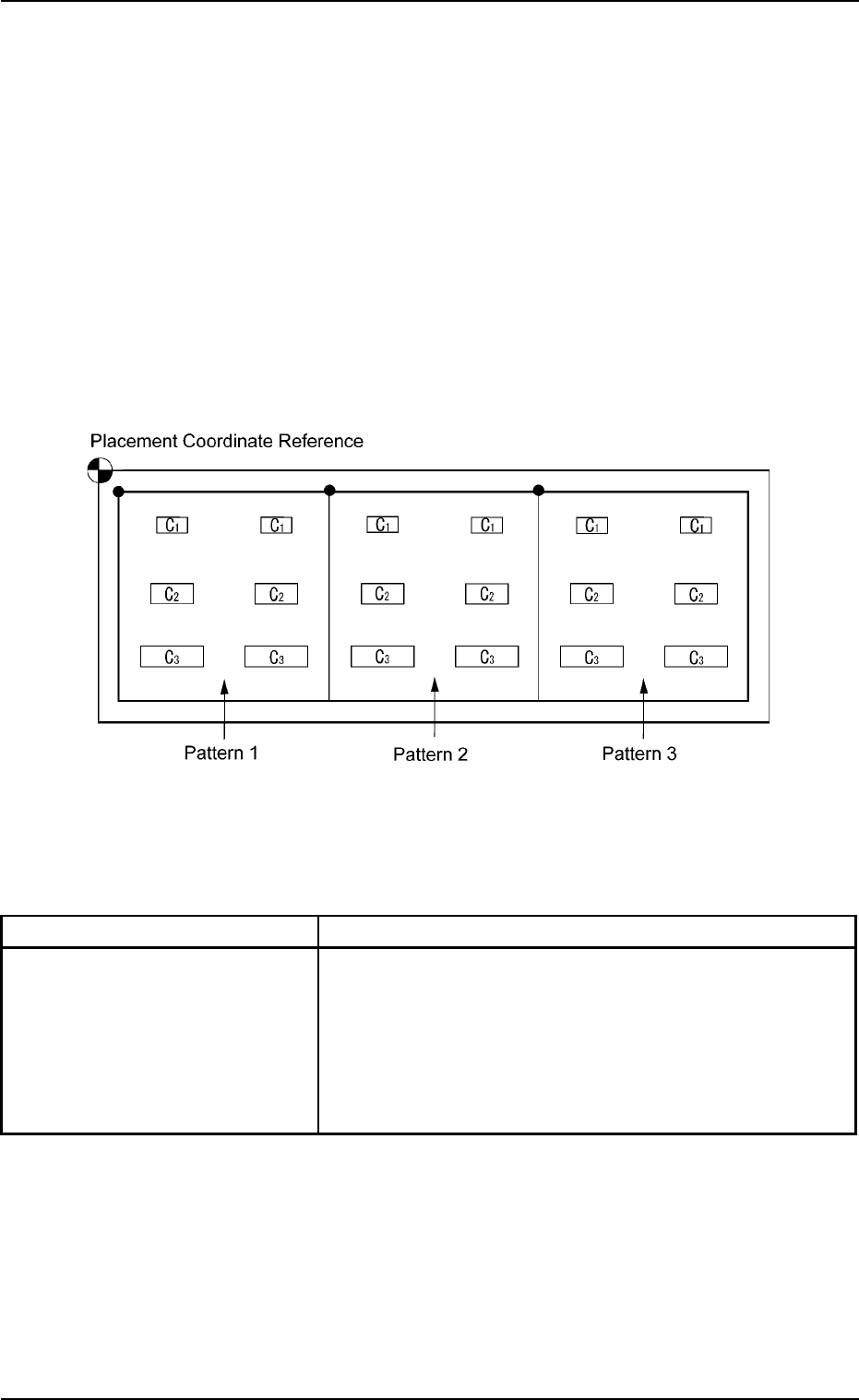
When components different in height are used in a repetitive pattern
program, this priority sorting function controls the machine to start its
placement operation with the shorter components than all the others on
all unit (child) boards of a multi-unit (mother) P.C.B., improving produc-
tivity.
In addition to that, the number of nozzle change operations can be re-
duced, avoiding deterioration of productivity because the components
that require the same nozzle are placed prior to all the other ones.
The example (figure) below shows that three kinds (C1, C2, and C3) of
components (different in height) are used.
Fig. 2B21
• How to use the priority sorting function
Table 2B3
Step Reference
1. Creating a Pattern Program
(1) "2.5 Placement Data" in "Section 2" of "Vol. 3: Program-
ming and Machine Data"
• C02_08C
(2) "3. Example of Pattern Program Creation" in "Section
2" of "Vol. 3: Programming and Machine Data"
• "3.6 Repetitive Patterns" (Priority Sorting Function)
0206-002 2-15 AHB01ESPP
2.3 Priority Sorting Function
2.4 P.E.C. Recognition Function
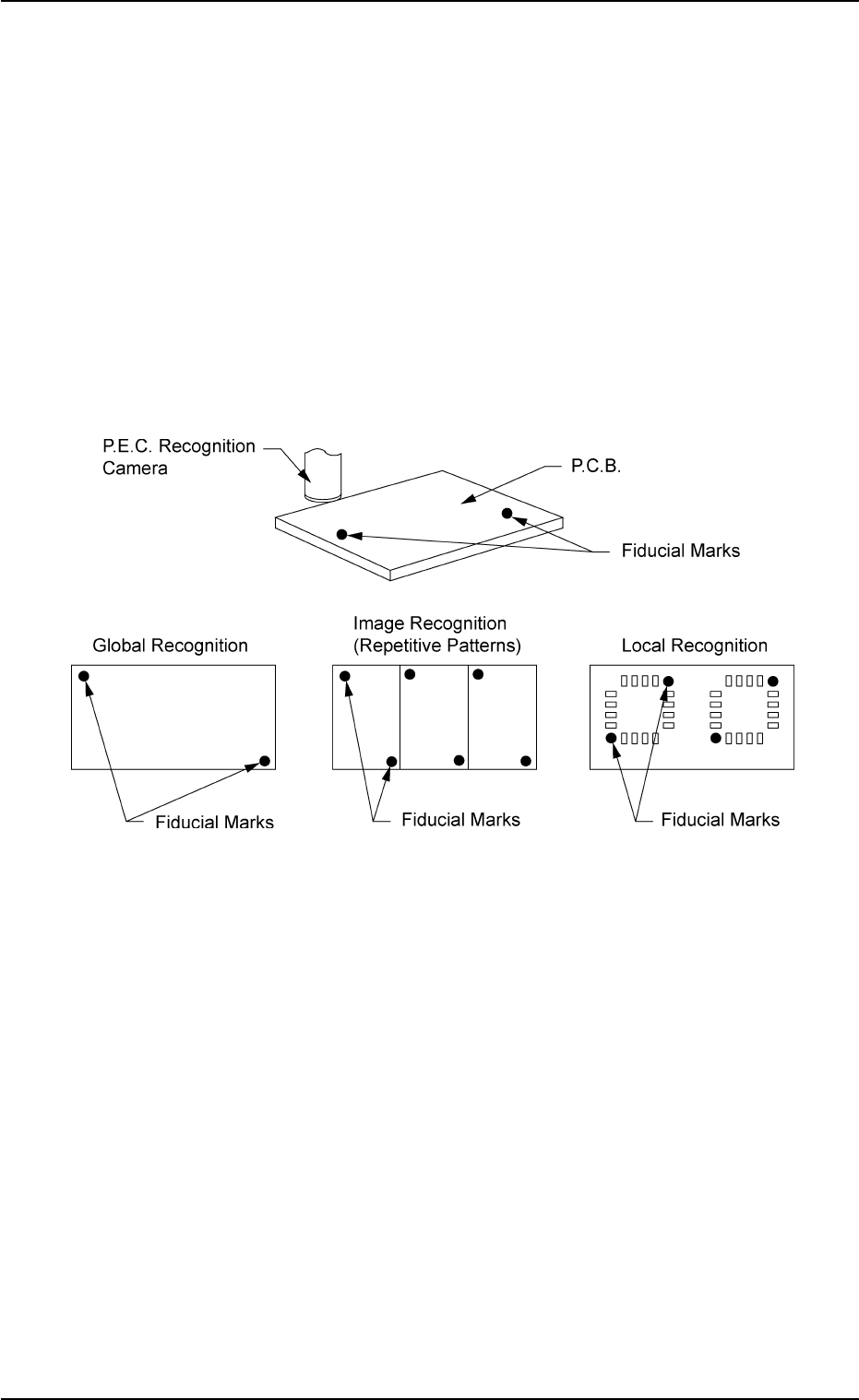
In normal cases, two fiducial marks are put on a P.C.B. and the coordi-
nate data and positional deviation are detected by the P.E.C. recognition
camera. This function automatically corrects placement positions of
components according to the recognized positional deviation.
• There are three kinds of P.E.C. recognition functions - "Global", "Im-
age", and "Local". The global recognition function covers all positional
deviation over one P.C.B. and is used to correct it. The image recog-
nition function is used to correct positional deviation for each indi-
vidual patterns. The local recognition function is used to correct posi-
tional deviation for each component placement point.
Fig. 2B22
0206-002 2-16 AHB01ESPP
2.4 P.E.C. Recognition Function