D1_ServiceManual_e.pdf - 第30页
3 Mechanical Section 3-4 ● Cleaning ① Remove the rem aining dispensing fluid wi th a cotton swab. Insert the syri nge with full of air into nozzle adapter openi ng. Hold the nozzle and slowly push the air into the adapte…
3 Mechanical Section
3-3
Nozzle
■ Cleaning.
If the dispensing fluid is left in a nozzle for a long time, it will harden. Once the fluid hardens in the nozzle,
the fluid in a syringe cannot be dispensed. So clean nozzles before the fluid gets hard. When you change the
dispensing fluid and when you are not using a nozzle for a long time, clean the nozzle in the same manner.
● Timing of Cleaning
・When the amount of dispensing is coming to smaller.
(When discharging or dot size are coming smaller.)
・When dispensing amount is not stable.
・When using the nozzle after a long interval.
NOTE: Cleaning timing depends on the state of storage. Follow the instruction of the manufacturer for
storing the material.
● Preparations
・ Syringe
・ Saucer
NOTE: Syringe does not need a needle. About 10cc is enough for the syringe capacity.
3 Mechanical Section
3-4
● Cleaning
① Remove the remaining dispensing fluid with a cotton swab.
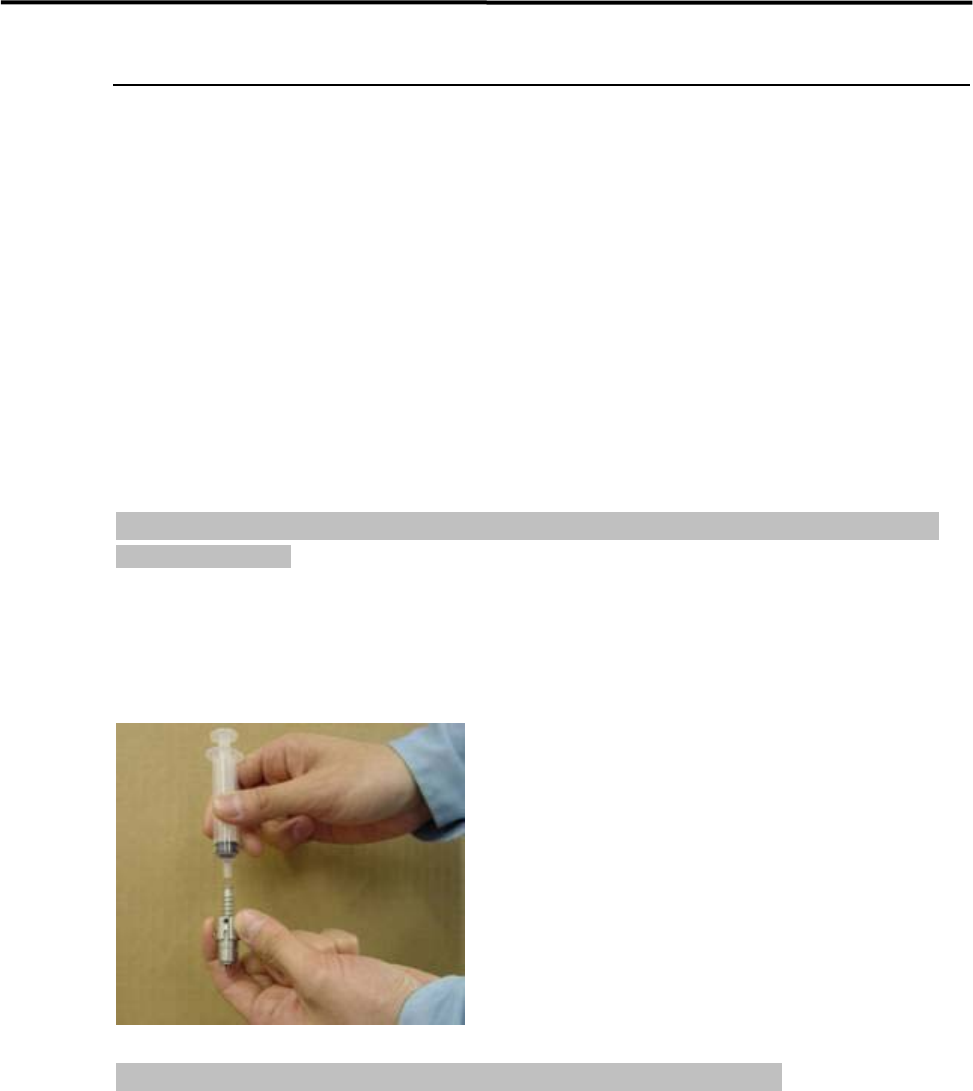
Insert the syringe with full of air into nozzle adapter opening. Hold the nozzle and slowly push the air
into the adapter to push out the residue.
NOTE: Syringe must be inserted tight to avoid air leak, or the residual may not be pushed out.
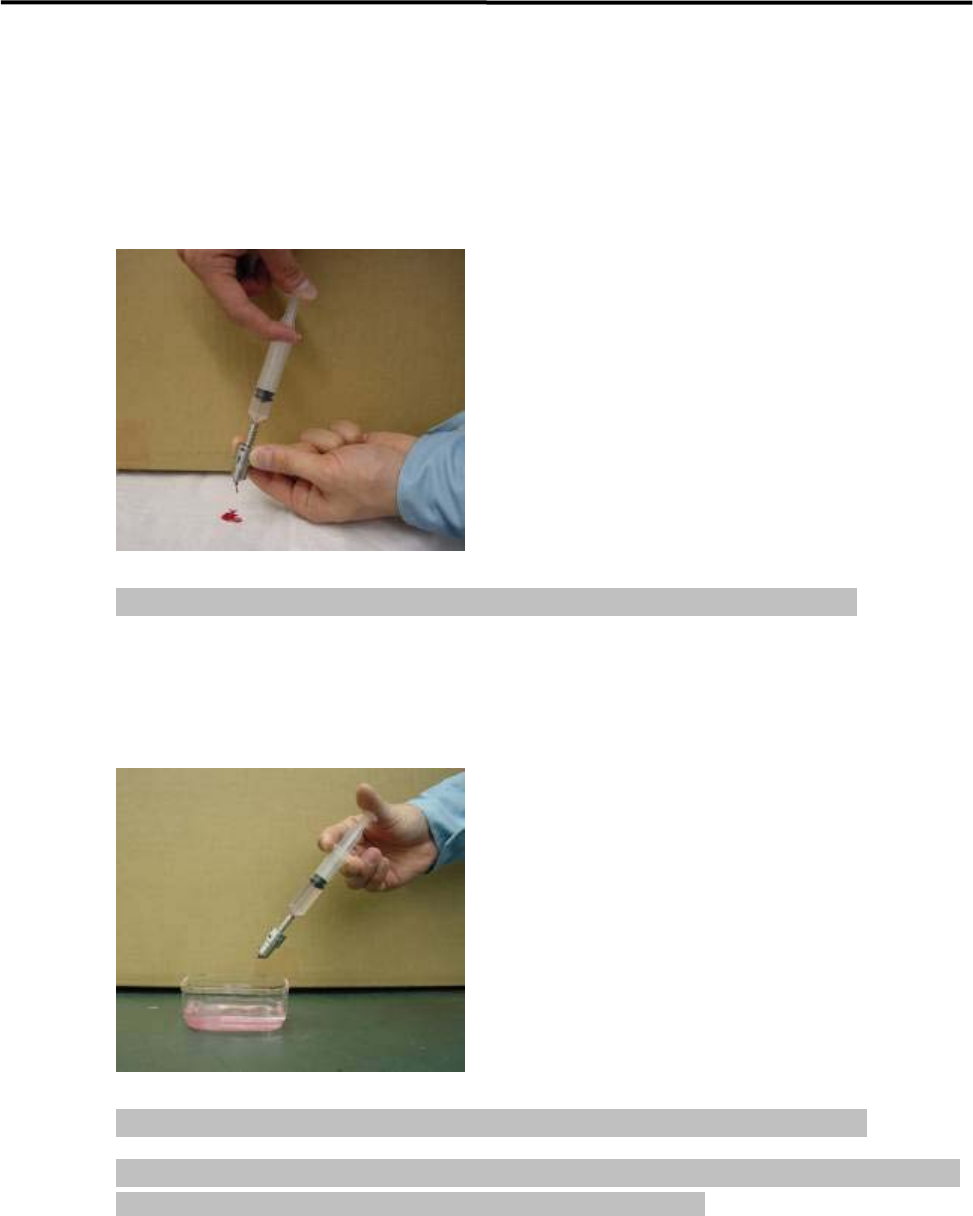
② Insert the syringe containing some solvent into nozzle adapter opening.
③ Press the syringe hard and push the solvent out.
④ Repeat the procedure until the nozzle becomes clean enough.
NOTE: Nozzle is not held by hand in the picture above, but it must be held to avoid slipping off.
NOTE: Use the solvent specified by the manufacturer of dispensing fluid. Some solvents may deteriorate a
syringe and a sealant inside of it. If this happens, replace the syringe.
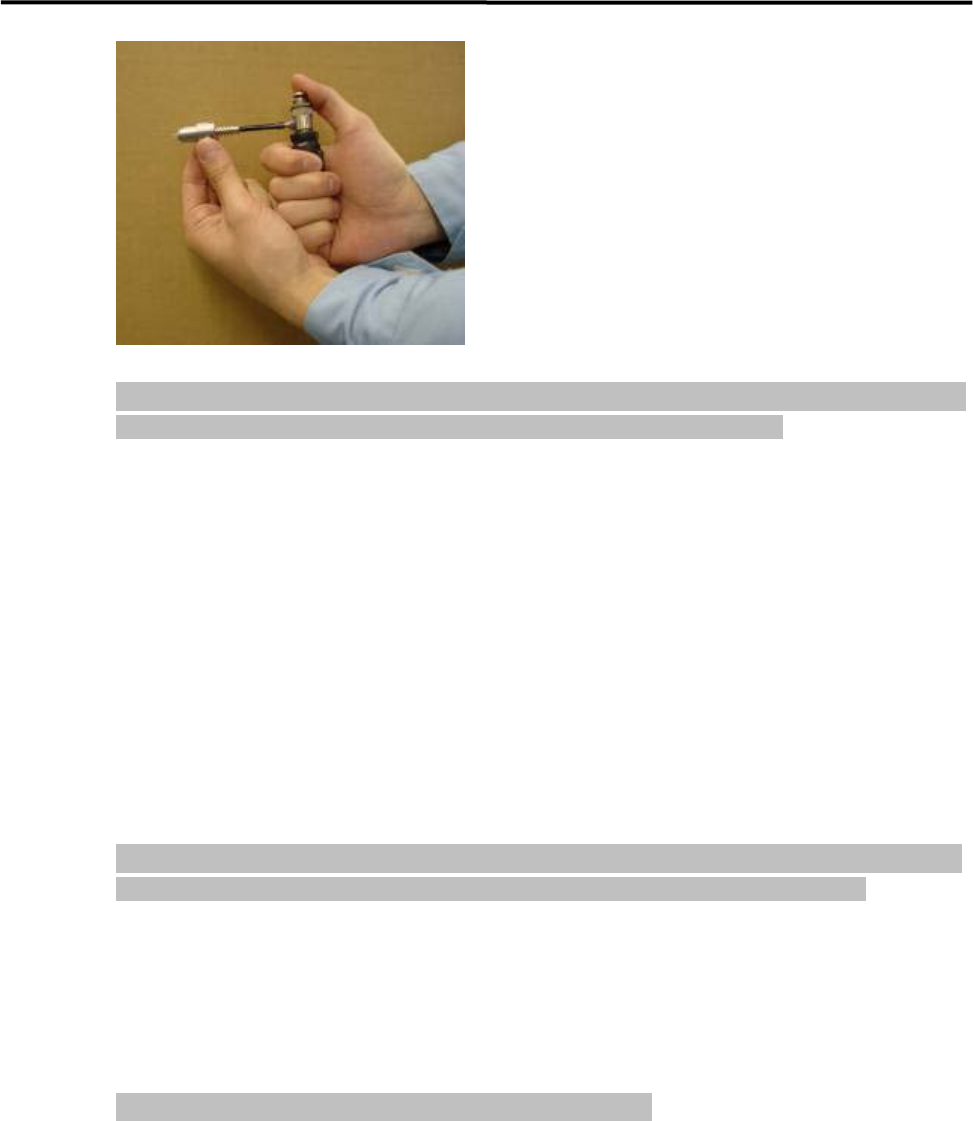
⑤ Blow off the remained solvent with air blow. Check with your eye if the nozzle hole is through.
3 Mechanical Section
3-5
NOTE: Cleaning must be performed by the procedure described above. Using a wire, such as a piano wire,
damages the inner wall and the edge, and may cause stringing or side leakage.
■ How to Set Nozzle
Follow the procedure below to set a nozzle after you have disassembled the nozzle assembly for nozzle
replacement.
① Put the O-ring in the bottom of the GUIDE,NOZZLE.
② Screw in the STOPPER (TWIN,SINGLE,MICRO_S) lightly until it stops.
③ Screw in four hex. socket set screws until they show their tips inside the guide. Use
two longer screws for flat side, and two shorter screws for round side. (See Figure A)
④ Use the ADAPTER(L) for a single nozzle, and the ADAPTER(S) for twin nozzle and
micro nozzle.
⑤ Assemble the nozzle and adapter, then put them into the GUIDE,NOZZLE.
NOTE: Be careful of the orientation of the nozzle-adapter assembly, especially for a twin nozzle, when you
insert the assembly into the GUIDE,NOZZLE. See Figure C for twin nozzle orientation.
⑥ Push the nozzle-adapter assy. into the GUIDE,NOZZLE with your finger, measure
the clearance between the tips of the nozzle and stoppers using a digital vernier
caliper or a special tool.
⑦ Pull out the nozzle-adapter assy. and turn the STOPPER with a screwdriver to
adjust the clearance. The clearance must fall within ±0.015mm of the reference
clearance (one turn of the STOPPER moves it about 1mm.).
NOTE: The reference clearance differs according to the type of nozzle.
⑧ After the nozzle clearance has been adjusted, insert the nozzle-adapter assy. with
your finger, screw four hex. socket set screws until they slightly contact the nozzle.
(See Fig. A)
⑨ Adjust the screws so that the difference between X1 and X2, and the difference
between Y1 and Y2 will fall within 0.05mm. One turn of a screw moves it about
0.5mm. The tightening torque must be 0.15 to 0.2 N・m. (See Fig. D)
⑩ Screw three hex. socket set screws until they slightly contact the adapter. Then,
screw each set screw little by little (about 30 deg. each time) to make them equally
screwed in. The tightening torque must be 0.10 to 0.15 N・m. (See Fig. B)