SIPLACE Line Computer UNIX.pdf - 第530页
17 Practical Tips on Using the LC UNIX User Manual Line Computer UNIX 17.3 Description of Com ponents and PC Bs Software Version 5 02.xx 10 /2000 Issue 528 I t I I Entering the dim ens- ions of the PCB Defining f iducial…
User Manual Line Computer UNIX 17 Practical Tips on Using the LC UNIX
Software Version 502.xx 10/2000 Issue 17.3 Description of Components and PCBs
527
I
t I I
17.2.1.1 Package Form Description
The package forms used are contained in the standard GF-library, the description is dispensed with.
17.2.1.2 Component Description
To open the Component Editor for a component, proceed as follows:
1. On the desktop click on the icon of the Component Editor .
The file selection window is opened.
2. Click on the Selection editing field.
3. Enter the name of the component, here: Comp1.be, click on the OK button.
The Component Editor is opened.
To enter the component data, proceed as follows:
4. Click on the Comment editing field.
5. Enter a comment uniquely describing the component, here: SOT23.
6. Click on the Package form editing field.
7. Enter the package form number, here: 400.
8. Activate the appropriate button in the Processing selection area, here: Placing and Glueing.
9. Activate the appropriate button in the CRDL selection area, here: No check.
10. On the FILE menu click on the Save option.
The component data are now saved.
11. On the FILE menu click on the Quit option.
The Component Editor is closed.
12. Perform the component description for the other components, here: Comp2.be and Comp3.be.
17.2.1.3 Adhesive Pattern (DM) Description
An adhesive pattern has already been defined in the standard GF-Bibliothek for the package forms defined.
17.2.1.4 PCB Description
To open the PCB Editor for a PCB, proceed as follows:
13. On the desktop click on the icon of the PCB Editor .
The file selection window is opened.
14. Click on the Selection editing field.
15. Enter the name of the PCB, here: Example_1.la and click on the OK button.
A dialog box is opened.
16. Click on the TYPE editing field.
17. Enter a type designation, here: SMD and click on the OK button.
The PCB Editor is opened. The PCB is represented as a rectangle.
To specify the position of the PCB in the machine, proceed as follows:
18. Activate the Coordinate System icon.
19. Click on the PCB (rectangle).
A dialog box containing the display of four coordinate systems is opened.
20. Click on a coordinate system, here: 0° .
21. Click on the OK button.
The dialog box is closed.
17 Practical Tips on Using the LC UNIX User Manual Line Computer UNIX
17.3 Description of Components and PCBs Software Version 502.xx 10/2000 Issue
528
I
t I I
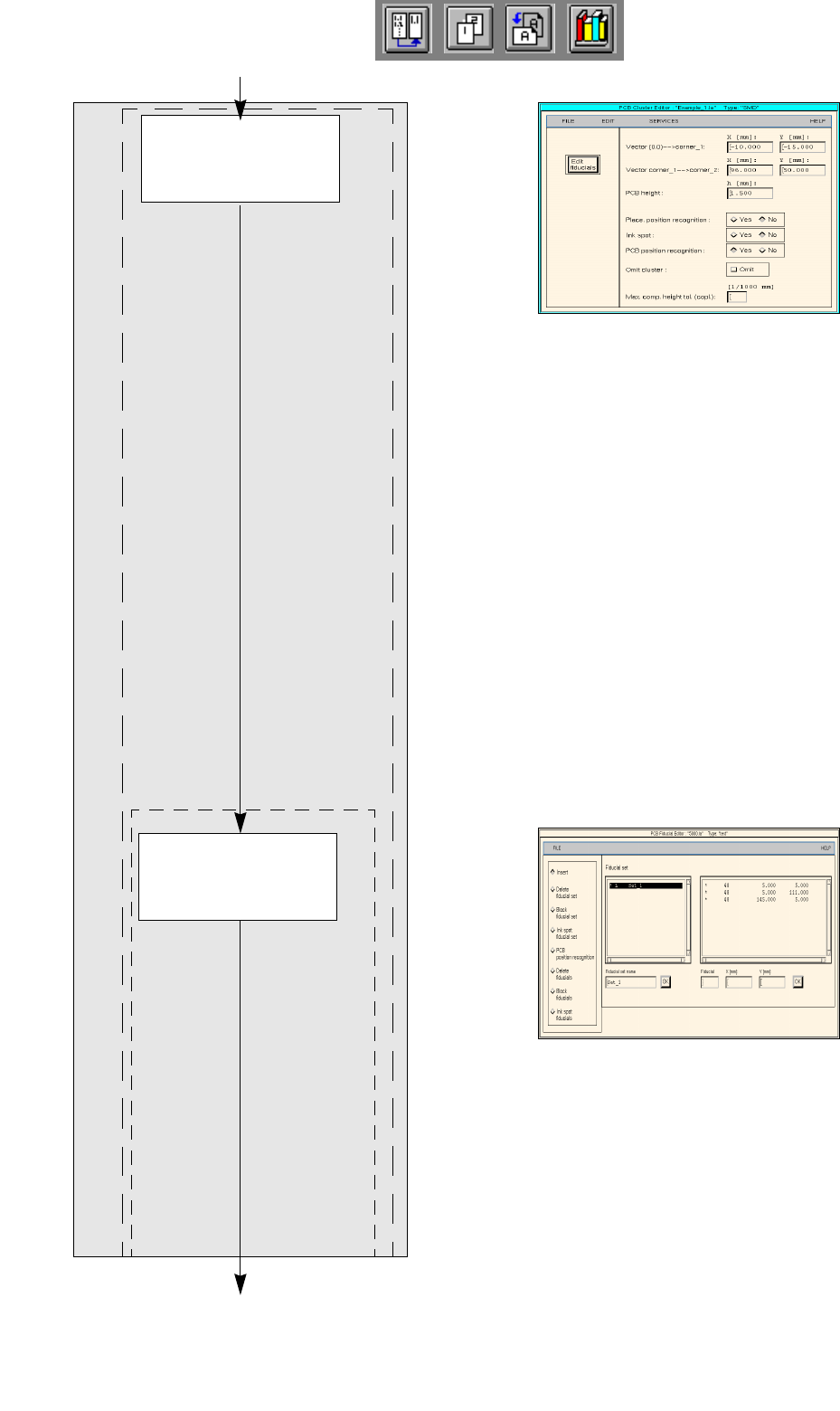
Entering the dimens-
ions of the PCB
Defining fiducials
continued from page 17-14
PCB Description
Cluster Editor
Fiducial Editor
continued on page 17-18
User Manual Line Computer UNIX 17 Practical Tips on Using the LC UNIX
Software Version 502.xx 10/2000 Issue 17.3 Description of Components and PCBs
529
I
t I I
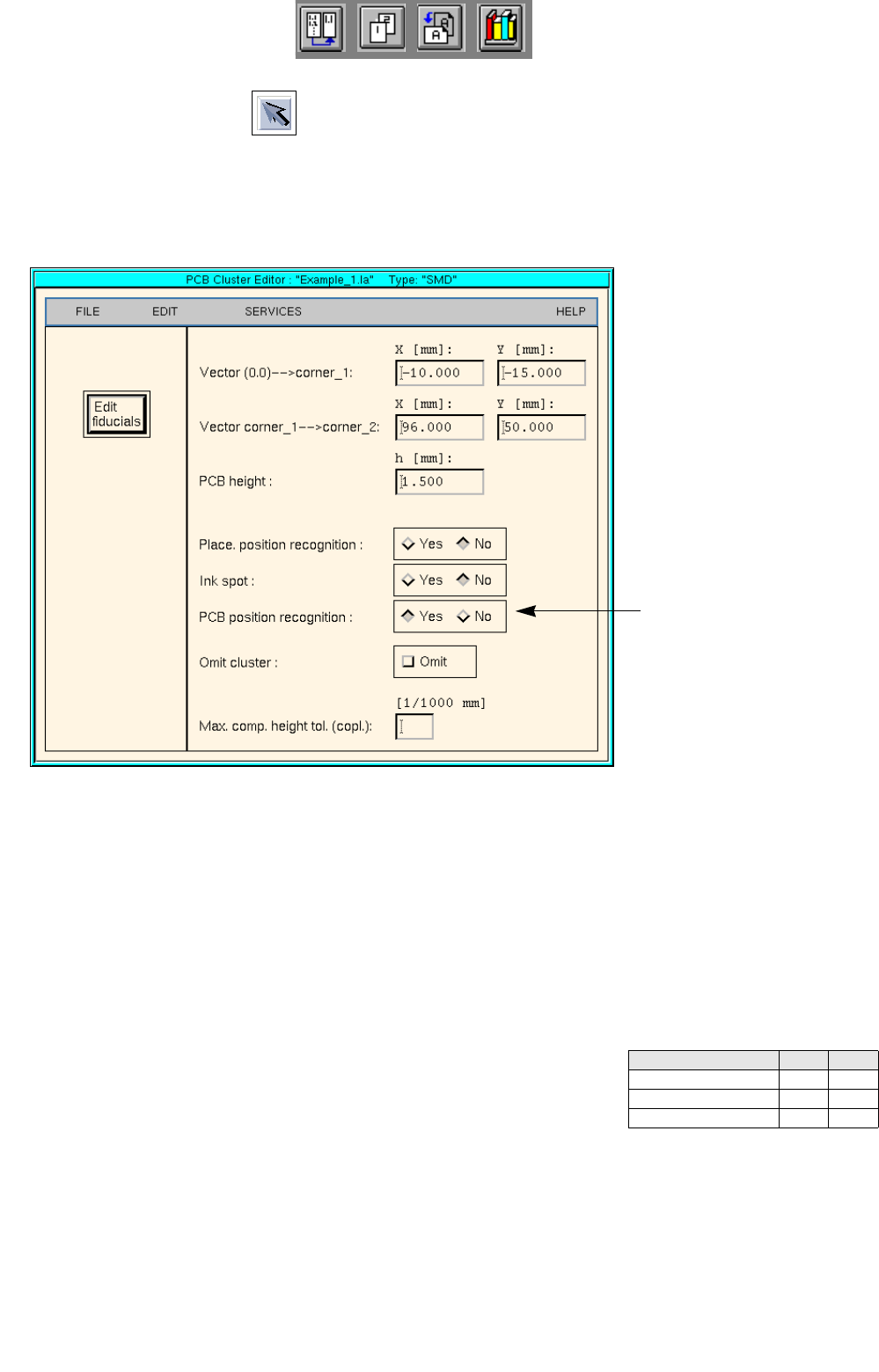
To enter the dimensions of the PCB, proceed as follows:
22. Activate the Select icon .
23. Click on the PCB (rectangle).
The rectangle is highlighted in green.
24. On the SERVICES menu click on the Cluster Editor... option.
The Cluster Editor is opened.
25. Enter the dimensions of the PCB. See Fig. 17.3.1 on page 17-524 and Fig. 17.3.2 .
Fig. 17.3.2 Cluster Editor for PCB 1
To define the fiducials, proceed as follows:
26. In the Cluster Editor click on the Edit fiducials button.
The Fiducial Editor is opened.
27. Activate the Insert button.
28. Click on the Fiducial set name editing field.
29. Enter the name for the new fiducial set, here: Set_1.
30. Click on the OK button.
Fiducial set Set_1 appears on the fiducial list.
31. Click on fiducial set Set_1 on the fiducial list.
32. Click on the Fiducial editing field.
33. Enter the fiducial number, here: 48.
34. Click on the editing fields for the coordinates, enter coordinates
(do not confirm by pressing the Enter key!), here: see chart:
35. Click on the OK button.
The fiducial data are transferred to the list of the fiducials of the fiducial set.
36. Define the other fiducials accordingly, here: fiducials 48 and 48.
37. Activate the PCB position recognition button.
38. Click on fiducial set Set_1 on the fiducial list.
The fiducial set Set_1 is marked by a preceeding
L for PCB position recognition.
Fiducial number X Y
48 -5 30
48 81 -10
48 81 30
Activate the PCB position
recognition