SIPLACE Line Computer UNIX.pdf - 第544页
17 Practical Tips on Using the LC UNIX User Manual Line Computer UNIX 17.3 Description of Com ponents and PC Bs Software Version 5 02.xx 10 /2000 Issue 542 I t I I continu ed from page 17-28 Enteri ng handling data Packa…
User Manual Line Computer UNIX 17 Practical Tips on Using the LC UNIX
Software Version 502.xx 10/2000 Issue 17.3 Description of Components and PCBs
541
I
t I I
C) Description of an irregular FDC using package form 1503 as an example
To open the Package Form Editor for package form 1503, proceed as follows:
60. On the desktop click on the icon of the Package Form Editor .
The file selection window is opened.
61. Click on the Selection editing field.
62. Enter the package form number, here: 1503.gf and click on the OK button.
The Package Form Editor with the Package form type selection window is opened.
To define the package form type „irregular FDC“ for package form 1503, proceed as follows:
63. Click on the Irregular FDC type in the Package form type selection window.
The selection window is closed.
64. In the Package Form Editor click on the Comment editing field, enter a unique comment, here: Micro-X.
To enter the dimensions for package form 1503, proceed as follows:
65. Enter the dimensions of the package form with pins in the Nominal dimensions editing area, confirm your
entry by pressing the Enter key, here: see chart:
The tolerances are entered automatically.
The package form with the tolerance range is displayed.
66. Enter the dimensions of the package form without pins in the Body editing area, confirm by pressing the
Enter key, here: see chart:
(These entries are only required for the display).
The display of the package form is updated.
67. In this example the default values of the Packaging tolerances and Features editing areas can be
adopted, no entries are required.
To create the lower pin group (pins 1 to 4) of package form 1503, proceed as follows:
68. Click on the Create button.
The Group data window is opened. On the upper side of the component a predefined pin group with three
pins (gray areas) is displayed.
69. Overwrite the default values in the editing fields with the pin group data for package form 1503 (see dis-
plays in On-line Help) and confirm your entry by pressing Enter key, here: see chart:
Every time the Enter key is pressed, the display of the pin group (gray areas) is updated, the pin groups
are now displayed on the bottom side of the component.
70. Click on the OK button.
The Group data window is closed.
To define the pin model for the lower pin group of package form 1503, proceed as follows:
71. Select one of the two pin groups by clicking on it.
72. Click on the Pin/Ball button.
The Pin model data window is opened.
73. Enter the pin model data, here: see chart:
In this example the automatically calculated values of the other editing fields can be adopted. Every time
the Enter key is pressed, the display of the pin model is updated.
74. Click on the OK button.
The Pin model data window is closed. The package form together with the pins is displayed at the
bottom side.
X
(Length D)
Y
(Width H
E
)
Z
(Height A)
6.5 7 1.8
X
(Length D)
Y
(Width E)
6.5 3.5
No. of pins
Spacing
e2
Pin angle
X (BG
Off
) Y (BG
Off
)
4 1.27 -90 0 -2.625
Pin length BL Pin width b
1.75 0.6
17 Practical Tips on Using the LC UNIX User Manual Line Computer UNIX
17.3 Description of Components and PCBs Software Version 502.xx 10/2000 Issue
542
I
t I I
continued from page 17-28
Entering handling
data
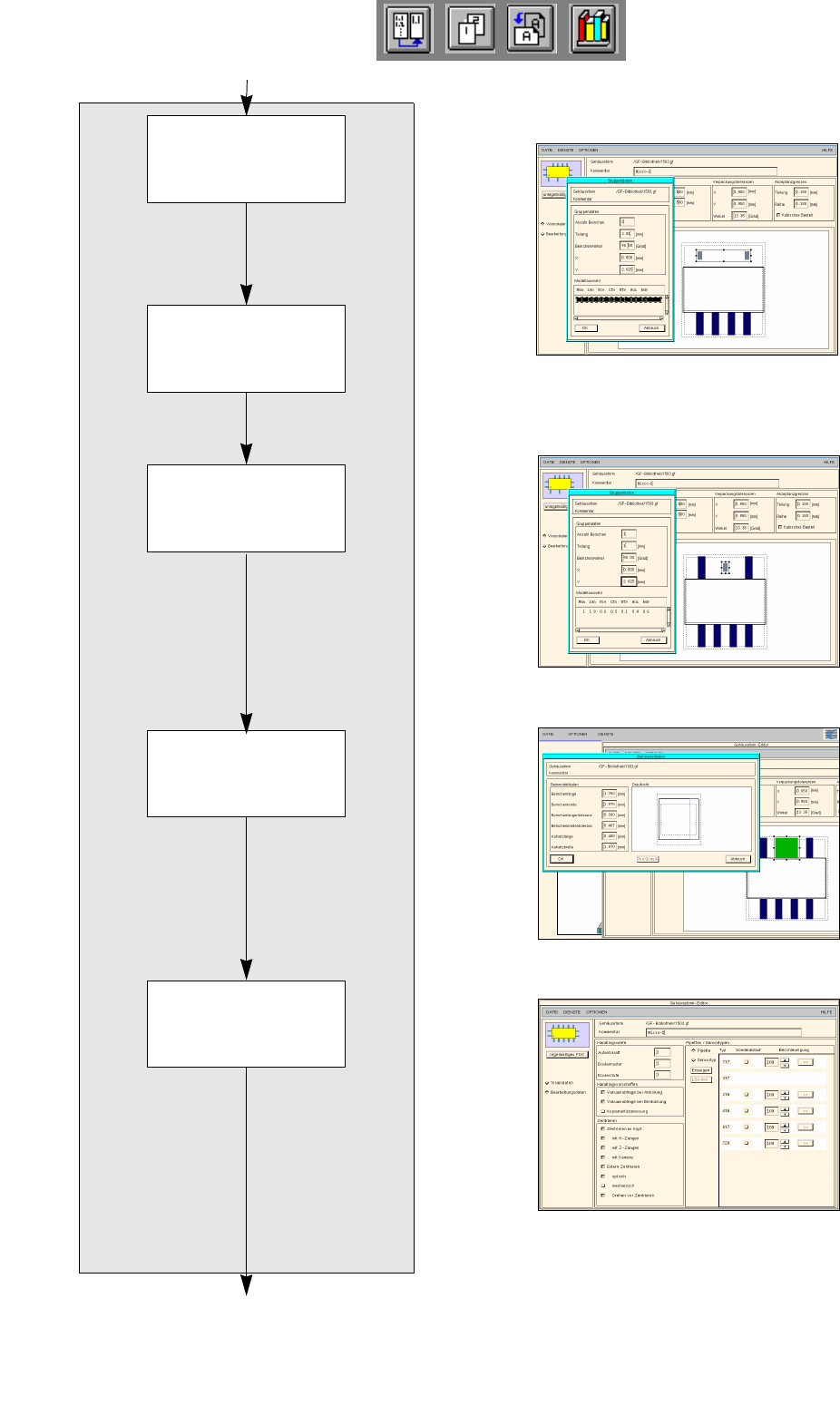
Package form description for package form 1503
Creating pin group
Accepting pin model
Creating pin group
Defining pin model
continued on page 17-32
User Manual Line Computer UNIX 17 Practical Tips on Using the LC UNIX
Software Version 502.xx 10/2000 Issue 17.3 Description of Components and PCBs
543
I
t I I
To create the first pin group (pins 5 and 7) at the top and to adopt the pin model from the pin group at
the bottom, proceed as follows:
75. Click on the Create button.
The Group data window is opened.
76. Overwrite the default values in the editing fields with the pin group data for package form 1503 (see dis-
plays in On-Line Help) and confirm by pressing the Enter key, here: see chart:
Every time the Enter key is pressed, the display of the pin group (gray areas) is updated.
77. In the selection field Model selection click on the model data of the lower pin group created.
78. Click on the OK button.
The Group data window is closed. The Model data for the upper pin group are adopted. The package
form is now displayed with the pins on the bottom side and the two pins on the top side.
To create the second pin group at the top (pin 6), proceed as follows:
79. Click on the Create button.
The Group data window is opened.
80. Overwrite the default values in the editing fields with the Pin group data for package form 1503 (see dis-
plays in On-Line Help) and confirm the entry by pressing the Enter key, here: see chart:
Every time the Enter key is pressed the display of the pin group (gray areas) is updated.
81. Click on the OK button.
The Group data window is closed.
To define the pin model for the second pin group at the top, proceed as follows:
82. Select one of the two pin groups by clicking on it.
83. Click on the Pin/Ball button.
The Pin model data window is opened.
84. Enter the pin model data, here: see chart:
In this example, the automatically calculated values of the other editing fields can be adopted.
The pin model is displayed graphically and updated after every entry.
85. Click on the OK button.
The Pin model data window is closed. The pins of the package forms are now completely defined. The
display corresponds to the package form on the data sheet.
To define the handling data for package form 1503, proceed as follows:
86. Activate the Handling data button.
The screen for entering the handling data is displayed.
87. Activate the Nozzle button in the command area.
88. Click on the Create button.
The Nozzle type selection window containing a list of the nozzle types is opened.
89. Click on a nozzle, here: 615.
The selection window closes, the nozzle is transferred to the view area.
90. Select all other nozzle required accordingly, here: 618.
91. Activate the Sensor type button.
92. Click on the Create button.
The Sensor type selection window containing a list of the sensor types is opened.
93. Click on the sensor type, here: 9 .
The selection window closes, the sensor type is transferred to the view area.
No. of pins Spacing Pin angle
X (BG
Off
) Y (BG
Off
)
1 1 90 0 2.625
Pin length BL Pin width b1
1.75 1.87
No. of pins Spacing e1 Pin angle
X (BG
Off
) Y (BG
Off
)
2 3.81 90 0 2.625