YSH20_Ope_E.pdf - 第67页
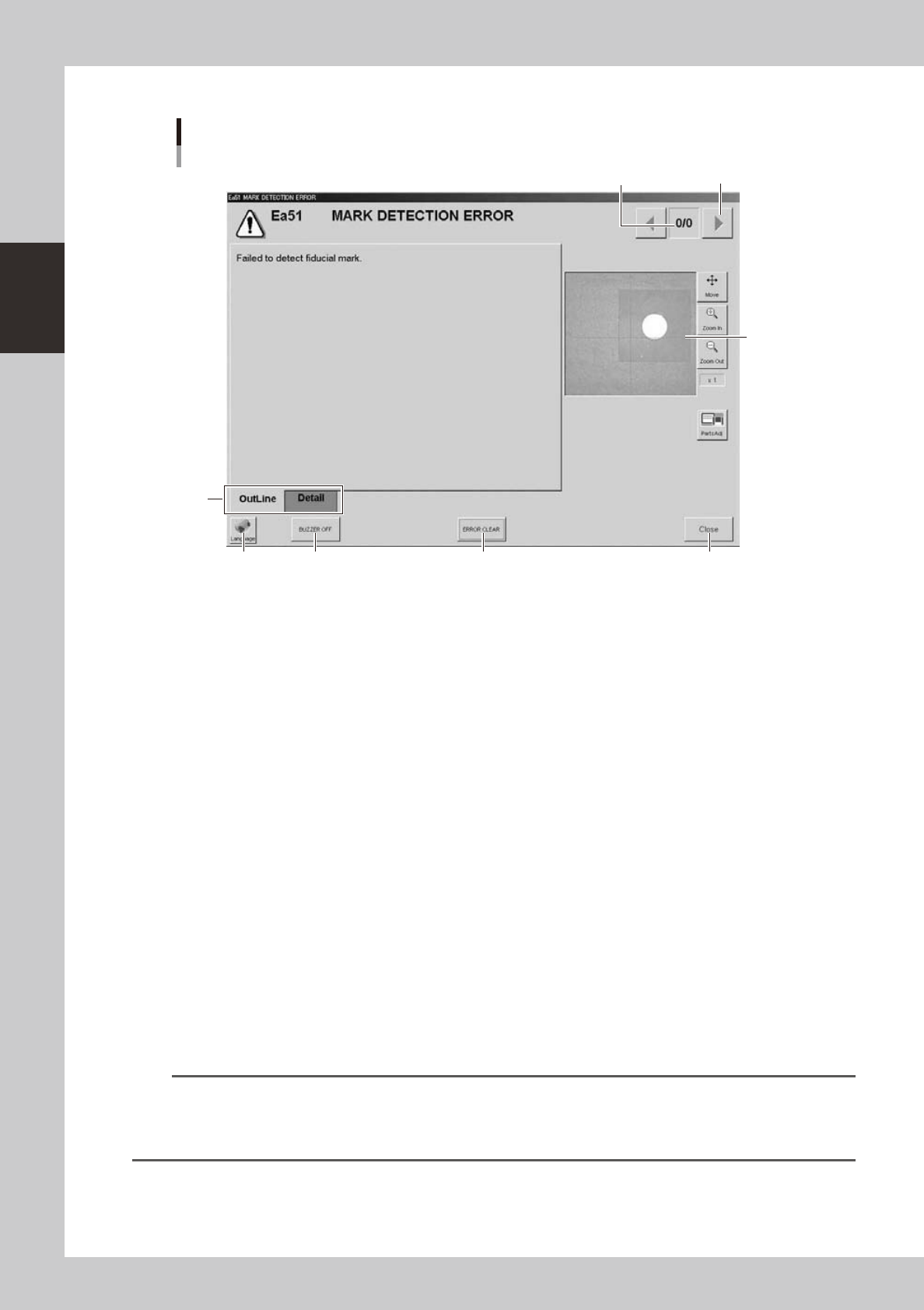
2-10 2 asic operation About error screen Error screen Mark detection error 1 2 3 7 4 6 5 [Error Switching] button 24202-H0-00 1. Error count display Shows the currently displa yed error and the total number of errors. …
2-9
2
asic operation
n
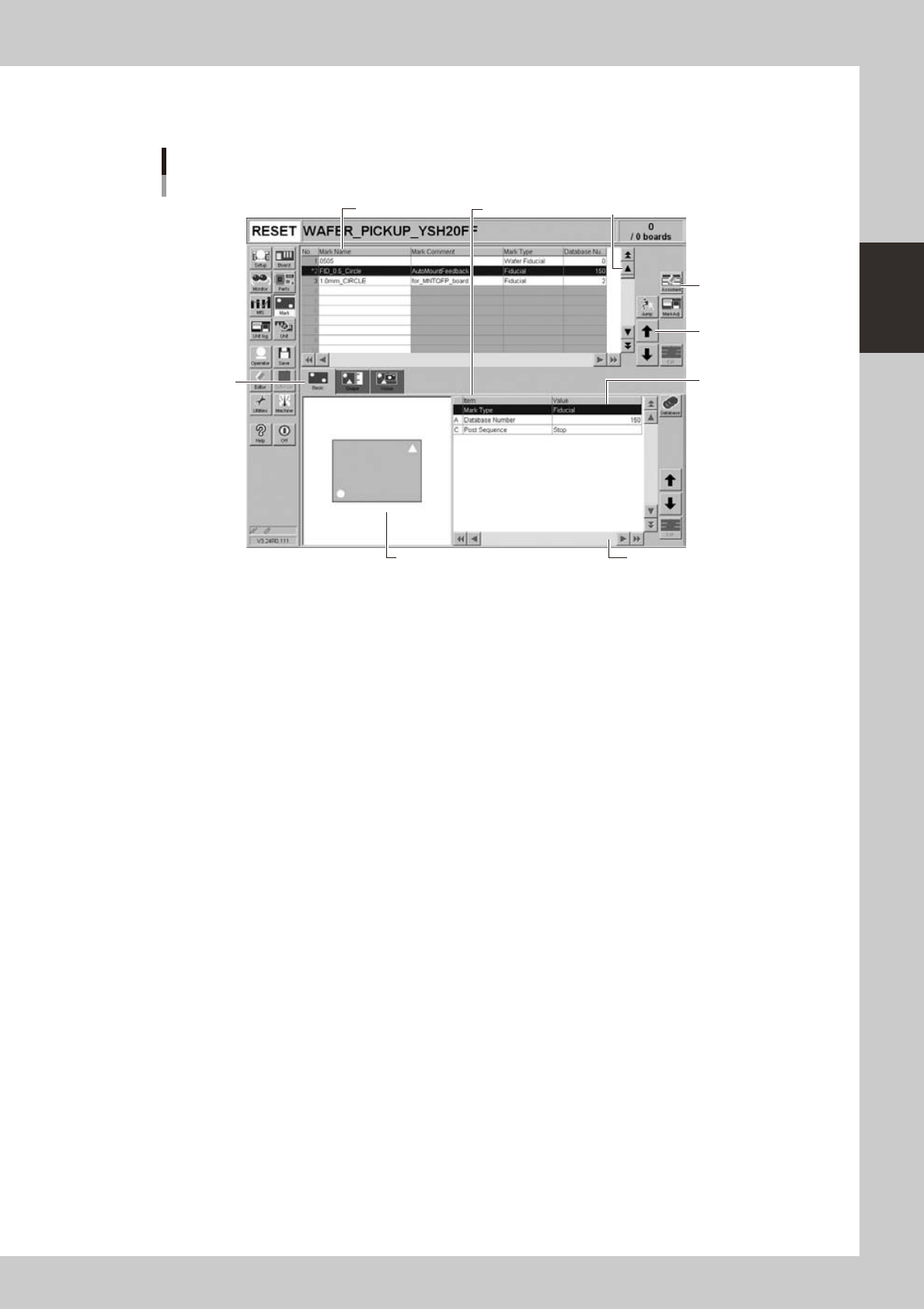
Various buttons and parameter input boxes
Various types of buttons, selection tabs and parameter input boxes are used on the operation screen.
1
1
2
3
4
5
6
Operation screen basic elements
Mark screen
Parameter listData No. list
24201-H0-00
1. Scroll bar and button (up/down, left/right)
Use the scroll bars or arrow buttons to see hidden items in the data No. list or parameter list.
2. Operation button
Press these buttons to open the next operation screen or dialog box.
3. Line up/down button
Use these buttons to move the cursor up or down through the data No. list or parameter list.
4. Parameter input box
Select, enter or edit parameters here. When the keyboard is used, double-click on a parameter input box to enter or edit
the data.
When a touch screen (option) is used, press the [Edit] button on the lower right of the parameter list. The edit box then
pops up for data input and editing.
5. Selection tab
Select this tab to switch the parameter input screen.
6. Assistant screen
Shows an illustration or information useful for parameter input or editing.
Alphabet characters shown in the parameter list and in the illustration on this screen correspond to each other.
2-10
2
asic operation
About error screen
Error screen
Mark detection error
1
2
3
7
46 5
[Error Switching] button
24202-H0-00
1. Error count display
Shows the currently displayed error and the total number of errors. If two or more errors occurred, use the [Error
Switching] buttons (right/left arrow buttons) to switch to other error screens.
2. Message switching tab
Outline:
Displays a message for the operator.
Detail:
Displays a message for the administrator/supervisor or service personnel. This tab does not appear unless a message is
available.
3. Recognition image display (component pickup error and mark recognition error screens)
If an error has occurred in image processing during component pickup or mark recognition, the error image is displayed
here.
4. [BUZZER OFF]
Turns off the buzzer.
5. [ERROR CLEAR]
Clears the error that has occurred.
6. [Language] button
Switches the language of the message displayed on the error screen.
7. [Close] button
Closes the error screen without clearing the error.
TIP
After closing the error screen by pressing the [Close] button, you can check the locations where errors have occurred
by opening the [Monitor] - [Production] tab. Pressing the [Error Detail] button on the [Production] tab screen redisplays
the error message. For more details on the [Production] tab screen, refer to Chapter 3, "Starting and ending
production".
2-11
2
asic operation
2.2 Setup screen
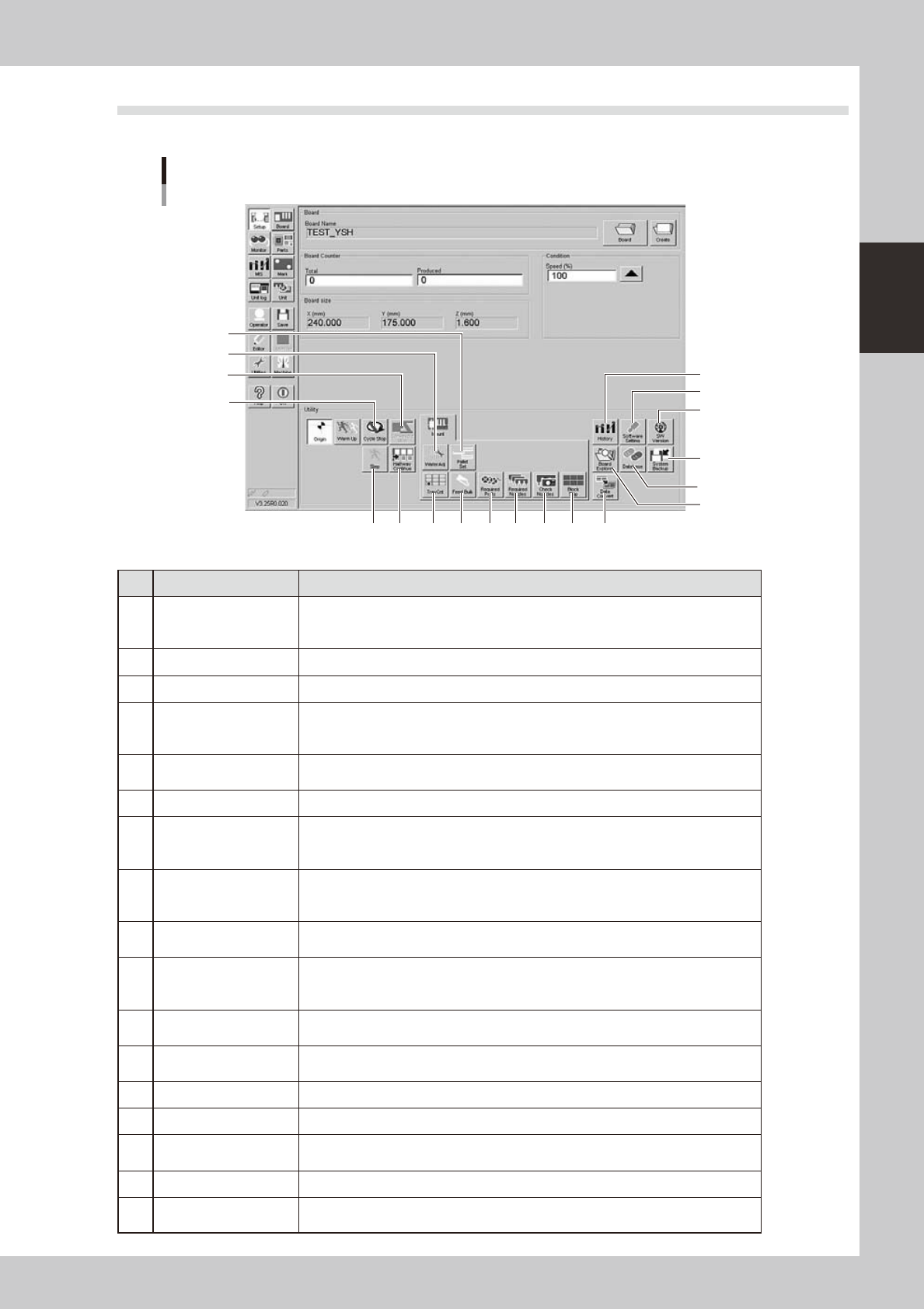
This section describes the operation buttons displayed on the Setup screen.
Setup screen
1
2
3
4
5
6
7
8
9
10
11 161413
12
19
17
18
15
24203-H0-00
Button name Function
1 History
Saves production history data, and saves or clear any desired items of "MIS" and
"Unit log" records. Also use this button when removing a storage medium from the
machine.
2 Software Setting Sets machine screen display items, adds or deletes operators, and sets passwords.
3 Version Shows version information on application software and system.
4 System Backup
Makes a backup of machine coordinates, accuracy information, option device
information and standard coordinates necessary for machine operation or restores
the data using the backup.
5 Database
Makes a backup of parts and mark database necessary for board production or
restores the data using the backup. Also sets the database locations.
6 Board Explorer Moves, backs up, restores or copies board data.
7 Data Convert
Use this button to convert from VIOS data to YGX data or from YGX data to VIOS
data. Refer to the separate "Programming Manual" for instructions on how to convert
data.
8 Cycle Stop
Stops machine operation just after mounting components on the current board, for
example, to check the mounted results or to prevent the board from flowing to the
downstream machine.
9 Conveyor-out Stop
Stops machine operation after mounting components on all boards on the conveyor
and transferring them to the downstream machine.
10 Halfway Continue
After stopping the machine for some reason during component mounting and
resetting the data, pressing this button loads that data to resume component
mounting from the next mount point.
11 Step
Temporarily stops the machine at a specific position, for example, during initial
component mounting, test mounting, or trouble analysis.
12 WaferAdj
Use this button to adjust the pickup level after replacing a wafer nozzle or push-up
pin, which is usually required when the wafer component size is changed.
13 TrayCnt Displays the number of tray components that have been used until now.
14 Feed Bulk Not currently used.
15 Required Parts
Displays the component types and feeder positions that are set up for the production
to be started.
16 Required Nozzles Displays a list of nozzles to be used.
17 Check Nozzles
Checks if nozzle tips for chip components are dirty or clogged by acquiring their
images.