00194591_02.pdf - 第26页
3 Instal lation Installation Manual SIPLACE Setup Center RF 2.1 3.3 Installation of SIPLACE Setup Center and Possible Setup Types Edition 09/2005 EN 26 Step 2 → In the Select SQL-Server dialog box you enter the informa t…
Installation Manual SIPLACE Setup Center RF 2.1 3 Installation
Edition 09/2005 EN 3.3 Installation of SIPLACE Setup Center and Possible Setup Types
25
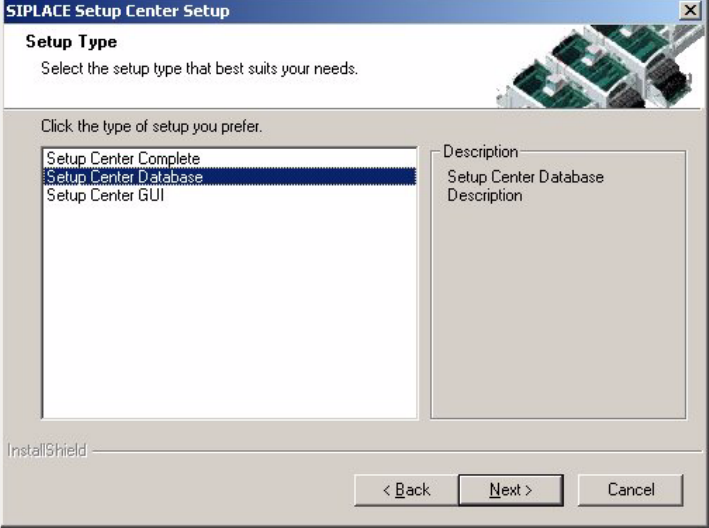
3.3.2.2 Setup Type - SIPLACE Setup Center Database
This setup type contains the database components of the SIPLACE Setup Center. Setup detects
if SQL Server or MSDE (Microsoft Data Desktop Engine) has already been installed. Select this
type to install the SIPLACE Setup Center database to a SQL Server. 3
Step 1
→ Run through the steps in “Starting Installation - First Steps” on page 14.
3
Fig. 3.3 - 13 "Setup Type" dialog box
→ Select the Setup Center Database setup type.
→ Click Next.
3
3 Installation Installation Manual SIPLACE Setup Center RF 2.1
3.3 Installation of SIPLACE Setup Center and Possible Setup Types Edition 09/2005 EN
26
Step 2
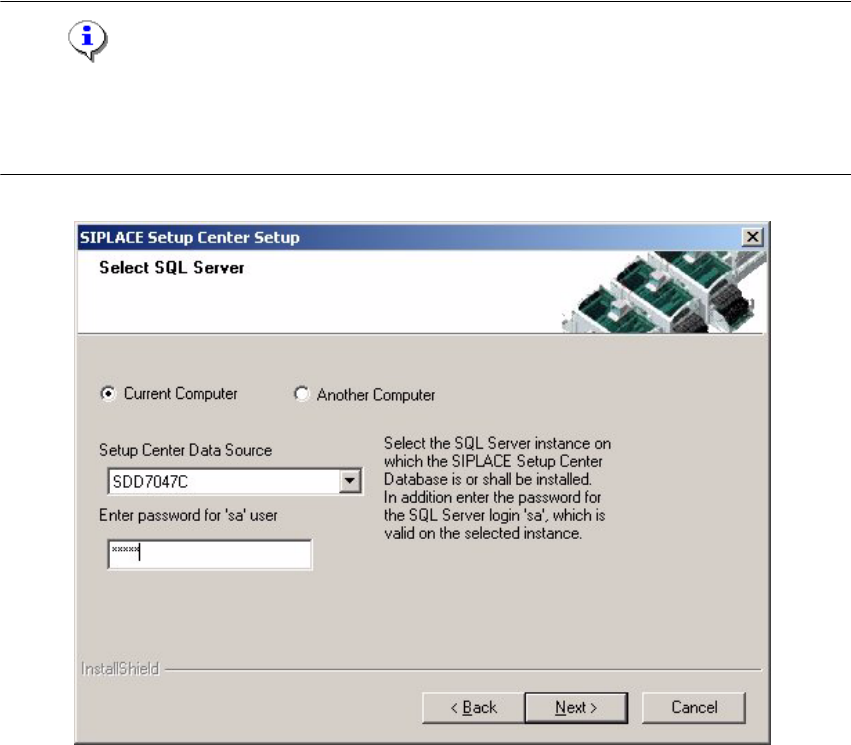
→ In the Select SQL-Server dialog box you enter the information required to be connected with
the SQL Server and database.
Note
This password is empty if MSDE has been freshly installed. In this case, erase the displayed de-
fault password. Subsequently, a window will open, prompting you to change this password. You
may accept the Siemens Service default password or choose one of your own. 3
3
Fig. 3.3 - 14 "Select SQL-Server" dialog box
→ Enter the Password for the SQL Server user ’sa’, i.e. the SQL server system administrator.
→ Choose your Another Computer from the pull-down menu to show other computer.
→ Choose your SQL Server Instance from the pull-down menu.
→ Click Next.
Installation Manual SIPLACE Setup Center RF 2.1 3 Installation
Edition 09/2005 EN 3.3 Installation of SIPLACE Setup Center and Possible Setup Types
27
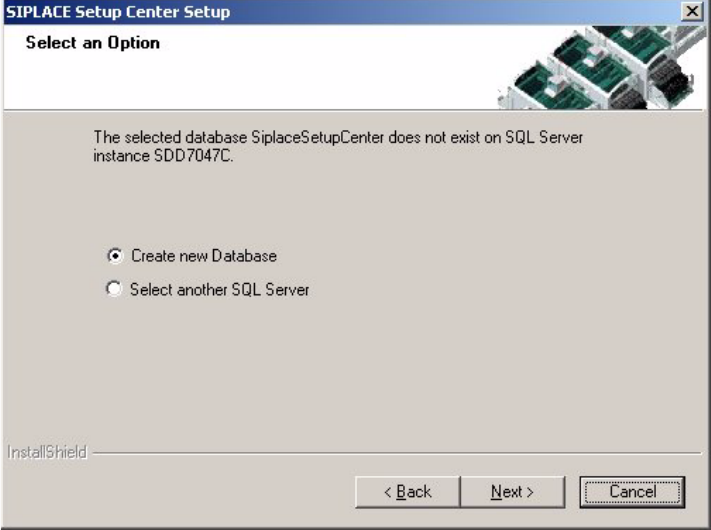
In case no database with the name SiplaceSetupCenter exists, the following dialog will ap-
pear: 3
3
Fig. 3.3 - 15 "Select an Option" dialog box
→ If you choose Select another SQL Server instance you will be returned to the previous dialog.
→ Click Next to create a new database.