00191297-02.pdf - 第304页
6 Vision functions User Manual S-23 HM 6.8 Recommendation for vis ually centering com ponents Software Vers ion SR.405.xx 05/99 Issue 302 6.8 Recomm endation for visually centering compo- nent s 6.8.1 V isually centering…

User Manual S-23 HM 6 Vision functions
Software Version SR.405.xx 05/99 Issue 6.7 Guidelines for Describing Package Forms
301
Measure the component. Measurement is successful.
– Reset the settings to the suggested values:
flat: 170
middle: 60
steep: 120
¬ optimum setting
NOTE 6
With respect to 0402 and 0603 components, avoid the nozzle being displayed during imaging. If
this seems likely, remove the component from the nozzle and use the ’Illumination Option’ (see
page 261 to see whether the nozzle did appear in the image. 6
6.7.6.6 General Information on Setting Illumination Values
– As a rule it is better to overilluminate the component than to underilluminate it. A saturated im-
age is preferable to a low-contrast image.
– Optimum illumination is attained when only the leads are imaged and the component body is
not shown.
– If you cannot clearly separate the image of the component body from the leads, we recom-
mend to illuminate body and leads equally and then to measure the outline.
6 Vision functions User Manual S-23 HM
6.8 Recommendation for visually centering components Software Version SR.405.xx 05/99 Issue
302
6.8 Recommendation for visually centering compo-
nents
6.8.1 Visually centering flip-chips
6.8.1.1 Entering the data on the line computer
È Describe the ball radius.
È Select tolerances of between 10 % and 20 %.
6.8.1.2 Setting the parameters on the station computer
È Under the’ Illumination Option’ in the ’Test Component Menu’, select the flat illumination plane
and set the brightness values to between 200 and 255. Do
NOT
use transformation tables to
do this.
È Select a positive ball contrast under the Ball Image Option (see page 265).
PLEASE NOTE 6
If a lot of ’non-ball structures’ are identified as ball structures (they can be recognized by the
small crosses), increase the ball contrast. The number of crosses can be estimated in the
’Measure’ menu during the grid measurement. 6
6.8.1.3 Recommended sequence of measurements for flip-chips
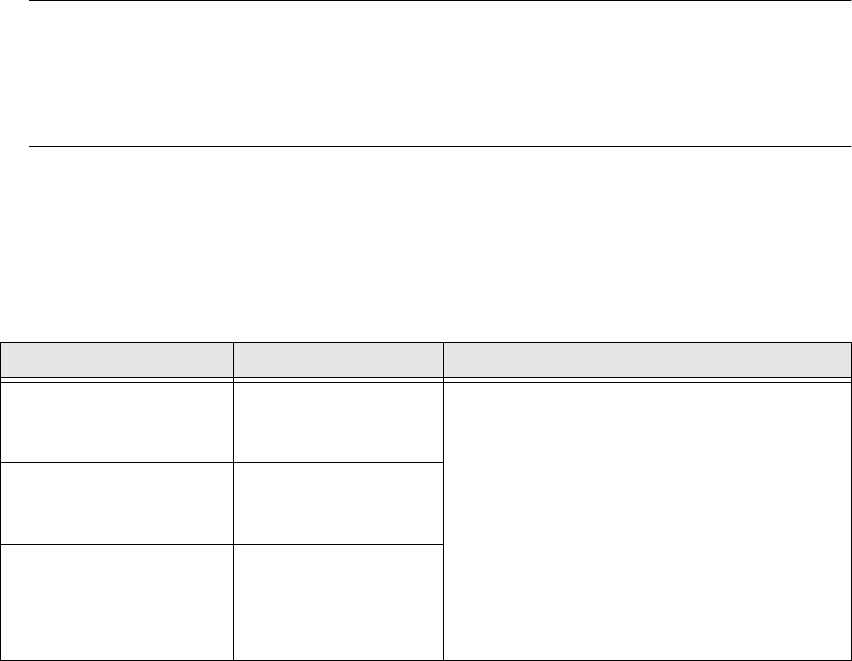
Recommended sequence of measurements for visually centering flip-chips 6
Size measuring mode Grid measuring mode Ball measuring mode
Resolution for calculating
the angle:
low resolution
For single measure-
ment:
3 balls per corner
Standard
ball detection:
Hex value P1 = 80
Fast
ball detection:
Hex value P1 = A0
PLEASE NOTE:
Switch Ball mode off if it is not necessary
to measure all the balls.
In this case, P1 must be set to 80 in Grid mode.
Resolution in the measur-
ing direction:
medium
For multiple measure-
ment:
5 balls per corner
Resolution
in the integration direction:
medium
Hex value P1 = 80
Tab. 6.8.1

User Manual S-23 HM 6 Vision functions
Software Version SR.405.xx 05/99 Issue 6.8 Recommendation for visually centering components
303
6.8.2 General recommendations for centering flip-chips, BGAs and screening
plates
6.8.2.1 Setting the ball contrast parameters
If you select a high value for the ’Ball image’ option in the ’Test component’ menu, this will reduce
the effect of any defective structures. It does mean, however, that there is a possibility that not
every ball will be detected. 6
Set a lower value to ensure that all the balls are detected. This will reduce the reject rate, but the
measurement will take longer.
6.8.2.2 Setting the ball radius parameters
Enter the ball radius on the line computer. This value is automatically reduced by 20 % since the
vision system will detect balls even if the specified dimensions are smaller then their actual phys-
ical dimensions. 6
So, set the ball radius on the station computer and then adjust the quality in the ’Measure’ menu.6
– If no crosses are displayed on the ball, the radius is incorrect or the contrast is too high.
– If several crosses are displayed on a ball, then the radius has been entered incorrectly in the
’Measure’ menu.
PLEASE NOTE 6
We recommend that you select a radius on the line computer that is slightly larger than the
theoretical value and then adjust it in the ’Ball image’ menu. 6
6.8.2.3 Setting the case shape dimension parameters on the station computer
For high-contrast flip-chips and BGAs, you can reduce the physical case shape dimension to the
square surrounding the balls (’Case dimension’ option). This will reduce the measuring time, al-
though it can only be used for single measurements. Size mode must also be active. 6
6.8.3 Visually centering flip-chips
6.8.3.1 Setting the parameters on the station computer
Under the’ Illumination Option’ in the ’Test Component Menu’, select: 6
– a value of around 50 for the medium illumination plane
– a value of around 20 for the steep illumination plane