SPI HS60规格书 - 第2页
SPI HS60 SPI HS60 The most r eliabl e and accurate 3D data Our innovative 3D laser triangulation sensor, the RSC TM profiles real shape of features and also provides highly robust 3D data against considerable variations …
PARMI CO., LTD.
Daeduk Atomic Valley 461-63
Jeonmin-dong, Yuseong-gu, Daejeon, 305-811, KOREA
www.parmi.com parmi@parmi.com
TEL. +82-42-478-9900 FAX. +82-42-478-9905
SPI HS60
TM
3D solder paste inspection System
Specifications
Functionality
HS60
HS60L
Measuring Principle
Paste Type Supported
Board Type Supported
Offline Teaching
SPC & Process Monitoring
System Diagnosis
Camera System
Scan Resolution
Lateral Resolution
Height Resolution
Max. Paste Height
Max. Paste Size
Min. Paste Size
Min. Paste Pitch
Inspection Type
Inspection Speed
High Resolution
High Speed
Load, Unload Time
Height Repeatability
Area Repeatability
Volume Repeatability
Height Accuracy
Gage R&R
Maximum Board Size
Minimum Board Size
Maximum Board Weight
Maximum Board Warp
Board Thickness
Board Edge Clearance (Top/Bottom)
Underside Clearance
Topside Clearance
Dimensions (W
D H)
Weight
Conveyor Speed Range
Conveyor Height
Flow Direction
Conveyor Reference Side
Conveyor System
X-Y-Z robot
Computer
Operating System
Display
Input
Enclosure
Supplies
Data Input Type
Board Interface
Barcode (option)
Laser Optical Triangulation
All (Pb or Pb Free)
All colors and All pad finishes
GerberWorks
SPCworks
SPImanager
High frame rate C-MOS sensor, 18x18 pixel resolution
20
18
0.2
1000
20 20 mm
200
200
150
Height, Area, Volume, Offset, Bridge
30 sq.cm/sec
60 sq.cm/sec
1 sec
3 Sigma
< 1.5 , on a certification target
3 Sigma
< 3%, on a certification target
3 Sigma
< 3%, on a certification target
3
, on a certification target
Less than 10 %
390
260 mm 550 510 mm
50
50 mm
1.0 kg 1.3 kg
5 mm
0.4 to 4 mm
2.5 / 3 mm
25 mm
25 mm 15 mm
900 1000 1450 mm
1060 1285 1450 mm
750 kg 1000 kg
300 - 500
mm
/sec
890 - 940 mm
Left
Right or Right Left
Selectable when ordering
1 conveyors
Sensor head move in X-Y-Z Axis
Pentium IV 3.0GHz, 4GB Memory
MS-Windows XP Professional
17" LCD
Mouse, Keyboard
Conforms to CE regulations
AC 220V, 5 kgf/sq.cm
Gerber (RS-274X)
SMEMA
1D, 2D
Measurement
Inspection Performance
Board Specification
System Dimensions
Hardware System
Interface
SPI HS60 SPI HS60
The most reliable and accurate 3D data
Our innovative 3D laser triangulation sensor, the RSC
TM
profiles
real shape of features and also provides highly robust 3D data
against considerable variations of PCB color and finishing
condition, solder material, paste shape, and warpage.
This highest quality of 3D data backs up top level performance
of SPI HS60 system concerning about the reliability and
accuracy. This high performance is due to PARMI's unique
signal processing technology that is implemented as hardware
logic.
The utmost inspection speed
By virtue of the affordable profiling speed of the 3D sensor, the
SPI HS60 system provides 100% whole pads inspection in even
fast assembly lines.
The lateral resolution is set at 18
along the Y axis direction
and the scan resolution along the X axis is set at 20
. This
provides the system enables to inspect an area of 60
per
second. This utmost inspection speed with best quality 3D data
differentiates the SPI HS60 system from other systems and
leads the SPI HS60 system to the top level.
Authentic inspection and measurement
with no false call
Our intelligent vision algorithm applied to the high quality 3D
data detects every kind of solder paste defects. The measurable
items are height, area, volume, and positional offset that deviate
from tolerance limits. And also the algorithm detects bridged
pads in a very reliable manner.
The remarkable design concept such as rotating the laser sheet
beam against the scan direction and maintaining the small
angle between laser sheet beam and camera optical axis for
negligible shadow effect secure much better performance for
repeatability and accuracy.
Even for small CSPs and fine pitch QFPs, the Gage R&R is much
less than 10% for both height and volume data.
Fast job change and easy operation
The inspection job change consists of two stages. First stage is
making a teaching file. Teaching process using Gerberworks
TM
takes normally less than a half hour even in the case of complex
PCBs. The Gerberworks inputs the industry standard RS-274X
format file to prepare a hierarchy of information on a pad,
component, and array board level that are used during a PCB
inspection. For the component level measurement and analysis,
some CAD and BOM files can be imported. Teaching process
using Gerberworks is done off-line. And machine setting such
as tolerance setting, that is second stage, only requires 10
minutes. This extremely short job change time save customer's
valuable time.
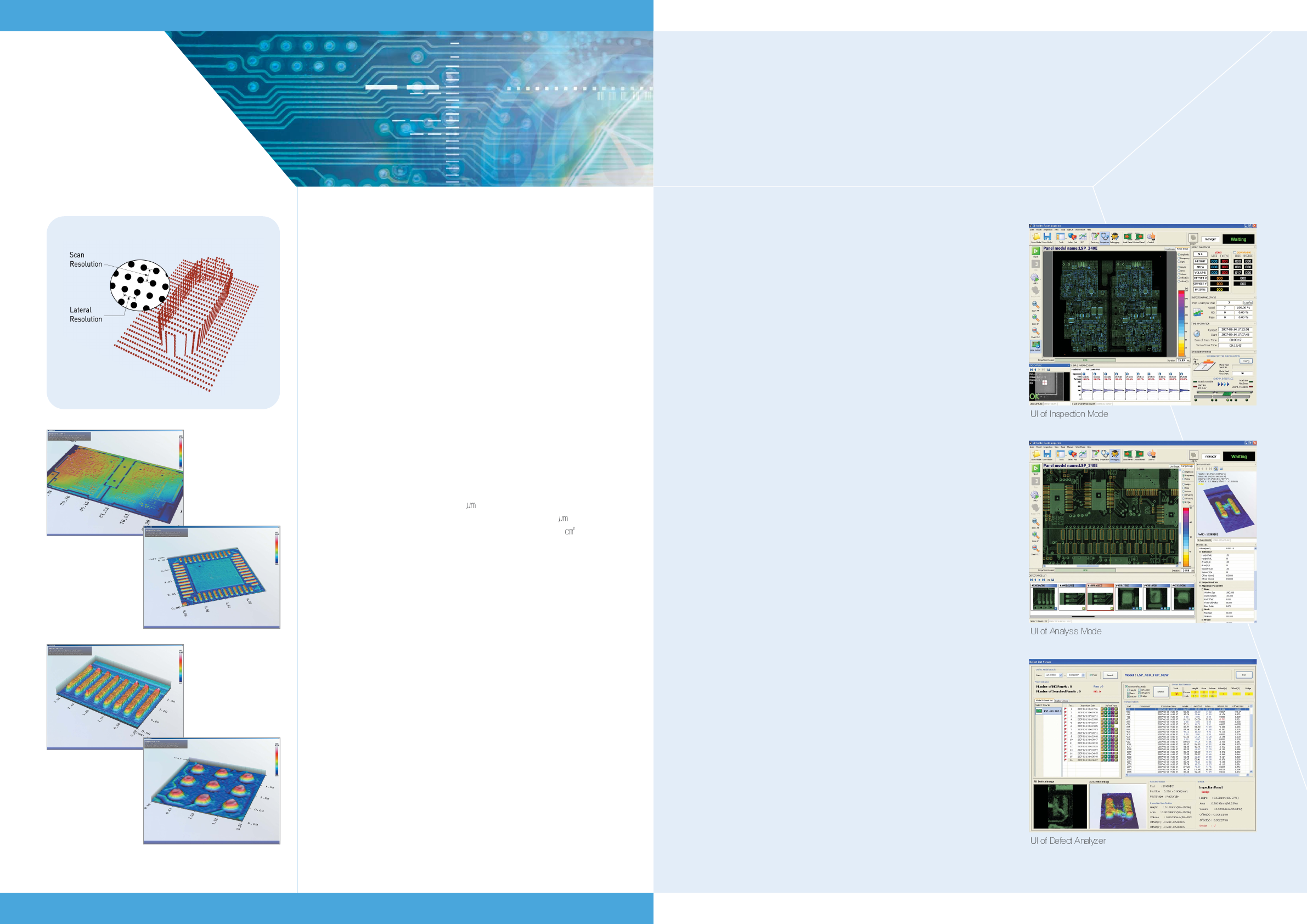
The user interface of inspection program SPIworks
TM
is based on
the voice of able field engineers, therefore it features intuition
and easiness to field engineers. And the UI also provides diverse
and useful functions for printing process monitoring and
analysis.
-X-bar & Variance chart
-Measured data list
-3D Shape viewer
-Defect Image List
-Offset graph
Clear and prompt insight into printing process
Not only to detect defect, but also to help customer to control
printing process is another important role of the inspection
system. Besides the independent SPC program SPCworks, the
SPCworks embeds very intuitive SPC functions for field
operator's prompt treatment on screen printer.
Coloring amplitude of measured data, sigma values, and defect
frequencies on every pad in the main viewer gives operators get
prompt insight into printing process. And also the X-bar &
variance chart let operator monitor and understand entire
printing process with ease. Operator's correct treatment could
prevent defect and secure quality of printing process. We know
that it is PARMI's unique and elegant attitude to move one more
step toward valuable and useful machine for customers.
Defect verification and review
The detected defects are possible to be identified by Defect
Analyzer such as details of defect panels, measured data of
defect pads, 2D and 3D images of defect pastes. Moreover,
defect analysis work can be easily done by configuring defect
analysis conditions to list only wanted defect items.