00198574-01_Process_Foundation_DEK_Micron_EN - 第6页
1 Machine Safety 1.8 ESD Guidelines 6 Process Foundation DEK Micron-Series 12/2017
1 Machine Safety
1.6 SAFETY INTERLOCKS
Process Foundation DEK Micron-Series 12/2017 5
1.6 SAFETY INTERLOCKS
The safety features designed into the printer are for the protection of all operators and maintenance
personnel. ASM strongly recommend safety devices are never overridden.
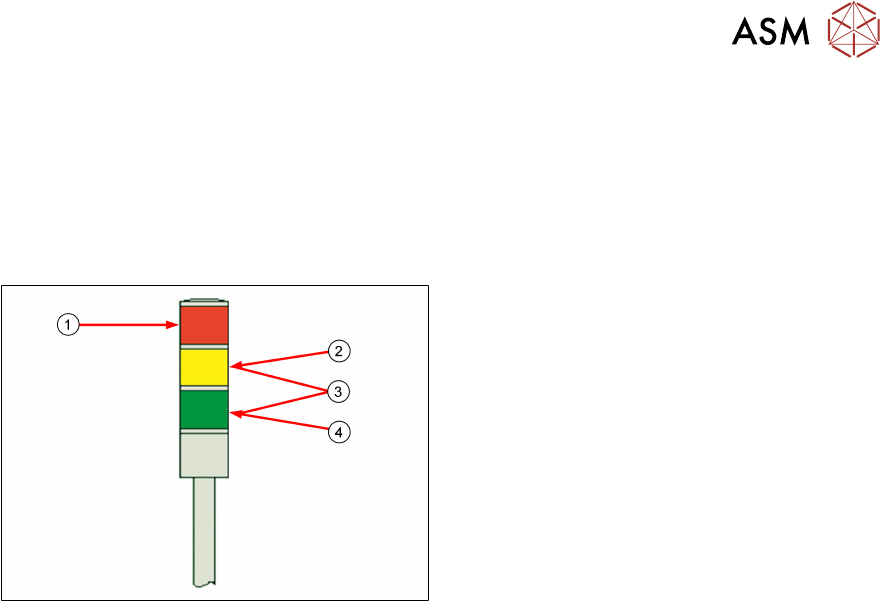
1.7 TRI Colour Beacon
1. Machine is not operational
System power is down
Error message displayed
2. Machine is not in a ready state
Machine is initializing
Machine is in set up
Machine is in maintenance
3. Paper Empty
Solvent Empty
4. Machine is operational
Machine is waiting in a ready state
1.8 ESD Guidelines
Do not touch electronic modules unless it is absolutely essential to do so. If it is necessary, make
sure that you do not touch the pins or printed conductors when you pick up flat modules.
Do not touch components unless
●
you are constantly earthed by an ESD wrist strap or
●
you are wearing ESD shoes or ESD shoe earthing strips on an ESD floor.
Always discharge yourself before you touch an electronic module. To do this, simply touch a
conductive and earthed object immediately before you touch the module (such as unpainted parts
of a switch cabinet, a water pipe, etc.).
Do not allow modules with chargeable and highly insulating materials to touch one another, e.g.
plastic films, insulating table surfaces or items of clothing made from synthetic fibers.
Always place the modules on a conductive surface (table with an ESD coating, conductive ESD
foam, ESD bag or container).
Do not bring modules near visual display units, monitors or televisions. Keep them at least 10 cm
away from the screen.
Do not take measurements on such modules unless
●
the measuring device is earthed (e.g. via PE conductors)
●
you discharge the measuring head before taking measurements with a potential-free
measuring device (e.g. by touching an unpainted metal part of the controller casing).
Always use an earthed soldering iron if you carry out any soldering work.
► Always store modules and components in conductive packaging (e.g. metallized plastic bags
or metal sleeves) and dispatch them in conductive packaging.
► If the packaging is not conductive, place the modules in a conductive envelope before
packaging. Use conductive expanded rubber, ESD bags, domestic aluminum foil or paper, for
example. NEVER use plastic bags or film.
► If the module has integral batteries, ensure that the conductive packaging does not touch or
short-circuit the battery terminals and, if necessary, first cover the terminals with insulating
tape or material.

1 Machine Safety
1.8 ESD Guidelines
6 Process Foundation DEK Micron-Series 12/2017
2 Introduction
Process Foundation DEK Micron-Series 12/2017 7
2 Introduction
Course Aim
The aim of this course is to provide the skills necessary to design and optimize a new product file
and to maintain the quality of the print throughout production thus maximizing throughput and yield.
The course progresses in units, from basic theory right through to process optimization. It also
provides the opportunity to review a process and identify areas for improvement.
Course Goals
Upon completion of the Process Foundation training program you will be able to:
●
Understand the Screen Print Theory and Critical Success Factors
●
Design and Optimise a new Product File
●
Optimise Machine Setup Parameters
●
Maintain the Process Throughout the Production Run
●
Control Print Hardware and Environment to Prevent Defects
●
Identify and Troubleshoot Print Defects
●
Perform a Review of the Printing Process Using a Checklist
Course Content
●
Screen Print Theory *
#
●
Hardware Best Working Practices
#
●
Product File and Machine Basic set-up *
●
Process Maintenance
#
●
Product File and Machine Optimisation *
●
Troubleshooting and Process Review *
#
* : Product File Design Module
#
: Process Maintenance Module