SussPA300UserGuide.pdf - 第7页
6 SUSS / PA300 / User Manual / M10-121841-00 / February 2002 1 Introduction 1.1 Scope of the Document This document contains the facilities design and equipment installation requirements for the PA300 and conforms to SEM…
SUSS / PA300 / User Manual / M10-121841-00 / February 2002
5
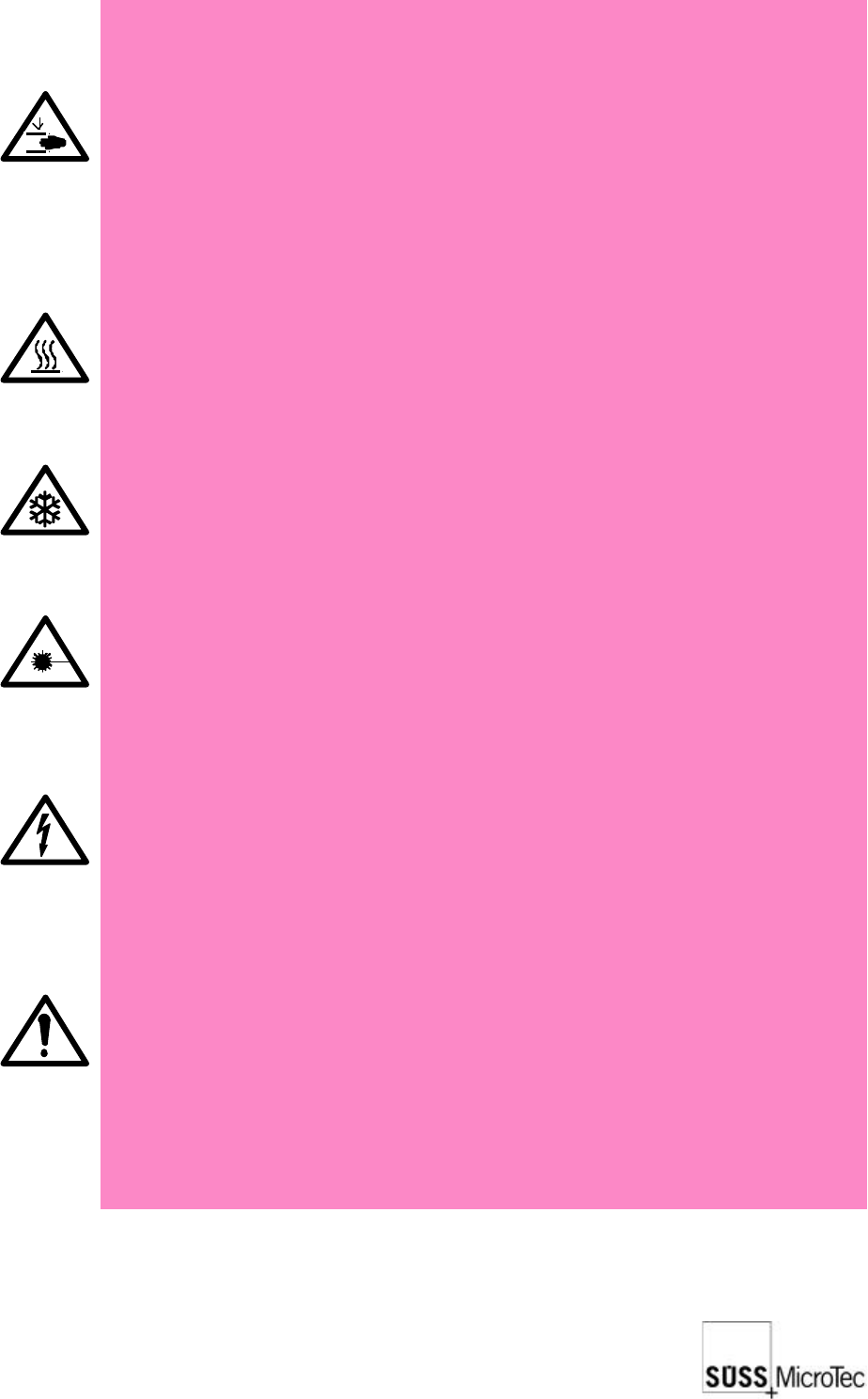
Safety Instructions and Symbols
D
US
F
I
Achtung, bewegte Teile! Verletzungsgefahr! Im eingeschalteten Zustand nicht
hineingreifen!
Attention, moving parts! Danger of injury! Do not touch the machine when
switched on!
Attention, pièces en mouvement! Risque de blessures! Ne pas toucher pendant
le fonctionnement de la machine!
Attenzione, parti in movimento! Pericolo, non toccare se la maccina è in
funzione!
D
US
F
I
Achtung, heiße Flächen! Verbrennungsgefahr! Im aktiven Zustand nicht
berühren!
Attention, hot surfaces! Danger of burning! Do not touch when active!
Attention, zones chaudes! Risque de brulures! Ne pas toucher si actif!
Attenzione superficie calda! Rischio di ustioni, non toccare una volta attivo!
D
US
F
I
Achtung, kalte Flächen! Erfrierungsgefahr! Im aktiven Zustand nicht berühren!
Attention, cold surfaces! Danger of freezing! Do not touch when active!
Attention, zones froides! Risque de brulures! Ne pas toucher si actif!
Attenzione superficie fredda! Rischio di congelamento, non toccare una volta
attivo!
D
US
F
I
Achtung, Laserstrahlen! Ohne Augenschutz Verletzungsgefahr!
Attention, laser beams! Danger of getting hurt without eye protection!
Attention rayonnement Laser! Risque de cécité en l’absence de lunettes de
securité!
Attenzionne raggio laser! Pericolo ustioni, non tocarre se la macchina è in
fuzione!
D
US
F
I
Achtung, spannungsführende Teile! Gefahr des elektrischen Schlages! Im
eingeschalteten Zustand nicht berühren!
Attention, high voltage! Danger of electrical shock! Do not touch during
operation!
Attention, haute tension! Risque d’électrocution! Ne pas toucher pendant le
fonctionnement de la machine!
Attenzione alta tensione! Pericolo, non toccare se la macchina è in fuzione!
D
US
F
I
Achtung, allgemeiner Gefahrenhinweis! Informationen im Handbuch beachten!
Attention, general hazard! Pay attention to the information given in the
manuals!
Attention, danger! Consulter les informations fournies dans les notices de la
machine!
Attenzione pericolo! Leggere attentamente il manuale!
6
SUSS / PA300 / User Manual / M10-121841-00 / February 2002
1 Introduction
1.1 Scope of the Document
This document contains the facilities design and equipment installation requirements
for the PA300 and conforms to SEMI E6 and SEMI S13 guidelines and formats. Design
and installation requirements vary with each owner and project. Therefore this guideline
is designed to cover all possible tasks that can be carried out using the equipment.
The successful installation and operation of semiconductor equipment is the mutual
objective of the owner, the operator, the installer and the supplier. Within the
semiconductor industry, the diversity and complexity of equipment have created
significant problems for those who design the facilities and install the equipment. It is
very difficult to stay current with the ever changing requirements necessary for individual
pieces of equipment. As a result, it is difficult to guarantee that the facilities will meet
the needs of each piece of equipment.
It is recommended that this manual is read thoroughly before any work is started with
the PA300 and that all safety instructions are taken into consideration.
1.2 Purpose of System
The PA300 is an analytical prober conforming to EN 61010 - 1: 1993-04 which
corresponds to UL 3101-1: 1993 and IEC 1010-1: 1992.
By means of the PA300 electrical measurements on wafers and substrates up to a
diameter of 300mm can be made. The only electrical connection to the measuring
object is through the probecard, the probehead and the chuck.
1.3 Acceptance Test
Tests will be performed to demonstrate that the facilities meet requirements:
______ Yes ü No
See appendix for further information.
1.4 Training
Special training will be required:
___ü Yes ______ No
User’s personnel are required to be trained in the operation and maintenance of the
equipment as a prerequisite to supplier-supplied training and prior to operation, use or
maintenance.
The supplier will provide training at the user’s site (optional).
SUSS / PA300 / User Manual / M10-121841-00 / February 2002
7
2 Safety
IMPORTANT: This section contains information that the user must know and
understand to minimize the risk of injuries.
SUSS equipment is designed to protect the user against all possible hazards. After
review by qualified safety personnel, the user should generate specific safety procedures
with regard to the particular application of the equipment and local regulations, and
make certain that operators are familiar with the procedures.
2.1 General Precautions
1. Read and understand the User Manual before using the system.
2. This system needs to be handled carefully to ensure no harm comes to the user.
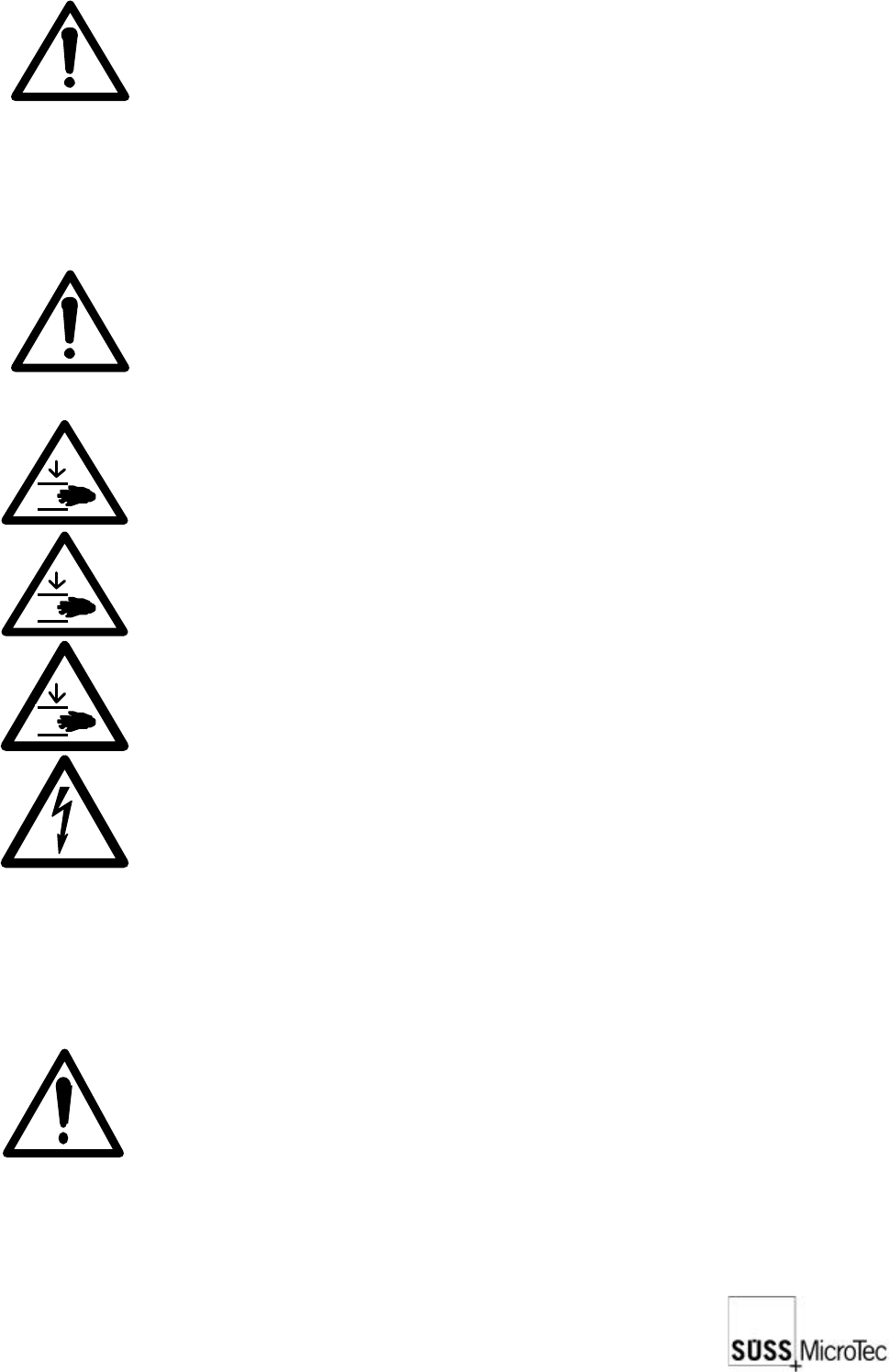
3. During use there is the danger of crushing, tripping, burning or being caught up in
the system. These dangers cannot be avoided due to the function of the system
but any areas of danger are clearly labeled with the signs overleaf. These should
be studied carefully in order to avoid unnecessary risk.
4. Do not reach into the prober when it is plugged into the mains. Do not reach into
the chuck area – danger of getting caught. The rear area is open when working
with a probe card adapter, therefore increased risk.
5. Never use the system with open or removed safety cover. Danger through moving
parts.
6. System is under low voltage (up to 28 V d.c.). In case of equipment failure the low
voltage can be present until the operator switches the current off at the main switch.
Do not touch the electrical connections.
7. Do not touch the probe head needles with your fingers as this will dirty them and
may result in injury.
8. Choose the position of the control panel so that the joystick cannot be inadvertently
operated.
Please take notice of the national and international safety regulations for example
BVG 4 and EC User Guidelines 89/655/EWG from November 1989.