YSM20R_YSM20WR_Mainte_E.pdf - 第16页
xiv Safety instructions 3. Safety T o ensure that the machine you purchased is used safely and correctly , always comply with the instructions and rules in this manual regarding safety . However this manual cannot cover …
xiii
Safety instructions
n
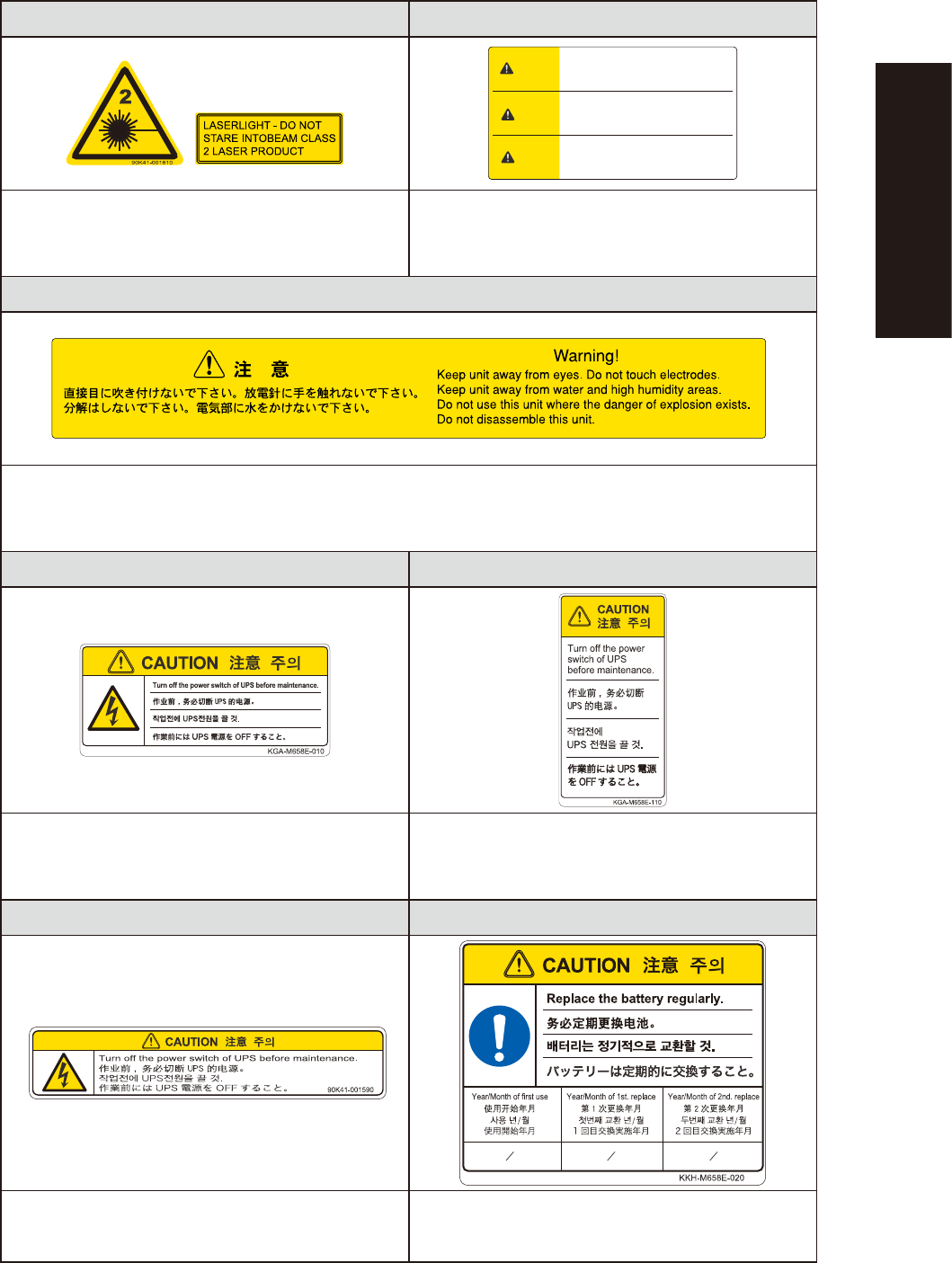
Labels of optional equipment
IT OPTION
barcode reader
Ionizer
可造成触电和故障的原因。
别用手触摸电极部位。
不可私自拆分部件。
请避免部件接触水分并远离极度潮湿环境。
To prevent the electric shock or damage.
Do not touch electrodes.
Do not disassemble this unit.
Keep unit away from water and high
humidity
感電や故障の原因になります。
放電針に手を触れないで下さい。
分解はしないで下さい。
電気部に水をかけないで下さい。
WARNING
警 告
警 告
Loss of eyesight Electrical shock hazard
Do not directly look into laser beam.
Do not touch and disassemble ionizer discharge needles.
Keep them away from water.
Ionizer
Electrical shock
Keep the ionizer away from eyes. Do not disassemble or touch the discharge needles.
UPS (Uninterruptible Power Supply) UPS (Uninterruptible Power Supply)
Electrical shock Electrical shock
Always turn off UPS switch when performing maintenance work. Always turn off UPS switch when performing maintenance work
UPS (Uninterruptible Power Supply) UPS (Uninterruptible Power Supply)
Electrical shock Loss of functions
Always turn off UPS switch when performing maintenance work Periodically replace UPS battery since it has a limited service life.

xiv
Safety instructions
3. Safety
To ensure that the machine you purchased is used safely and correctly, always comply with the instructions
and rules in this manual regarding safety. However this manual cannot cover all items regarding safety in
detail. So it is extremely important that the operator or person handling the machine make correct decisions
regarding safety.
3.1 To ensure safety
To maintain the safety of the operator or person working with this machine, it is essential that it (including
external parts feeders) be installed correctly in compliance with the safety standards and conditions of that
country.
Complying with the safety regulations and laws of that country is the responsibility of the customer who
purchased this machine. The supervisor of this machine must take responsibility to ensure all measures have
been taken for machine safety.
3.1.1 Defining safety
1. Safety has priority over all other operations.
2. Safety is more important than any other task.
3. Safety is the foundation for work efficiency.
4. Safety begins with maintaining (keeping it neat and orderly) the work environment.
3.1.2 Causes of injuries and accidents
Most accidents are not something that occurs but something that are caused. So it is important to make an
effort NOT to cause accidents.
n
Hazardous actions
• Ignoring causes of accidents
• Working or operating equipment in cramped locations
• Working in locations or positions where safety cannot be ensured
• Unsafe machine operation and using equipment whose safety cannot be ensured
• Working or operating equipment at speeds where safety cannot be ensured
• Working or operating machines with safety equipment removed
• Performing work or tasks on top of a machine currently in operation
• Playing around or goofing off during work
• Performing maintenance or inspections without wearing safety gear
3.2 Using safety gear
Always wear safety gear when operating or servicing equipment.
Helmet : Use during maintenance work
Safety glasses or goggles : Use around light harmful to eyes and when applying lubricant and when handling organic
solvents.
Respiratory gear : Use when handling organic solvents
Safety gloves : Use when applying lubricant and when handling organic solvents.
xv
Safety instructions
3.3 Restrictions on machine use
3.3.1 Defining the operator and service personnel
c
CAUTION
Only the operator and service personnel having sufficient knowledge of this machine should handle this machine.
Operator:
The operator is someone who has been trained by us in machine operation, has a thorough knowledge of the machine
operation manual and demonstrates adequate knowledge of machine operation and safety.
Main tasks of the operator include pre-operation checks, operation (component mounting) and making setups
(changeovers). The machine is only used in normal operating mode.
Service personnel:
The service personnel are those trained by us in machine maintenance as well as safety instruction and demonstrate a
thorough knowledge of safe handling of the machine according to the type and location of machine operation. They must
also understand hazardous sections of the machine and residual risks.
Main tasks of the service personnel include machine maintenance, repair, adjustment and management of the system.
The service personnel may make changes to the machine settings and operation in factory adjustment mode.
3.3.2 Restricting machine operation with passwords
Machine operating levels usable by the operator and service personnel (mentioned above) must be restricted
by password. This prevents the operator and service personnel from using the machine at a higher level than
allowed.
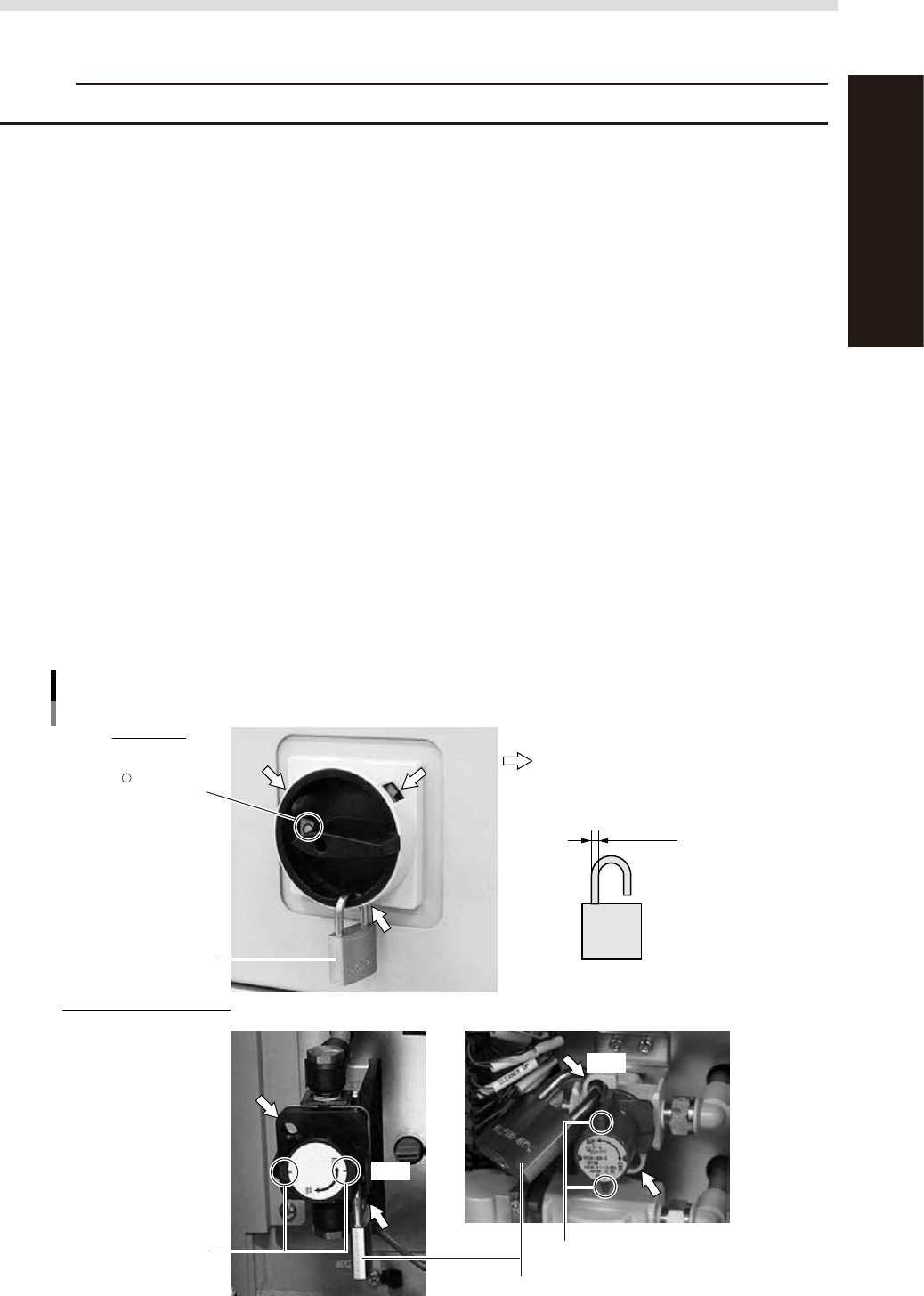
3.3.3 Lock out the main switch and the air supply/exhaust switch
When the maintenance work is performed with the power supply and the air supply off, make sure to lock the
main switch and the air supply/exhaust switch with a padlock as shown below before the work. This is to
prevent a bystander from accidentally turning on the power and the air supply during the maintenance work.
Also, make sure to lock the main switch and the air supply/exhaust switch with a padlock when the machine is
left unused for a long period of time. Manage the key of the padlock according to the customer's rules.
Lock out the main switch and the air supply/exhaust switch
Padlock
“ ”Circle Mark
(OFF position)
OFF position OFF position
Example: YCP10Example: YS100
Padlock
Main switch
Air supply / exhaust switch
: Position where the padlock can be set
Padlock
ø4 to ø6
OFF
OFF
OFF
93003-YSM-00